

I’ve been thinking about card games a lot recently. So much so that I decided it might be interesting to get some thoughts down on the blog about them (if you like looking at pictures of miniatures, there’s none in this post, apologies!). Card games form the majority of my gaming these days, eclipsing wargames, boardgames, and video games by a wide margin. The only thing that comes close is pen and paper RPGs which I play most weeks.
Card games generally have the advantage of ease of setup and the low time and space required to play them. You can easily just take a deck with you and play some games before/in between other activities (at work over lunch, or before an RPG session!). This is not the case with most of the other gaming that I like to do which requires significant setup, and blocking off a half day or even a day dedicated to gaming. I used to do this all the time when I was a student, but this kind of big setup game just doesn’t fit that easily in my life anymore with work and fatherhood!
I’ve said card games a lot in these opening paragraphs so what card games am I talking about here? I’m going to discuss three card games that I play (or am starting to play in one case) regularly: Magic: the Gathering, Vampire: The Eternal Struggle, and Netrunner. These are all collectible card games (CCGs), and funnily enough were all created by the same person – Richard Garfield. Garfield created these three games in quick succession (1993, 1994, and 1996 respectively) and purposedly made them quite different to each other, which makes for some nice variety in gameplay and deckbuilding. I’m a relatively long time player of Magic (10+ years, not that long for a 30 year old game!) and have only recently (last few years) been playing the other two games. I think they’re excellent and this post is me attempting to convince you that you should check them out, by showing them to you from my perspective as a Magic player broadening his horizons.
Note before we get started: this post will heavily be coloured by my experience with these games, which is playing their modern incarnations. All three games have seen some pretty major changes to their rules over the years, so if you’ve only played these in the 90s and what I say here does not gel with what you remember, chances are the game has changed since then!
Magic the Gathering
If you’re familiar with CCGs this game needs no introduction (I’ll still introduce it though, not everyone will know it and it is useful to set up as a contrast to the other two). This is the forebear of all CCGs, and had a massive influence on the genre as a result. The basic premise is simple enough, at its core this is a two-player game, with each player bringing a deck of cards they assembled outside the game and competing against the other player. This basic formula is still the entry point for the game, however as a still popular 30+ year old game Magic has many, many, variants, including multiplayer (3+ players) and variants that include deckbuilding as part of the game (the draft and sealed formats). I’ll be mostly discussing constructed one vs one games (i.e. two player games where players bring decks they’ve pre-built) in this post as that is the closest to the initial intent of the game as I understand it and is the most common tournament format. Note that the most popular way of playing the game these days is the casual multiplayer format Commander which is quite different.
The Premise
Magic is set in its own original universe, with the players representing Planeswalkers, powerful mages that can move between the planes in Magic‘s universe. These Planeswalkers are battling against each other, using powerful spells or summoning creatures to attack each other.
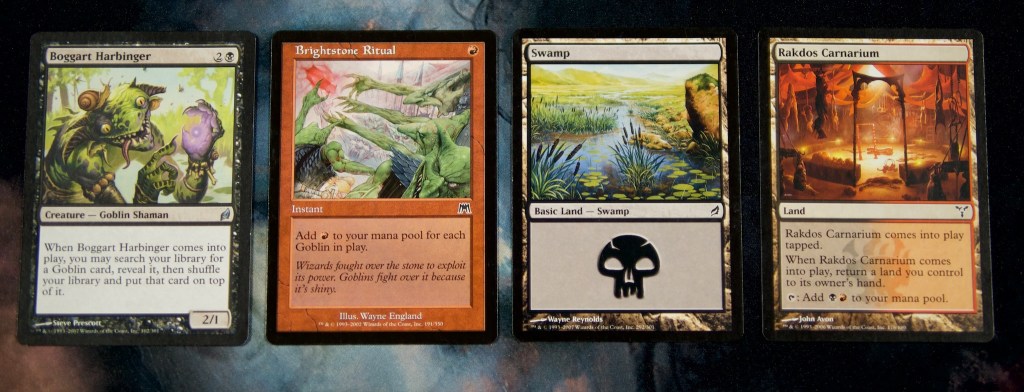
Deckbuilding
Sticking with our one vs one basic game for now, here’s a quick overview. Players assemble their decks by selecting spells and lands. Spells are cards that can summon creatures, or create more ephemeral effects such as once-off damage. Spells require mana to be cast, which is the main resource of the game. Mana comes in five colours (White, Blue, Black, Red, Green), and spells generally cost a mix of coloured mana and generic mana (i.e. mana of any colour), and the more powerful the spell, the higher the amount of mana required by that spell. Lands are cards that produce mana, with basic lands being lands that only tap for one colour of mana, while other lands have additional abilities (tapping for one of two colours being the most common). Each specific card can only be included up to four times in a deck with the exception of basic lands which can be included as many times as desired. Generally the minimum deck size is 60 cards, and for tournament play, players can include a 15-card sideboard from which they can select cards between the games in a match (tournament matches are best of three games).
Deckbuilding then focuses on selecting one or more colours to play, adding a variety of spell costs to be able to play cheap spells early on and more expensive spells later on in the game, as well as including the lands required to cast those spells. The more colours a deck has, the more options it has, however this is balanced by the difficulty of assembling the lands required to cast spells of multiple colours. Most decks are 1-3 colours as a result, with 4 and 5 colour decks being much rarer and more specialised.
Gameplay
A core concept of magic is tapping cards, which generally happens when a card that can be activated only once a turn is activated. The card is physically turned sideways to indicate their having been activated and the fact it can no longer be activated. Players untap their cards at the start of their turn.
The basic gameplay can be summarised as follows: Players start with 20 life, seven cards in hand, and draw a new card at the start of each turn. Players can play one land from their hand per turn. They can tap these lands to produce mana which they can use to cast their spells. Spells are broadly categorised into permanent spells (they stick around after being cast, for example summoned creatures), and spells that place a temporary effect on the game (dealing damage to a player, increasing the power of a creature etc.).
Players once per turn can also attack the other player with their summoned creatures by tapping them. The player on the other side of the attack can block, sending their own creatures to intercept the attacking creatures as long as those creatures are untapped. This means generally creatures can only be used to attack or defend in a given turn cycle which is a key part of the decisions a player must make during the game.
Once a player has cast their spells for the turn (or decided not to!) and attacked (or decided not to!) the turn passes to the other player. This continues until a player’s life total drops to zero. Games of magic are pretty fast, with tournament play expecting players to finish a match (best of three games) in 45 minutes.
My Experience
I first played Magic in 2011-12 and got properly into it in 2013. Since then I’ve played a lot of Magic, built many decks, and explored many of the variants out there. I’ve played quite a few tournaments although nothing very serious. My favourite way to play Magic is constructed one versus one formats, leaning towards those that allows larger card pools (so called eternal formats), with my favourite being Legacy, a format that allows for cards from all of Magic‘s 30+ year history. As you might imagine that represents a lot of potential options for deckbuilding!
Vampire: The Eternal Struggle
Vampire: The Eternal Struggle (VTES), or Jyhad as it was originally known, was the follow up CCG from Richard Garfield, set in the universe of the World of Darkness RPGs (specifically Vampire: The Masquerade). The game was built from the ground up to be a multiplayer game (3+ players), immediately breaking from the Magic mold, and the games were meant to be loooong by Magic standards. These days VTES tournaments impose a two-hour time limit for games (compared to the 45 minutes for 2-3 games in Magic), and it is quite easy to play three or four hour games if no time limit is imposed. This interview of Richard Garfield is a good overview of his mindset going into this game. The initial guidelines for the game suggest estimating 30 minutes per player in the game, with 5 players being what most groups aim for.
VTES has had an interesting history, being first published by Wizards of the Coast (alongside Magic) 1994-96, then by White Wolf (publishers of Vampire: The Masquerade) until 2010. Between 2010 and 2018 the fanbase kept the game alive through PDF releases, and finally in 2018 the some of that fan-base created an organisation called Black Chantry that got the license to officially release cards for the game. Black Chantry have moved away from the booster pack model and only release cards as part of full decks or packs with known contents in a similar model to living card games which is excellent for fans.

The Premise
As I mentioned above, the game is based on the Vampire the Masquerade (VTM) role-playing game. In VTM the players usually play recently turned people, discovering the dark world around them. Part of that dark world are ancient vampires (1000+ years old) called Methuselahs which don’t really participate directly in vampire society but rather influence it from a distance, through proxies such as younger vampires. These Methuselahs are generally fighting over control of vampire society in a shadow war called the Jyhad.
In VTES the players assume the role of Methuselahs, and are attempting to defeat the other Methuselahs in the game. The game then represents the Jyhad, hence the original name (changed in 1995 – the name not being very media friendly for obvious reasons). As Methuselahs do not engage in vampire society directly often, they must perform actions in the game by influencing younger vampires to do their bidding.

Deckbuilding
VTES departs from Magic’s deckbuilding in a few crucial ways:
- You have two decks! One deck is your crypt, which contains the younger vampires (called minions) you are influencing to do your bidding. This has minimum 12 cards in it. The other is your library (60-90 cards), which contains cards your minions can play (as well as a few other card types).
- There is no maximum on the number of times the same card can be included in either deck.
- There is no lands and no mana in this game. Most of the cards in your library will require you to have a minion in play however, and those minions have disciplines which represent their vampiric powers. Different disciplines are good at different things, much like colours in Magic. It is therefore imperative to match your crypt deck up with your library. This is similar in spirit to the relationship between lands and spells in Magic, but is a nice new take on restricting deckbuilding.
These three attributes make building decks for VTES completely different to building Magic decks. In fact coming into this game I was at a complete loss as to how to approach deckbuilding.
Gameplay
First let’s address the multiplayer aspect of the game. The ideal size for games of VTES seems to be five players. Four is second best, while three feels too small, and 6 really starts dragging on. As you might expect, a game with five players where the players are all competing for the win could devolve into a right mess without some order imposed on the game. Luckily the game sets up clear rules on how the players are allowed to interact.
During game setup players are randomly assigned a seat at the table. The player to their left is their prey, and the player to their right is their predator (they are that player’s prey). Players by default are only allowed to attack (called bleeding in VTES) their prey. This naturally sets up some interesting dynamics at the table: in a five player game each player is either attacking or being attacked by two of the five players which means the remaining two players are de-facto allies of the player (generally called the cross-table allies/buddies). If the player is extremely aggressive towards their prey, their prey might have to go on the defensive which benefits the prey‘s prey (or grand-prey as the parlance goes!). This goes the other way for the predator and the grand-predator. With this simple rule, the game goes from a mad free-for all to a complex network of alliances (and plenty of opportunities for betrayal!). To win a game of VTES then requires good ability at the game and a willingness to engage in the political aspects of the game.
Now the nature of the game has been touched on, let’s discuss the actual playing of cards. As mentioned above, the Methuselahs are mostly indirectly affecting the game, and require minions to be able to play most of their cards. The exception to this rule are Master cards (and Event cards but I’m not even going there in this overview!). Master cards represents the Methuselahs acting directly on the game, but they can only play a single one of these cards per turn. To play the rest of the cards in the deck then, players need to control minions. Minions are brought under control by spending the primary resource of the game, Pool, which represents the player’s influence. Importantly pool is also the player’s life in the game, run out of pool and the player is ousted and their predator gains a victory point (VP). This means players need to carefully balance their spending of pool, should they bring out more minions to be able to take more actions or keep some pool reserves to survive the coming attacks?
Once a minion has been brought under control they can take generic actions, such as bleeding the prey (attacking their pool reserves), or more specialised actions through playing cards. As mentioned above, minions have disciplines that guide what cards they can play, meaning in VTES minions can be loosely considered to be a cross between Magic‘s lands and creatures. Minions tap (called lock in the game) to take actions, and must be untapped (unlocked) to block actions, much like Magic’s creatures. Unlike magic, there are quite a few ways to unlock during or after your turn, allowing minions to both go on the offensive and defend in the same turn cycle.
The biggest difference with playing cards in VTES when compared to Magic is the fact players always have seven cards in hand. They must re-draw after playing or discarding a card (and do not draw at the start of their turn, altough they can discard one card at the end of their turn (which forces a redraw)). This makes a dramatic difference to gameplay. In Magic players are incentivised to hold on to their cards for the right moment, while in VTES they are encouraged to play cards as often as possible.
My Experience
I started playing VTES around 2020/21 and coming from magic it was completely alien to me. The differences in mechanics meant that my card gaming heuristics were all useless. I would almost exclusively focus on my prey rather than consider the full table, as if I was playing a one versus one game with them. It took me a while to break out of that mindset, and I’m really enjoying the game. With VTES Garfield aimed to make a CCG that was very different to Magic and I can say from my own experience that he has utterly succeeded.
Netrunner
The third Garfield CCG, Netrunner, was a return to two-player gaming in the vein of Magic, but with a crucial difference: the game is asymmetrical. Unlike the previous two games where the players are embodying similar entities and differ solely through their deckbuilding choices, Netrunner sees one player play as a Runner, effectively a hacker attempting to break into a corporation’s servers, and the other as said corporation (Corp). This means the two players play with completely different decks, and with different mechanics altogether.
Similarly to VTES, Netrunner was initially published by Wizards of the Coast (1996-99) then abandoned. In 2012 Fantasy Flight Games produced a new Netrunner game (not backwards compatible with the first version) under licence from Wizards until 2019, at which stage the fan community took over (sound familiar?) and are actively producing cards for the game under a non-profit called Null Signal Games. As far as I understand Null Signal Games does not have the license to Netrunner however so their products are labelled as “Compatible with Netrunner”. They do however run the big Netrunner events and the like, so for all intents and purposes they run the game at the moment. It will be interesting to see if they can get the license proper one day, similarly to what has happened with Black Chantry and VTES. Both the FFG version and the Null Signal Games version operate as Living Card Games, i.e. there is no random booster packs, rather packs of cards have known contents so it is easy for players to get the cards they need
The Premise
I’ve covered this mostly in the opening paragraph, but in games of Netrunner one player takes on the role of the Runner and the other the role of the Corp. The Wizards version of the game was set in the Cyberpunk 2020 universe, while the Fantasy Flight Games (FFG) redo was set in FFG’s Android cyberpunk setting. The Null Signal Games version continues the story from the FFG game, although presumably as fan content rather than officially.
The game centers around the Runner attempting to break into the Corp’s servers and spoil their operations, while the Corp is building defenses and attempting to advance its (most likely nefarious) agendas. The Runner wins if they can spoil the Corp’s plans by stealing their agendas, and the Corp wins if they can advance enough of their agendas (or sometimes simply by killing the Runner with ICE (intrusion countermeasures electronics) and other nasty surpises).
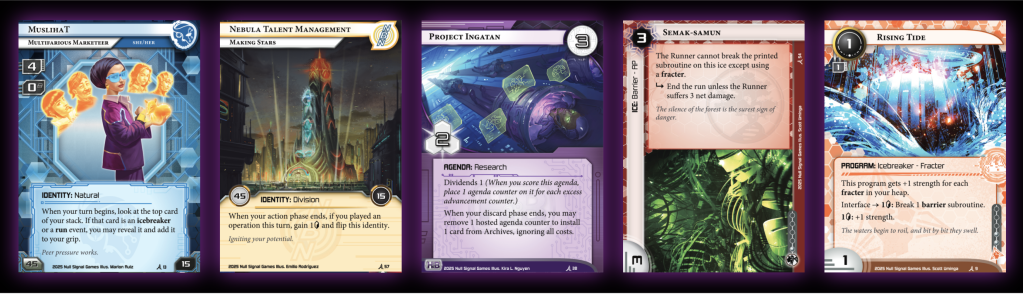
Deckbuilding
As befits an asymmetrical game, the deckbuilding is … asymmetrical. The game has Corp cards and Runner cards. These are separate pools of cards – Corp cannot play Runner cards and vice versa.
To build a deck players first choose an identity. This card, which is not part of the deck, dictates some of what can be in the deck. First of, the card specifies the faction of the deck. This is similar to colour in magic: different factions are good at different things. There are three Runner factions and four Corp factions. The identity also specifies the minimum size of the deck (usually 40 or 45 cards but this varies), and finally the faction specifies how much influence the player has to spend. Influence is used to “buy” cards from other factions (think playing a second colour in magic). Every card in Netrunner has a faction and an influence cost that dictates how much influence a deck of another faction needs to spend to include that card. No influence is required if the card and the identity are the same faction. Minimum deck size and influence are interesting balance levers for identities, as identities also have abilities that can be really quite strong. Generally smaller decks are better in card games (VTES being a weird exception), so identities with strong abilities can be balanced by increasing their minimum deck size. The same is true for influence, being able to patch your faction’s weaknesses by bringing in cards from other factions is very strong, so identities that offer more influence have a big advantage (and thus identities with strong abilities can be balanced by a drop in their influence).
As you might expect, Runner cards focus on breaking ICE and running Corp servers. These things tend to be expensive to do, so Runners also need ways to generate credits (more on that later), whether that be by using job cards, or some other mechanisms. Corps also need cards that generate credits, as well as ICE cards to protect their servers. In addition, the Corp player must include a certain amount of agendas based on their deck size which has a big impact on Corp deckbuilding.
There is a maximum of three of each card in a deck.
Players build both a Corp deck and a Runner deck, and take it in turns playing Runner and Corp.
Gameplay
Both players can take a limited number of actions per turn by spending clicks. Runners get four clicks, Corps get three. Actions can be playing cards or taking one of the default actions (gain a credit, draw a card, install a card etc.). The Corp always gets the first turn.
As the gameplay is quite different for Corp and Runner, I’ll start by explaining Corp gameplay. The Corp starts the game with three servers – Archives (their discard pile), R&D (their deck), and HQ (their hand). The can create additional servers called remote servers where they can install cards to use their abilities. The Corp starts each turn by drawing a card. To win the game the corporation needs to score seven points of agendas. To score an agenda, the Corp needs to install it in a remote server (takes 1 click) and advance it enough times to be able to score it (the number of advances required depends on the agenda, each advance requires a click and a credit). Generally this is hard to do in a single turn with only three actions, so the Corp needs to make sure its agenda in progress is protected from the runner who is going to try to steal it. All Corp cards are installed face down, and only revealed when the Corp player chooses (and can afford it), or if the runner successfully runs the server in the case of cards installed there. While the runner cannot be sure that the card on the server is an agenda in progress (some non-agenda cards can also be advanced), they are likely to try to get to any card that has some advancement counters on it. To stop the runner from doing just that, the Corp player can install ICE in front of that server (remember Corp cards are installed face down, this includes ICE – the Corp can spring some really nasty surprise on the runner). ICE cards have abilities that the Runner needs to get through to access the server, and if the runner can’t, more often than not, the run will end and the card will be safe.
On the other side of the table, the Runner is trying to win by stealing seven point of agendas from the Corp. The runner does that by accessing cards in the Corp’s servers and hoping to find an agenda there. By default the Runner accesses all the cards in a server (i.e. looks at them and can score any agenda they find there) if they successfully run it. There are two exceptions to this, when accessing HQ (the hand) the runner draws a card at random, and when accessing R&D (the deck) the runner accesses the top card only. Either way if the card is an agenda the runner can score it. This of course requires getting through the defenses the Corp has likely put on their servers, and therefore the Runner needs to balance running servers (costs a click) and installing hardware/software/resources to help with bypassing ICE (all of which also cost clicks). The runner does not draw at the start of their turn so they also might want to spend clicks on drawing cards. If the runner does nothing, the Corp will win through advancing agendas, so the Runner is forced on the offensive. Go too early and the Corp’s ICE can stop you dead in your tracks. This tension is at the core of Netrunner and makes it a great game.
My Experience
I think I played Netrunner before playing VTES, but I can’t remember for sure. What I do know however is that I’ve enjoyed all the games I’ve played, even if the game is a bit overwhelming at first. As the Runner there is a lot of hidden information in play, far more than in Magic or VTES where hidden information is limited to the other player(s)’ hand(s). There is also so many potential actions a player can take for each click, and it’s very hard to know what is the best course of action at any given moment. A few games in however, you start to understand what is important in the game and have a bit more direction. What’s held me from getting into the game proper (until now) is that the out of print FFG cards were somewhat hard to get a hold off (at least for any kind of sensible price!). Null Signal Games have however rotated out the last FFG cards from the Standard format (the most widely played format) which means the cards in that format are all Null Signal Games cards now which are readily available – to add to this, all the Null Signal Game cards are freely available on the Null Signal Games website as PDFs to print out and play, how good is that! They do accept donations if you’re into what they do.
Wrapping Up!
It’s been a long post, so thanks for reading all the way to here! I hope my experience as a Magic player trying out other CCGs was interesting and that you’ll check out VTES and Netrunner. They’re both really cool games and very unique. They both are easy to get cards for these days (thanks to their extremely engaged fan-bases), which is fantastic. What I described in this post is a very rough overview of all three games and there is a ton more to discover in each, I had to skip over a lot of detail and this post is still very long by the standards of this blog.
Both games showed that the CCG genre could do quite different things than what Magic did (Luckily! It would be sad if the first attempt at a new game type was the last time someone innovated). I hope that by juxtaposing these games you can see how similar concepts were addressed in different ways in all three games. I would like to highlight a couple here:
- It should be impossible and/or a bad strategy to play all the best cards in one deck
- Magic does this with the colour system, unless you’re willing to have an extremely clunky deck it is hard to play cards in all five colours, and therefore you need to pick a subset of colours to play.
- VTES does this with the discipline system. No minion has all the disciplines and therefore you must pick a subset of disciplines to play.
- Netrunner does this much more explicitly with the Faction and Influence systems, putting a cost and a cap on out of faction cards in your decks.
- Players should be limited in what they can do in a turn
- Magic does this with the mana system, lands can only be tapped for mana once per turn and once that mana is gone, very little can be done until the next turn. Magic also does this with card draw, with only drawing one card per turn, the late game of magic often sees players unable to use all of their mana as they do not have enough cards in hand to use it.
- VTES does this with locking minions, and limiting actions. Once minions take an action, they lock and can’t be used for any more actions that turn. The more minions therefore the more actions a player can take, but more minions costs more pool so this is a dangerous game. VTES also generally prevents minions from taking the same action multiple times in cases where they can unlock (i.e. only one bleed action per turn).
- Netrunner again does this much more explicitly with the click system. You have a set number of actions unless you have a way of gaining clicks. Netrunner does this implicitly with credits too, many actions cost credits so are off the table if a player runs out.
If you know/play any of the games (or any other card game!) I’d love to hear what you think of them and if you agree with my take on them. If you’re not a card gamer, I hope you enjoyed looking at how the CCG concept was iterated on in its early days!
This post is a bit of a departure for me, this is the first non-painting related post on this blog I believe. I’m not sure if I’ll do this type of post more, but one of the things that drew me to blogging over instagram or the like was the ability to do longer form text, which I haven’t really done yet on here. I did enjoy putting this post together, so I hope you enjoyed reading it.




 Lair of the Lagomorph