Middenland Swordsmen

I haven’t painted much over the last few weeks as it’s been a bit of a busy time, with some travelling (more on that later!) but I managed to chip away some more at some Empire models.

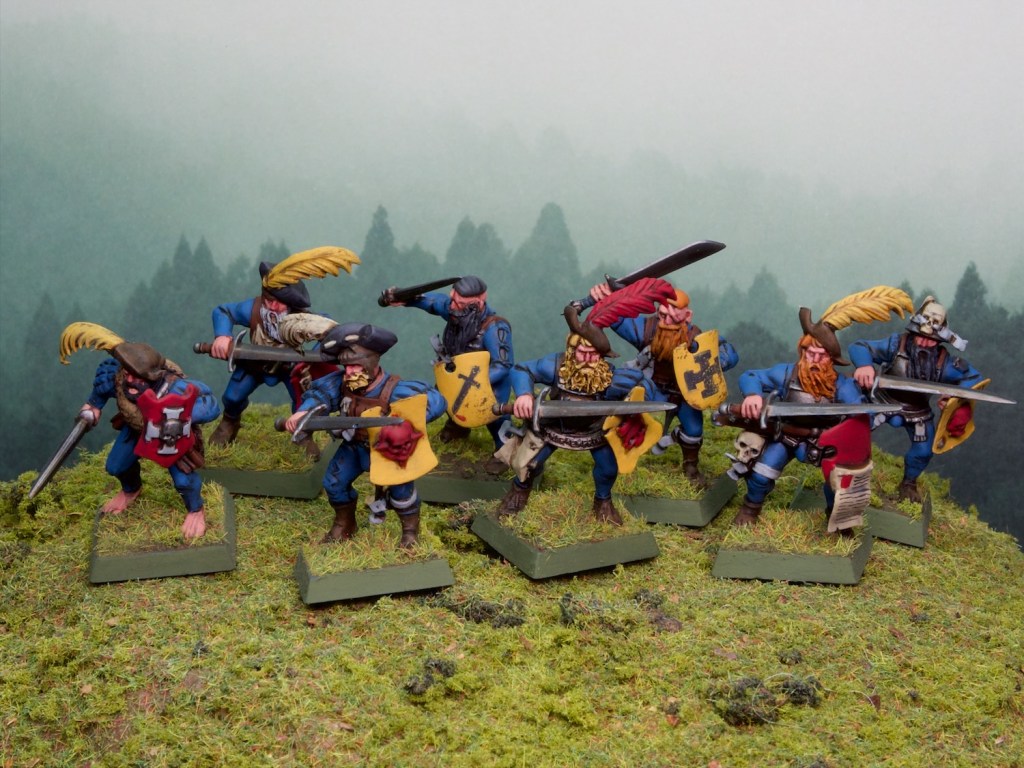
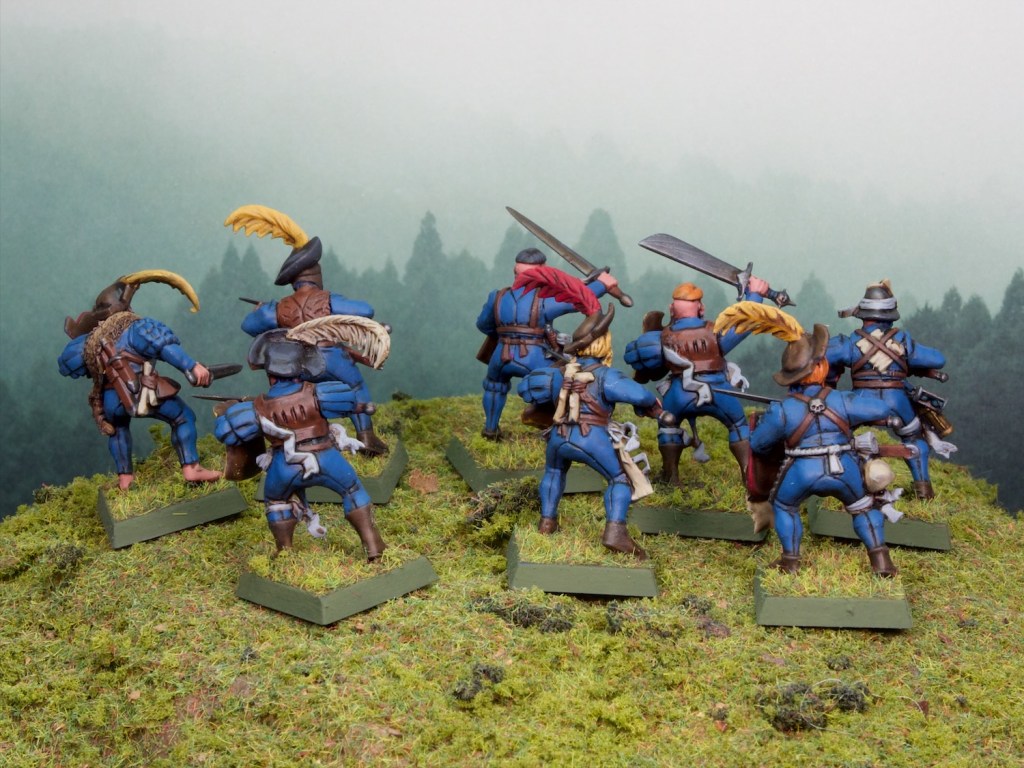
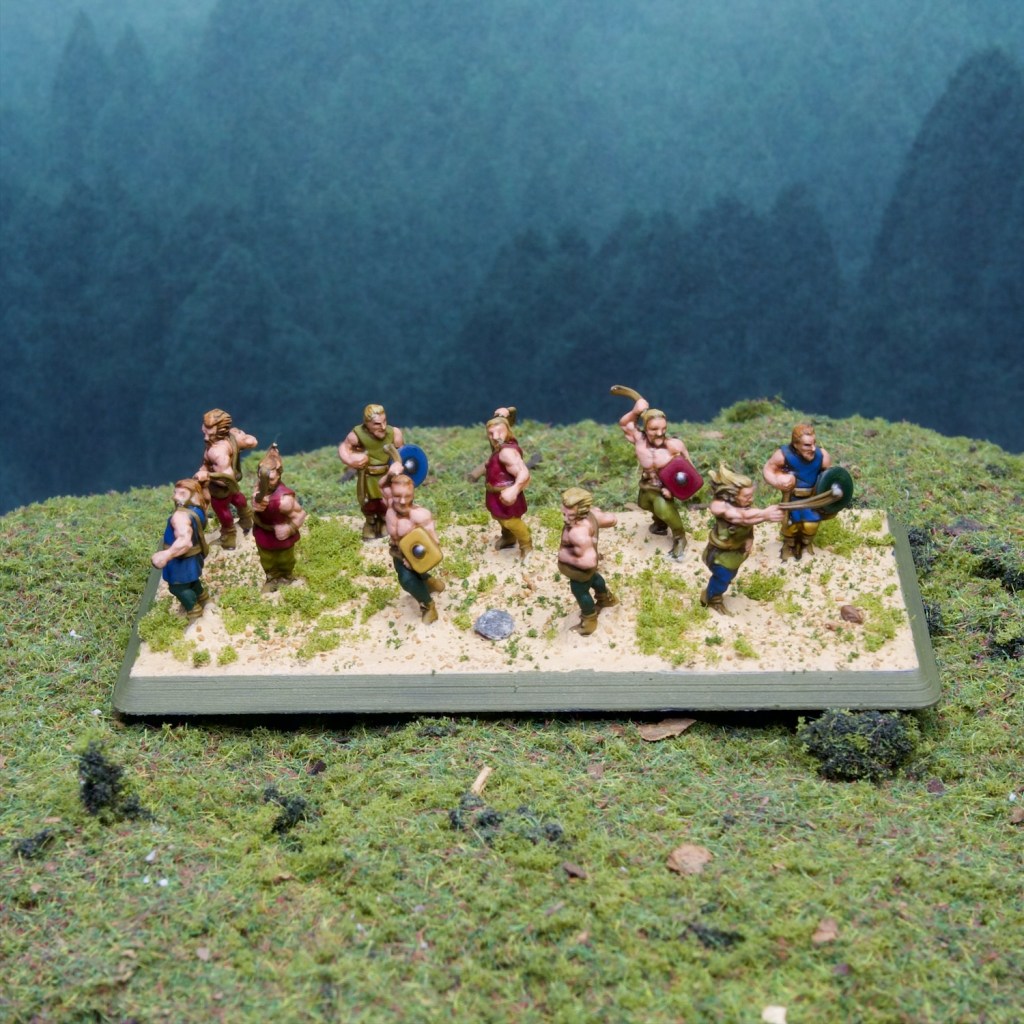
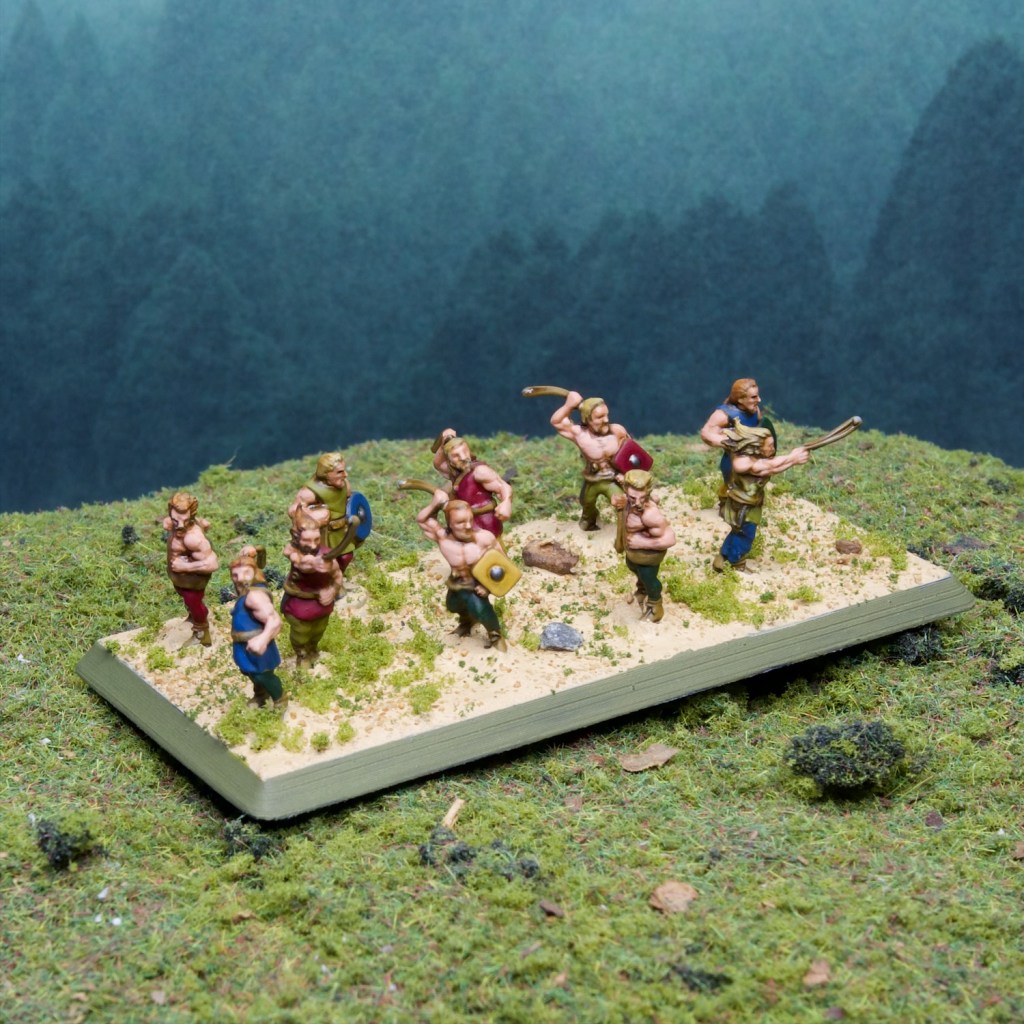
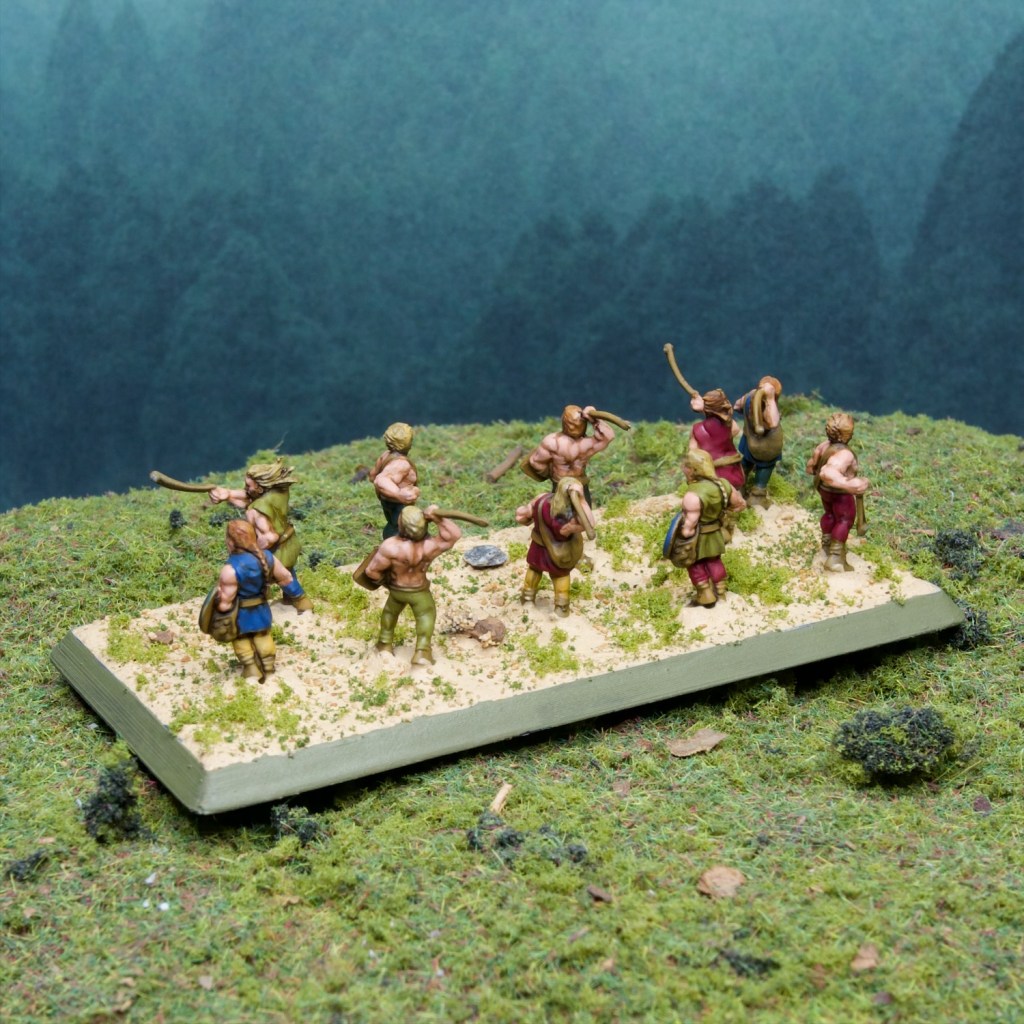
After learning to sculpt beards for last post’s Valten, I tried my hand at it again on these swordsmen. I wanted to represent some state troops from Middenland, one of the northern provinces of the Empire which is presumably filled with gruff bearded men. The Storm of Chaos campaign is mostly set around Middenheim which is the capital of Middenland. These models will then be fighting on their home ground.

The uniform of Middenland is just blue, but the book I have on Empire uniforms suggests multicoloured feathers, and I extended that to the shields. They might be a bit more colourful than the average representation of Middlenlanders but they work for me.

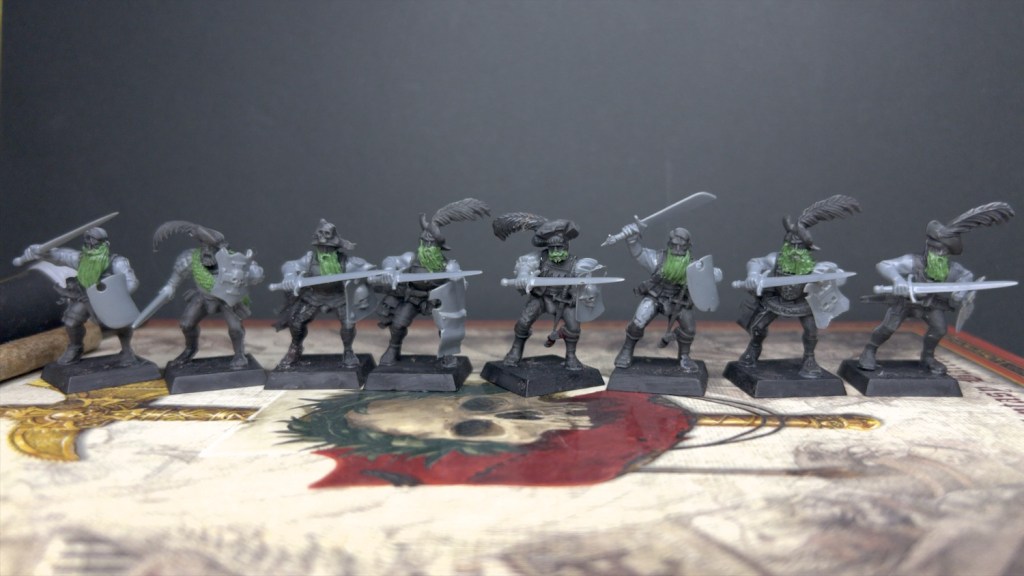
These models are “rescues”, in a previous life they belonged to a friend that had built them as halberdiers, but all of the halberds had broken over the years. I inherited them a little while back and have since then stripped them of paint and rebuilt them as swordsmen from spare arms I had.

I find that I can get most if not all the paint off when stripping plastics, but there is always some residue which adds a bit of texture to the models. As a result I wouldn’t use these as display models but they’re ok for armies!
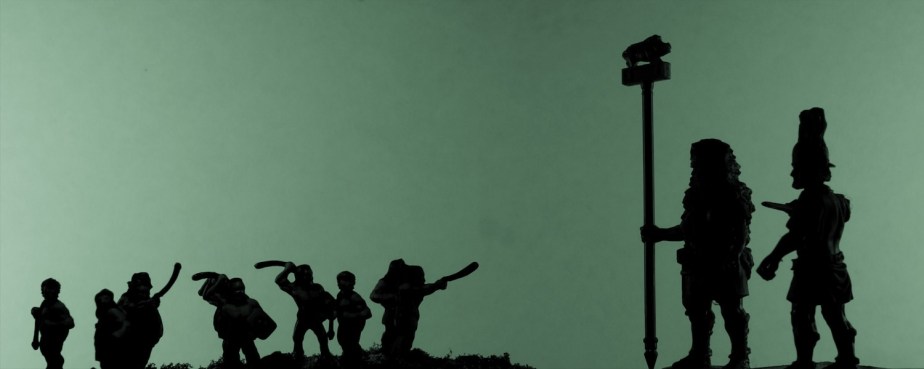
You can see what I mean in the unpainted photo above, the light grey plastic is the new parts I glued on, while the dark grey/black areas are the stripped models. You can also see my attempts at sculpting!
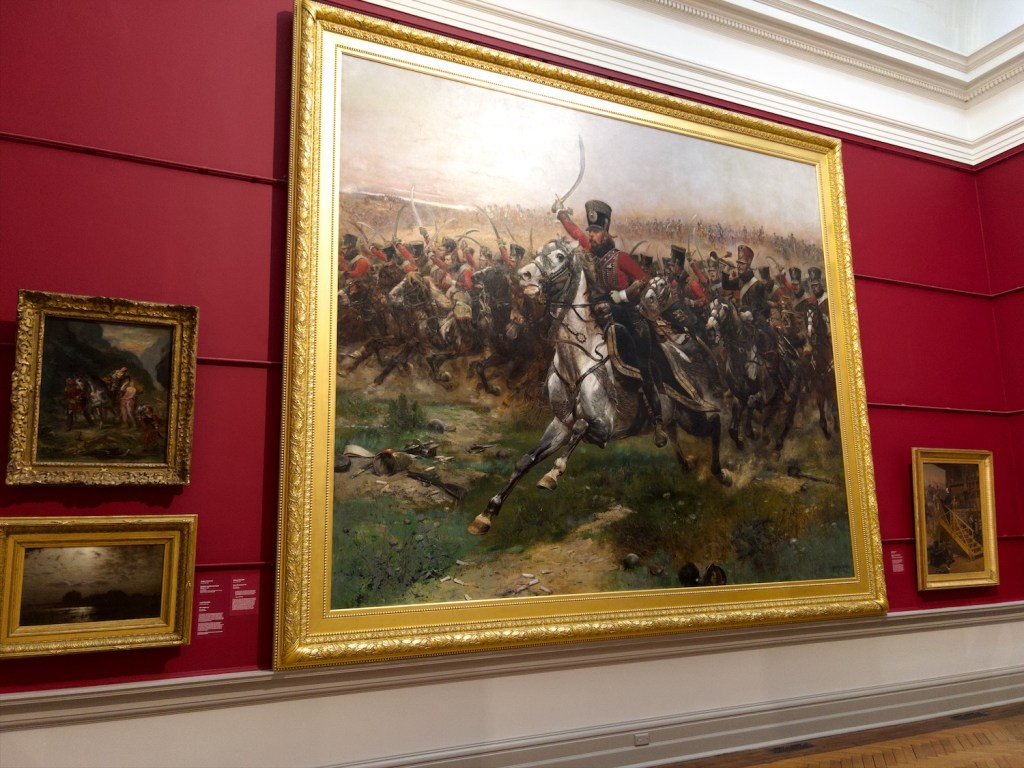
I mentioned travel above, I ducked over to Sydney for a few days to see a concert at the Opera house (a metal band would you believe!). I took the opportunity to visit some museums and the art gallery there and wanted to share this humungous painting of some Napoleonic cavalry by Édouard Detaille.

The painting is something like 4.5x5m and dominates the room. You can get a better view of the painting itself on the gallery’s website (https://www.artgallery.nsw.gov.au/collection/works/4560/), but hopefully my photo gives you a sense of scale! The whole gallery was very inspirational, plenty of ideas to pinch for hobby projects!

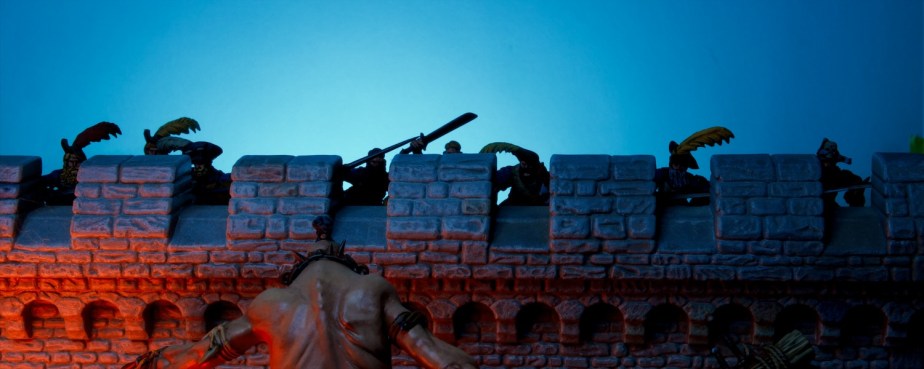
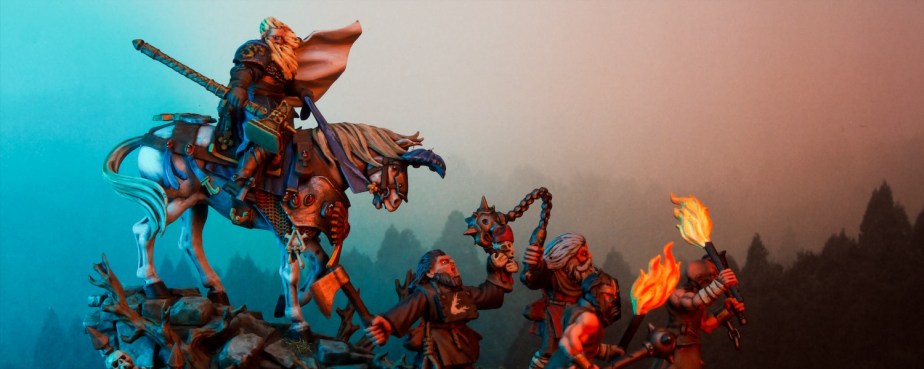
Valten, Exalted of Sigmar and Flagellants

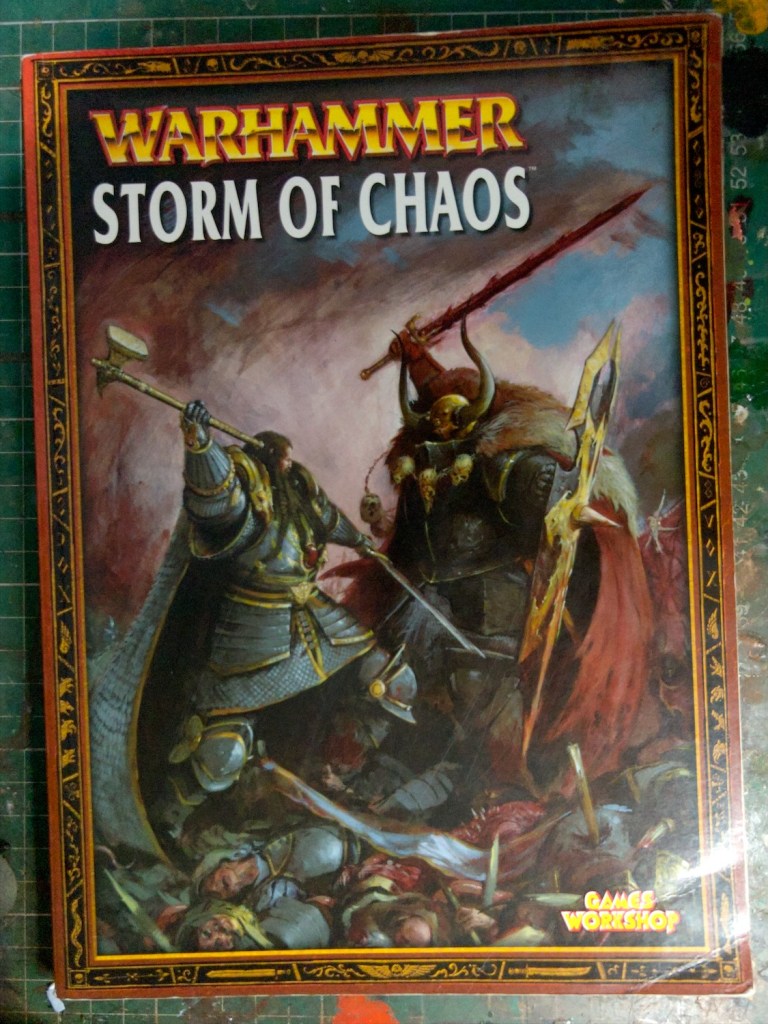
I’ve had a productive week, getting a fair bit built and painted. I’m still inspired by the idea of playing out a big game set in Warhammer’s Storm of Chaos campaign, specifically the battle that occurs as part of the relief of Middenheim by a combined army of Empire, High Elves, and Dwarfs. It sounds like a great excuse to break out our collective collections and play a very large game for most of a day (using the Midgard rules).

For those not in the know, Middenheim is a big city built on a mountain in the Empire, and is the target of a very large Chaos invasion led by Archaon, the biggest baddest Chaos champion. Middenheim is pretty much impregnable because of its natural defenses so the Chaos forces settle down for a long siege. Meanwhile Karl Franz, the emperor (of the empire!) gathers an army to relieve the city, with troops from many provinces of the empire. Along the way he’s joined by a Dwarf army and a High Elf army who both recognise the threat posed by the Chaos invasion. Alongside Karl Franz is Valten, who as a young man single-handedly wiped out a beastman attack on his village and has since been hailed/raised as Sigmar (the chief god of the empire) returned. There’s a whole interesting sub-story a to whether that is the case or not, but regardless the powers that be seem to buy into the story (or at least realise that if the people believe it it doesn’t make much of a difference). As a result, Karl Franz gives Valten the warhammer (the one on the cover of all the books), Ghal Maraz, and when the elves and dwarfs join up with Karl’s army, they also gift equipment to Valten, the dwarfs give him a suit of armour (that was orginally meant for Sigmar himself) and the elves a mighty steed (sired by the horse of Tyrion, the greatest high elf hero).

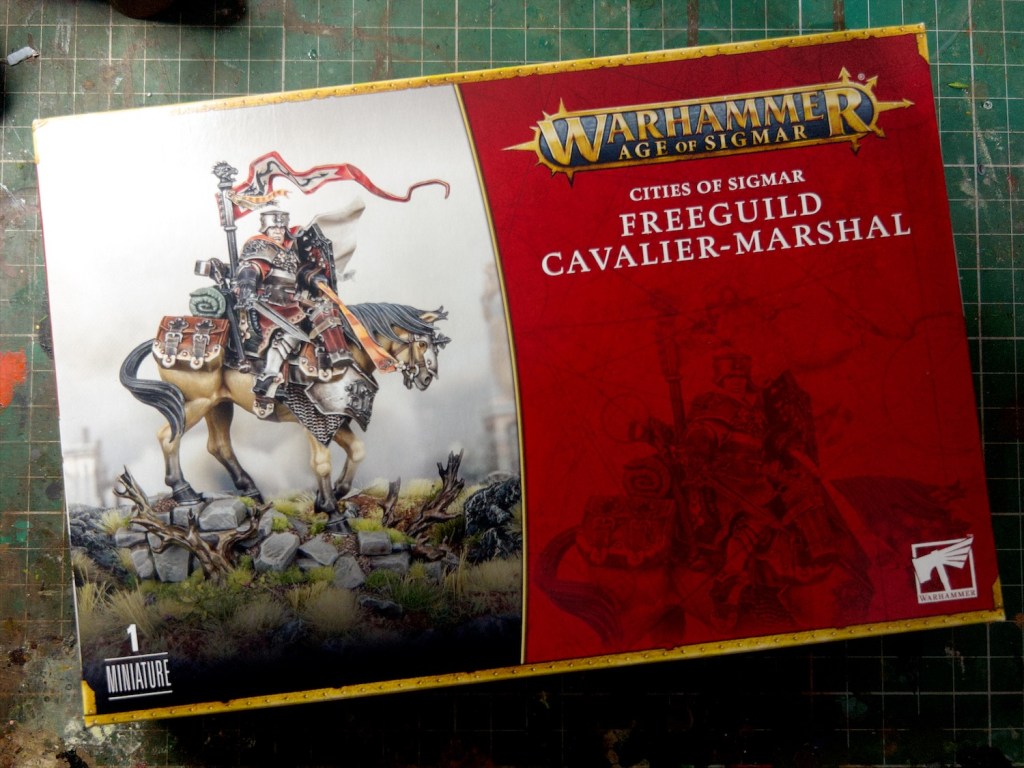
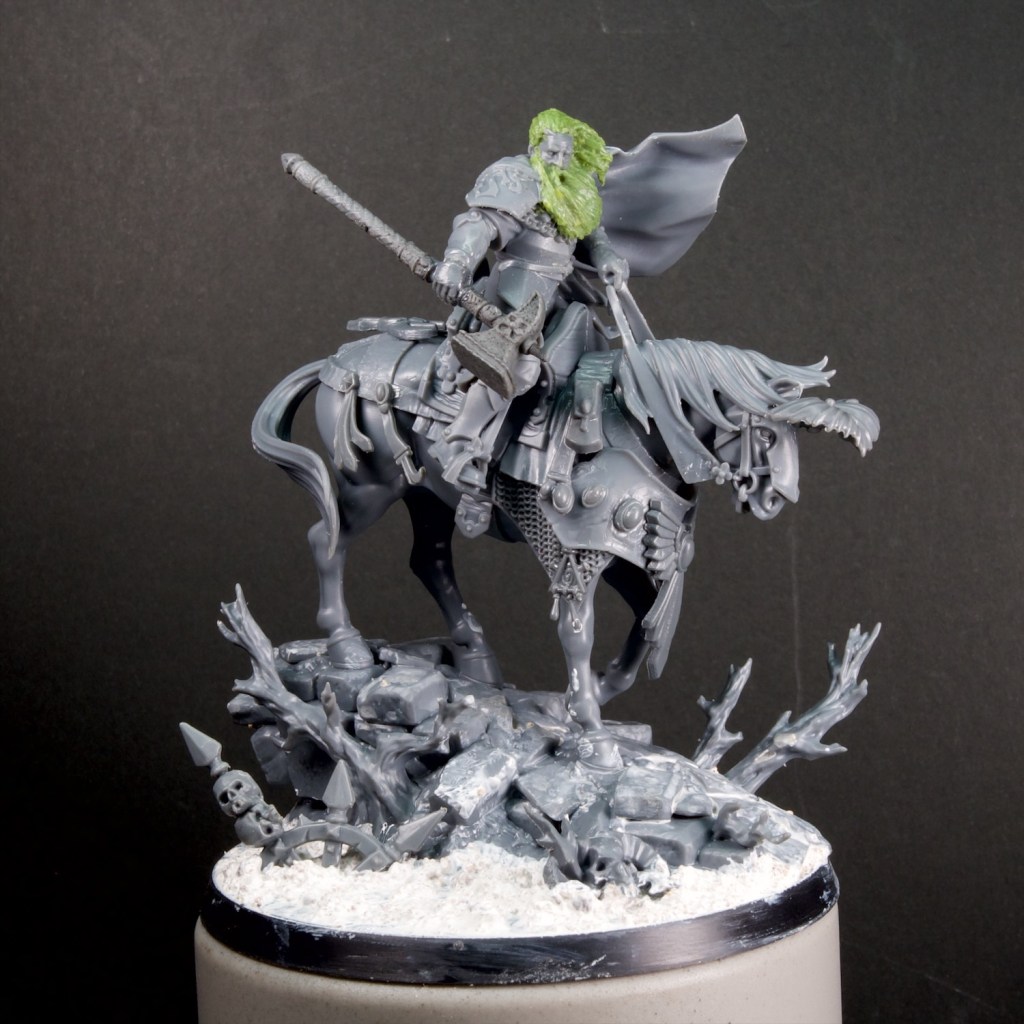
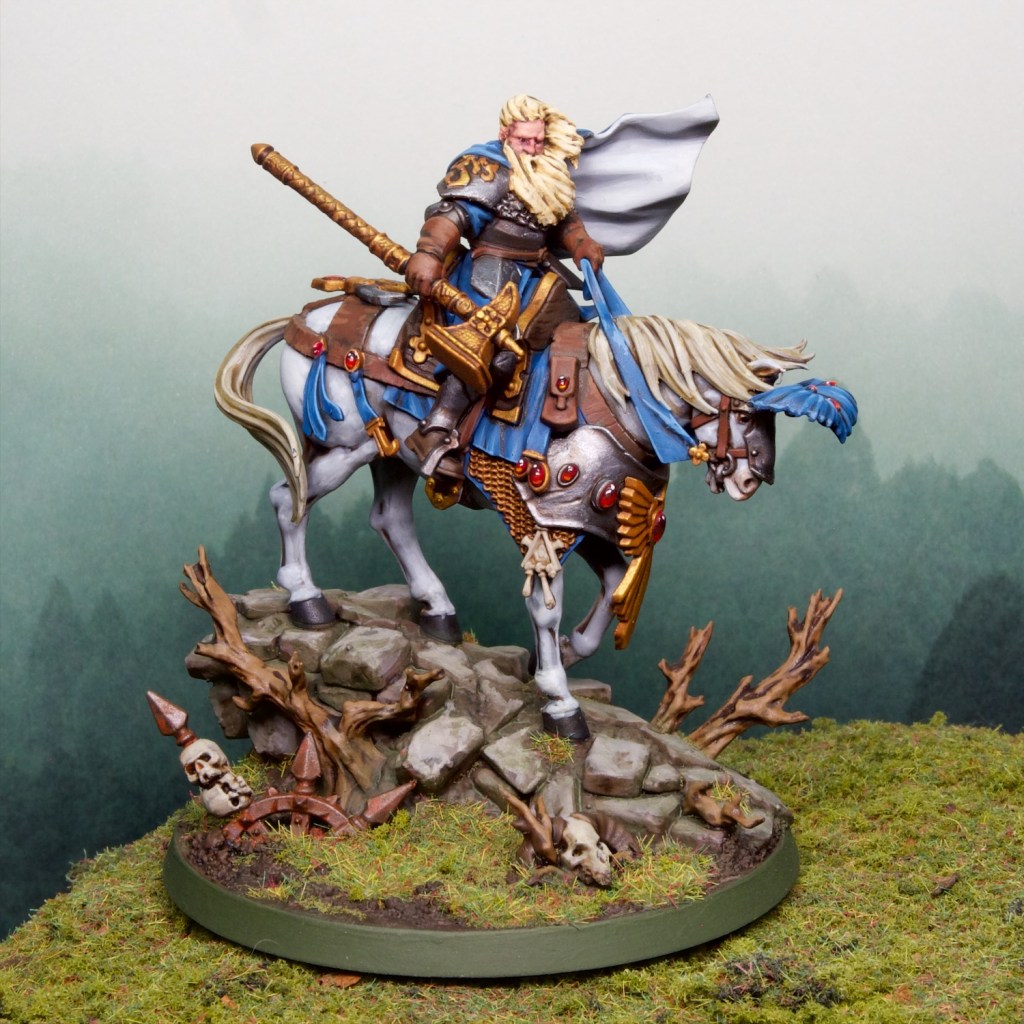
The reason I’m telling you all this is that I built and painted a custom model for Valten, and tried to capture the story in that model. Valten had a model at the time of release of the campaign book (~2004) and I think was re-released as a Finecast model during that later era. I was scouring ebay for the model and despairing slightly at the prices (and postage, UK or US to Australia is veeery expensive these days). After some deliberation I decided to just convert my own out of a model I’ve had my eye on for quite a while: the Cities of Sigmar Cavalier-Marshal.

The character of Valten is a bit of a tragic, maybe reluctant hero in my mind, the cavalier model really has a weary look to it that I think really fits Valten so it seemed like a great base for the model.

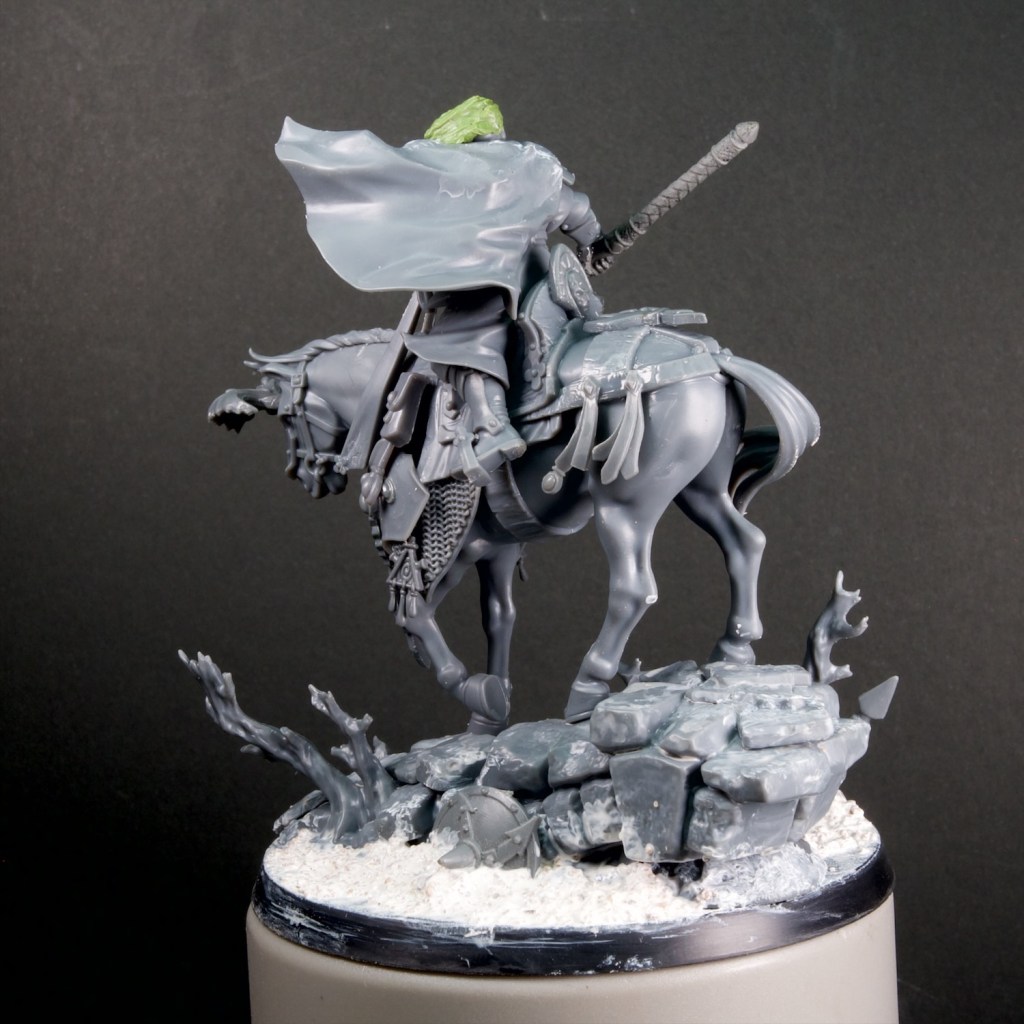
I removed as much iconography off the horse as I could and added lots of spare high elf bits I had big around to sell the horse as a gift from the elves. I kept the armour on the rider as is, the cities of sigmar range armours have a very angular look to them which I think is good for a dwarven made suit of armour.

For the head I liked the expression on the Cavalier model, but Valten has long hair and a long beard, while the Cavalier is clean shaven and short haired. So I decided to do something I do rarely, which is to sculpt! It was a bit daunting to build up this centrepiece model and to try my hand at something new right on its face, but I found this very handy tutorial by Valbjorn on YouTube and at least I knew I was going in with a plan. The result is ok I think, a bit rough in some places (not helped by the age of my green stuff) but it does the job!

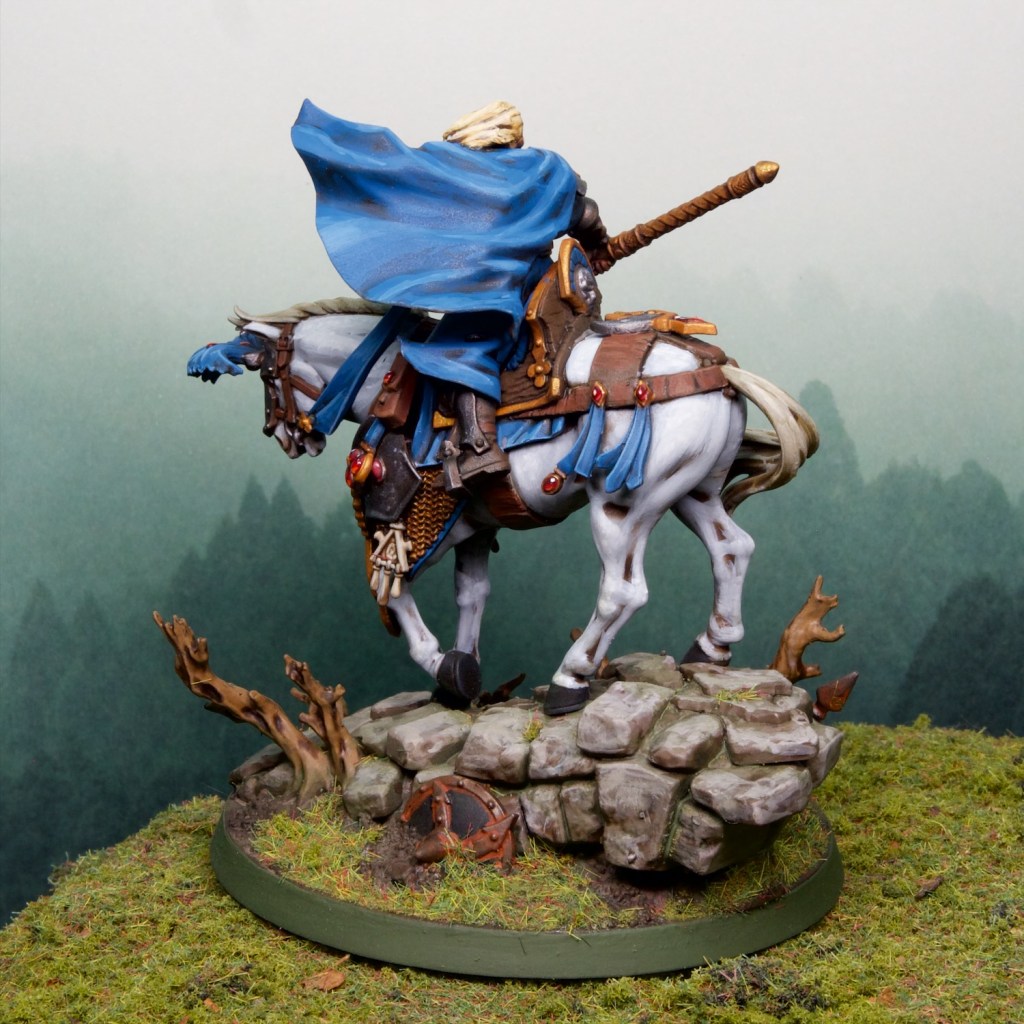
For the painting stage I stuck to blues, whites, and gold as a scheme. This is how the original model was painted and helps with the whole Elven influence on the horse.

The cavalier model comes with a very cool scenic base meant to fit on an oval base. I decided to go for a 60mm round base instead so had to fill out some of the extra space. I cut up some chaos bits and blended everything in using a mix of acrylic paste and sand.

Overall I’m very happy with the model, was fun to get kit bashing and even do a bit of sculpting. It’s been a while since I painted a bigger character model and that’s enjoyable too. Getting to spend some more time on some of the details I would usually keep simpler for regular army models makes for a nice change.

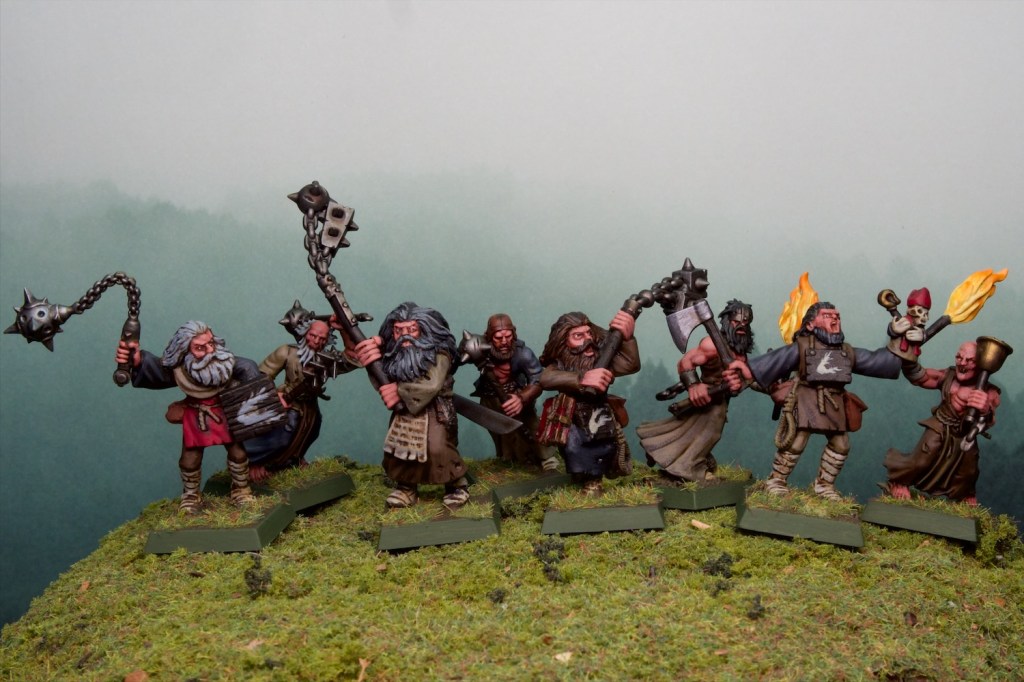
Valten is not all that I finished this week, I also painted up the first batch of some Flagellants for that same empire army.

Four of these are originally Mordheim models, some of the first models I ever bought in fact, as part of the Witch Hunter warband for the game. They’ve seen a lot of mistreatment throughout the years, and all had some breakage over that time, so I fixed them up with some plastic parts. The other four are from the current (still 10+ years old I think), plastic flagellants kit. I have another 8 to paint up of these, for a future update.

There you go, busy week but I’m happy with what I got done!

Halfling Archers

Ever since my experiments playing Warhammer with Midgard rules I’ve been thinking of fun “historical” battles we could re-create. One that’s stood out is re-fighting the siege of Middenheim from the Storm of Chaos campaign. As a group we have plenty of miniatures we could use, except a proper Empire army, which given they’re the primary force on the “good” side is a bit problematic! Luckily I have plenty of empire models, but none that are really painted.

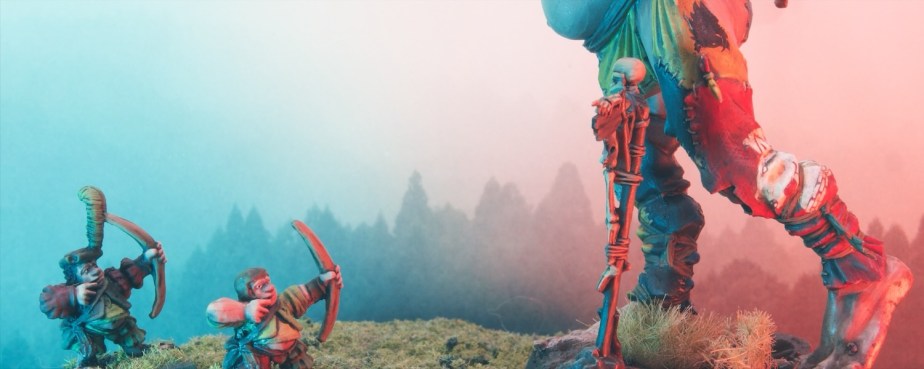
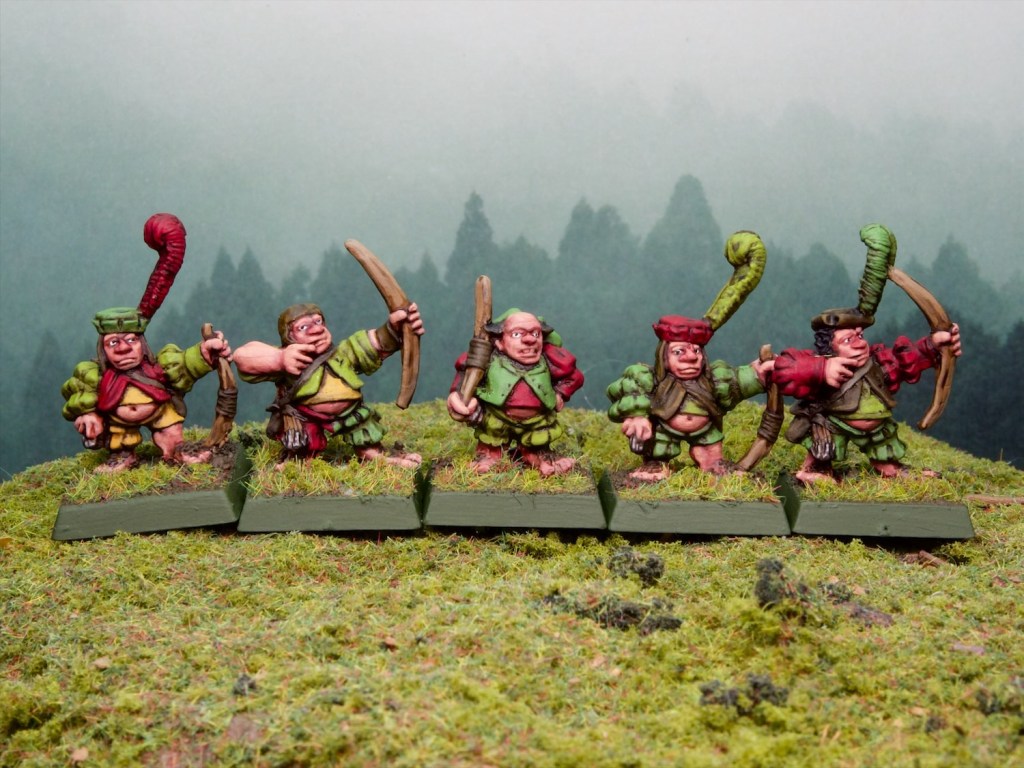
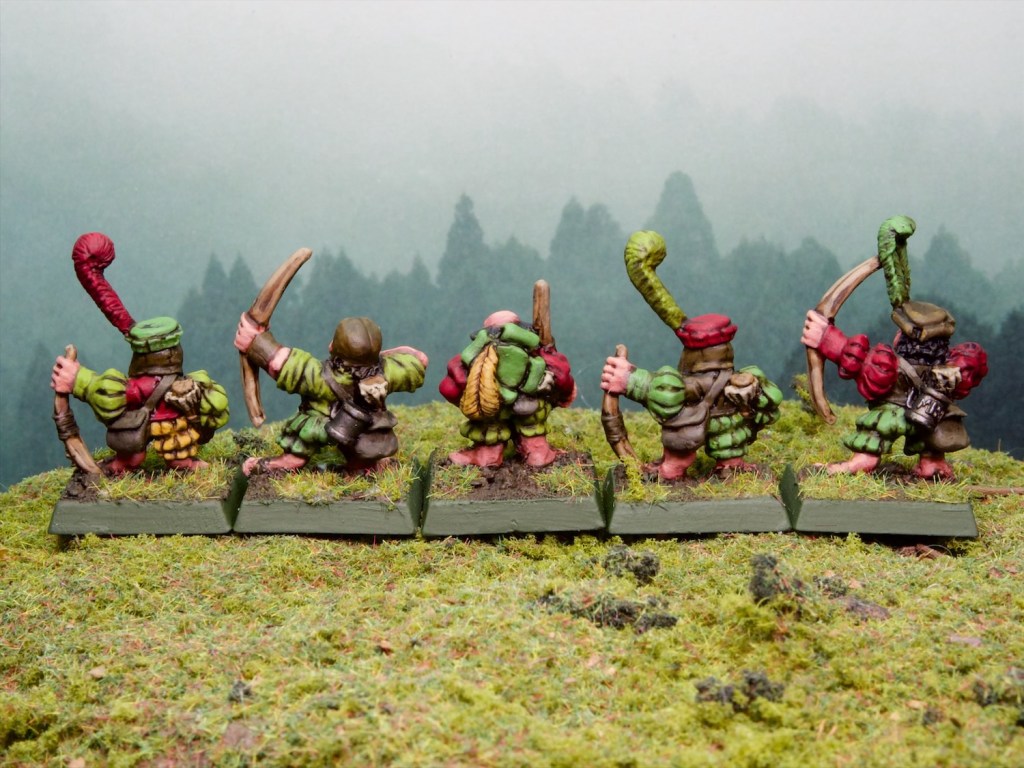
With the idea of “painting Empire models” in mind, I went scrounging through my reserves and found this small unit of halfling archers that have been sitting in a case for 15 or so years. They seemed perfect, I had a few hours to myself and they’re quite small models they seemed paintable in the allotted time.

They’re fairly old models from the Empire range, and I’m not exactly sure when they date from but I found them in a 1998 catalogue on Solegends so that should give you a rough idea.

I painted them in the colours of the Moot, the halfling province in the Empire. The uniforms are primarily green and red, but some of the guides show yellow as a spot colour so I added that too. I went for two different shades of green to keep things interesting, with the lighter yellower green being Scale75 Sherwood Green and the darker being Vallejo Game Color Goblin Green. The red is Vallejo Heavy Red, the yellow Heavy Goldbrown. They were quick to paint, I think roughly 3 hours start to finish which is a nice rate. The base rims are Scale75 Ardennes Green.

I might keep on chipping away at Empire units like this, with different uniforms rather than having only one province for the collection. Another good motivation to paint some of the pile of shame!

In other news I published another small booklet over on itch.io, this time a set of forest-themed adventure hooks for role-playing games https://lair-of-the-lagomorph.itch.io/woodland-adventures. It’s not miniatures related (although I suppose you could use it to generate wargaming scenarios in forests!), so I won’t go into it too much here, but feel free to check it out of interested.

A Review of Midgard Heroic Battles

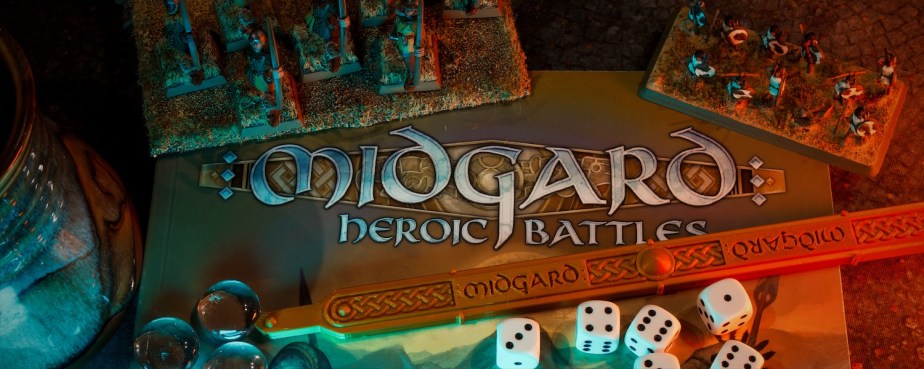
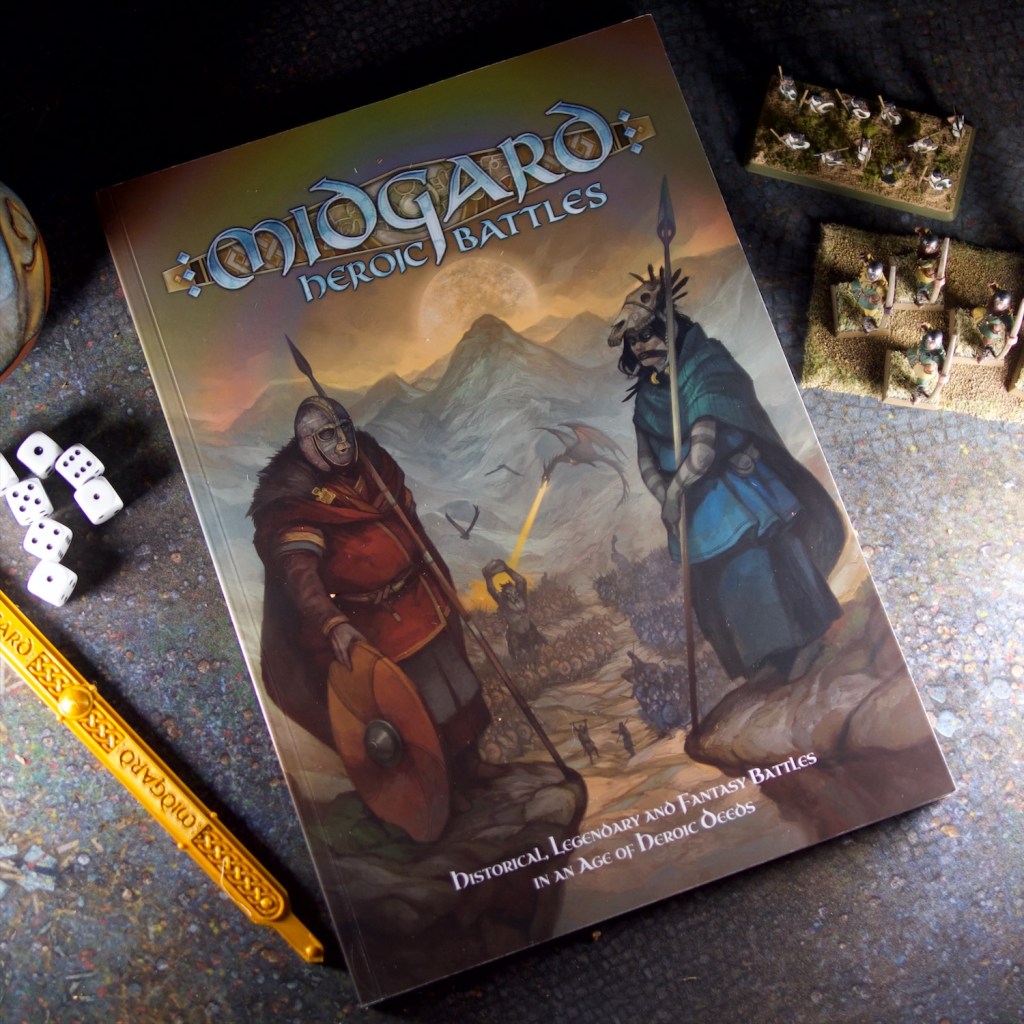
I noticed last post that I was starting to mention aspects of Midgard Heroic Battles that I’d never really explained and felt that a review post for the game might be in order. Clearly if you’ve seen my other posts you’ll know this review will be a positive one, but I think it provides some useful information about the game for players that might be interested in picking it up.

What is Midgard Heroic Battles?

Midgard Heroic Battles (Midgard from now on!) is a set of rules for playing out battles in any setting that can be described as having the following characteristics:

  • Battles are fought mostly by ranked up regiments of close order fighters wielding spears/swords/axes/etc, supported by cavalry and skirmishers (and sometimes monsters/elephants!)
  • Shooting is helpful but not the primary way to win a battle.
  • Most importantly, leaders lead from the front. They are found where the melee is thickest, performing mighty deeds (or dying mighty deaths!) that will be sung of by the bards for aeons to come.

This covers quite the range of historical eras (roughly antiquity all the way to sometime in the Middle Ages when leaders decided to focus on strategy over feats of arms), but also covers a swathe of fantastical settings (Tolkien’s Middle Earth being a prime example).

In addition to this broad applicability setting-wise, Midgard also is a scale agnostic system that handles whatever your collection can throw at it. I achieves this through its adaptive measurement system (the spear throw) and flexible list building.

The spear throw

The spear throw (ST) is the basic unit of measure of the game. Pretty much everything in the game is measured in multiples of STs, for example units are always 1ST wide, cavalry move 2ST per move, short bows can fire arrows 3ST away etc. A ST does not have a fixed length; how long a ST is depends on the scale of the miniatures you use. For 28mm miniatures, the suggested ST is 12cm long (which lets you fit 8-10 miniatures on your 1ST wide base), while for smaller miniatures (say 15mm or less) the suggestion is to use an 8cm ST. This is a purely subjective choice, driven primarily by how you like your units to look on the tabletop. Want wider units? Use a larger ST.

By using this abstract measure, the rules do something quite clever, which is to provide ranges for all kinds of things in the game while never committing to a fixed measure. No need to do some on the fly measurement conversions (“this bow shoots 20 inches at 28mm, we’re playing at 15mm so it should shoot 10.71 inches!”), just get/make a measuring stick of your chosen ST and you can measure everything you need for the scale you’re playing at.

Left is an 8cm spear throw base and measuring stick, right is a 12cm spear throw base and measuring stick. These very stylish measuring sticks are STLs that can be purchased from the TooFatLardies site.

Here is the first hint of what the game is trying (and therefore not trying) for: this is a game that is not aiming to be particularly suitable for random pickup games at a club or say for playing tournaments. It is important that both sides in a game use the same ST length. Unlike in a Warhammer-style ruleset which mandates all aspects of the game and therefore provides a common standard for all gamers to align to, Midgard requires pre-agreement on the ST the game will be played at. Considering the ST affects the bases of all the units on both sides, that is not an inconsiderable hobby hurdle to overcome if one gamer has based their army on 8cm bases and the other on 12cm.

The List-building

Midgard provides a set of generic profiles (such as Heavy Infantry, Skirmishers, Light Cavalry, etc.) which can be modified by changing their equipment (e.g. adding or removing armour), and the addition of traits which modify the behaviour of the units (e.g. impetuous can force the unit to charge).

Much like STs this list building is a cooperative activity and not done in a vacuum. The maximum armour for most units is 4, which might represent a mail and a shield for a dark ages game, or full plate armour in a later medieval game. What’s important here is that relative to each other, both sides in a game are consistent. This again indicates tournament play is not the point of Midgard, it would be hard to coordinate a room full of players to achieve this.

What you get as a result is an extremely flexible list building system that is capable of representing all kinds of troops, whether historical or fantastical. I’ve been able to create fun and evocative profiles for my Middle-Earth miniatures, my Warhammer miniatures, and my emerging Punic Wars collection so far.

The author provides a number of lists in the back of the rulebook, as well as many more on his website https://mogsymakes.net/resources-for-midgard-heroic-battles/ alongside some great list builders that make putting armies together a breeze.

As a result of the above, Midgard feels more like a framework for creating games than a simple self-contained game. While it is possible to just get the models required to field some of the armies in the back of the book and play a game as is, the real power of the game in my opinion is to provide an easy way to get your collection on the table and playing fun games with it.

Midgard Gameplay

“This flexibility is nice, but once I have chosen my ST and made my army lists, what’s the actual game like?”

If you have War of the Ring trays around, they are perfect for Midgard.

The answer is Midgard is a very fun rank and flank ruleset, that is fast to play, easy to pick up, but hard to master. In its pages you’ll find rules for the usual array of restricted ranked unit movement rules (a staple of the genre), shooting and combat. All of these are quite streamlined compared to what I’m used to from Warhammer and other such systems. Generally all combat/shooting die rolls require you to get a 5 or above (no complex comparison tables here), and modifiers halve the size of your dice pool rather than modify the target number. This makes for some rather quick combat resolution, and keeps the game going.

The only other die roll to remember is the command die roll, which is used for situations where a unit may not do what it is told (e.g. holding still instead of pursuing a fleeing unit), similar to leadership tests in Warhammer. Just as combat rolls, this is a set number and never changes (again speeding things up!).

Heroes matter greatly in the game, leading your troops and assisting them by using a resource called mighty deeds. Heroes get these according to their level and can spend said deeds on making units re-roll failed command tests, get extra attacks, cast spells, and most shamefully to keep themselves safe.

Framing all these rules is the reputation system. This pool of tokens represents the morale of the army, and grows with the acts of bravery of heroes and shrinks when losing units or when heroes bring dishonour upon themselves. If your reputation is at or below zero at the end of the turn, your army breaks and you lose the game.

The main advantage of the reputation system is that it lets you use your coolest cups for their true purpose: gaming.

This resource drives the behaviour of the players in a really fun way: as their reputation drops, players have no choice but to dive in and try to regain the upper hand through desperate actions with their heroes. This is magnified when an army’s reputation drops to zero during a turn, as they have until the end of the turn to get it back above zero, which makes for some extremely fun (and cinematic!) moments where heroes lead wild charges in the forlorn hope of reinvigorating their side.

Who Is Midgard For?

As highlighted above, Midgard is not a tournament game, and is probably not particularly well suited to a pickup game scenario against unknown opponents at a club or other. What Midgard excels at is creating fun narrative games where the two sides and a scenario are created specifically for those games. This is really good for convention games where the game is set up and the players join in, and I’ve found it excellent for games with my game group, where I’ve set up a scenario for two forces and invited my friends over to play it out.

I’m not sure I would have known what to do with Midgard 10 or so years ago, as I was very much in the playing tournaments and pickup games paradigm, with armies specifically created for an edition of a game, ready to play against anyone with an army for the matching system. In some ways that’s an easier way to go as there is no need to coordinate anything for a game (beyond a time and a place), everyone is following the same set of rules and can just show up with their legal army. If that’s how you want to do most of your gaming then Midgard might not be for you.

The games look great too!

I have much less time for gaming these days and find that what I really want to do when I do is to get a group of friends together and play a big fun game. Midgard helps me do that in quite a few ways. First, it’s easy to play – I know that friends that aren’t regular wargamers will have an easy time picking it up (recently one of said non-wargaming friends corrected me on the rules multiple times during a game!). This really broadens the pool of players, and I’d recommend Midgard for teaching new players a wargame. Second, while building lists sounds like a lot of work, I think building lists for Midgard is much faster and easier than building lists for Warhammer – even with the need to keep both sides somewhat consistent. Third, the game is fast to play. The rules stay out of the way of the action, and games with hundreds of models can take as little as a few hours to play through. Finally, the game lets me use my whole miniatures collection. While I have some armies that are legal armies in other systems, I have some that are too small or out of date and haven’t seen play in many years. Midgard with its flexible list building system has had me scrounging through my cases (which has been a great trip down memory lane), thinking up scenarios for all kinds of settings.

If the above sounds like a good time then I heartily recommend you check out Midgard. It’s likely to be the most played game by far in my group this year, and I look forward to finding out what else we can do with it.

Playing Warhammer with Midgard Heroic Battles

I’ve been talking a decent amount about Midgard Heroic Battles over the last few posts, and that’s unlikely to change as I’ve been thoroughly enjoying the game. Part of what’s made it fun for me has been the flexibility and general simplicity of the ruleset. It’s meant that for the last few weeks, units that I haven’t put on the battlefield for years have been taking part in some really fun games.

While most games we’ve played so far have been Lord of the Rings themed, we’ve been wondering if the rules would work well for games in the Warhammer setting. While we enjoy the new Warhammer the Old World rules, they’re quite complex and don’t necessarily make for a beginner friendly game. We have a few friends in our gaming group that are not wargamers (board games and roleplaying games are their usual fare), and haven’t really been interested in playing Warhammer before. They have however been enjoying the games of Midgard we’ve been playing, and have been happy to play more, which is great news for me!

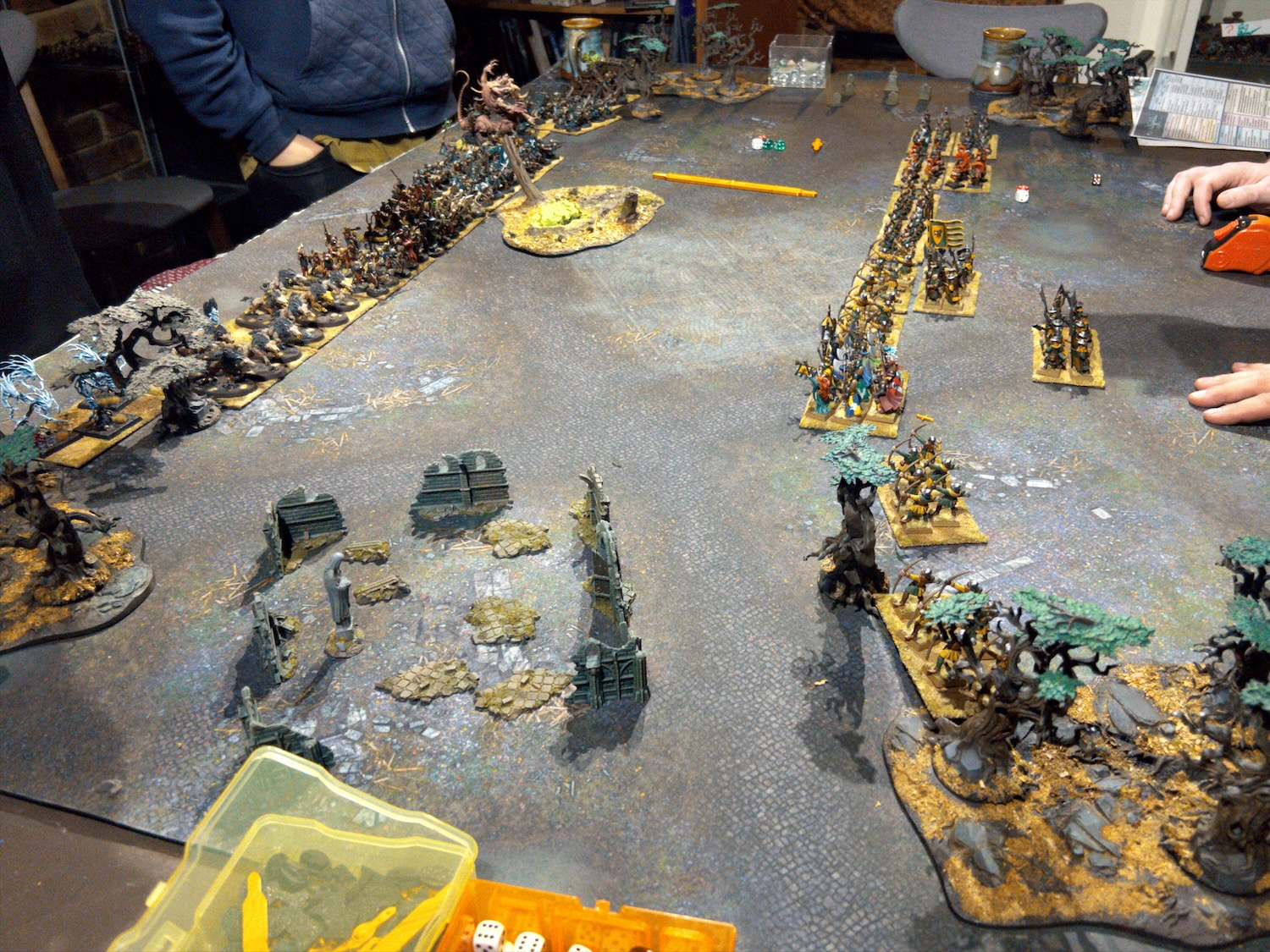
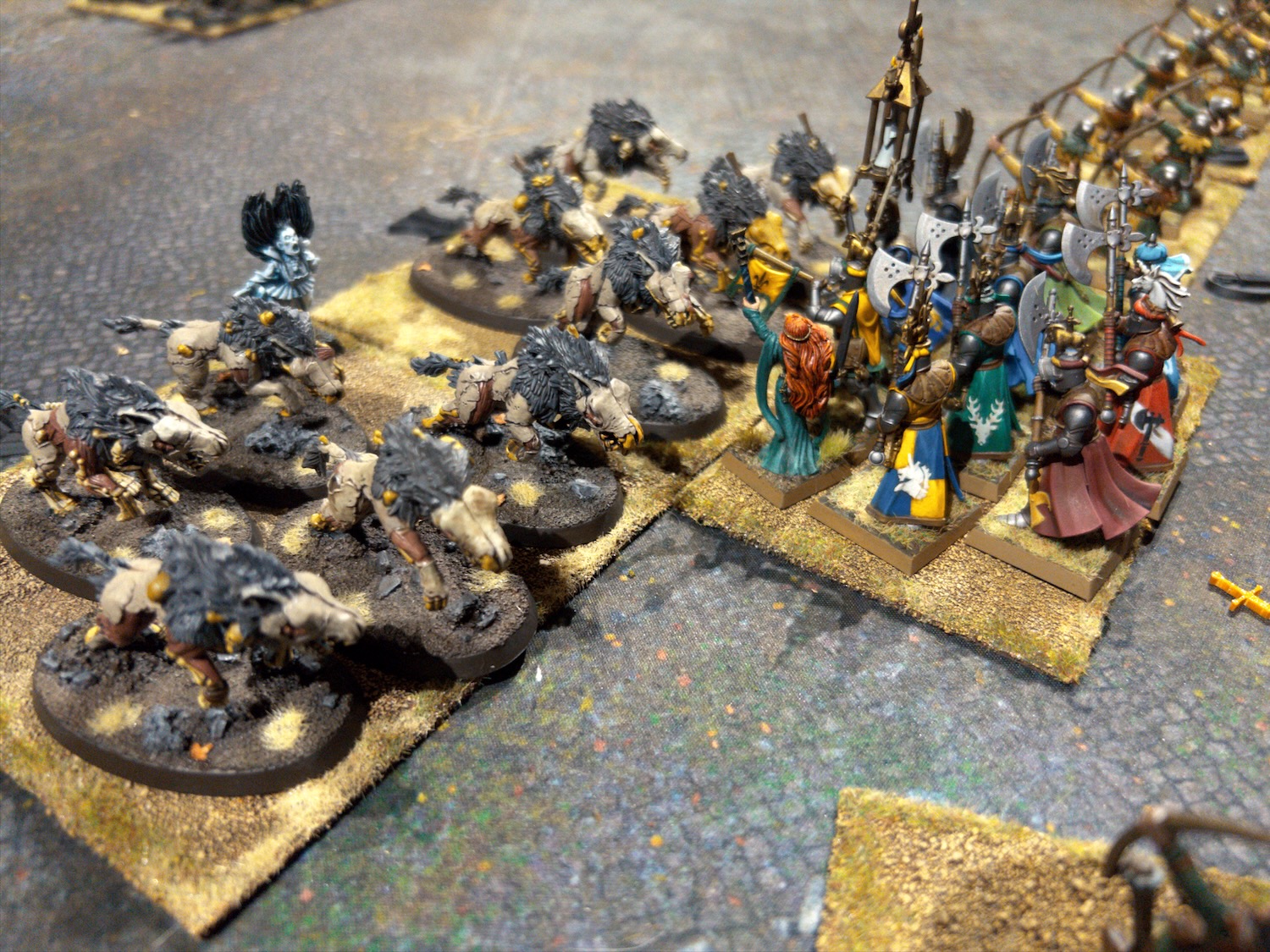
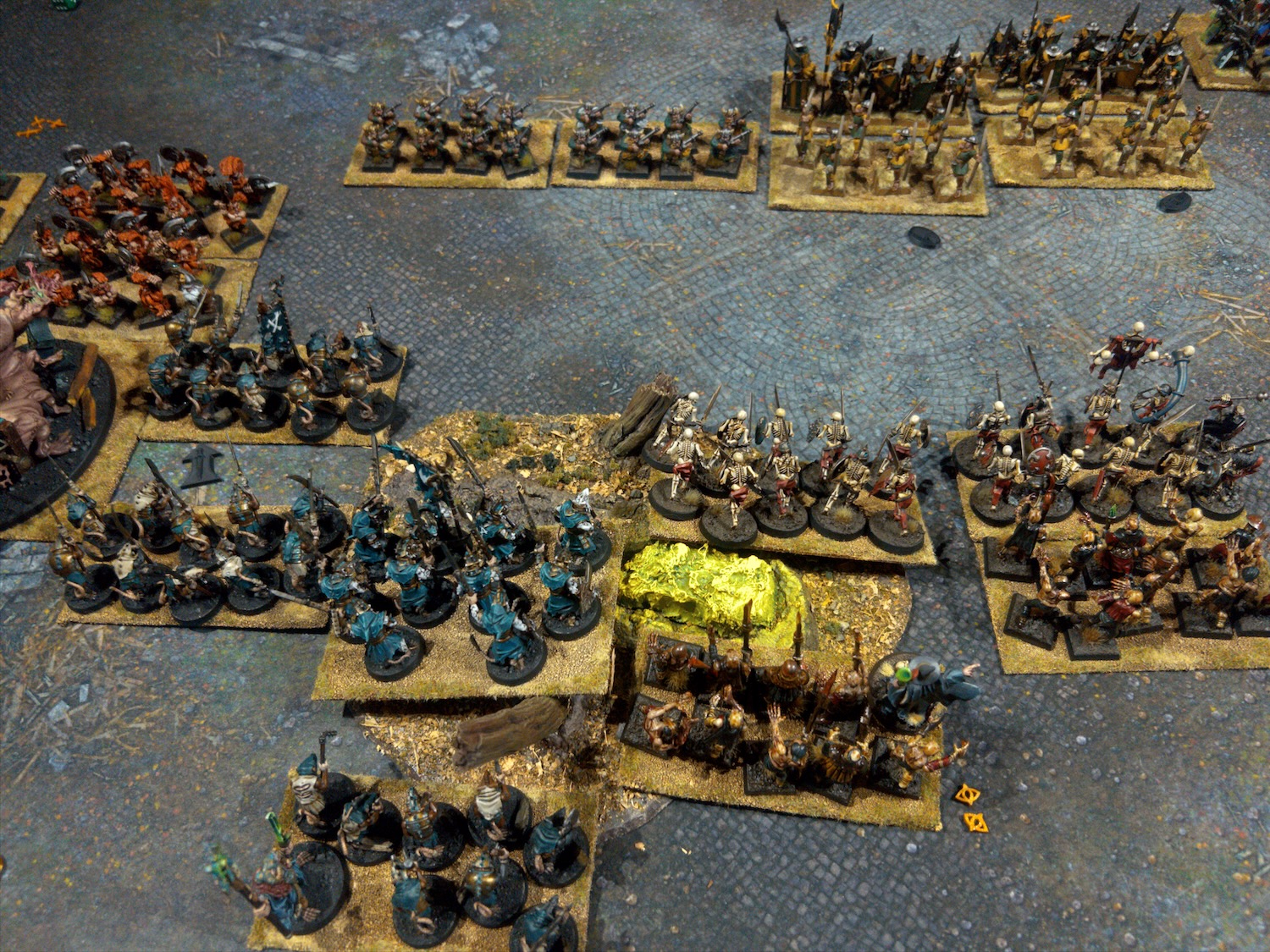
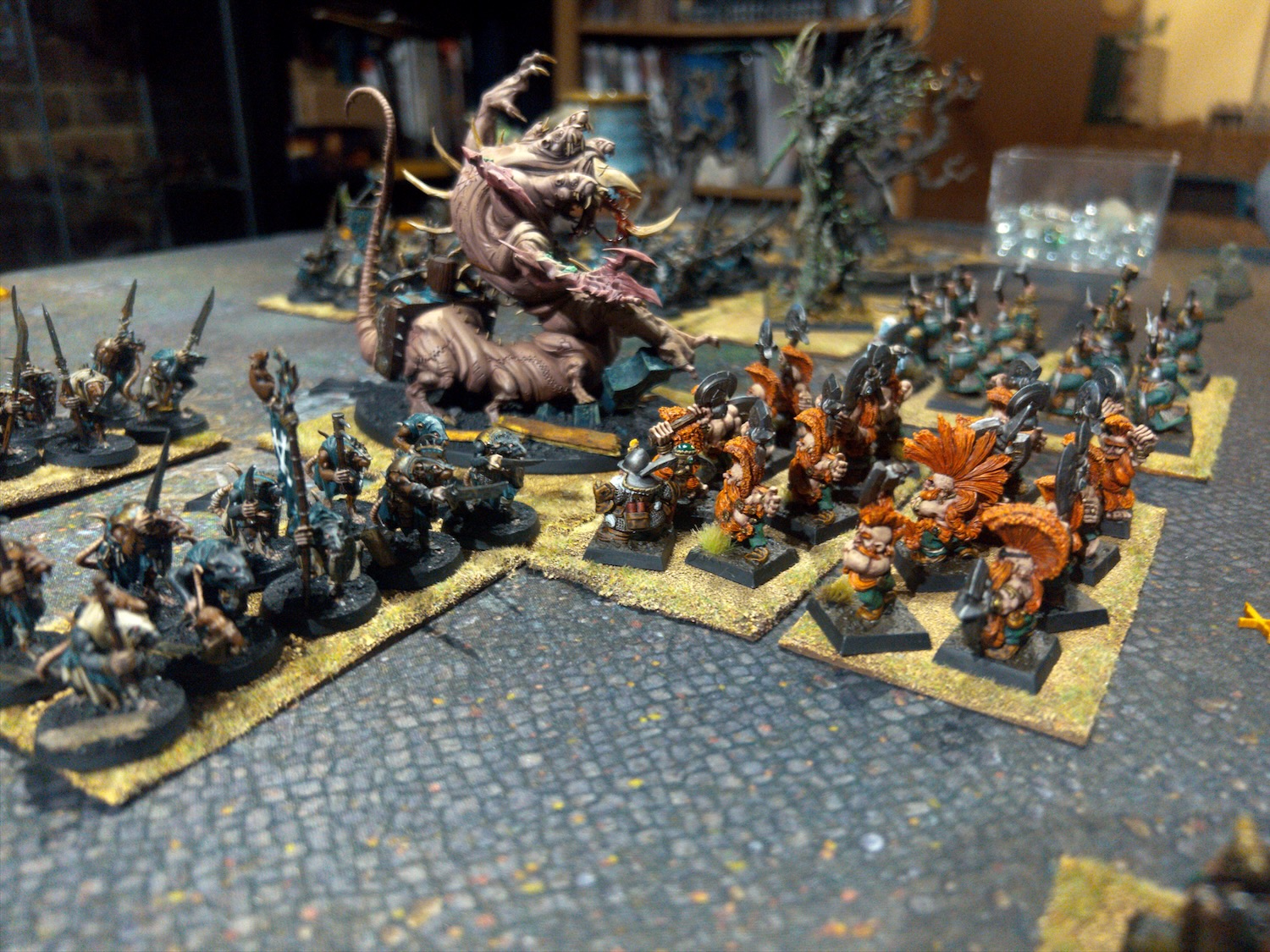
This week I had a few of those friends over and we played a big game involving four armies: a loose alliance of Skaven and Undead against Dwarves and Bretonnians. Two of the players were wargaming novices, one is relatively new, and one is an enfranchised wargamer. I was running the game as a games master. Despite the lack of experience of most of the players, and the relatively large size of the game, we comfortably got through the game in an evening which is a testament to the rules.

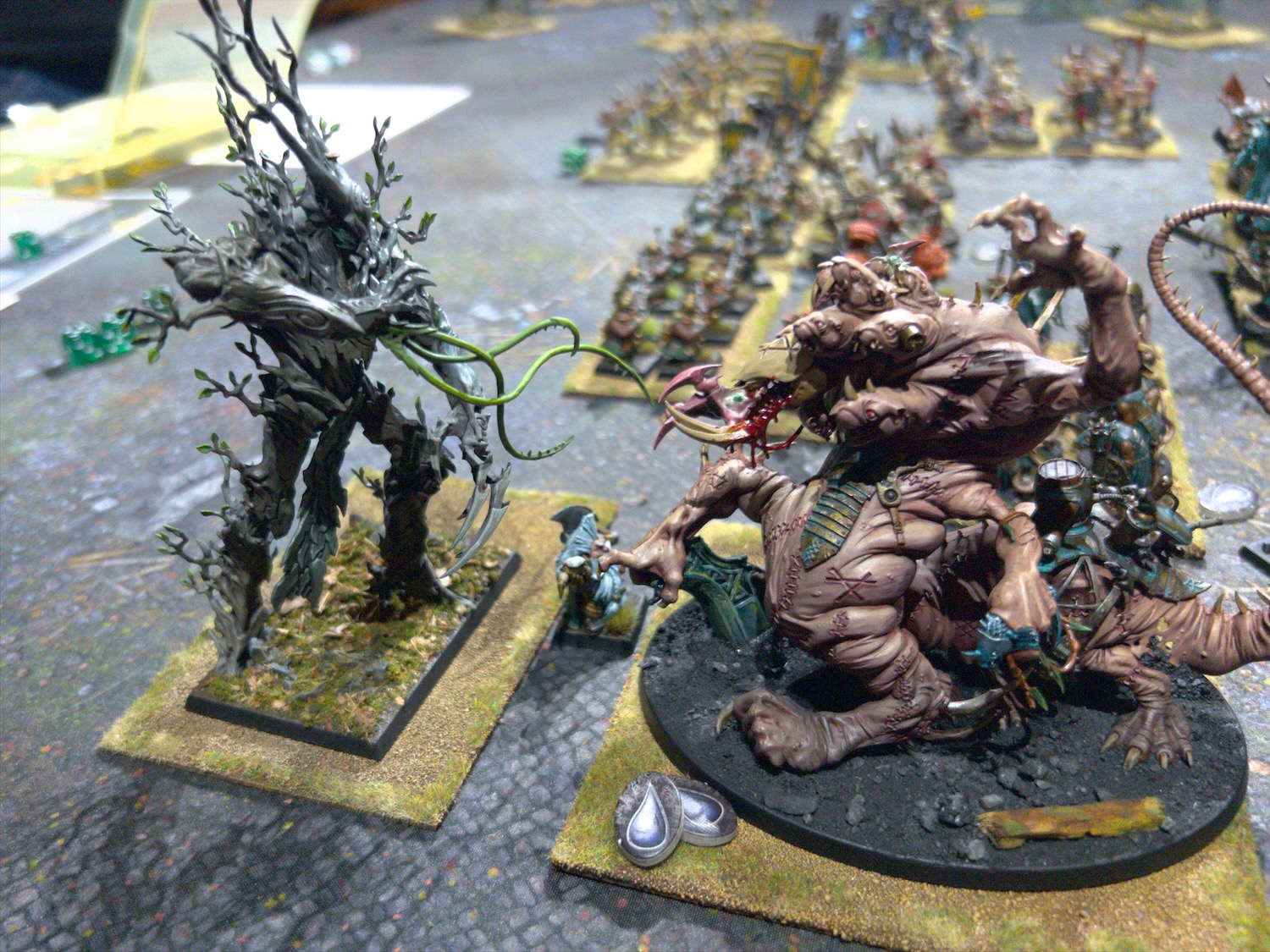
The scenario I set up was as follows: the Skaven and Undead armies needed to hold onto a warpstone meteor while the Dwarf/Bretonnian alliance needed to get them clear of it. To spice things up some, I placed four isolated trees on the board (i.e. not on the forest bases), and after turn one revealed them to actually be treemen who were generally opposed to the idea of big battles being fought in their forests and went after whatever unit was closest. Despite this extra chaos the game was extremely close and ended with both sides within a single reputation point of each other (reputation tracks your force morale, if it’s at or below 0 at the end of the turn, you lose the game). The Skaven/Undead forces won the day, but it really could have gone either way.

Overall, the game was a success I’d say, all the players enjoyed themselves, the game was fun, and it generally felt like playing Warhammer without the big rules overhead. What was missing however was some of that Warhammer atmosphere that is generated by things such as wizards miscasting and Skaven wargear blowing up. Midgard as a low-fantasy/historical wargame does not really cater for this out of the box, but it is easy enough to add some house rules to capture this, and I’ll be doing that going forwards.

After this successful foray into playing Warhammer with Midgard, I’ve been excited about the possibilities. As I said in the opener, Midgard is a very flexible game system, and looks to be able to cater for some of the more esoteric things that can be found in the Warhammer setting and are not catered for in the normal Warhammer rules. With that in mind I’ve been reading through the late 80s/early 90s Realm of Chaos books which are probably about as esoteric as Warhammer gets (I’m sure I’ll be shown something more esoteric in the comments!), and having a great time imagining what that could look like in a game of Midgard.

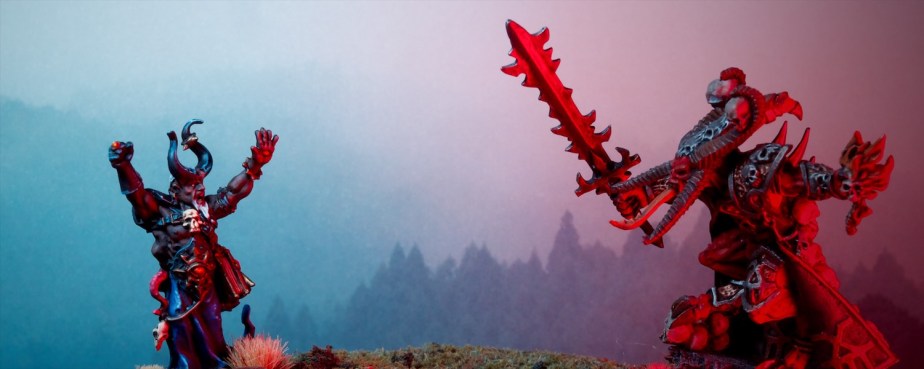
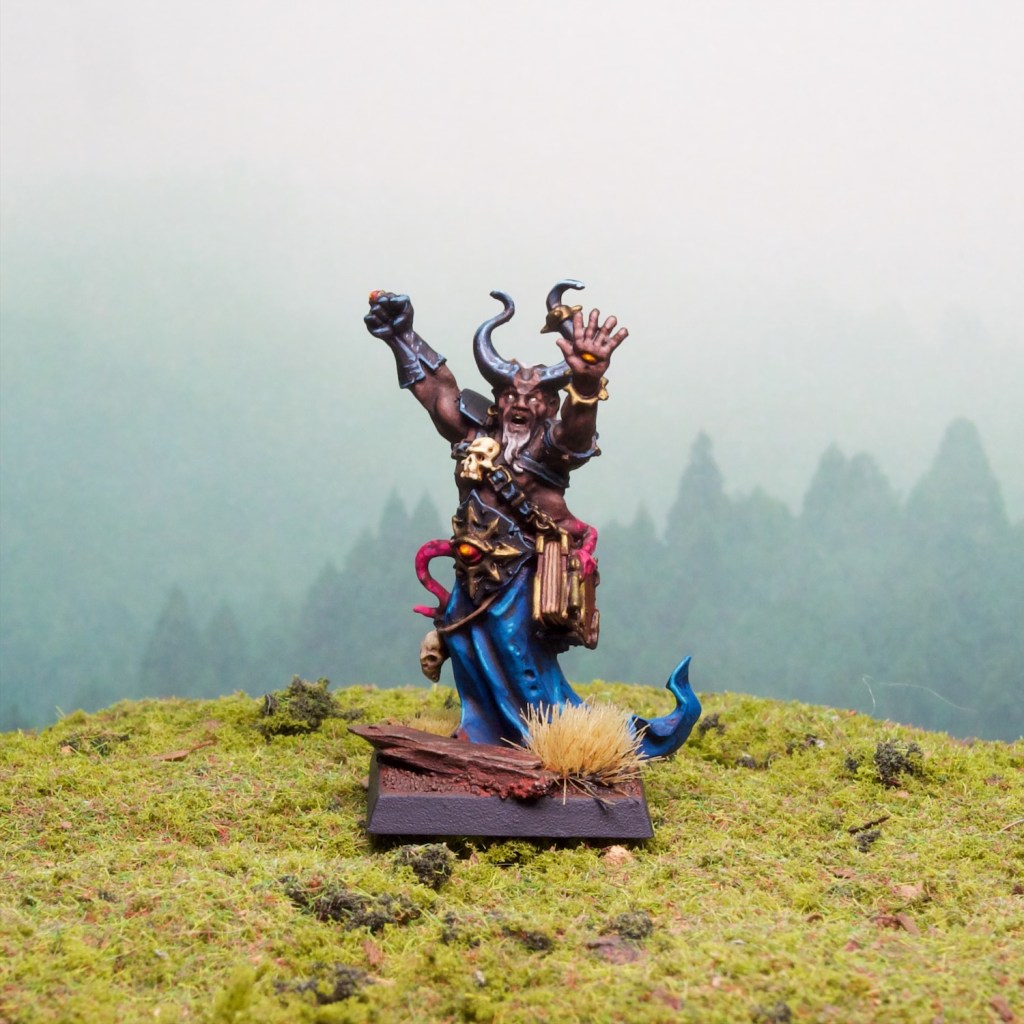
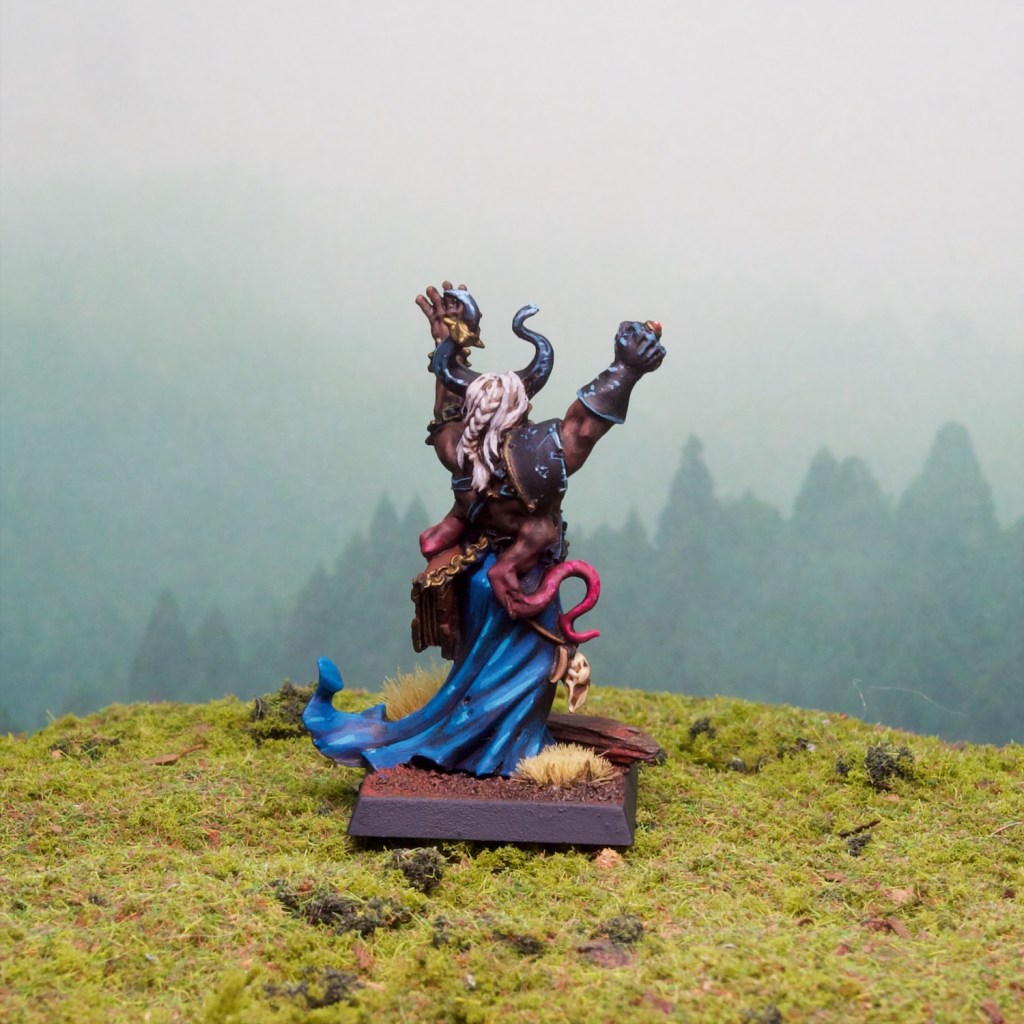
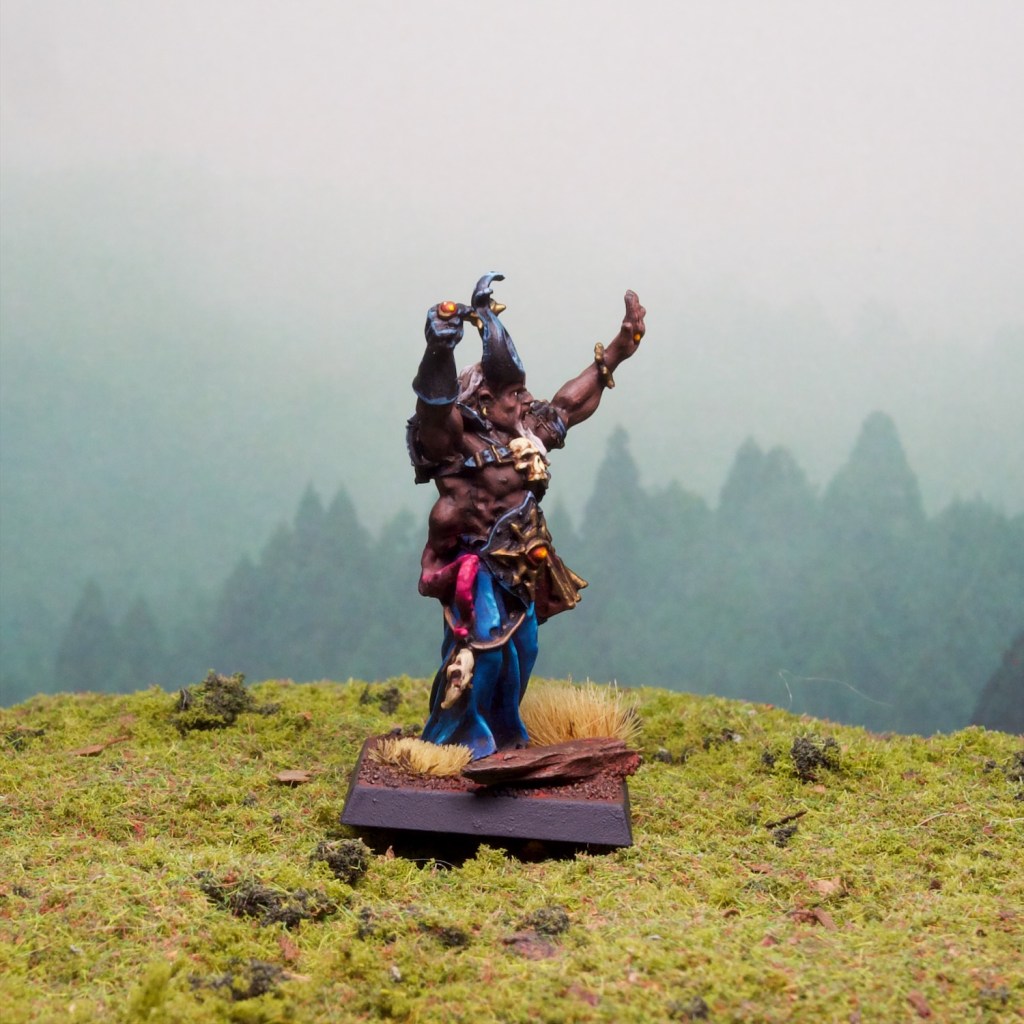
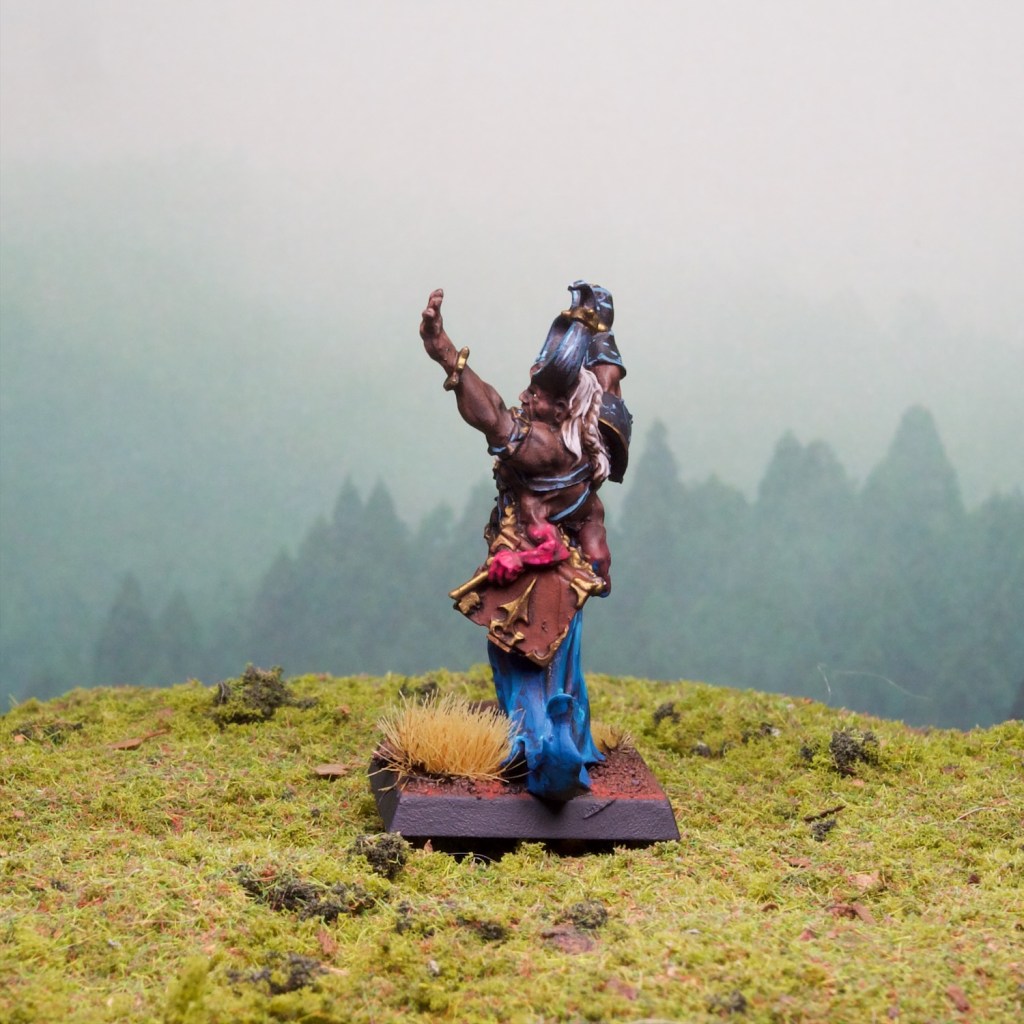
Needless to say some of this energy was redirected towards miniature painting, and in this case towards this Chaos Sorcerer that I found in a case while scrounging for Chaos models for my Midgard/Realm of Chaos plans.

This is a really cool model that was released for Games Day 2010, and that I bought back then. It’s therefore been undercoated in a case for 15 years, and I was well past time I got some paint on him!

I had some fun with the skin (especially the parts with the extra limbs!). I’ve been trying to work on painting darker skin tones and I’d picked up some of the Duncan Rhodes/Two Thin Coats paints made for this purpose (Druid Flesh and Bard Skin). I really like how they worked, although I did feel they needed a touch of extra warmth so I glazed some Citadel Contrast Wyldwood over the top which did the trick.

The model has a lot of nice little details on it which were great fun to paint, the small hand holding the key to the book being my favourite.

I’m sure we’ll see this Sorcerer lead a Midgard contingent at some stage!

Making Bases for Midgard Heroic Battles

I’ve been really enjoying Midgard Heroic Battles as you might have been able to tell from my last few posts. While I’ve been working on my Epic scale Punic War armies specifically for the game, I’ve really enjoyed the opportunity it has given me to break out some older models I’ve had painted for a long time that have not hit the gaming table in almost just as long. So far these models have mostly been Lord of the Rings/Middle Earth models, as they fit nicely in the War of the Ring movement trays that work quite well for Midgard. I’ve been wanting to use the rules to play with Warhammer models and historical models however, and those do not (generally) work with the War of the Ring trays.

The opportunity to remedy this problem came in an unusual form, when a large frame containing a cool fantasy map came off the wall and smashed itself on the ground. The frame itself was wrecked, and so was the glass, but the MDF backing on it was mostly OK (the map also survived unscathed!). This meant I had a mostly nice sheet of 60x90cm 3mm MDF on my hands, and realised it would be a good solution to my Midgard basing issue.

Midgard requires a common frontage for all units, but is pretty flexible on depth for models of greater size. This frontage is recommended to be 12cm for 28mm scale miniatures (you can change this, one of the really cool things that makes the game scale agnostic – for example my Punic Wars models are on 8cm bases), and the default depth is half the frontage. Most infantry units should fit on 12x6cm bases, while units with larger footprints should increase the depth (e.g. calvalry might be on 12x10cm, large monsters on 12x12cm etc.).

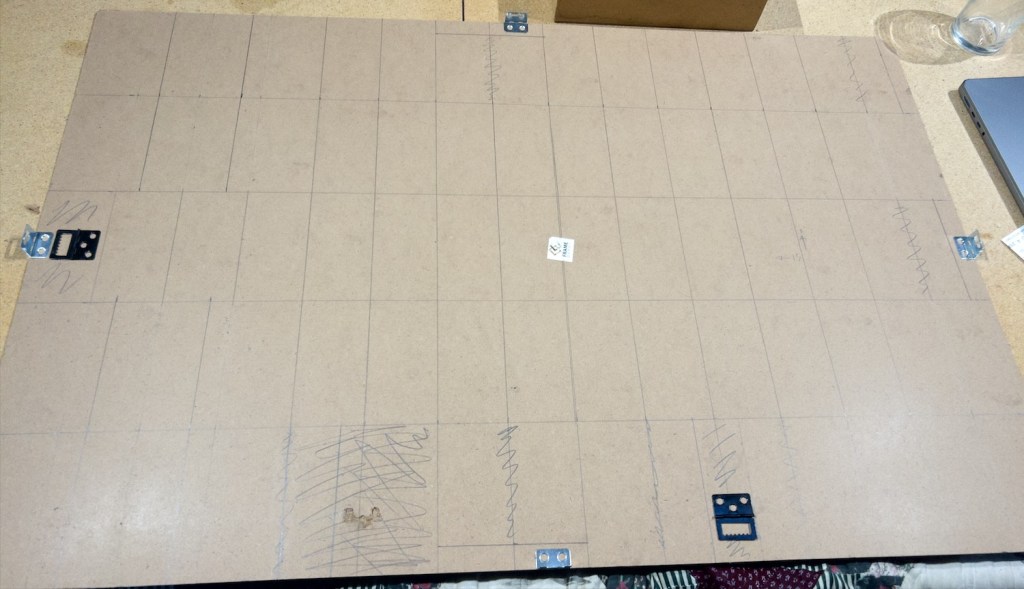
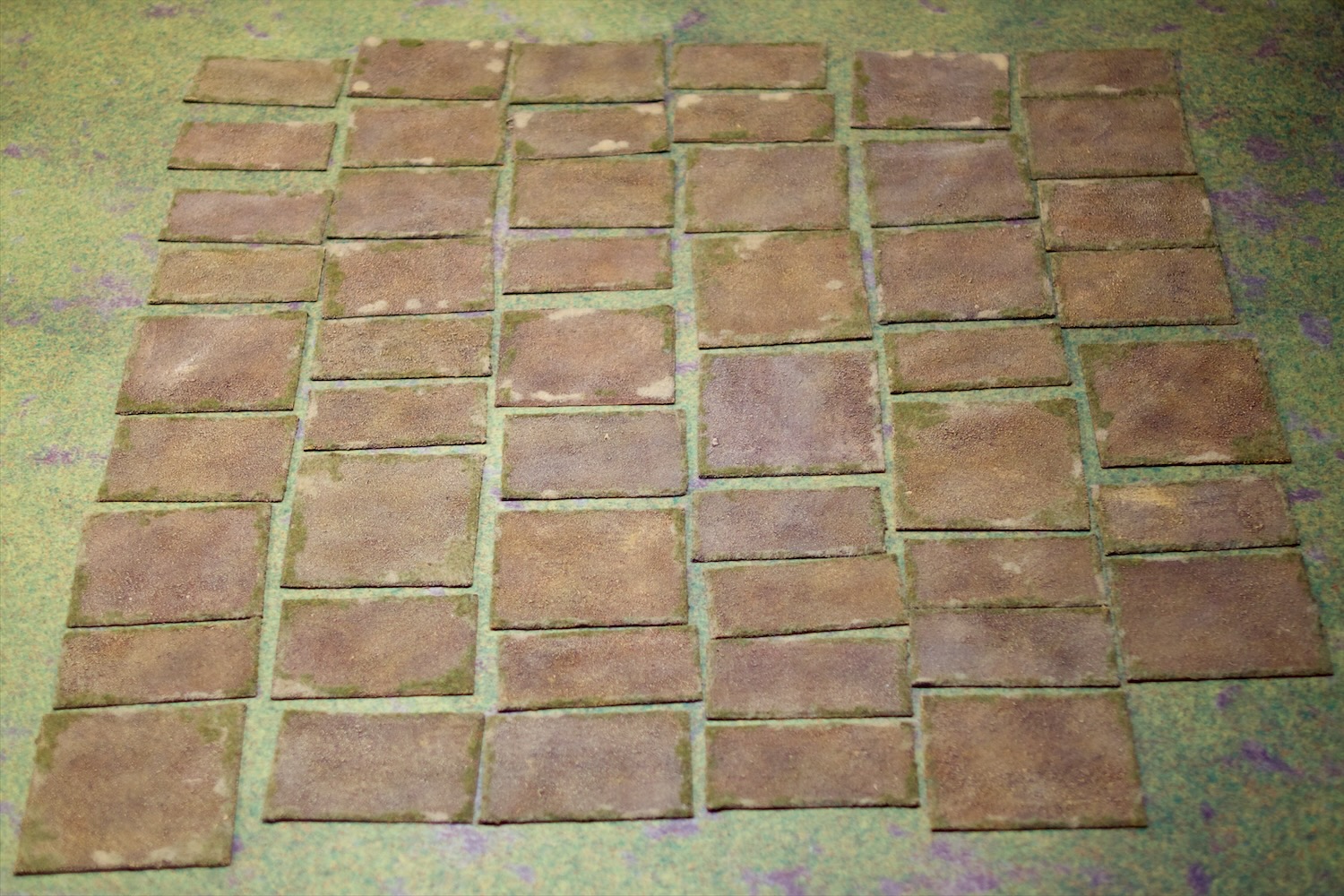
The good news for me is that 60 is nicely divisible by 12 and 90 by six, so I was able to plot a 12x6cm grid on my frame backing. I of course wasn’t able to fully utilise the board, as the hardware is anchored there (not that strongly clearly, you can see bottom left the spot where the other loop broke off leading to my frame mishap in the first place!). I used the marked bases with hardware on them to extend the 6cm depth of some bases to 10cm. In other areas you can see where I turned four 12×6 bases into three 12×8, and where I combined 2 12×6 bases into one 12×12 base. This gave me a nice spread off sizes, and more bases (I hope) than I could ever use!

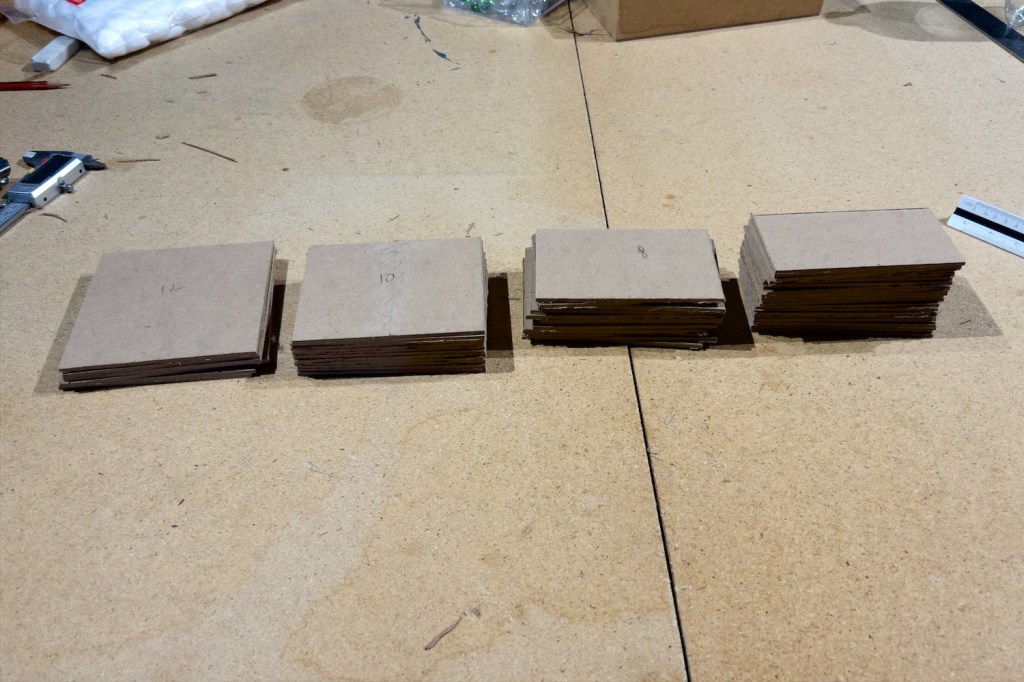
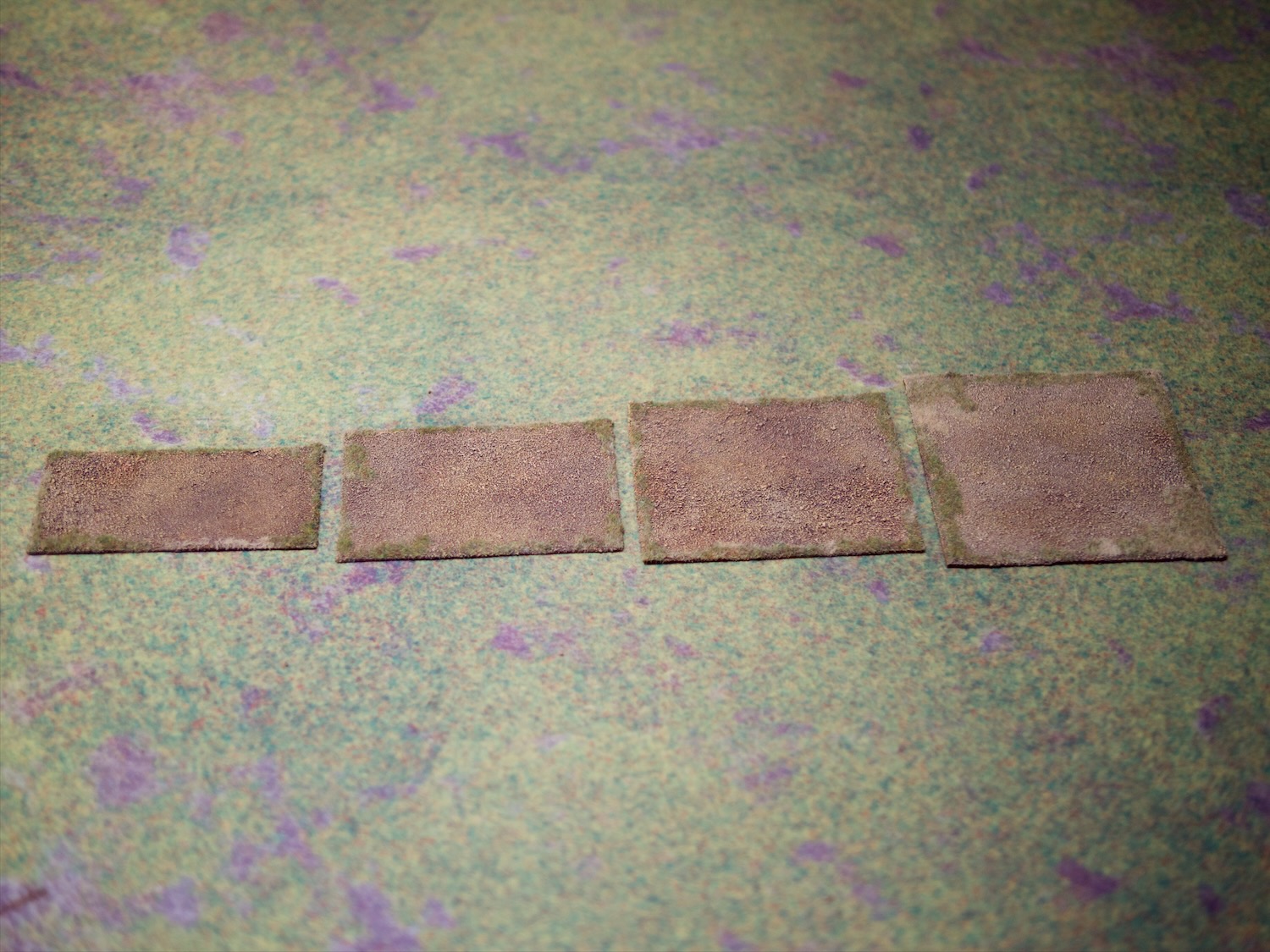
I usually use a jigsaw for MDF, but these needed to be pretty straight cuts and I didn’t think I could manage them freehand with the jigsaw. I went back and forth considering a few other methods for cutting these, but I ended up settling on using a long metal ruler and a box cutter. I read online that you can cut through 3mm MDF most of the way with the cutter, then snap the board along the cut, much like you would with plasticard. That worked pretty well, giving mostly clean edges apart from the snapped section. That was easy enough to trim away though so in general I think this is a pretty good method. Note that MDF dust is nasty stuff so wear a mask whenever cutting or sanding it – have a look at Guru Pig’s thoughtful comment below for more detail. Left-to-right above you can see the stacks of 12-10-8-6cm deep bases.

I glued sand on the bases and painted them with a series of dry brushes of successively lighter brown tones (raw umber, yellow ochre, yellow ochre with a touch of white), followed by some light flocking with green and dry static grass around the rims where model bases would most likely not sit. Painting that many was a bit tedious I have to say, but the results are hopefully worth it! Let’s take a look at them in action.

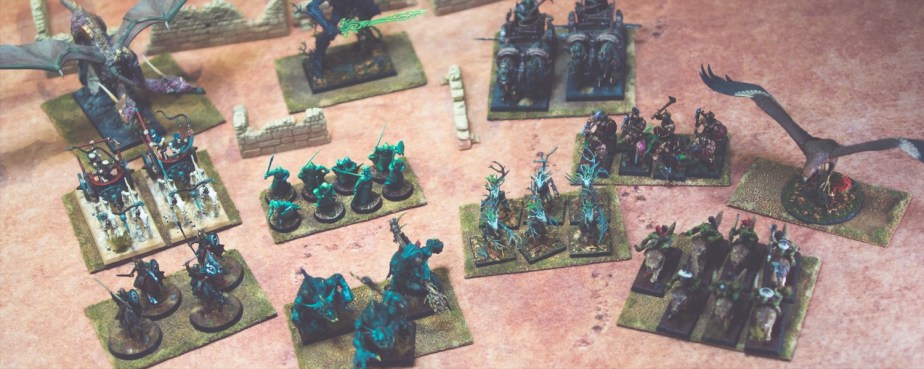
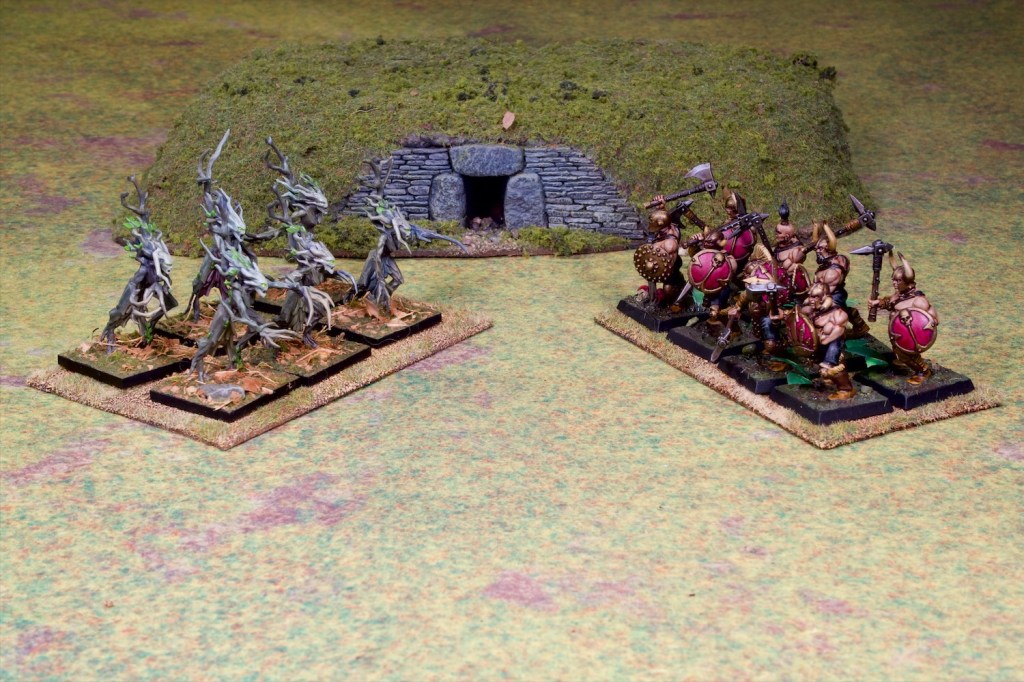
In the photo above we have on the left the 12x8cm base – good for larger infantry such as these dryads, on the right the 12x6cm regular infantry tray, which comfortably fits eight 25mm square based infantry.

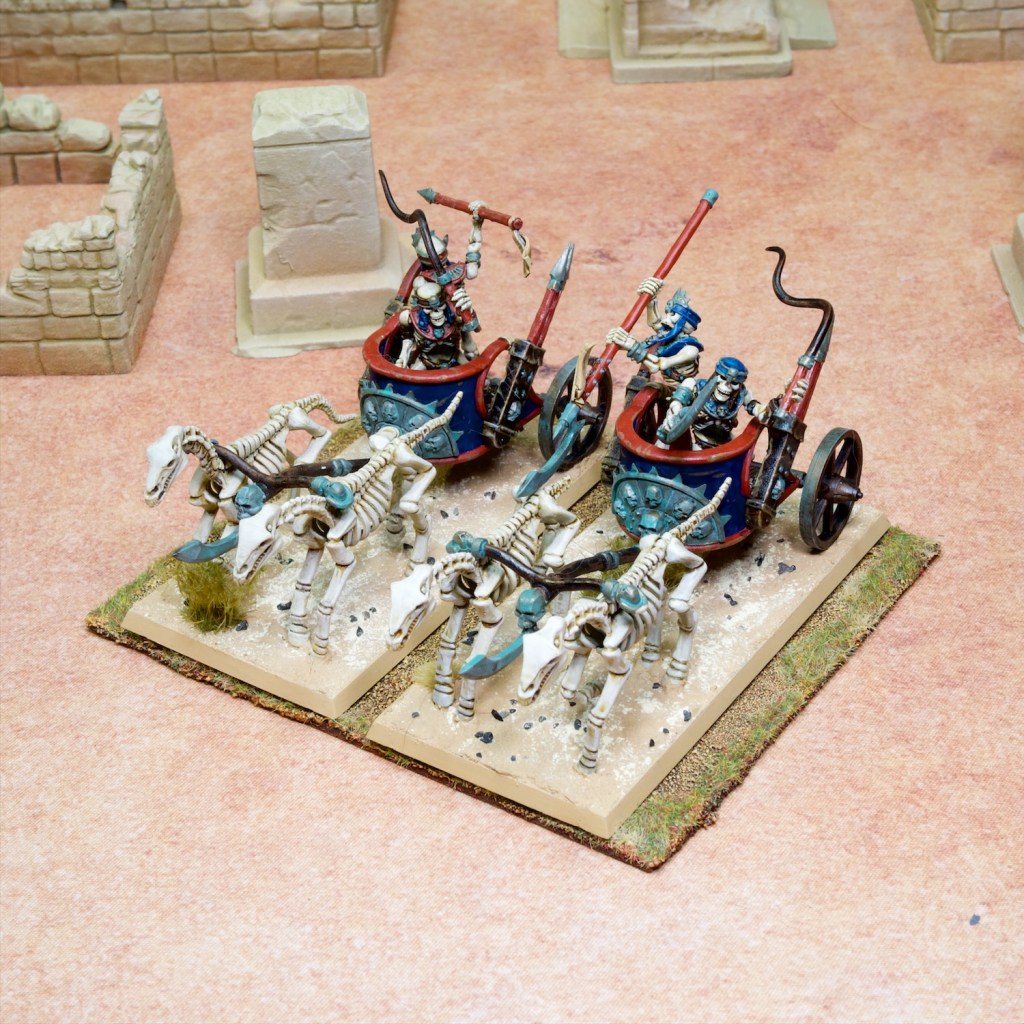
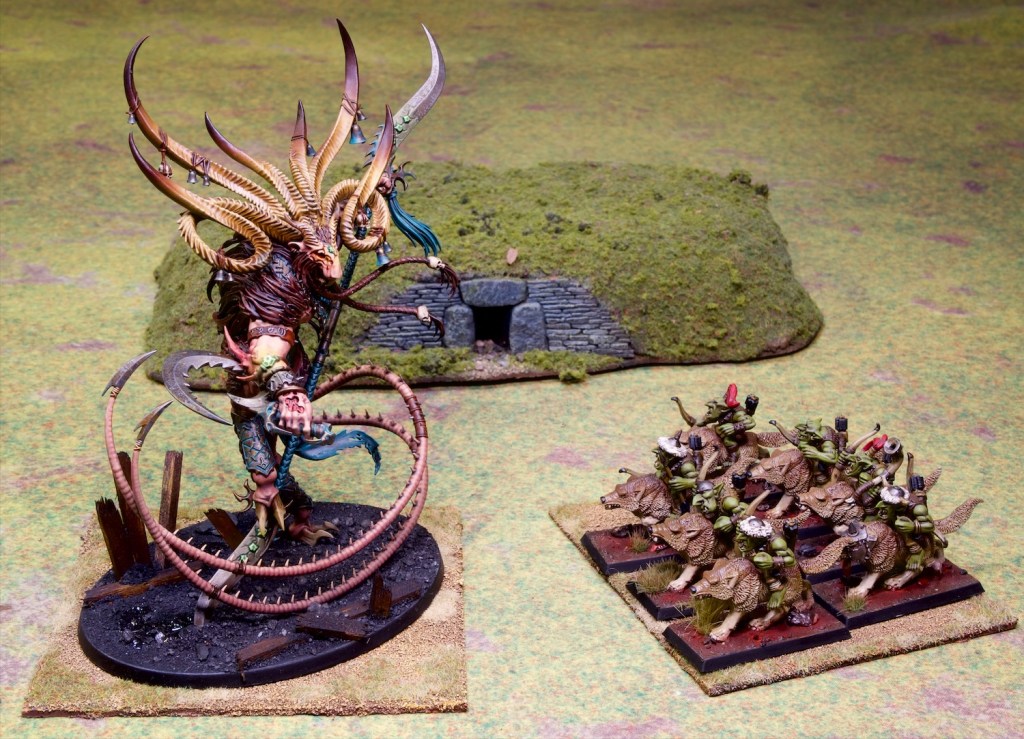
Left is the 12x12cm tray, big enough to fit this Verminlord, and right is the 12x10cm tray, good for cavalry models.

I painted and flocked the trays so they wouldn’t look too out of place on either of the mats I use for gaming the most, i.e. the green field and the desert you see in the photo above.

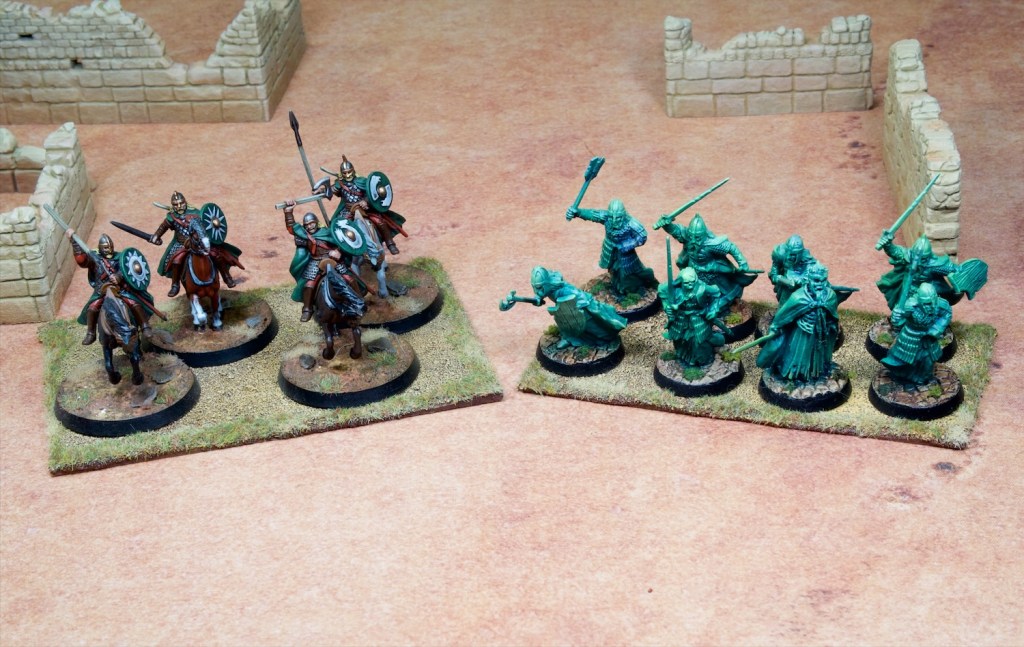
The Lord of the Rings miniatures also work fine on these, the cavalry bases with four models look better than the two you get on the War of the Rings bases.

Overall, these bases are pretty plain, and I think for armies that I build specifically for Midgard I’d like to use the opportunity to make proper scenic bases. These however have the advantage of being very flexible and letting me field a lot of existing armies in fun games of Midgard. I’m very much looking forward to that.

Carthaginian Infantry

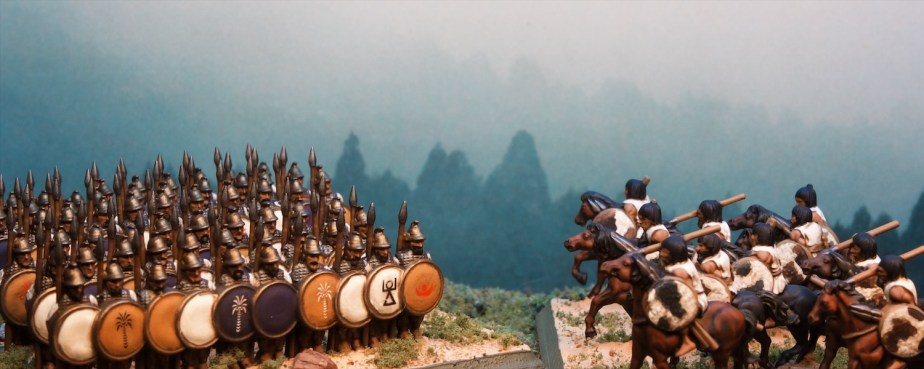
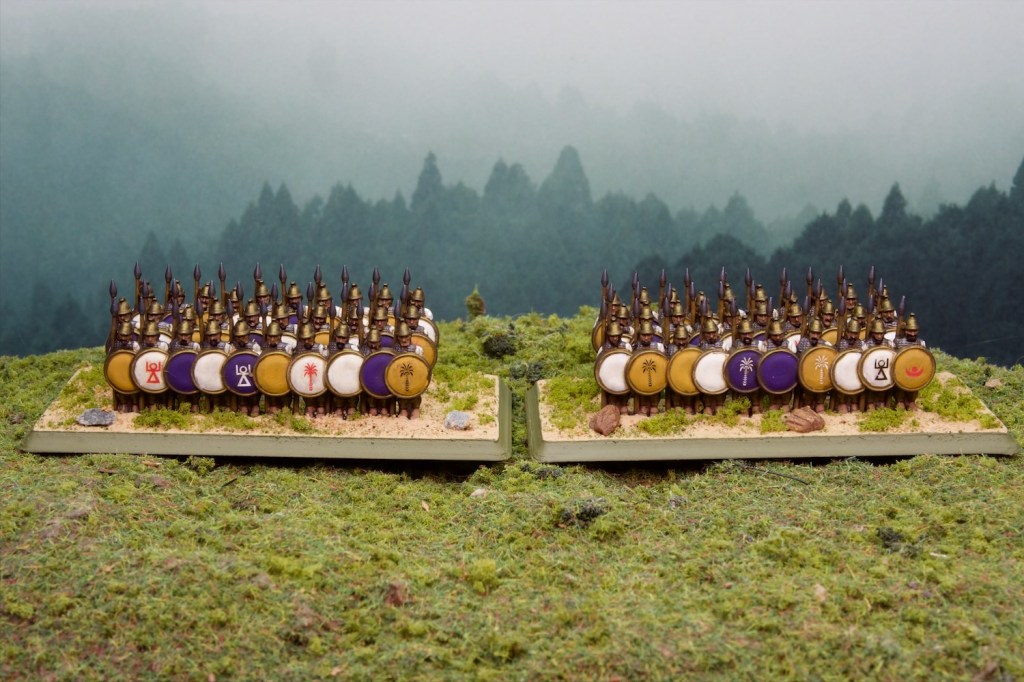
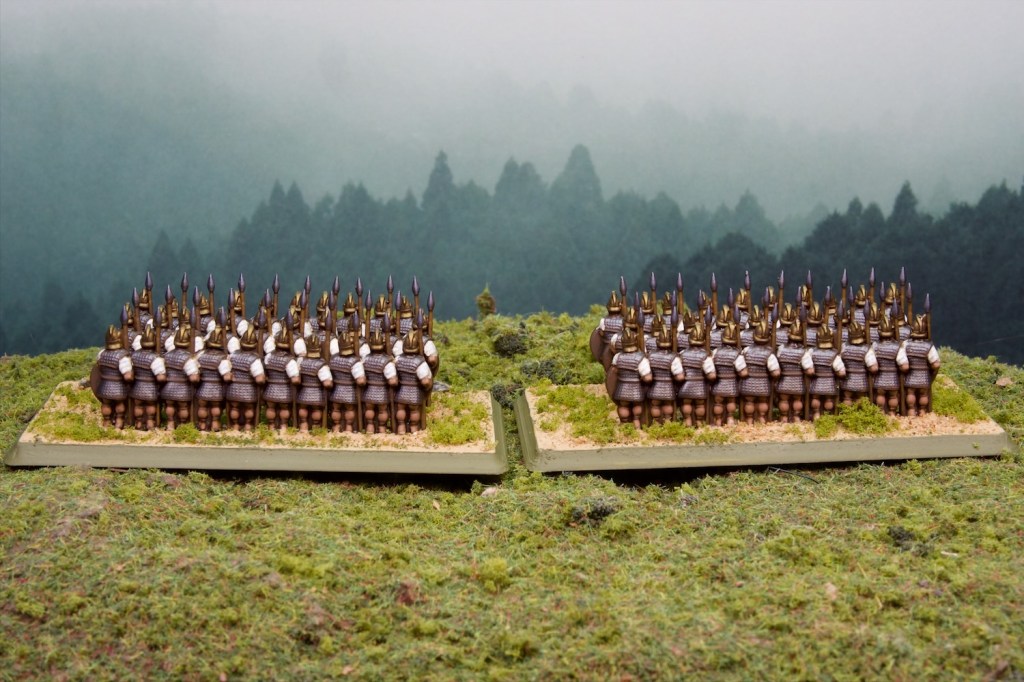
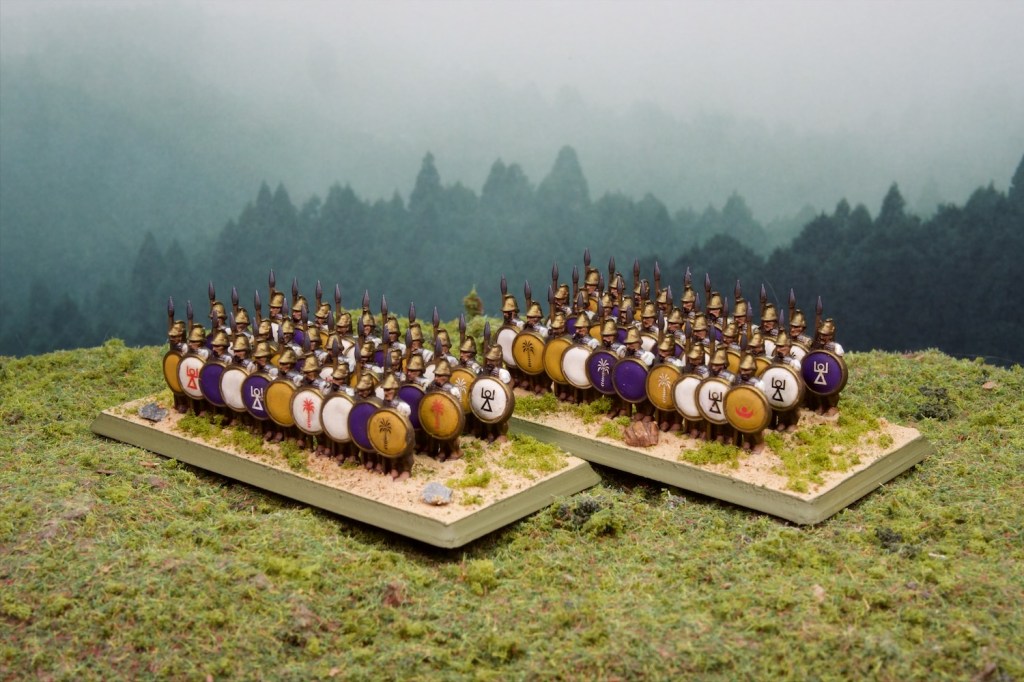
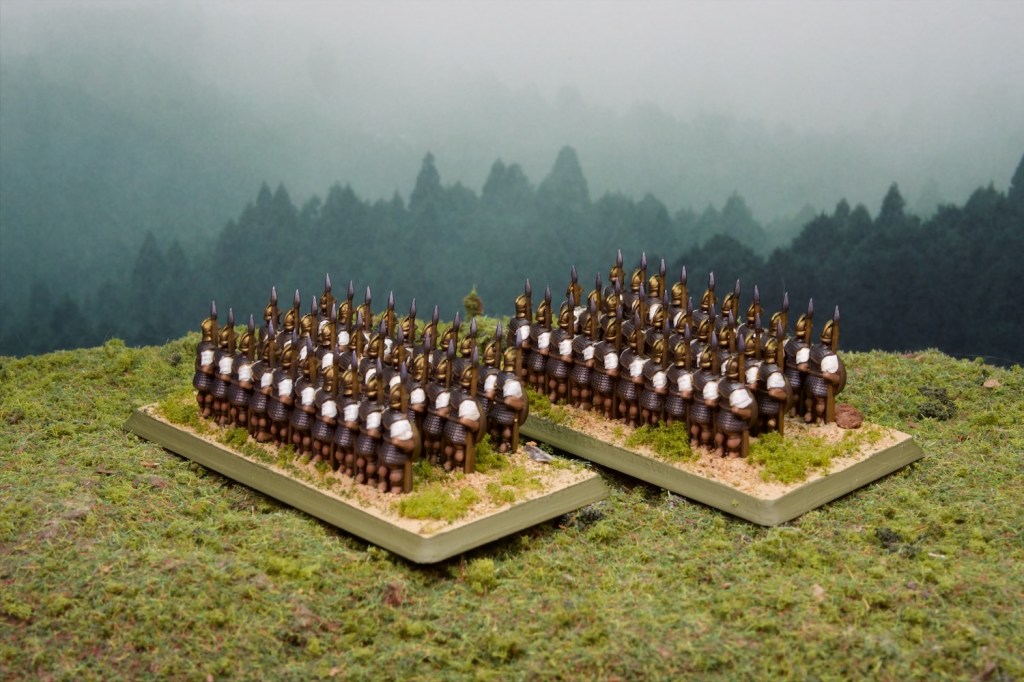
The Epic scale painting continues, this time with my first blocks of ranked infantry: Carthaginian infantry.

As with all my models for this project, these are Warlord’s Epic Scale Punic Wars range for their Hail Caesar game. As I mentioned in the last few posts however I’m not basing these on Warlord’s bases, which are 60x20mm but on my own 3D printed bases which are 80x40mm and are more suited to the Midgard game.

As a result of the larger bases I decided to stick down 3 strips per base rather than the two that fit on the Warlord bases. I quite like the look of the 3 strips together, and therefore am happy with the decision. I also quite like the look of the separation I get between blocks even when the bases are touching as the bases are wider than the strips. This will be accentuated for the Romans when I get to them as they are modelled to fit 3 ranks on the Warlord bases (so roughly the same footprint of 2 strips of the more normally ranked infantry).

Painting-wise there were a few things I had to do differently to the skirmishing troops. First of all, these are not single models, but a full strip of 10 overlapping models, which presents advantages (definitely faster than painting 10 individual models!), and adds some tricky-ness for basing as the basing material is added after the strips are glued down and I had to veeery carefully get basing paste between the strips (a roughly 5mm gap) after gluing them down.

The skin was painted exactly as per the Numidians from the past post, that is with AK Tan Earth. The shields are a mix of AK Ivory, Vallejo Game Heavy Goldbrown and Vallejo Game Heavy Violet. The bronze is Scale75 Necrogold, and the silver Scale75 Black Metal, both my go to colours for those. As for the other models I went for an all over wash of Army Painter Soft Tone followed by a highlight of the basecoat colour.

Overall I really like the ranked look you get from these models, especially with the overlapping shields. These were slightly more tedious to paint than the skirmishers, but again I painted 60 models in the time I painted 20 skirmishers so I suppose I can’t complain.

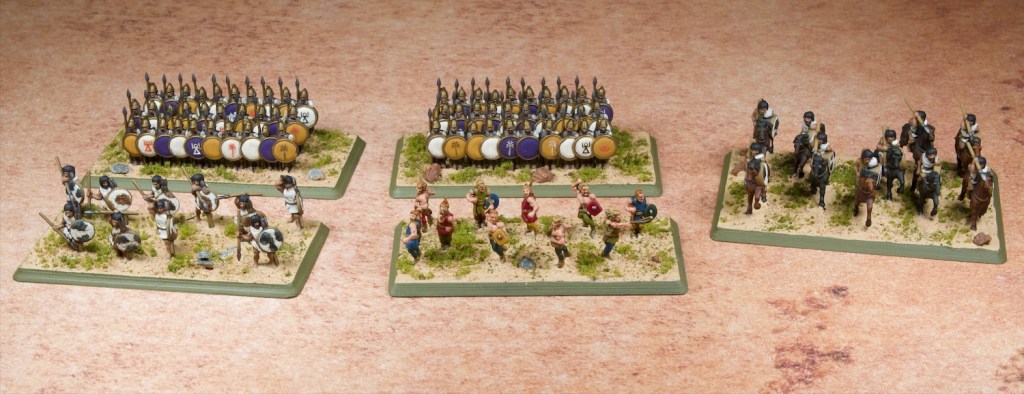
Here they are amongst the other bases I painted so far. I really like the distinction between skirmishers and ranked infantry you get at this scale. I’ve made a small dent in the Carthaginian Division set now, with roughly a third of the units painted (the rest is mostly a lot of Gauls and Iberians!).

In other news, I just got a notification that today marks five years since my first post which is quite something. I don’t think at the time I had any idea I’d go this long, so thanks a lot to all of you for reading the blog, it does keep me motivated to see comments and views on my posts! Here’s to 5+ more!

Numidian Allies

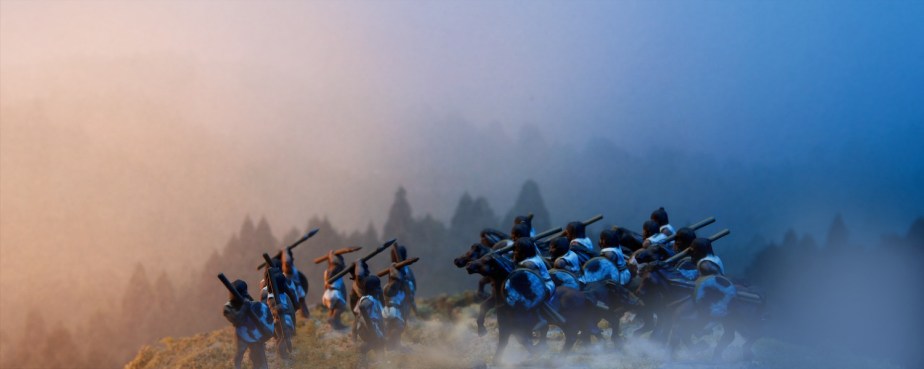
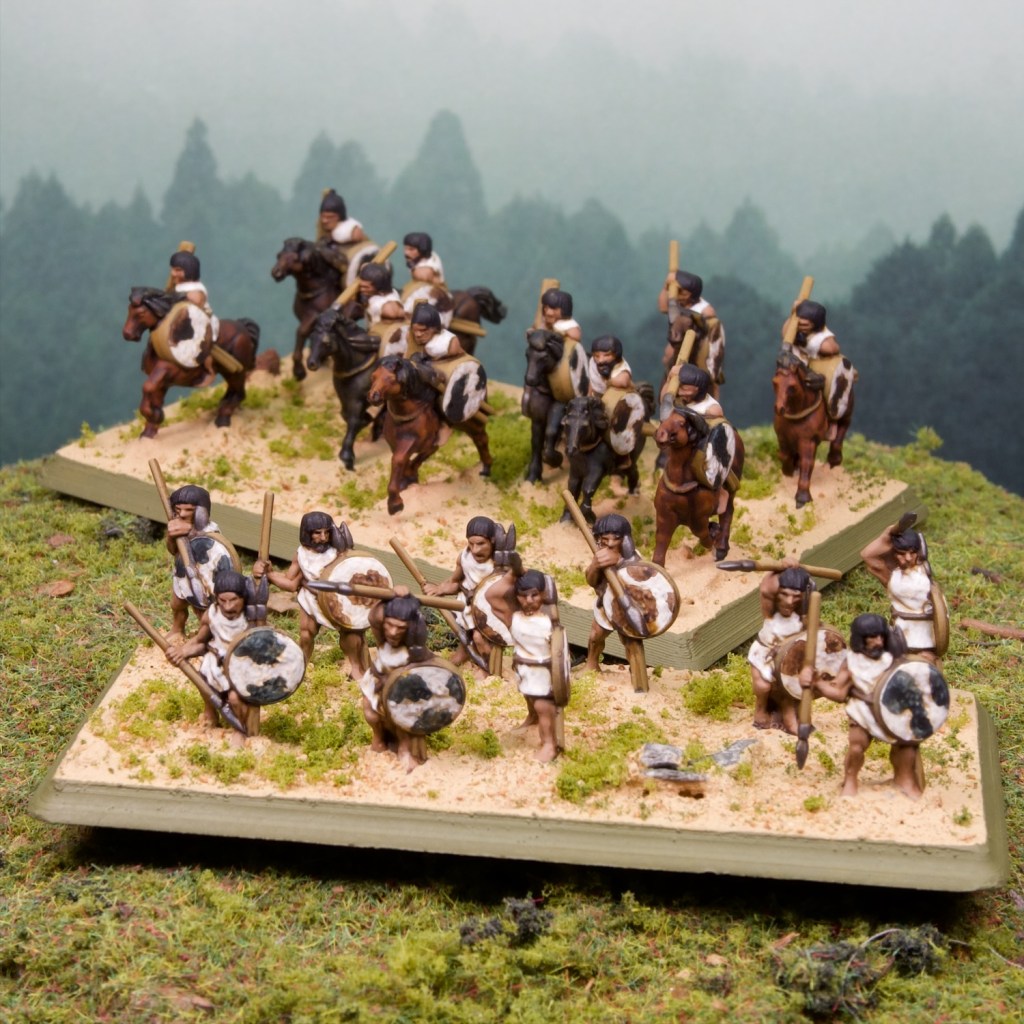
Back with a small update this week; two more bases for my Punic Wars project. As the title indicates these are Numidians, a base of cavalry and a base of javelin skirmishers.

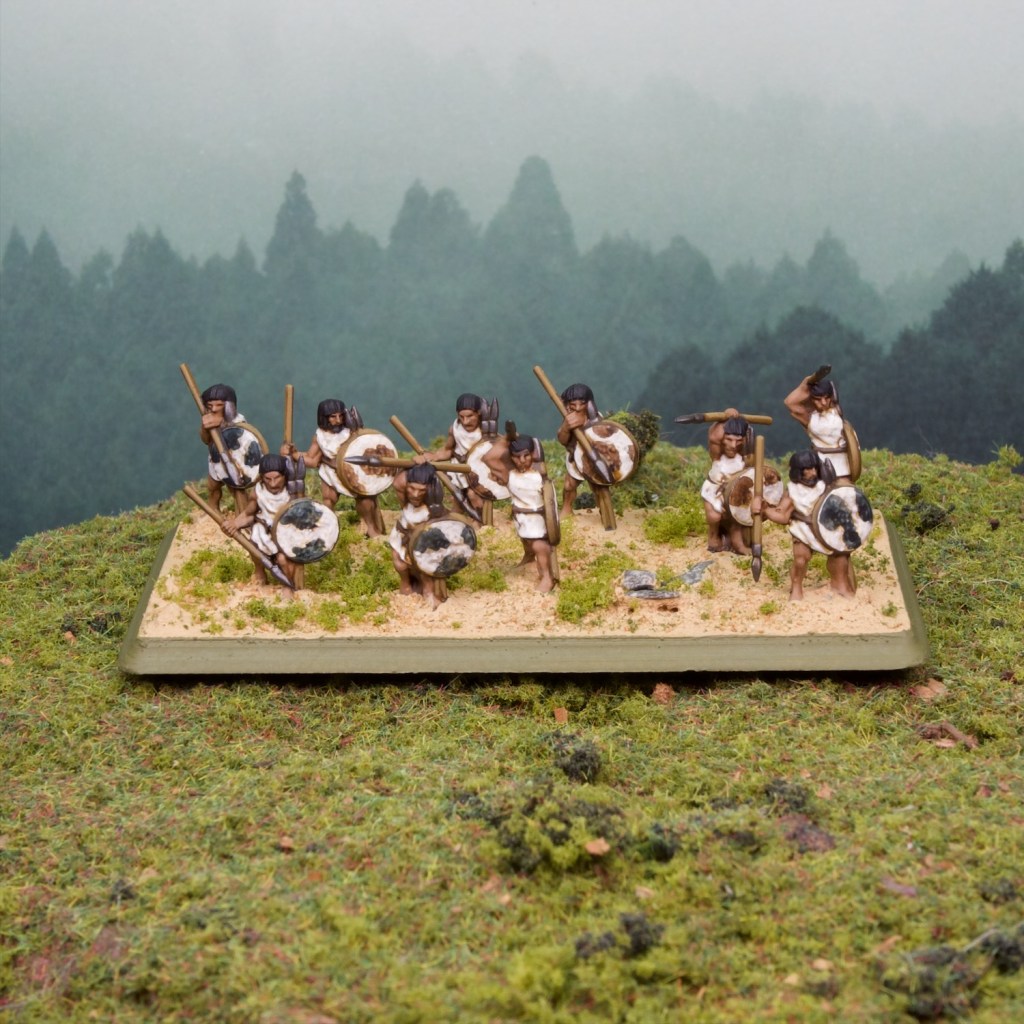
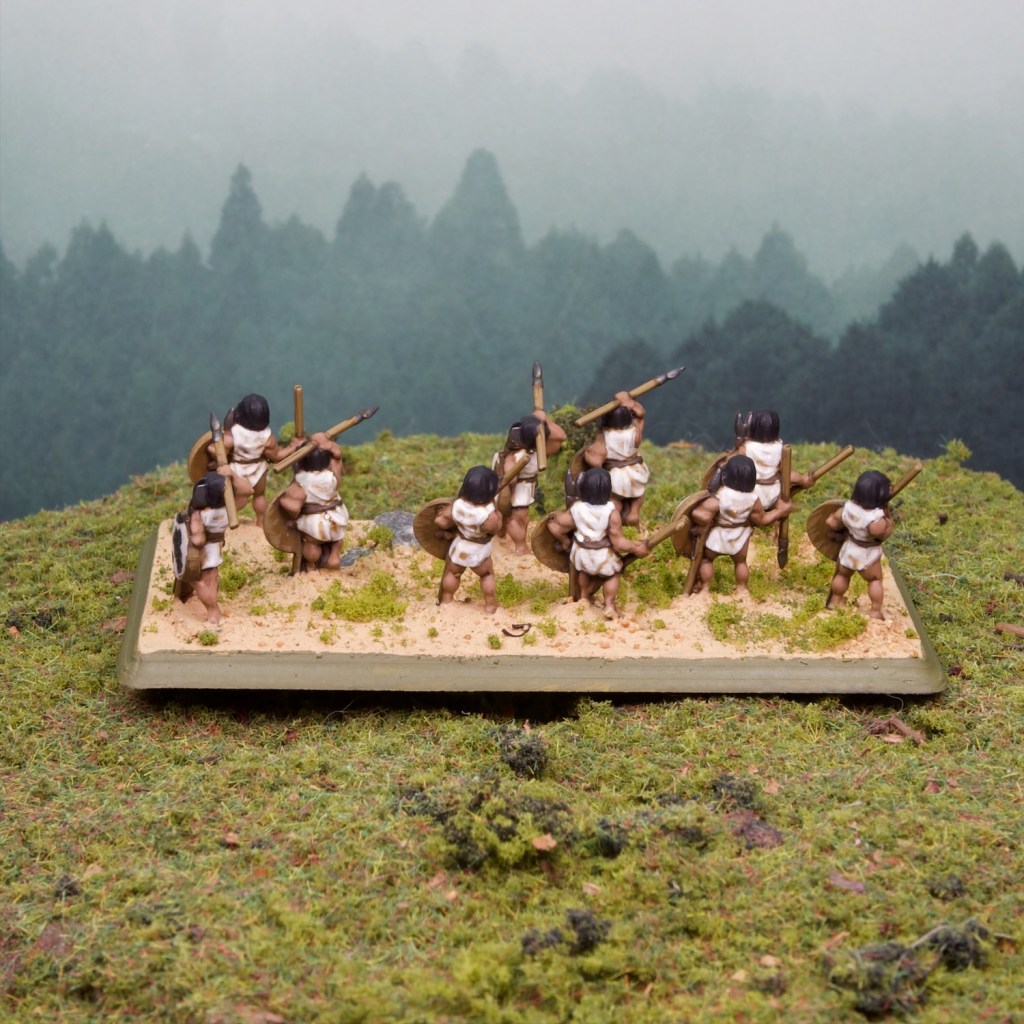
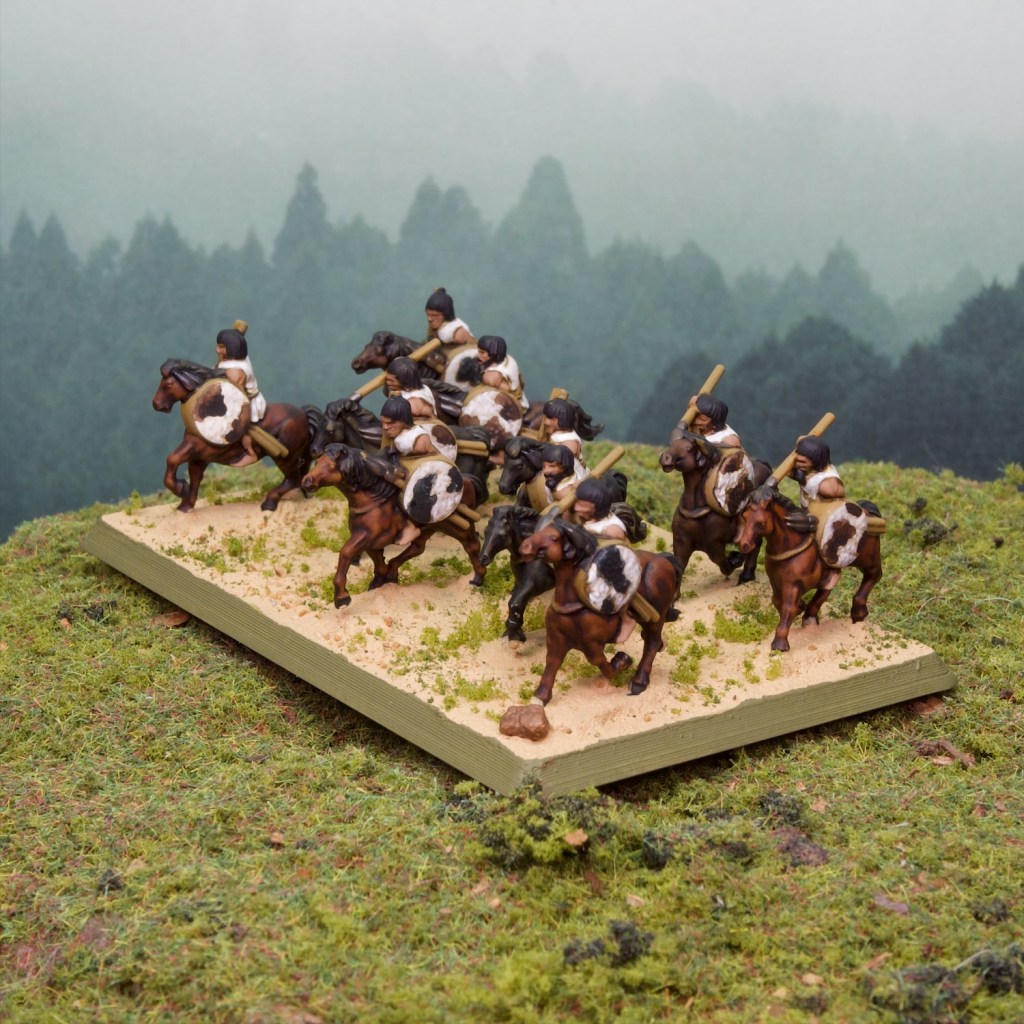
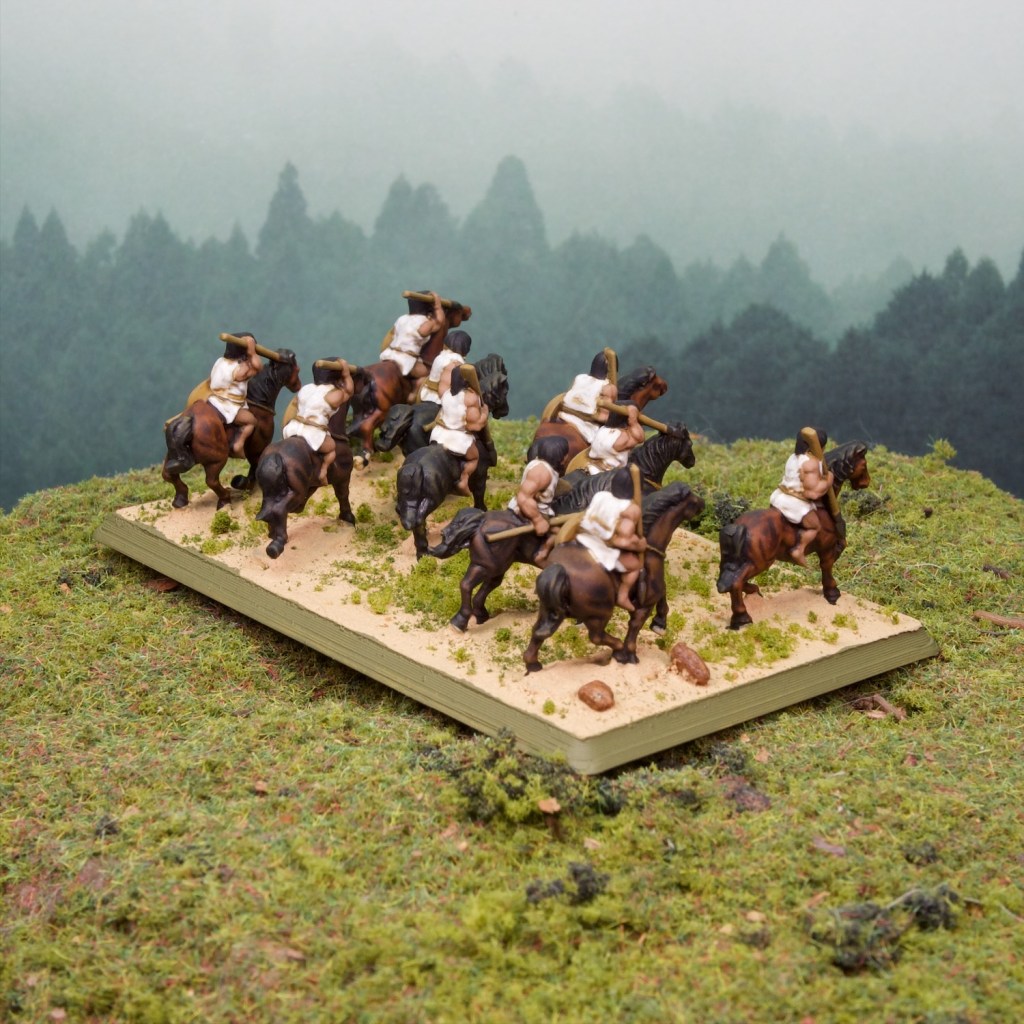
Much like the slingers last week, these were fun and fast to paint. I went for the classic cowhide shields on these, although I have no idea how historical it may be. I’ve always loved the look!

Painting-wise, the strategy was much as it was for the first unit last week (i.e. basecoat, wash, highlight with basecoat), but with some different colours. The white cloth and white fur is AK Ivory, the skin is AK Tan Earth, the wooden areas (spears/shields) are basecoated in Vallejo English Uniform, and highlighted with 50/50 English Uniform and Vallejo German Camo Beige WW2.

The horses and the spots on the shield used contrast paints. As I undercoated my models with a leather brown, I put the contrasts directly on that rather than the more usually recommended white/cream colour. I quite like the look of contrast paints over browns, I think they look more natural than over whites. The reddish-brown horses are done using Gore-Grunta Fur Contrast, the brown horses using Wildwood Contrast and the black horses as well as the manes/tails of all the others using Black Templar Contrast. I think that gives a pretty good result at this scale, and I’ll happily do the rest of the horses I have to paint for this project (which is quite a few horses) this way.

Both of these sets of models are from the Carthaginian Division set of the Hail Caesar Epic Battles range. I have two more Numidian bases, this time archers from the Allied Division set so these aren’t the last Numidians you’ll see for this project.

So far I’ve only done loosely ordered troops so I might try my hand at some close order troops next. We’ll see where inspiration strikes!

Back to the Punic Wars!

My historical wargaming kick is still going strong (I’ll get back to you Fantasy gaming I promise!), and I’ve put some birthday vouchers to good use, picking up some models I’ve been eyeing off since they were released last year: Warlord Games’ Punic War “epic scale” range.

I you’ve been keeping an eye on this blog for a while you might remember my foray into Republican Romans back in 2021. This was in 28mm scale, which is home for me scale wise (well that and the associated 25, and 32mm scales), but while I enjoyed painting the models I was always troubled by the fact that to get some of the formations in the historical record (e.g. the famed Triplex Acies for the romans, with its triple row of supporting infantry blocks) I would need a lot of space on the game board (not to mention crazy amounts of miniatures!). That took the wind out of my sails for this project and the models have sat unprogressed for a long time. When I saw the Warlord announcement last year I knew this was the way forward, a smaller scale letting me have the number of units to play games with some semblance of the historical formations. This doesn’t solve my unused miniatures problem for my 28mm romans however, and the plan there is to repurpose them for smaller scale games in the Caesarean invasion of Gaul which is something else I’d like to wargame.

Another tricky aspect of the era was finding rules that captured the kind of gaming that I’d like to do for the period. That was resolved when I discovered Midgard last month, the game is fun and simple to play and has some great rules to reward the in depth formations the Roman’s adopted. In fact the author has published some army lists for the Punic wars specifically, making using Midgard for the period very easy.

Armed with some rules and a model range I plunged in and picked up the Roman/Carthaginian/Allied division boxes (and most importantly the elephant set) from Warlord, which gave me more than enough models to play a large game of Midgard.

The models come with bases for Hail Caesar, which aren’t quite right for Midgard where units are more standalone. So I decided to make my own bases, larger than the Hail Caesar bases, and put more models on each. The bases are of an 8cm frontage, 4cm deep for infantry and 5.5cm deep for cavalry. I modelled these and 3d printed them. If you’re interested in the files I put them up on Cults3D as a free download.

That’s enough context, onto the models! The models are Warlord’s epic scale which seems to be around 14mm so half size from what I’m used to. The detail is really quite good given the size and the models took washes really well which is very helpful. I painted this base of gallic slingers as a test unit to try out a few things: what washes work well at the scale, and what basing scheme I was going to go with. Wash wise, I was worried that my usual go-to Agrax Earthade might be a bit much (too dark/strong) for the scale so I looked for something lighter. I settled on Army Painter’s Soft Tone wash, which I think worked really nicely.

The process I used is as follows: I airbrushed some leather brown all over the models to get a nice brown base to work with, which would work for any leather items (belts, shoes, slings), and let me focus on painting cloth, shields and skin. I then basecoated these areas in nice bright colours (probably inspired by my reading and re-reading of Asterix comics as a kid!), basecoated the skin in AK Beige Red, and gave the models an all over wash of Soft Tone. Once that was dry I gave the skin areas a second wash of Citadel Reikland Fleshshade (somewhat diluted) to get some red into the skin. I then used the basecoat colours to highlight the models back up. The hair was then painted, basecoating it with an off-white, and using GW contrasts for colour (Aggaroth Dunes for the blonde hair, and Gore Grunta Fur for the reddish hair). Nice and quick!

For the basing I wanted to aim for a generic Mediterranean look, which could work for Summery Italy as well as the North African coast. To that end I used and AK texture paint called Sandy Desert, and while it was wet sprinkled on a couple of Woodland Scenics foams and some old GW sand mix I had lying around. The base rim is Vallejo Russian Uniform WW2. Overall I’m happy with the look, it’s probably a bit too deserty for Italy if I’m being honest, but hopefully close enough that suspending disbelief is easy enough!

A Busy Few Weeks!

As the title suggested, I’ve been busy the last couple of weeks, with some painting and some gaming to discuss in this latest post.

The Gaming!

I have a regular games night with some friends which is usually spent playing role-playing games or board games. The last few of these we had to change the program as a couple of us couldn’t make it, and we decided to get some wargaming in.

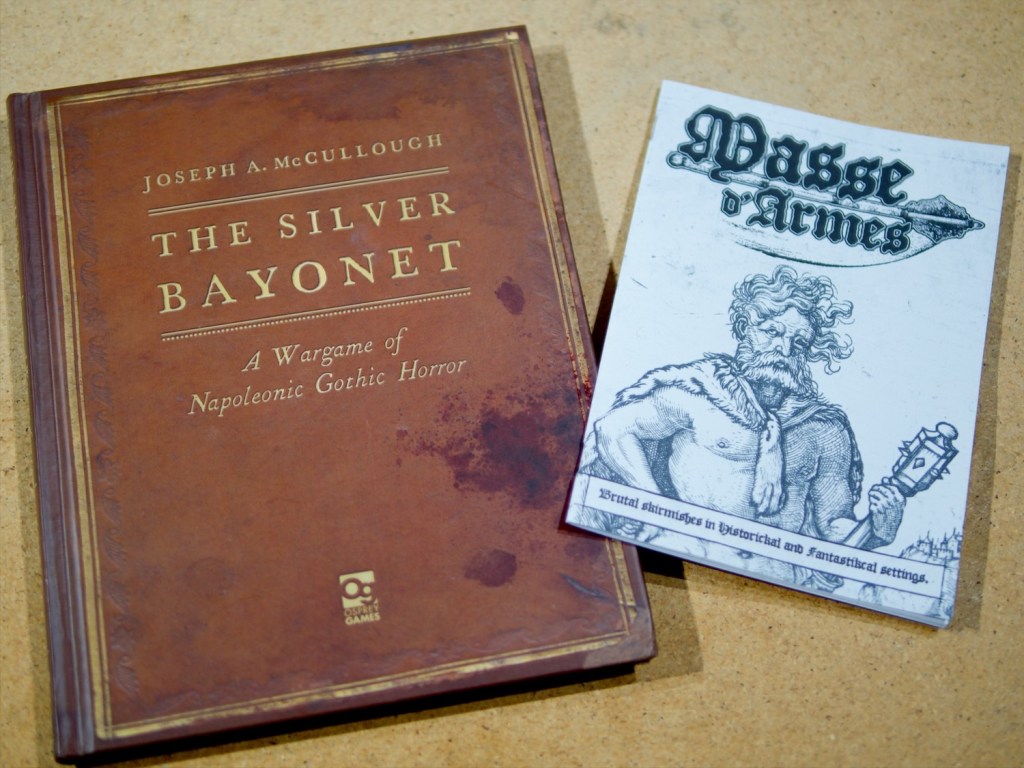
For the first one of these I introduced the group to Silver Bayonet and we played through the fourth solo mission of the main rulebook with my British warband.

The scenario had the unit attempt to leave the wilderness after its encounters there in the past few missions, but finding their way home cut off by some bandits (role played by the French Imperial Guard unit I painted a few years back). I didn’t take very many photos as I was too busy running the game unfortunately, so no battle report for this mission. Playing the game was very last minute so I had to improvise some of the terrain as you can see in the photo above, with the river being represented by some shiny blue cloth, and the bridge is a section of a ruined church I used for WW2 games!

The game went very well, the two players were running the unit together while I was telling them the rules and taking the monster actions. They were much more aggressive than I usually play, but it paid off and they cleared the mission relatively easily. Both of them really enjoyed the game so that’s always a plus!

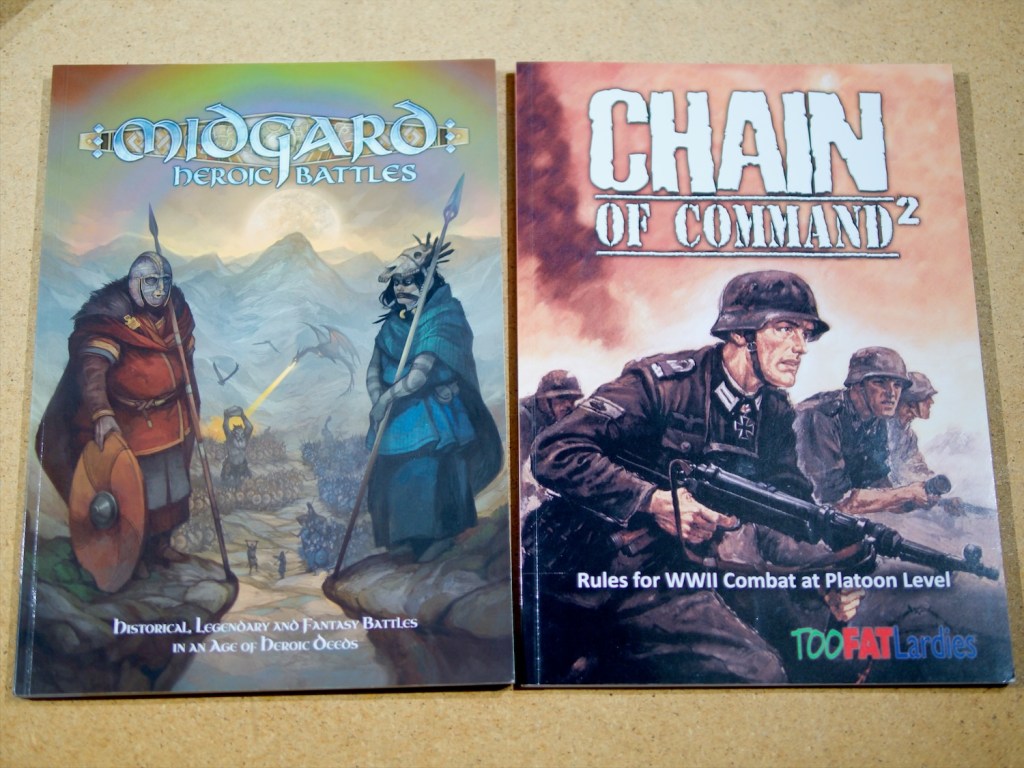
On the second week we decided to try out a new (to us!) ruleset for fantasy/historical battles: Midgard. Midgard is a game by James Morris (check out his blog, it’s very cool https://mogsymakes.net/blog/) which came out last year and covers quite a lot of ground. At its core, it’s a system for covering historical (and fantastical) battles where the heroic actions of army leaders can carry the day. This is suitable for covering periods all the way from antiquity to mid to late middle ages when commanders started running battles from a bit further back than the front lines. Midgard also caters for more mythological/fantastical battles, with rule for monsters and magic thrown in. I’ll be talking a lot more about Midgard in the future as it ticks a lot of boxes for me.

We decided to play the game with some Lord of the Rings armies, and I dusted off two of mine: my Cirith Ungol force, led by Shagrat and Gorbag to rival orc captains, and an amalgamation of Elves led by Legolas and Gildor Inglorion.

If you’re familiar with Games Workshop’s efforts in the Lord of the Rings space, you might recognise the trays they produced for the War of the Ring mass battle version of the game. As Midgard also uses trays they seemed like a great starting point. Midgard however requires all the unit base sizes to have the same frontage so I 3D designed and printed some adapters for the cavalry trays (which are narrower than the infantry trays) and for the monsters (who never had trays in the first place). As I did these adapters the day of the game I needed to go fast and decided to make them simple and to include a little joke – the elven script reads “One tray to adapt them all“.

The game was great fun even for a learning game, and everyone was very impressed with the rules. They are easy to pick up and the system puts pressure on heroes to go out and perform heroic acts in a way that leads to some excellent moments. I look forward to playing much more of the game.

The Painting

My painting table has had some form of WW2 models on it for quite a while now, as the build up of forces to get ready to play games of Chain of Command continues.

First up some British Paratroopers, with a Bren gunner and a 2-inch mortar team to bring my 6th Airborne up to strength.

Secondly we have the first unit of a new army (don’t I already have too many WW2 projects on the go? Yes, probably).

The models are from Warlord Games’ German Infantry (Winter) set, that I’ve built up as Volksgrenadiers for use in late war games on the Eastern Front or the Ardennes. I have a full platoon of these to paint for a game I’m planning soon, so this is just the tip of the iceberg.

Painting-wise, these were quite straightforward as the greatcoats really simplify the models. I started with an all over airbrush of Fieldgrey, then got painting in the details. The process is my usual easy army painting one, with basecoat, wash, then highlight back up with the basecoat colour. The exception is the skin which uses a second highlight colour.

The colours are as follows:

  • Washed with Citadel Agrax Earthshade and highlighted with basecolour
    • Coats/uniforms – VMC German Fieldgrey WWII
    • Wood/leather – VMC Flat Brown
    • Waterbottle/blankets – VMC German Camo Medium Brown
    • Bags/Pouches – VMC German Camo Beige WWII
    • Helmets/Gas Mask Boxes – VMC German Camo Dark Green
    • Panzerfausts – Vallejo Surface Primer German Dark Yellow
    • Cloth Helmet Cover – VGC Heavy Bluegrey
  • Washed with Citadel Agrax Earthshade – no highlights
    • Guns – VGA Gunmetal
    • Other metallic objects – S75 Black Metal
    • Webbing – VMC Black
    • Boots bottom – VMC Dark Rust
    • Boots top – VMC German Camo Medium Brown
  • Skin
    • Basecoat – Pro Acryl Shadow Flesh
    • Wash – Citadel Reikland Fleshshade
    • Highlight 1 – Pro Acryl Shadow Flesh
    • Highlight 2 – 50/50 Pro Acryl Shadow Flesh/AK Beige Red
    • Pick out the nose – Citadel Carroburg Crimson
  • Bases
    • Texture paint – AK Muddy Ground
    • Flock – some mix of foams and static grass I made ages ago
    • Snow flock – Citadel Snow
    • Rim – S75 Ardennes Green (Seemed appropriate!)

This scheme is very quick, I just lay down the basecoats (including the skin), then wash the whole model (Agrax for everything apart from the skin, Reikland Fleshade for the skin – doesn’t matter if they bleed a bit into each other), then highlight.

I’m happy with the way they look, the basing works well for me as I didn’t want to go full snow but rather light snow/frost. I’m also happy with the speed at which I can paint them, these were done in an afternoon/evening with some distractions.

Anyhow this was a rather long post, but I hope it was enjoyable!