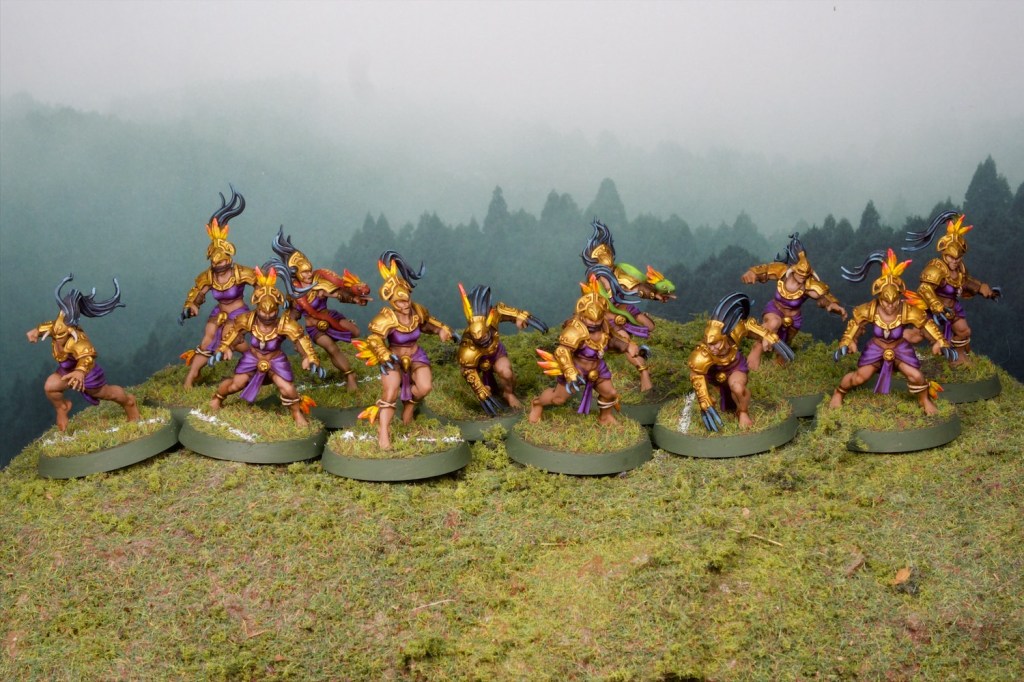
I’ve taken a slight detour through the screaming crowds of Blood Bowl fans over the last couple of weeks, as my gaming group decided to get ready for some games of Blood Bowl after the release of the latest edition of the rules. I’ve always enjoyed Blood Bowl, so I did not take much convincing and found myself assembling a freshly unsealed box of Amazons soon after.
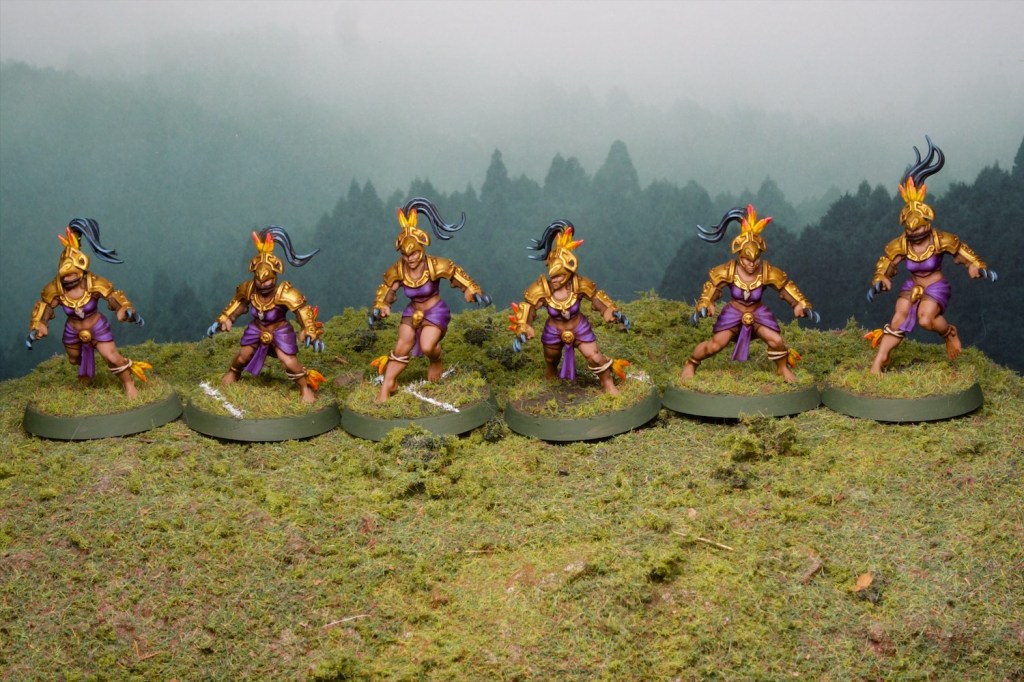
I’d sort of kept an eye on Blood Bowl models over the last few years, and was always pretty impressed with the sculpts. Now I’ve put a modern team together and painted it I can say they stand up to that initial impression. They’re great models, with a nice amount of detail (but not so much they’re tedious to paint, which is a great balance).
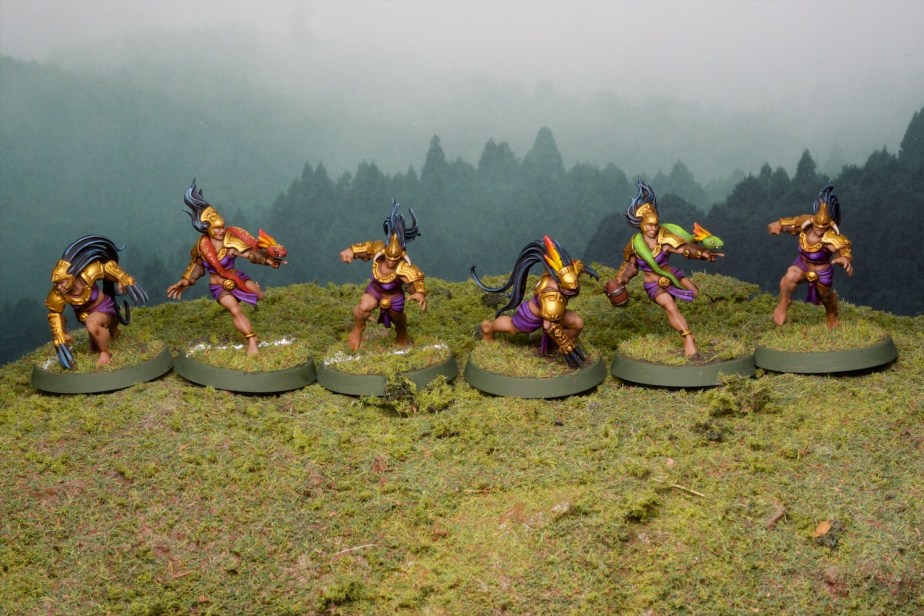
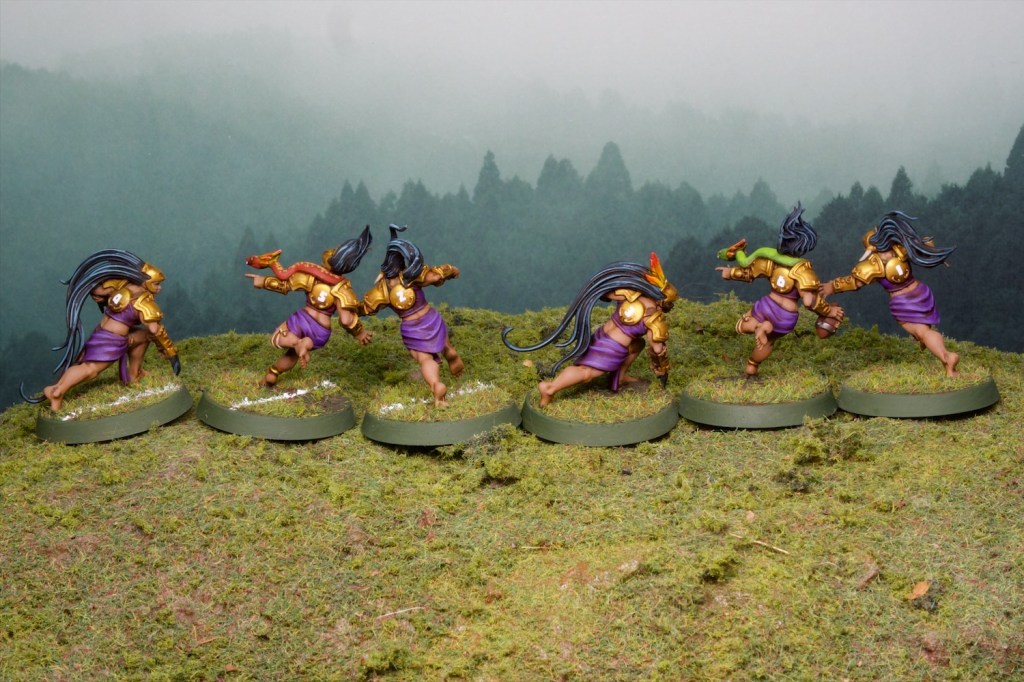
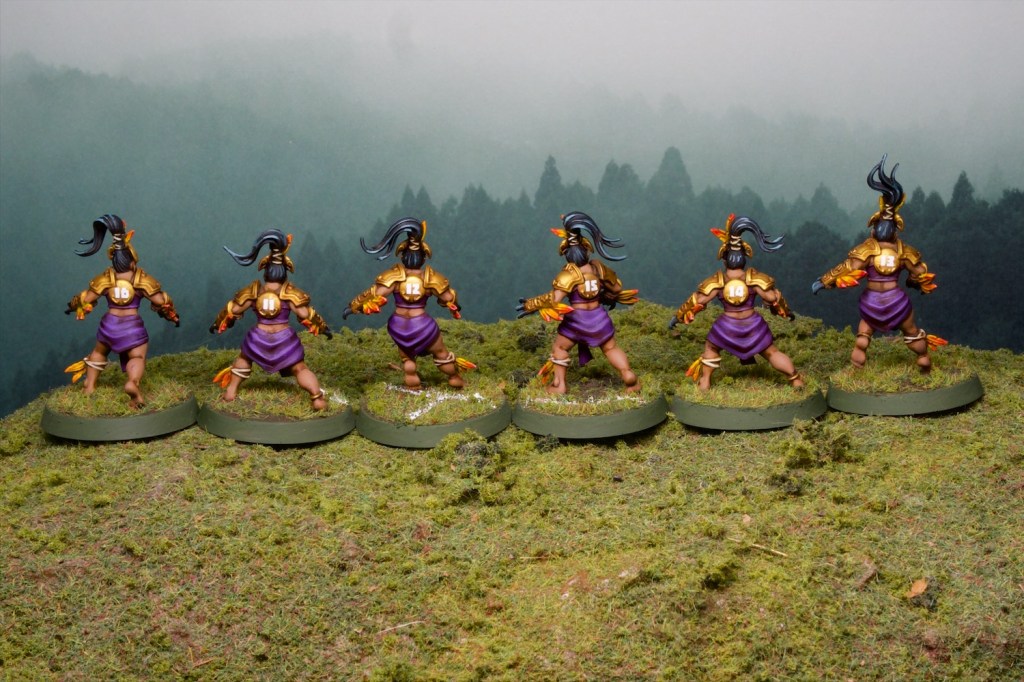
The specialist players.The specialist players from the back.
I went for a gold and purple colour scheme for no other reason than I found it pleasing to the eye. The yellow and red feathers were inspired by the artwork for the Magic: The Gathering set Ixalan which has these really cool yellow/red/purple feathered dinosaurs all through it.
The lineswomen.The lineswomen from the back.
The numbers are from the transfer sheet that came with the set. They also had transfers for the base rims to indicate the player positions (e.g. blitzer etc.) which I’m sure is practical but I didn’t really like the look of that so I avoided them.
I look forward to playing some games with them, it’s been ages since I’ve played tabletop Blood Bowl (I’ve played a bit of the video games in the intervening years). Amazons were very fun to play back in the day and I hope that still holds.
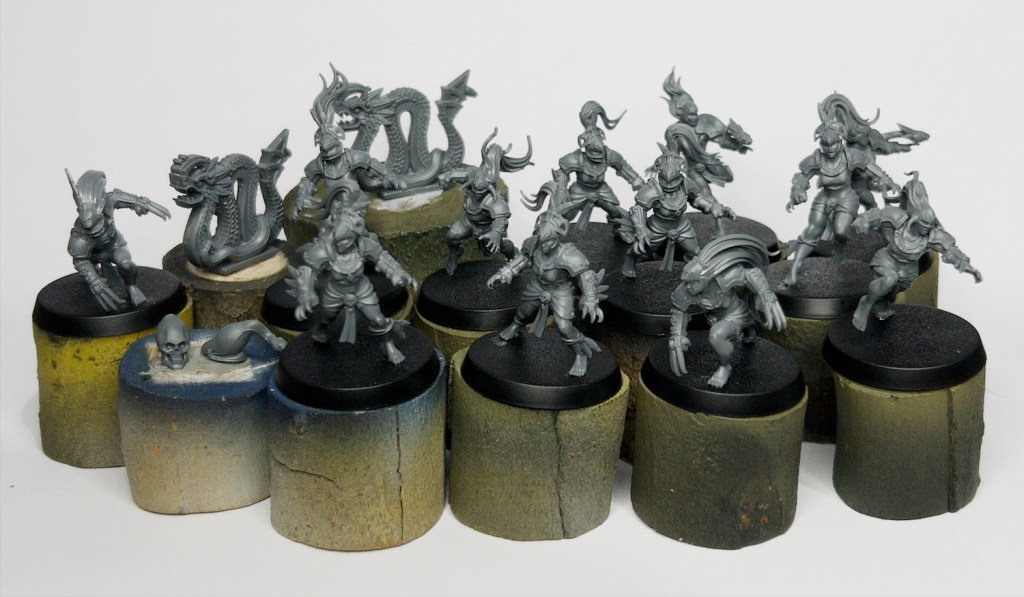
I wanted to show a photo of my setup for batch painting after a discussion with Jeff over at https://kuribospainting.com on holders for miniatures in the last post‘s comments.
As you can see I tack on the models to some bits of branch I’ve cut up into ~4cm cylinders. I find these quite comfortable to hold and they have a nice bit of weight to them (they’re eucalyptus, so quite dense) which means the models don’t topple over. I prime the models like this and don’t take them off till I go paint the base rims. Having one per model is quite practical. You can also see some of the markers and the balls which I didn’t paint yet, I’ll get to them at a later date!
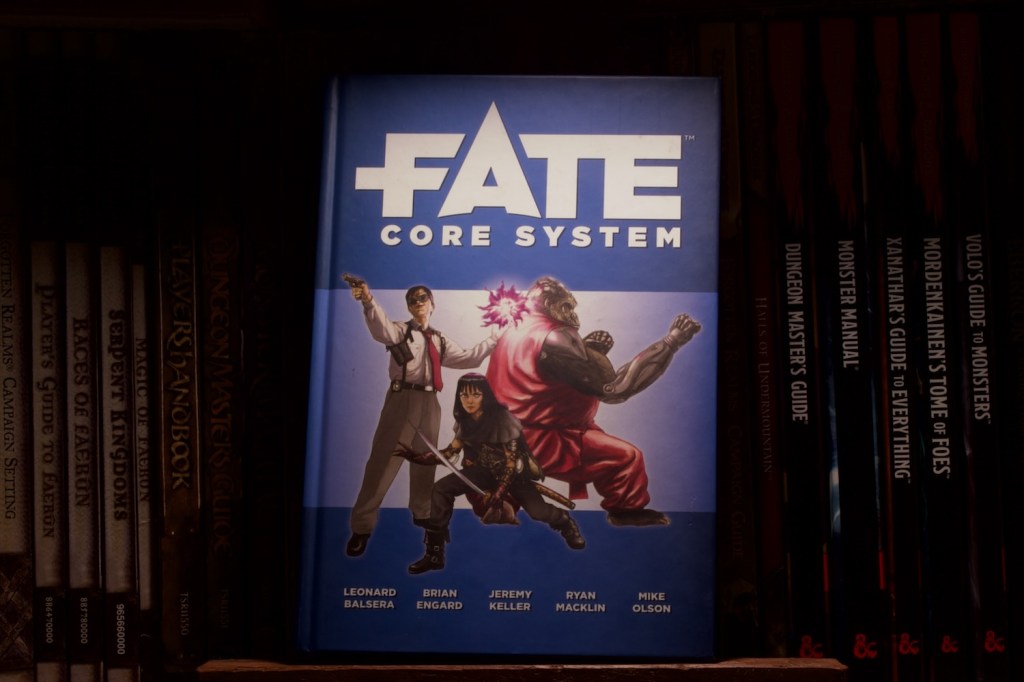
For the second instalment of From the shelves I have Fate Core from 2013.
Fate is a really interesting system that has clearly influenced a lot of later roleplaying games. I’ve played a decent amount of it over the years (although mostly an earlier version, which was part of the Dresden Files roleplaying game). As I mentioned earlier this book is from 2013 and represented a refreshed version of Fate. I’d actually never read it, so it’s been sitting on my shelves unread for 10 or so years. One good outcome of this series is that I’ve finally read through it.
The core concept of Fate is the Aspect system. The way that works is characters, antagonists, locations, basically anything in the game works have aspects, which are short descriptive sentences. These sentences can be used in the game to change what is happening by spending a resource called fate points. For example a player with a character with the aspect “Avid wargamer” could spend a fate point to get a bonus to a roll to do with statistics (this is called invoking an aspect), the player justifying this because their character is very familiar with probabilities. This works for locations too, if a location is “dimly lit”, the player could spend a fate point to get a bonus to hiding. The games master can also use these aspects to make the player’s life difficult (called a compel), for example by making the “Avid wargamer” fail to resist going into a games store when they’re meant to be meeting a friend somewhere else. When the GM does this, they offer the player a fate point which they can spend later for a positive bonus. This whole aspect system is very cool and makes the game really character driven.
There are quite a few other systems to the game but I’m focusing on aspects because I think they’re an interesting mechanic that I’d like to leverage in wargames. It would be quite easy to give aspects to units on the battlefield (e.g. “Bodyguard to the King”, “Want to prove themselves”, “Fled in the last battle”) and give players a pool of fate points they can use to invoke the aspects of their own troops for bonuses, or compel their opponent’s troops to do something negative, but passing a fate point to the opposition in so doing. I think it would be great fun for more narrative games.
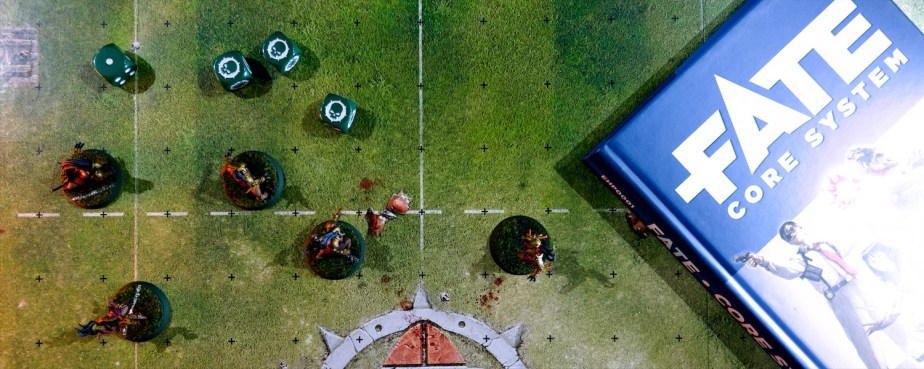
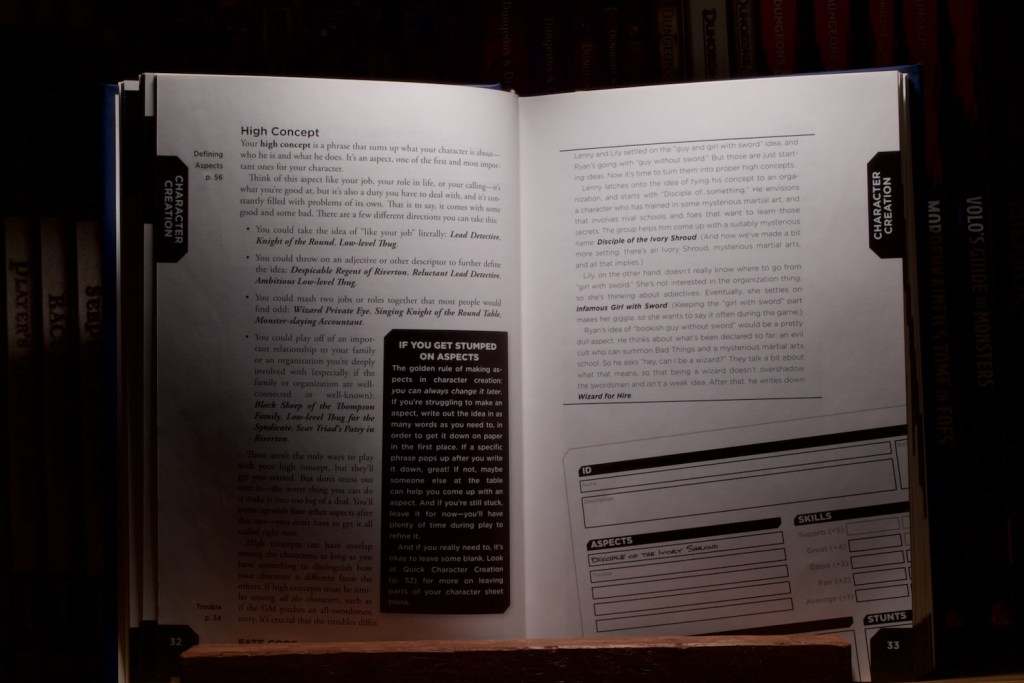
From a book writing perspective, I think this is a really well laid out book, with an abundance of clarifications for the reader. The pages above are a good representation of the style of the book, with a rules section (left page), a play example (right page, italics), and where appropriate an example of what the rule looks like on the character sheet. You also have these dark tabs on the edges of the pages that make it really easy to find sections by quickly flicking through the book.
Overall I’m impressed with the book, and really like what the game is doing. In practice my group has struggled with Fate, the system as a whole just doesn’t quite work for us and that’s why we stopped playing it. However it is packed with great ideas and I’ve re-used plenty of them throughout the years and plan on doing so plenty more in the future. Fate has also clearly had an impact on many later roleplaying games, and I find Fate mechanics or ideas all the time when reading/playing other roleplaying games.
Over the Christmas break I reconnected with one of my favourite pastimes: reading roleplaying game books (hence me posting something painting-related just once over two weeks of mostly free time!). I have a regular gaming group with which I play roleplaying games (and the occasional wargame!), and we play quite a few different games, but my gaming bookshelf is filled with games I’ve never played (and in some cases never read). I’d like to turn that around to some extent, and use the blog to motivate me to read through these books and write up my thoughts around them (More on that later!).
What I immediately got out of my readings however is a furthering of my appreciation of narrative gaming (as opposed to competitive gaming), and/or rules light games. I’m saying and/or because I see quite a bit of overlap between the two. While narrative games aren’t always rules light, both narrative games and rules light games expect players to come up with rules for their games, which is very different to competitive games where rules are expected to be provided.
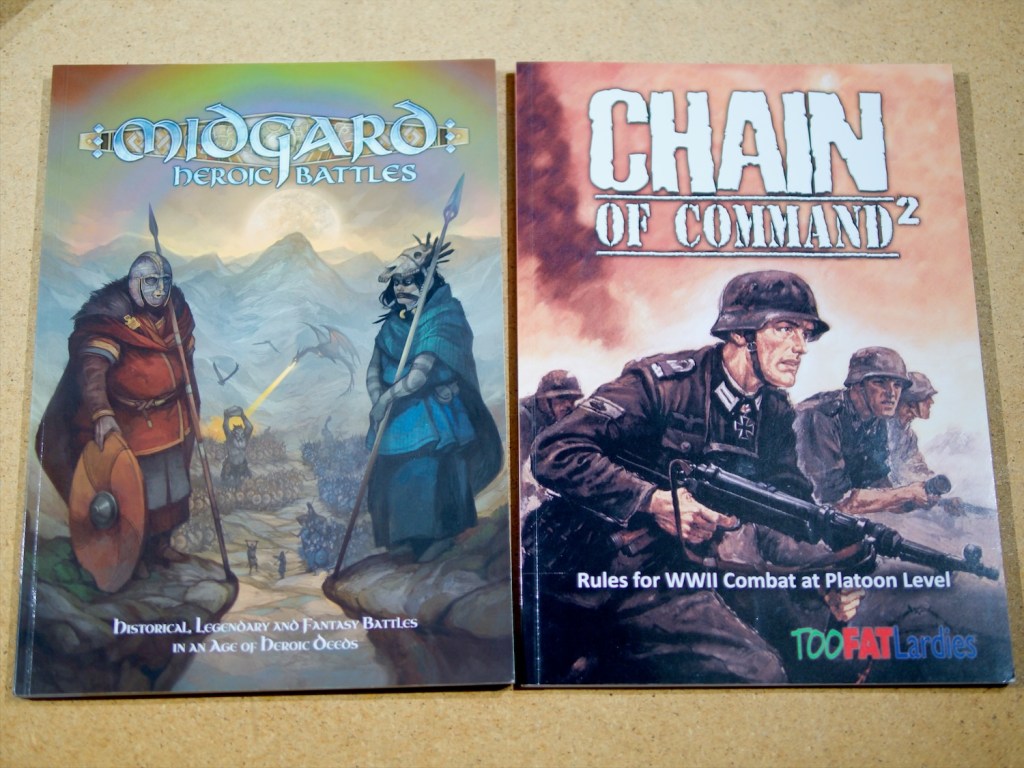
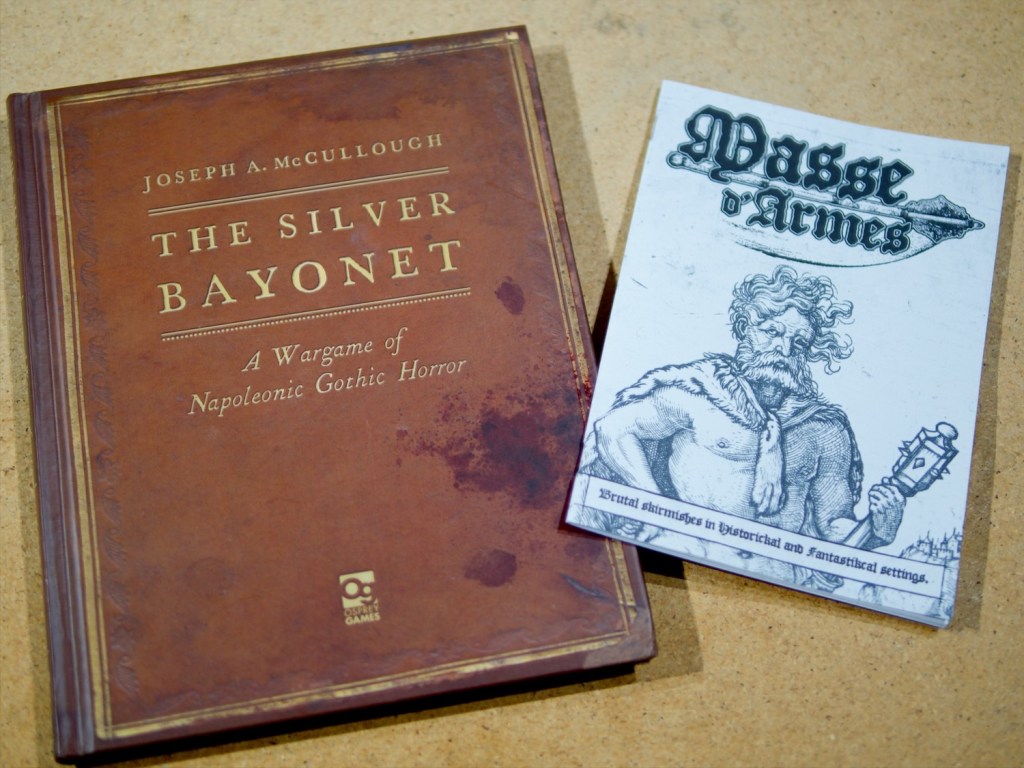
This personal shift is something that’s been happening quite a bit over the last year, you’ve seen me take to Midgard over Warhammer and other historical and fantastical rulesets, Chain of Command over Bolt Action, explore narrative solo gaming with The Silver Bayonet and dip my toes into rules writing with my own rules-light skirmish game Masse d’Armes. This was a very wargames focussed transition, but this Christmas reading got me effectively in the same place for roleplaying games.
Neither is rules-light as such, but they are lighter rules than many other similar wargames, and both have a definite narrative bent.
I’m enjoying lighter rules in games for a few reasons. First of all, my time is more limited now than when I was younger, therefore my ability to a) play games, and b) read a massive rulebook front to back is much more limited than it used to be. I also more importantly have had a bit of an attitude shift to gaming itself, moving from a mindset of doing well in a game, playing to win etc. to enjoying the stories that emerge from these games. Looking back on 20+ years of wargaming, I don’t remember many of my victories (maybe not many to remember hah!), but I do remember plenty of fun moments in games where a lone soldier took down some chaos monstrosity, or when a unit of puny Skaven clan rats routed a mighty dragon.
The Silver Bayonet’s light rules had a lot of influence on my own attempt at writing rules.
More competitive play-styles tend to rely on tight rulesets, which cater to (or try to) all situations that can arise in games – and therefore lead to big rulebooks. This style of game aims for game balance and fairness. In wargames of this style this means that players can assemble their armies and expect a game where in theory the best general can walk away with the victory. In roleplaying games, while not competitive as such, this tendency to aim for game balance as well as fairness is also present, with games trying to make sure all players are roughly the same power level and therefore able to have the same amount of fun. Games in this vein tend to have rules covering all kinds of situations so that the game master needs to make as few rulings as possible during games – keeping things fair.
This competitive play style is very common in wargames because it means you can build your army to a common ruleset and play games against anyone else that has also followed those rules. It allows tournaments to be played, but also allows for random pickup games at clubs. This shared rules phenomena is also present in roleplaying games, with games organised at stores and conventions following rules familiar to players that may not know each other before the game. This is the style of games I played for most of my gaming life, whether it be Warhammer or Dungeons and Dragons. If a query came up, I expected to be able to pick up a rulebook and find out how to resolve it (or failing that go look at FAQs online).
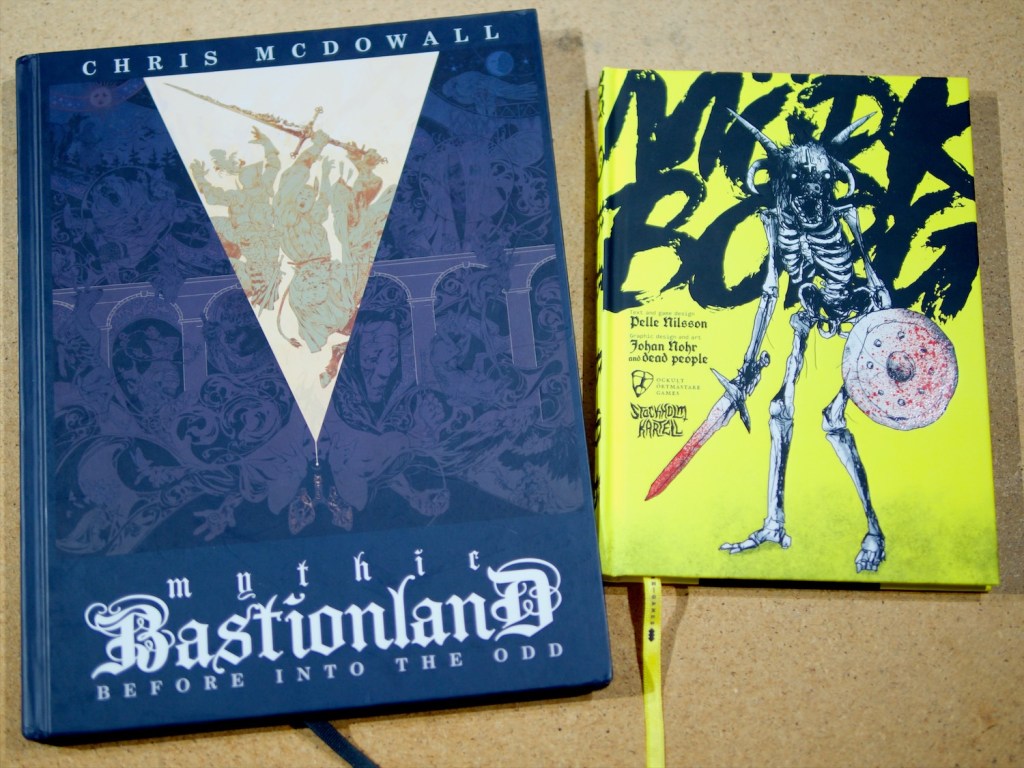
Mythic Bastionland’s main rules fit on a handful of pages, so do Mörk Borg’s.
Rules-light games on the other hand expect that situations will arise that will not be covered by the rules and therefore need some adjudicating during play. This is not a bug, it’s a feature. There is a movement in the roleplaying space called the OSR (Old School Renaissance/Revolution) which calls back to some glorious past vision of roleplaying in the 80s and 90s. I’m not sure things were that rosy, but I have to say the ethos that’s come out of that movement definitely resonates with me. One of the mantras I hear in this space is “Rulings not rules” which touches on that exact point: the rules provide a framework, the players (the game master mostly) are expected to fill in the gaps as they arise.
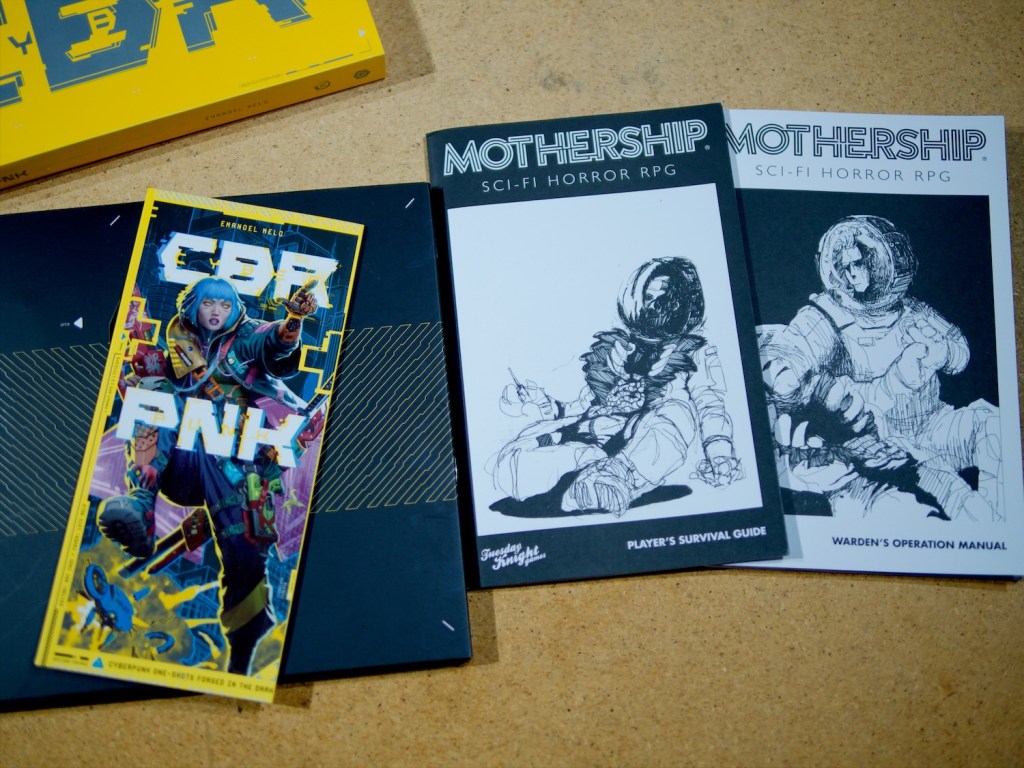
CBR+PNK’s rules are literally a pamphlet, and Mothership fits in a few zine-style booklets.
This sounds like more work, but in practice I really like it – I would much rather make a call on rules in the moment than try to find the relevant rule in a book. It’s probably not any faster, but it creates a shift in focus: instead of thinking about how to play the rules, you start thinking about how to play the situation in the game. For example, say a unit retreats into a dangerous magical swamp. A comprehensive set of rules might say they take d6 hits and how to resolve them. A more rules-light game might not, and the players will have to decide what this swamp does. Maybe this is a necromantic swamp filled with the dead dragging the living down and therefore some agility or initiative test might be in order to avoid being drowned. Perhaps the players land on the same rules they would have been given by a more comprehensive ruleset, but at least they’ve thought about what is happening in the imagined world.
Clearly I’m enjoying this shift, so what took me so long? Well I was always worried about this game balance and fairness aspect. For me, house rules were never going to be as tested as “proper” rules, and therefore would lead to unfair and consequently unfun games. I’ve now come to the decision that fairness is overrated in these games we play, and we’re much more likely to have a good time if we don’t worry so much about what is fair, and rather focus on what is unfolding in the game. The price of this is that it might be hard for me to find people that want to play games the way I do at a club or store. Luckily for me I have some friends that enjoy this play style, and we’re having a great time. This right there might be the reason you prefer one style of game over another, and that’s just fine – do what works for you!
To get back to that sentence right at the top on how I want to use the blog to motivate me to read through my book pile of shame, I’ve decided to try something along the lines of a series of posts dedicated to books. For these I would pick a book off my bookshelf, read through it and write down my thoughts. Not really as a review, more like reading notes. It would likely be a mix of wargames books and roleplaying books, which given this blog is 99% about wargaming might be a bit of a change but hopefully those of you that aren’t into roleplaying might find the posts interesting if only from your familiarity with rulebooks!
Anyway I hope my digression into games rules was interesting to read, let me know in the comments what you think about all this!
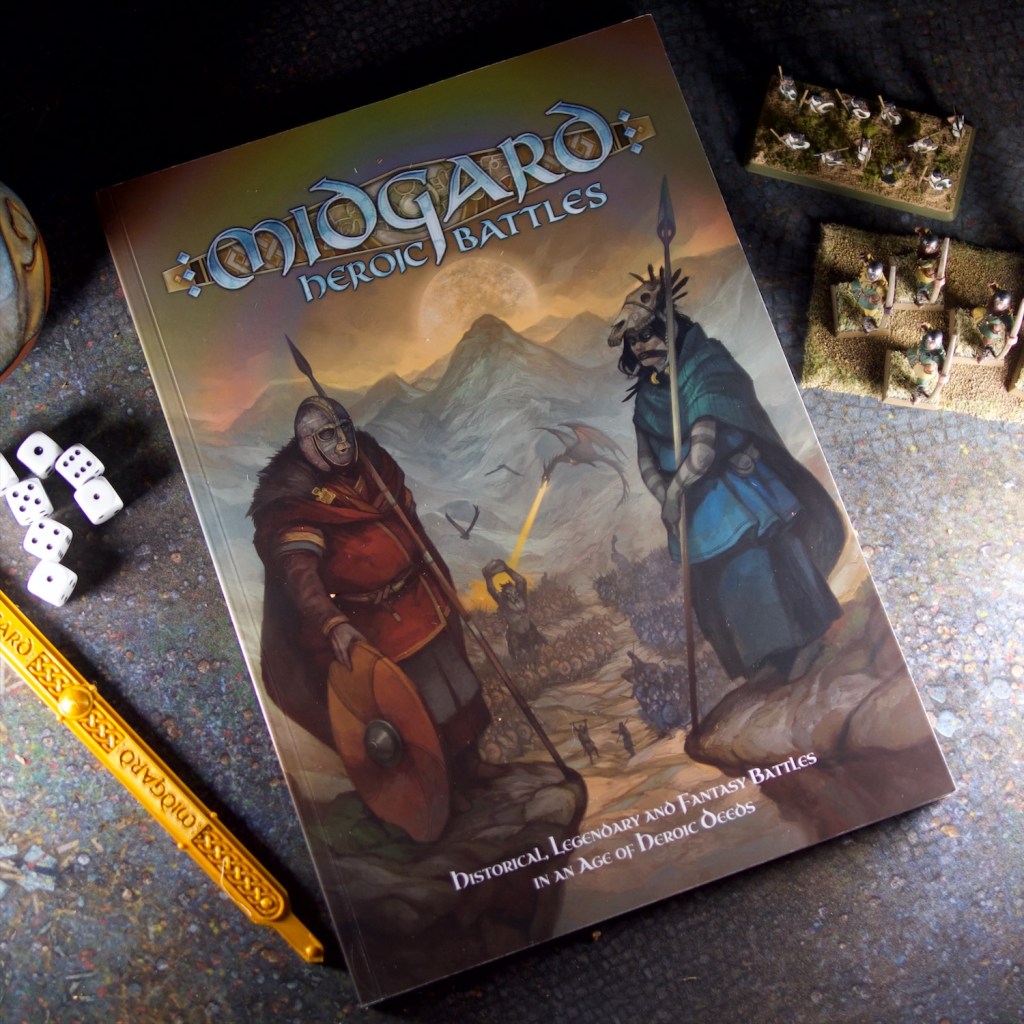
I noticed last post that I was starting to mention aspects of Midgard Heroic Battles that I’d never really explained and felt that a review post for the game might be in order. Clearly if you’ve seen my other posts you’ll know this review will be a positive one, but I think it provides some useful information about the game for players that might be interested in picking it up.
What is Midgard Heroic Battles?
Midgard Heroic Battles (Midgard from now on!) is a set of rules for playing out battles in any setting that can be described as having the following characteristics:
Battles are fought mostly by ranked up regiments of close order fighters wielding spears/swords/axes/etc, supported by cavalry and skirmishers (and sometimes monsters/elephants!)
Shooting is helpful but not the primary way to win a battle.
Most importantly, leaders lead from the front. They are found where the melee is thickest, performing mighty deeds (or dying mighty deaths!) that will be sung of by the bards for aeons to come.
This covers quite the range of historical eras (roughly antiquity all the way to sometime in the Middle Ages when leaders decided to focus on strategy over feats of arms), but also covers a swathe of fantastical settings (Tolkien’s Middle Earth being a prime example).
In addition to this broad applicability setting-wise, Midgard also is a scale agnostic system that handles whatever your collection can throw at it. I achieves this through its adaptive measurement system (the spear throw) and flexible list building.
The spear throw
The spear throw (ST) is the basic unit of measure of the game. Pretty much everything in the game is measured in multiples of STs, for example units are always 1ST wide, cavalry move 2ST per move, short bows can fire arrows 3ST away etc. A ST does not have a fixed length; how long a ST is depends on the scale of the miniatures you use. For 28mm miniatures, the suggested ST is 12cm long (which lets you fit 8-10 miniatures on your 1ST wide base), while for smaller miniatures (say 15mm or less) the suggestion is to use an 8cm ST. This is a purely subjective choice, driven primarily by how you like your units to look on the tabletop. Want wider units? Use a larger ST.
By using this abstract measure, the rules do something quite clever, which is to provide ranges for all kinds of things in the game while never committing to a fixed measure. No need to do some on the fly measurement conversions (“this bow shoots 20 inches at 28mm, we’re playing at 15mm so it should shoot 10.71 inches!”), just get/make a measuring stick of your chosen ST and you can measure everything you need for the scale you’re playing at.
Left is an 8cm spear throw base and measuring stick, right is a 12cm spear throw base and measuring stick. These very stylish measuring sticks are STLs that can be purchased from the TooFatLardies site.
Here is the first hint of what the game is trying (and therefore not trying) for: this is a game that is not aiming to be particularly suitable for random pickup games at a club or say for playing tournaments. It is important that both sides in a game use the same ST length. Unlike in a Warhammer-style ruleset which mandates all aspects of the game and therefore provides a common standard for all gamers to align to, Midgard requires pre-agreement on the ST the game will be played at. Considering the ST affects the bases of all the units on both sides, that is not an inconsiderable hobby hurdle to overcome if one gamer has based their army on 8cm bases and the other on 12cm.
The List-building
Midgard provides a set of generic profiles (such as Heavy Infantry, Skirmishers, Light Cavalry, etc.) which can be modified by changing their equipment (e.g. adding or removing armour), and the addition of traits which modify the behaviour of the units (e.g. impetuous can force the unit to charge).
Much like STs this list building is a cooperative activity and not done in a vacuum. The maximum armour for most units is 4, which might represent a mail and a shield for a dark ages game, or full plate armour in a later medieval game. What’s important here is that relative to each other, both sides in a game are consistent. This again indicates tournament play is not the point of Midgard, it would be hard to coordinate a room full of players to achieve this.
What you get as a result is an extremely flexible list building system that is capable of representing all kinds of troops, whether historical or fantastical. I’ve been able to create fun and evocative profiles for my Middle-Earth miniatures, my Warhammer miniatures, and my emerging Punic Wars collection so far.
The author provides a number of lists in the back of the rulebook, as well as many more on his website https://mogsymakes.net/resources-for-midgard-heroic-battles/ alongside some great list builders that make putting armies together a breeze.
As a result of the above, Midgard feels more like a framework for creating games than a simple self-contained game. While it is possible to just get the models required to field some of the armies in the back of the book and play a game as is, the real power of the game in my opinion is to provide an easy way to get your collection on the table and playing fun games with it.
Midgard Gameplay
“This flexibility is nice, but once I have chosen my ST and made my army lists, what’s the actual game like?”
If you have War of the Ring trays around, they are perfect for Midgard.
The answer is Midgard is a very fun rank and flank ruleset, that is fast to play, easy to pick up, but hard to master. In its pages you’ll find rules for the usual array of restricted ranked unit movement rules (a staple of the genre), shooting and combat. All of these are quite streamlined compared to what I’m used to from Warhammer and other such systems. Generally all combat/shooting die rolls require you to get a 5 or above (no complex comparison tables here), and modifiers halve the size of your dice pool rather than modify the target number. This makes for some rather quick combat resolution, and keeps the game going.
The only other die roll to remember is the command die roll, which is used for situations where a unit may not do what it is told (e.g. holding still instead of pursuing a fleeing unit), similar to leadership tests in Warhammer. Just as combat rolls, this is a set number and never changes (again speeding things up!).
Heroes matter greatly in the game, leading your troops and assisting them by using a resource called mighty deeds. Heroes get these according to their level and can spend said deeds on making units re-roll failed command tests, get extra attacks, cast spells, and most shamefully to keep themselves safe.
Framing all these rules is the reputation system. This pool of tokens represents the morale of the army, and grows with the acts of bravery of heroes and shrinks when losing units or when heroes bring dishonour upon themselves. If your reputation is at or below zero at the end of the turn, your army breaks and you lose the game.
The main advantage of the reputation system is that it lets you use your coolest cups for their true purpose: gaming.
This resource drives the behaviour of the players in a really fun way: as their reputation drops, players have no choice but to dive in and try to regain the upper hand through desperate actions with their heroes. This is magnified when an army’s reputation drops to zero during a turn, as they have until the end of the turn to get it back above zero, which makes for some extremely fun (and cinematic!) moments where heroes lead wild charges in the forlorn hope of reinvigorating their side.
Who Is Midgard For?
As highlighted above, Midgard is not a tournament game, and is probably not particularly well suited to a pickup game scenario against unknown opponents at a club or other. What Midgard excels at is creating fun narrative games where the two sides and a scenario are created specifically for those games. This is really good for convention games where the game is set up and the players join in, and I’ve found it excellent for games with my game group, where I’ve set up a scenario for two forces and invited my friends over to play it out.
I’m not sure I would have known what to do with Midgard 10 or so years ago, as I was very much in the playing tournaments and pickup games paradigm, with armies specifically created for an edition of a game, ready to play against anyone with an army for the matching system. In some ways that’s an easier way to go as there is no need to coordinate anything for a game (beyond a time and a place), everyone is following the same set of rules and can just show up with their legal army. If that’s how you want to do most of your gaming then Midgard might not be for you.
The games look great too!
I have much less time for gaming these days and find that what I really want to do when I do is to get a group of friends together and play a big fun game. Midgard helps me do that in quite a few ways. First, it’s easy to play – I know that friends that aren’t regular wargamers will have an easy time picking it up (recently one of said non-wargaming friends corrected me on the rules multiple times during a game!). This really broadens the pool of players, and I’d recommend Midgard for teaching new players a wargame. Second, while building lists sounds like a lot of work, I think building lists for Midgard is much faster and easier than building lists for Warhammer – even with the need to keep both sides somewhat consistent. Third, the game is fast to play. The rules stay out of the way of the action, and games with hundreds of models can take as little as a few hours to play through. Finally, the game lets me use my whole miniatures collection. While I have some armies that are legal armies in other systems, I have some that are too small or out of date and haven’t seen play in many years. Midgard with its flexible list building system has had me scrounging through my cases (which has been a great trip down memory lane), thinking up scenarios for all kinds of settings.
If the above sounds like a good time then I heartily recommend you check out Midgard. It’s likely to be the most played game by far in my group this year, and I look forward to finding out what else we can do with it.
I’ve been talking a decent amount about Midgard Heroic Battles over the last few posts, and that’s unlikely to change as I’ve been thoroughly enjoying the game. Part of what’s made it fun for me has been the flexibility and general simplicity of the ruleset. It’s meant that for the last few weeks, units that I haven’t put on the battlefield for years have been taking part in some really fun games.
While most games we’ve played so far have been Lord of the Rings themed, we’ve been wondering if the rules would work well for games in the Warhammer setting. While we enjoy the new Warhammer the Old World rules, they’re quite complex and don’t necessarily make for a beginner friendly game. We have a few friends in our gaming group that are not wargamers (board games and roleplaying games are their usual fare), and haven’t really been interested in playing Warhammer before. They have however been enjoying the games of Midgard we’ve been playing, and have been happy to play more, which is great news for me!
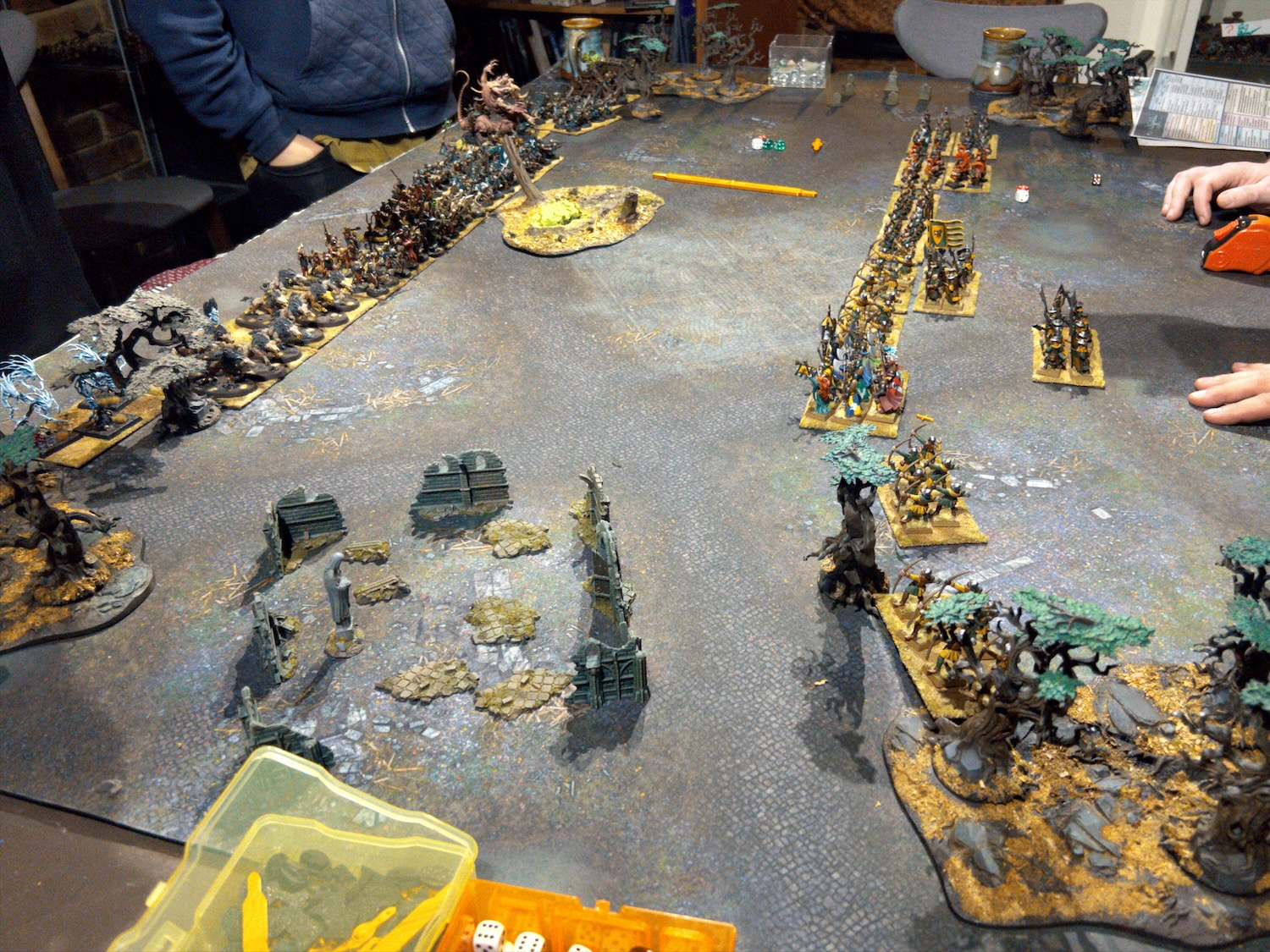
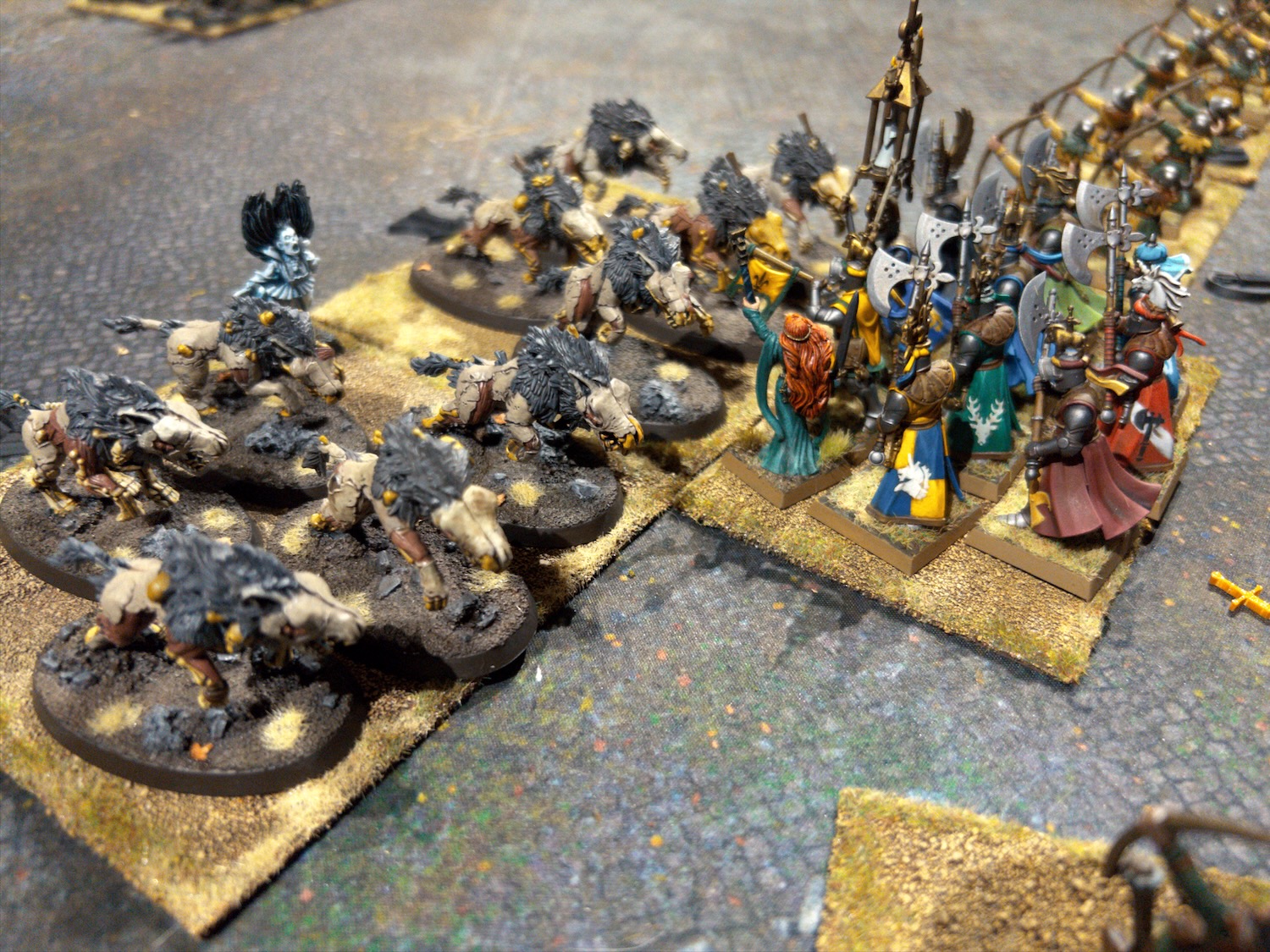
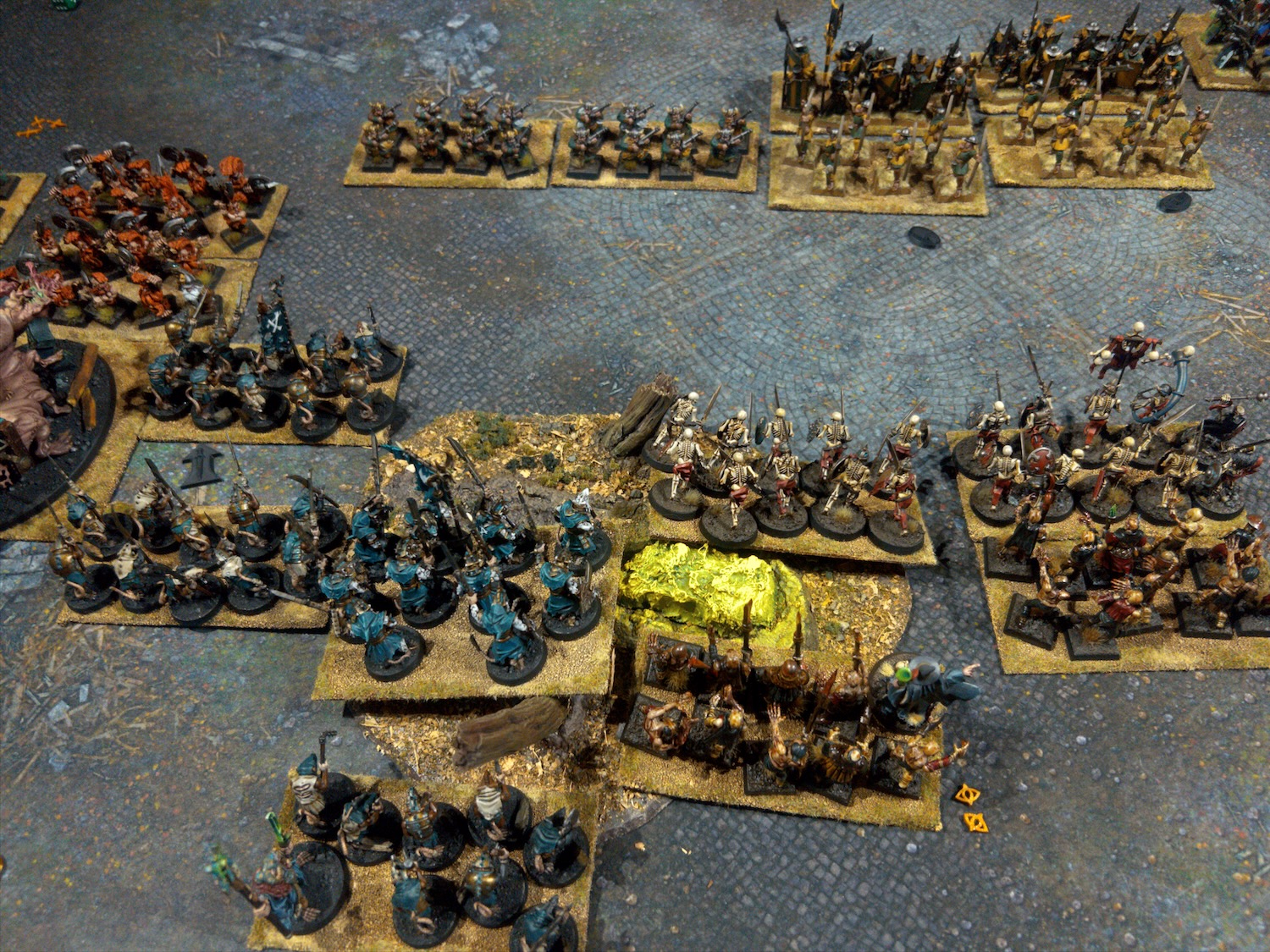
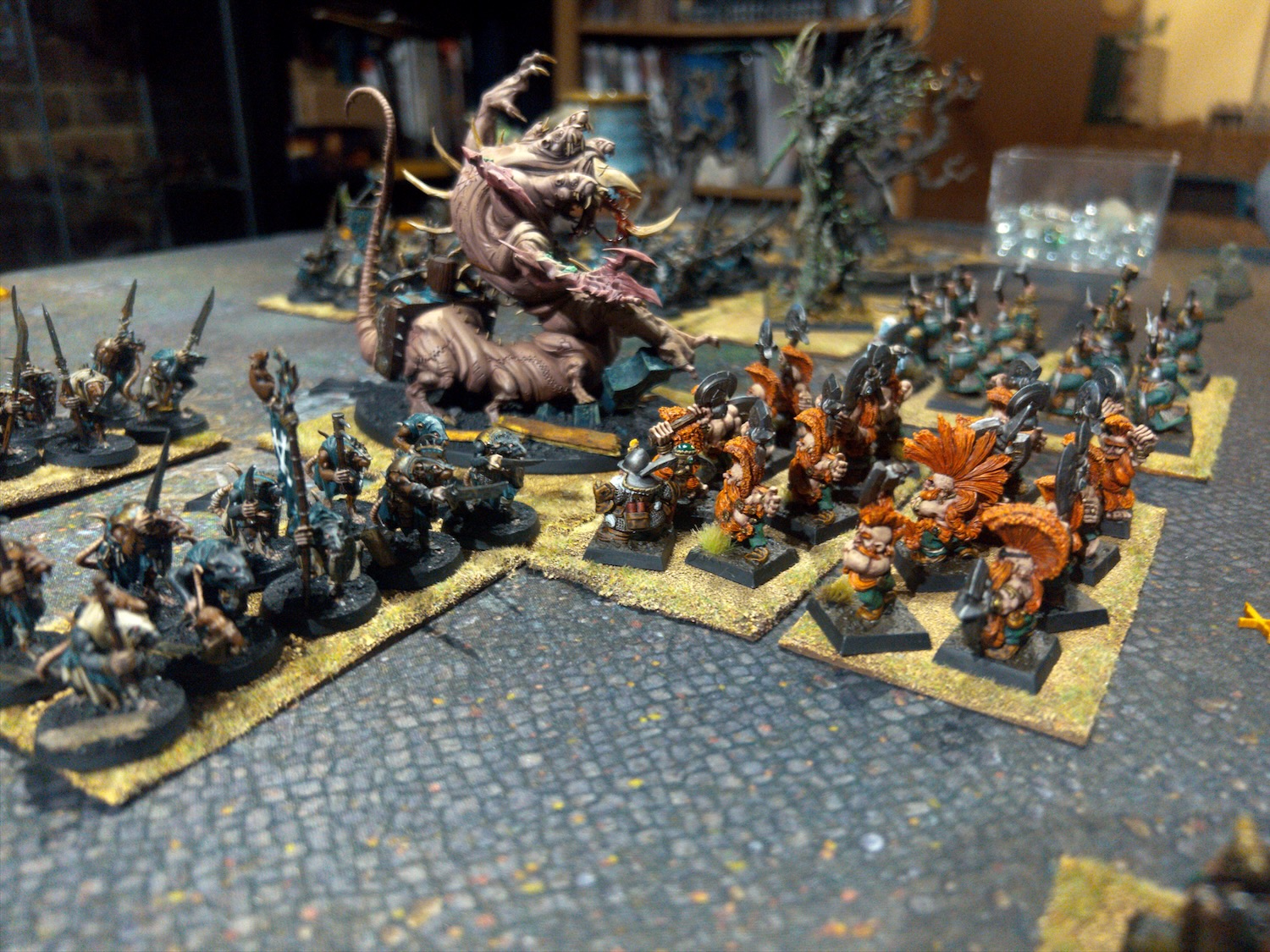
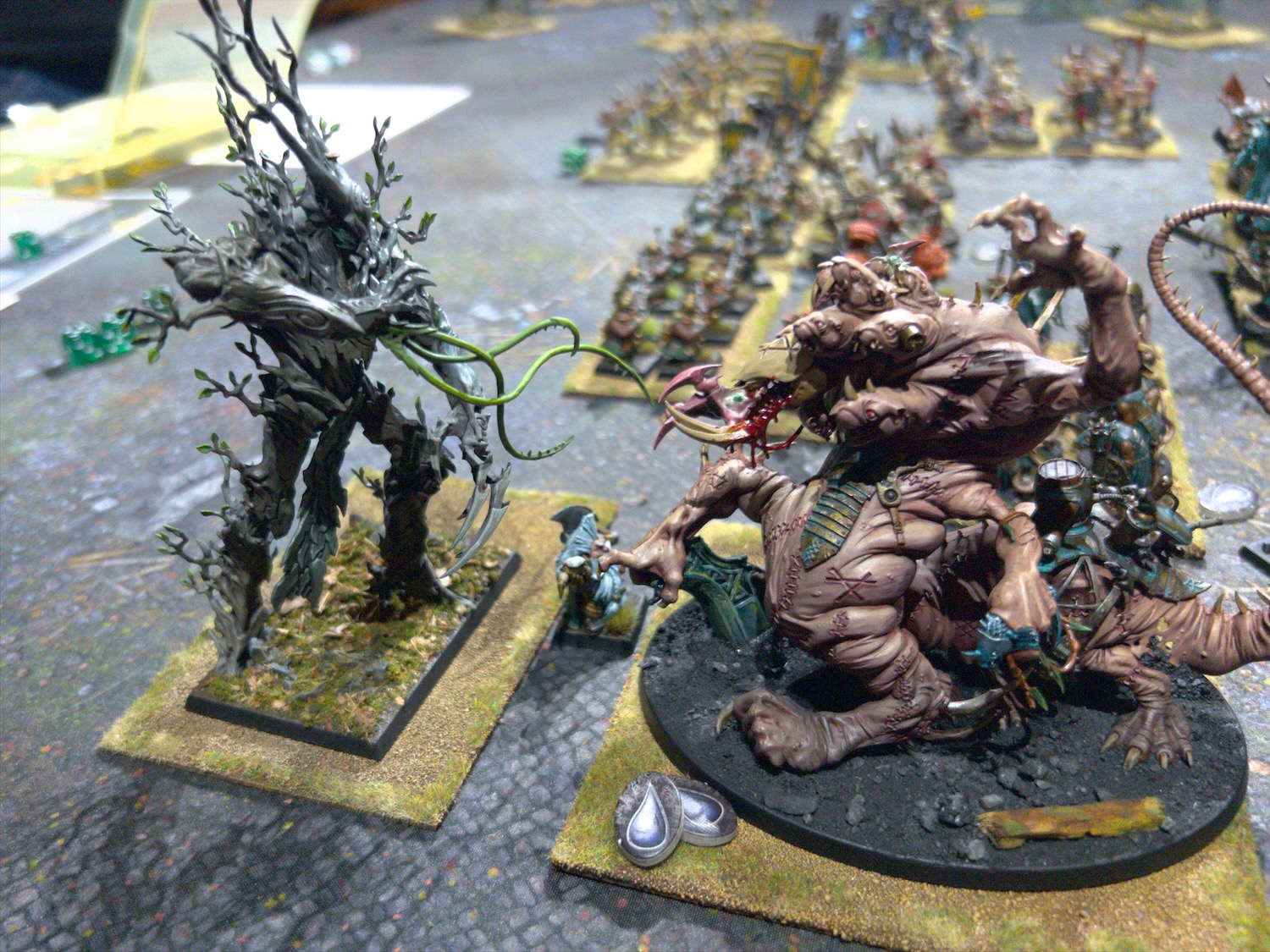
This week I had a few of those friends over and we played a big game involving four armies: a loose alliance of Skaven and Undead against Dwarves and Bretonnians. Two of the players were wargaming novices, one is relatively new, and one is an enfranchised wargamer. I was running the game as a games master. Despite the lack of experience of most of the players, and the relatively large size of the game, we comfortably got through the game in an evening which is a testament to the rules.
The scenario I set up was as follows: the Skaven and Undead armies needed to hold onto a warpstone meteor while the Dwarf/Bretonnian alliance needed to get them clear of it. To spice things up some, I placed four isolated trees on the board (i.e. not on the forest bases), and after turn one revealed them to actually be treemen who were generally opposed to the idea of big battles being fought in their forests and went after whatever unit was closest. Despite this extra chaos the game was extremely close and ended with both sides within a single reputation point of each other (reputation tracks your force morale, if it’s at or below 0 at the end of the turn, you lose the game). The Skaven/Undead forces won the day, but it really could have gone either way.
Overall, the game was a success I’d say, all the players enjoyed themselves, the game was fun, and it generally felt like playing Warhammer without the big rules overhead. What was missing however was some of that Warhammer atmosphere that is generated by things such as wizards miscasting and Skaven wargear blowing up. Midgard as a low-fantasy/historical wargame does not really cater for this out of the box, but it is easy enough to add some house rules to capture this, and I’ll be doing that going forwards.
After this successful foray into playing Warhammer with Midgard, I’ve been excited about the possibilities. As I said in the opener, Midgard is a very flexible game system, and looks to be able to cater for some of the more esoteric things that can be found in the Warhammer setting and are not catered for in the normal Warhammer rules. With that in mind I’ve been reading through the late 80s/early 90s Realm of Chaos books which are probably about as esoteric as Warhammer gets (I’m sure I’ll be shown something more esoteric in the comments!), and having a great time imagining what that could look like in a game of Midgard.
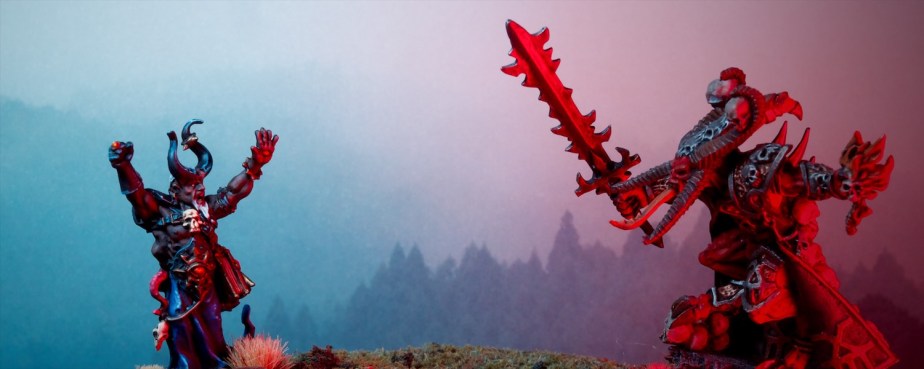
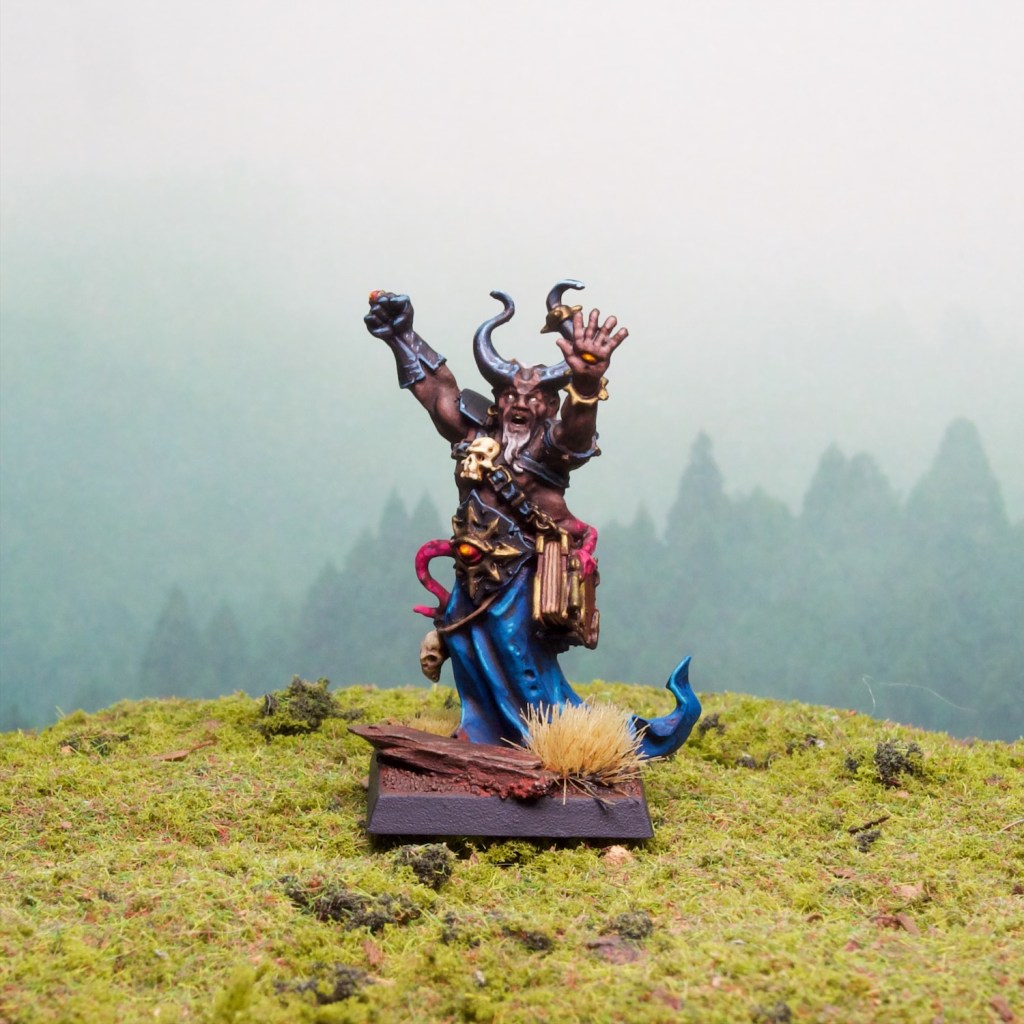
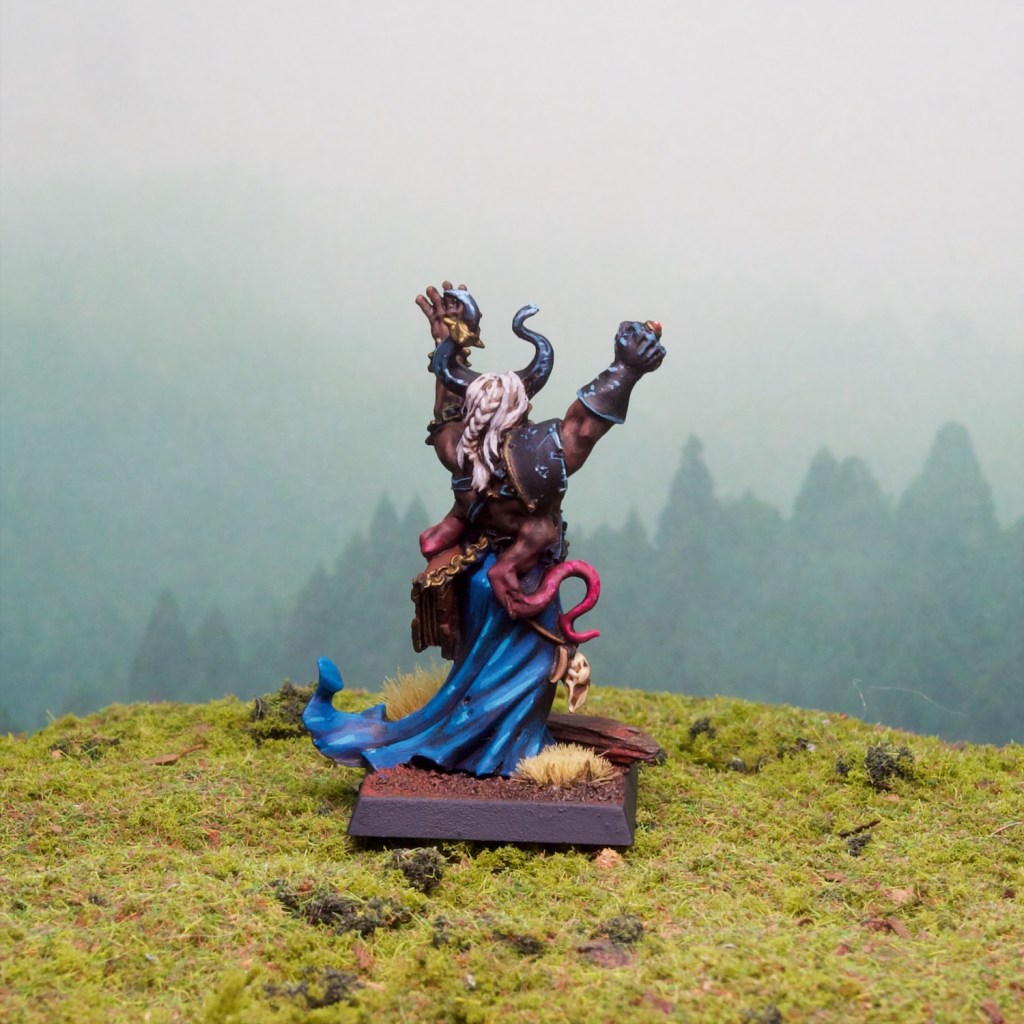
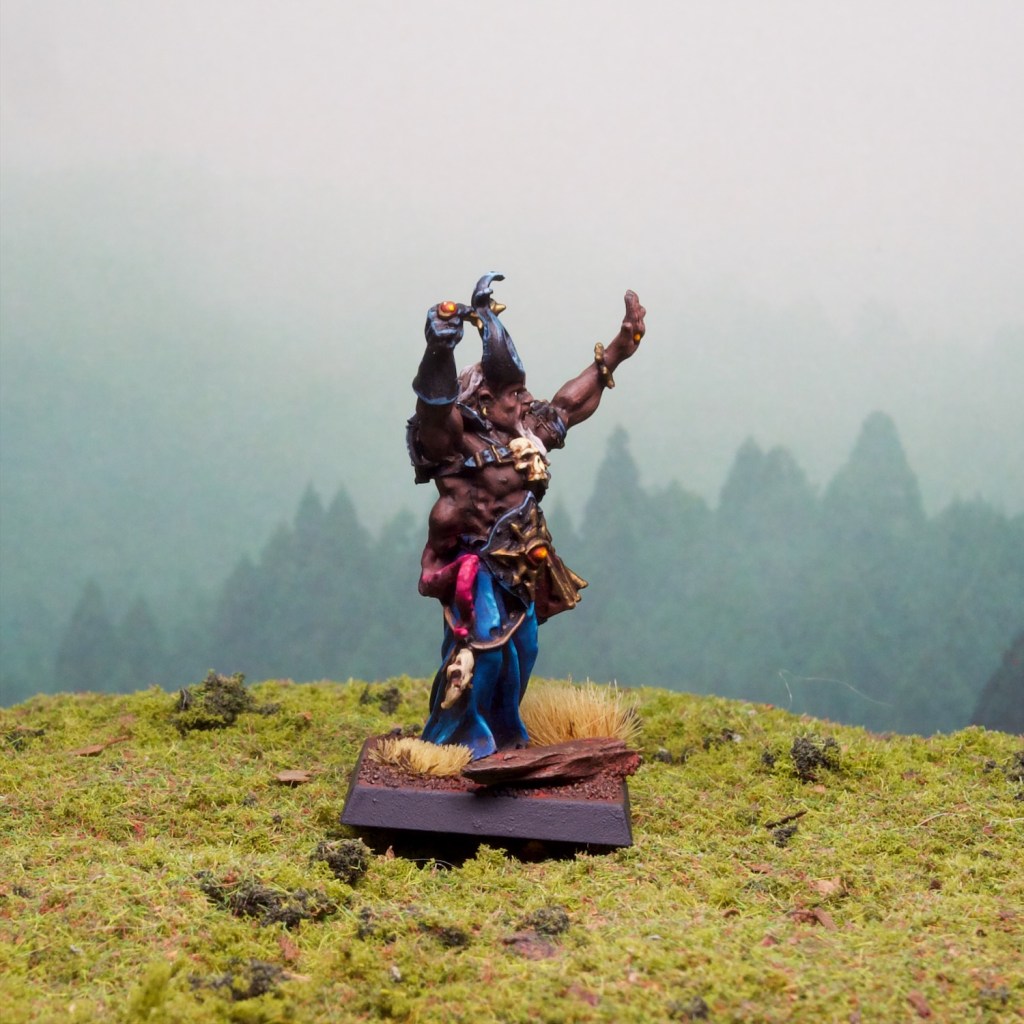
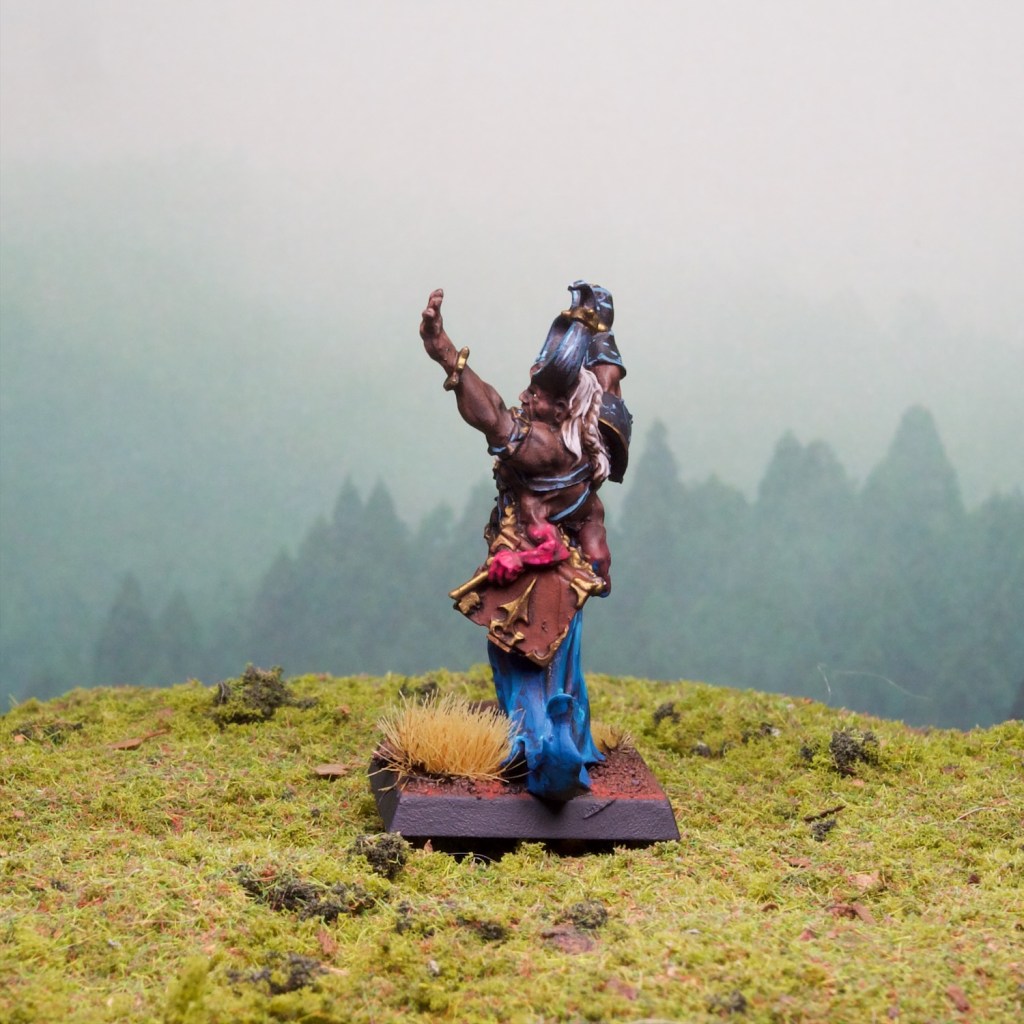
Needless to say some of this energy was redirected towards miniature painting, and in this case towards this Chaos Sorcerer that I found in a case while scrounging for Chaos models for my Midgard/Realm of Chaos plans.
This is a really cool model that was released for Games Day 2010, and that I bought back then. It’s therefore been undercoated in a case for 15 years, and I was well past time I got some paint on him!
I had some fun with the skin (especially the parts with the extra limbs!). I’ve been trying to work on painting darker skin tones and I’d picked up some of the Duncan Rhodes/Two Thin Coats paints made for this purpose (Druid Flesh and Bard Skin). I really like how they worked, although I did feel they needed a touch of extra warmth so I glazed some Citadel Contrast Wyldwood over the top which did the trick.
The model has a lot of nice little details on it which were great fun to paint, the small hand holding the key to the book being my favourite.
I’m sure we’ll see this Sorcerer lead a Midgard contingent at some stage!
I’ve been thinking about card games a lot recently. So much so that I decided it might be interesting to get some thoughts down on the blog about them (if you like looking at pictures of miniatures, there’s none in this post, apologies!). Card games form the majority of my gaming these days, eclipsing wargames, boardgames, and video games by a wide margin. The only thing that comes close is pen and paper RPGs which I play most weeks.
Card games generally have the advantage of ease of setup and the low time and space required to play them. You can easily just take a deck with you and play some games before/in between other activities (at work over lunch, or before an RPG session!). This is not the case with most of the other gaming that I like to do which requires significant setup, and blocking off a half day or even a day dedicated to gaming. I used to do this all the time when I was a student, but this kind of big setup game just doesn’t fit that easily in my life anymore with work and fatherhood!
I’ve said card games a lot in these opening paragraphs so what card games am I talking about here? I’m going to discuss three card games that I play (or am starting to play in one case) regularly: Magic: the Gathering, Vampire: The Eternal Struggle, and Netrunner. These are all collectible card games (CCGs), and funnily enough were all created by the same person – Richard Garfield. Garfield created these three games in quick succession (1993, 1994, and 1996 respectively) and purposedly made them quite different to each other, which makes for some nice variety in gameplay and deckbuilding. I’m a relatively long time player of Magic (10+ years, not that long for a 30 year old game!) and have only recently (last few years) been playing the other two games. I think they’re excellent and this post is me attempting to convince you that you should check them out, by showing them to you from my perspective as a Magic player broadening his horizons.
Note before we get started: this post will heavily be coloured by my experience with these games, which is playing their modern incarnations. All three games have seen some pretty major changes to their rules over the years, so if you’ve only played these in the 90s and what I say here does not gel with what you remember, chances are the game has changed since then!
Magic the Gathering
If you’re familiar with CCGs this game needs no introduction (I’ll still introduce it though, not everyone will know it and it is useful to set up as a contrast to the other two). This is the forebear of all CCGs, and had a massive influence on the genre as a result. The basic premise is simple enough, at its core this is a two-player game, with each player bringing a deck of cards they assembled outside the game and competing against the other player. This basic formula is still the entry point for the game, however as a still popular 30+ year old game Magic has many, many, variants, including multiplayer (3+ players) and variants that include deckbuilding as part of the game (the draft and sealed formats). I’ll be mostly discussing constructed one vs one games (i.e. two player games where players bring decks they’ve pre-built) in this post as that is the closest to the initial intent of the game as I understand it and is the most common tournament format. Note that the most popular way of playing the game these days is the casual multiplayer format Commander which is quite different.
The Premise
Magic is set in its own original universe, with the players representing Planeswalkers, powerful mages that can move between the planes in Magic‘s universe. These Planeswalkers are battling against each other, using powerful spells or summoning creatures to attack each other.
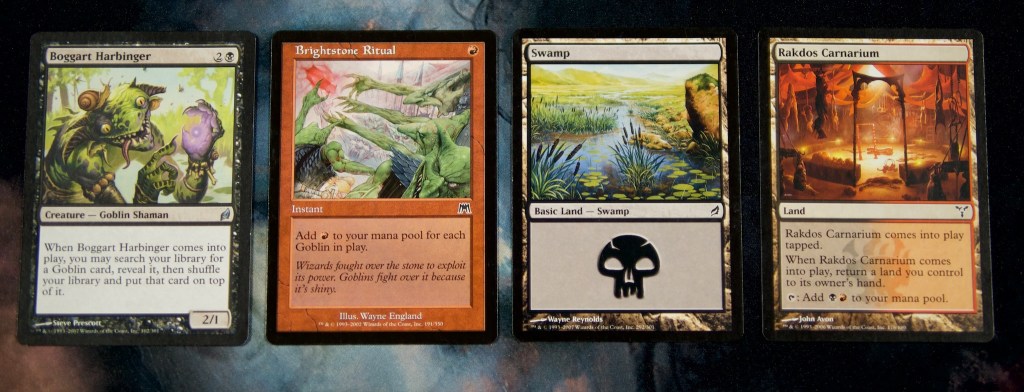
Example Magic cards, left to right: Creature, Instant (a type of non-permanent spell), Basic Land, Non-basic Land
Deckbuilding
Sticking with our one vs one basic game for now, here’s a quick overview. Players assemble their decks by selecting spells and lands. Spells are cards that can summon creatures, or create more ephemeral effects such as once-off damage. Spells require mana to be cast, which is the main resource of the game. Mana comes in five colours (White, Blue, Black, Red, Green), and spells generally cost a mix of coloured mana and generic mana (i.e. mana of any colour), and the more powerful the spell, the higher the amount of mana required by that spell. Lands are cards that produce mana, with basic lands being lands that only tap for one colour of mana, while other lands have additional abilities (tapping for one of two colours being the most common). Each specific card can only be included up to four times in a deck with the exception of basic lands which can be included as many times as desired. Generally the minimum deck size is 60 cards, and for tournament play, players can include a 15-card sideboard from which they can select cards between the games in a match (tournament matches are best of three games).
Deckbuilding then focuses on selecting one or more colours to play, adding a variety of spell costs to be able to play cheap spells early on and more expensive spells later on in the game, as well as including the lands required to cast those spells. The more colours a deck has, the more options it has, however this is balanced by the difficulty of assembling the lands required to cast spells of multiple colours. Most decks are 1-3 colours as a result, with 4 and 5 colour decks being much rarer and more specialised.
Gameplay
A core concept of magic is tapping cards, which generally happens when a card that can be activated only once a turn is activated. The card is physically turned sideways to indicate their having been activated and the fact it can no longer be activated. Players untap their cards at the start of their turn.
The basic gameplay can be summarised as follows: Players start with 20 life, seven cards in hand, and draw a new card at the start of each turn. Players can play one land from their hand per turn. They can tap these lands to produce mana which they can use to cast their spells. Spells are broadly categorised into permanent spells (they stick around after being cast, for example summoned creatures), and spells that place a temporary effect on the game (dealing damage to a player, increasing the power of a creature etc.).
Players once per turn can also attack the other player with their summoned creatures by tapping them. The player on the other side of the attack can block, sending their own creatures to intercept the attacking creatures as long as those creatures are untapped. This means generally creatures can only be used to attack or defend in a given turn cycle which is a key part of the decisions a player must make during the game.
Once a player has cast their spells for the turn (or decided not to!) and attacked (or decided not to!) the turn passes to the other player. This continues until a player’s life total drops to zero. Games of magic are pretty fast, with tournament play expecting players to finish a match (best of three games) in 45 minutes.
My Experience
I first played Magic in 2011-12 and got properly into it in 2013. Since then I’ve played a lot of Magic, built many decks, and explored many of the variants out there. I’ve played quite a few tournaments although nothing very serious. My favourite way to play Magic is constructed one versus one formats, leaning towards those that allows larger card pools (so called eternal formats), with my favourite being Legacy, a format that allows for cards from all of Magic‘s 30+ year history. As you might imagine that represents a lot of potential options for deckbuilding!
Vampire: The Eternal Struggle
Vampire: The Eternal Struggle (VTES), or Jyhad as it was originally known, was the follow up CCG from Richard Garfield, set in the universe of the World of Darkness RPGs (specifically Vampire: The Masquerade). The game was built from the ground up to be a multiplayer game (3+ players), immediately breaking from the Magic mold, and the games were meant to be loooong by Magic standards. These days VTES tournaments impose a two-hour time limit for games (compared to the 45 minutes for 2-3 games in Magic), and it is quite easy to play three or four hour games if no time limit is imposed. This interview of Richard Garfield is a good overview of his mindset going into this game. The initial guidelines for the game suggest estimating 30 minutes per player in the game, with 5 players being what most groups aim for.
VTES has had an interesting history, being first published by Wizards of the Coast (alongside Magic) 1994-96, then by White Wolf (publishers of Vampire: The Masquerade) until 2010. Between 2010 and 2018 the fanbase kept the game alive through PDF releases, and finally in 2018 the some of that fan-base created an organisation called Black Chantry that got the license to officially release cards for the game. Black Chantry have moved away from the booster pack model and only release cards as part of full decks or packs with known contents in a similar model to living card games which is excellent for fans.
The VTES card backs throughout the years.
The Premise
As I mentioned above, the game is based on the Vampire the Masquerade (VTM) role-playing game. In VTM the players usually play recently turned people, discovering the dark world around them. Part of that dark world are ancient vampires (1000+ years old) called Methuselahs which don’t really participate directly in vampire society but rather influence it from a distance, through proxies such as younger vampires. These Methuselahs are generally fighting over control of vampire society in a shadow war called the Jyhad.
In VTES the players assume the role of Methuselahs, and are attempting to defeat the other Methuselahs in the game. The game then represents the Jyhad, hence the original name (changed in 1995 – the name not being very media friendly for obvious reasons). As Methuselahs do not engage in vampire society directly often, they must perform actions in the game by influencing younger vampires to do their bidding.
Example VTES cards, left to right: Crypt card (The disciplines are the boxes and diamonds to the left of the card – The boxes are disciplines the vampire knows at inferior, and the diamonds are the disciplines the vampire knows at superior), Action card (Note the discipline required, and the different effects for inferior and superior), Modifier card (Modifies an action with the effect – also requires a discipline), Master card.
Deckbuilding
VTES departs from Magic’s deckbuilding in a few crucial ways:
You have two decks! One deck is your crypt, which contains the younger vampires (called minions) you are influencing to do your bidding. This has minimum 12 cards in it. The other is your library (60-90 cards), which contains cards your minions can play (as well as a few other card types).
There is no maximum on the number of times the same card can be included in either deck.
There is no lands and no mana in this game. Most of the cards in your library will require you to have a minion in play however, and those minions have disciplines which represent their vampiric powers. Different disciplines are good at different things, much like colours in Magic. It is therefore imperative to match your crypt deck up with your library. This is similar in spirit to the relationship between lands and spells in Magic, but is a nice new take on restricting deckbuilding.
These three attributes make building decks for VTES completely different to building Magic decks. In fact coming into this game I was at a complete loss as to how to approach deckbuilding.
Gameplay
First let’s address the multiplayer aspect of the game. The ideal size for games of VTES seems to be five players. Four is second best, while three feels too small, and 6 really starts dragging on. As you might expect, a game with five players where the players are all competing for the win could devolve into a right mess without some order imposed on the game. Luckily the game sets up clear rules on how the players are allowed to interact.
During game setup players are randomly assigned a seat at the table. The player to their left is their prey, and the player to their right is their predator (they are that player’s prey). Players by default are only allowed to attack (called bleeding in VTES) their prey. This naturally sets up some interesting dynamics at the table: in a five player game each player is either attacking or being attacked by two of the five players which means the remaining two players are de-facto allies of the player (generally called the cross-table allies/buddies). If the player is extremely aggressive towards their prey, their prey might have to go on the defensive which benefits the prey‘s prey (or grand-prey as the parlance goes!). This goes the other way for the predator and the grand-predator. With this simple rule, the game goes from a mad free-for all to a complex network of alliances (and plenty of opportunities for betrayal!). To win a game of VTES then requires good ability at the game and a willingness to engage in the political aspects of the game.
Now the nature of the game has been touched on, let’s discuss the actual playing of cards. As mentioned above, the Methuselahs are mostly indirectly affecting the game, and require minions to be able to play most of their cards. The exception to this rule are Master cards (and Event cards but I’m not even going there in this overview!). Master cards represents the Methuselahs acting directly on the game, but they can only play a single one of these cards per turn. To play the rest of the cards in the deck then, players need to control minions. Minions are brought under control by spending the primary resource of the game, Pool, which represents the player’s influence. Importantly pool is also the player’s life in the game, run out of pool and the player is ousted and their predator gains a victory point (VP). This means players need to carefully balance their spending of pool, should they bring out more minions to be able to take more actions or keep some pool reserves to survive the coming attacks?
Once a minion has been brought under control they can take generic actions, such as bleeding the prey (attacking their pool reserves), or more specialised actions through playing cards. As mentioned above, minions have disciplines that guide what cards they can play, meaning in VTESminions can be loosely considered to be a cross between Magic‘s lands and creatures. Minionstap (called lock in the game) to take actions, and must be untapped (unlocked) to block actions, much like Magic’s creatures. Unlike magic, there are quite a few ways to unlock during or after your turn, allowing minions to both go on the offensive and defend in the same turn cycle.
The biggest difference with playing cards in VTES when compared to Magic is the fact players always have seven cards in hand. They must re-draw after playing or discarding a card (and do not draw at the start of their turn, altough they can discard one card at the end of their turn (which forces a redraw)). This makes a dramatic difference to gameplay. In Magic players are incentivised to hold on to their cards for the right moment, while in VTES they are encouraged to play cards as often as possible.
My Experience
I started playing VTES around 2020/21 and coming from magic it was completely alien to me. The differences in mechanics meant that my card gaming heuristics were all useless. I would almost exclusively focus on my prey rather than consider the full table, as if I was playing a one versus one game with them. It took me a while to break out of that mindset, and I’m really enjoying the game. With VTES Garfield aimed to make a CCG that was very different to Magic and I can say from my own experience that he has utterly succeeded.
Netrunner
The third Garfield CCG, Netrunner, was a return to two-player gaming in the vein of Magic, but with a crucial difference: the game is asymmetrical. Unlike the previous two games where the players are embodying similar entities and differ solely through their deckbuilding choices, Netrunner sees one player play as a Runner, effectively a hacker attempting to break into a corporation’s servers, and the other as said corporation (Corp). This means the two players play with completely different decks, and with different mechanics altogether.
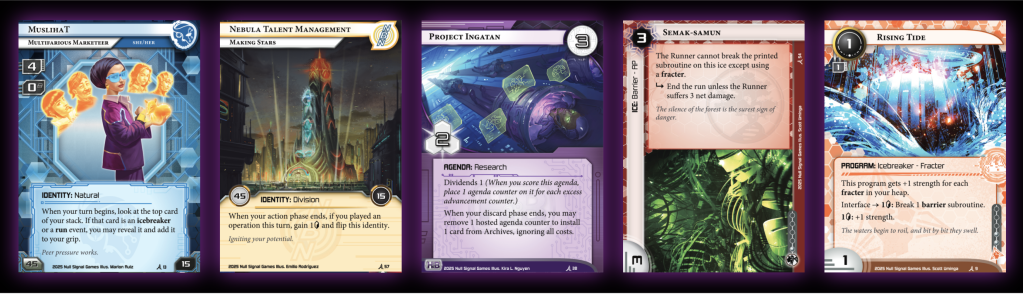
Similarly to VTES, Netrunner was initially published by Wizards of the Coast (1996-99) then abandoned. In 2012 Fantasy Flight Games produced a new Netrunner game (not backwards compatible with the first version) under licence from Wizards until 2019, at which stage the fan community took over (sound familiar?) and are actively producing cards for the game under a non-profit called Null Signal Games. As far as I understand Null Signal Games does not have the license to Netrunner however so their products are labelled as “Compatible with Netrunner”. They do however run the big Netrunner events and the like, so for all intents and purposes they run the game at the moment. It will be interesting to see if they can get the license proper one day, similarly to what has happened with Black Chantry and VTES. Both the FFG version and the Null Signal Games version operate as Living Card Games, i.e. there is no random booster packs, rather packs of cards have known contents so it is easy for players to get the cards they need
The Premise
I’ve covered this mostly in the opening paragraph, but in games of Netrunner one player takes on the role of the Runner and the other the role of the Corp. The Wizards version of the game was set in the Cyberpunk 2020 universe, while the Fantasy Flight Games (FFG) redo was set in FFG’s Android cyberpunk setting. The Null Signal Games version continues the story from the FFG game, although presumably as fan content rather than officially.
The game centers around the Runner attempting to break into the Corp’s servers and spoil their operations, while the Corp is building defenses and attempting to advance its (most likely nefarious) agendas. The Runner wins if they can spoil the Corp’s plans by stealing their agendas, and the Corp wins if they can advance enough of their agendas (or sometimes simply by killing the Runner with ICE (intrusion countermeasures electronics) and other nasty surpises).
As befits an asymmetrical game, the deckbuilding is … asymmetrical. The game has Corp cards and Runner cards. These are separate pools of cards – Corp cannot play Runner cards and vice versa.
To build a deck players first choose an identity. This card, which is not part of the deck, dictates some of what can be in the deck. First of, the card specifies the faction of the deck. This is similar to colour in magic: different factions are good at different things. There are three Runner factions and four Corp factions. The identity also specifies the minimum size of the deck (usually 40 or 45 cards but this varies), and finally the faction specifies how much influence the player has to spend. Influence is used to “buy” cards from other factions (think playing a second colour in magic). Every card in Netrunner has a faction and an influence cost that dictates how much influence a deck of another faction needs to spend to include that card. No influence is required if the card and the identity are the same faction. Minimum deck size and influence are interesting balance levers for identities, as identities also have abilities that can be really quite strong. Generally smaller decks are better in card games (VTES being a weird exception), so identities with strong abilities can be balanced by increasing their minimum deck size. The same is true for influence, being able to patch your faction’s weaknesses by bringing in cards from other factions is very strong, so identities that offer more influence have a big advantage (and thus identities with strong abilities can be balanced by a drop in their influence).
As you might expect, Runner cards focus on breaking ICE and running Corp servers. These things tend to be expensive to do, so Runners also need ways to generate credits (more on that later), whether that be by using job cards, or some other mechanisms. Corps also need cards that generate credits, as well as ICE cards to protect their servers. In addition, the Corp player must include a certain amount of agendas based on their deck size which has a big impact on Corp deckbuilding.
There is a maximum of three of each card in a deck.
Players build both a Corp deck and a Runner deck, and take it in turns playing Runner and Corp.
Gameplay
Both players can take a limited number of actions per turn by spending clicks. Runners get four clicks, Corps get three. Actions can be playing cards or taking one of the default actions (gain a credit, draw a card, install a card etc.). The Corp always gets the first turn.
As the gameplay is quite different for Corp and Runner, I’ll start by explaining Corp gameplay. The Corp starts the game with three servers – Archives (their discard pile), R&D (their deck), and HQ (their hand). The can create additional servers called remote servers where they can install cards to use their abilities. The Corp starts each turn by drawing a card. To win the game the corporation needs to score seven points of agendas. To score an agenda, the Corp needs to install it in a remote server (takes 1 click) and advance it enough times to be able to score it (the number of advances required depends on the agenda, each advance requires a click and a credit). Generally this is hard to do in a single turn with only three actions, so the Corp needs to make sure its agenda in progress is protected from the runner who is going to try to steal it. All Corp cards are installed face down, and only revealed when the Corp player chooses (and can afford it), or if the runner successfully runs the server in the case of cards installed there. While the runner cannot be sure that the card on the server is an agenda in progress (some non-agenda cards can also be advanced), they are likely to try to get to any card that has some advancement counters on it. To stop the runner from doing just that, the Corp player can install ICE in front of that server (remember Corp cards are installed face down, this includes ICE – the Corp can spring some really nasty surprise on the runner). ICE cards have abilities that the Runner needs to get through to access the server, and if the runner can’t, more often than not, the run will end and the card will be safe.
On the other side of the table, the Runner is trying to win by stealing seven point of agendas from the Corp. The runner does that by accessing cards in the Corp’s servers and hoping to find an agenda there. By default the Runner accesses all the cards in a server (i.e. looks at them and can score any agenda they find there) if they successfully run it. There are two exceptions to this, when accessing HQ (the hand) the runner draws a card at random, and when accessing R&D (the deck) the runner accesses the top card only. Either way if the card is an agenda the runner can score it. This of course requires getting through the defenses the Corp has likely put on their servers, and therefore the Runner needs to balance running servers (costs a click) and installing hardware/software/resources to help with bypassing ICE (all of which also cost clicks). The runner does not draw at the start of their turn so they also might want to spend clicks on drawing cards. If the runner does nothing, the Corp will win through advancing agendas, so the Runner is forced on the offensive. Go too early and the Corp’s ICE can stop you dead in your tracks. This tension is at the core of Netrunner and makes it a great game.
My Experience
I think I played Netrunner before playing VTES, but I can’t remember for sure. What I do know however is that I’ve enjoyed all the games I’ve played, even if the game is a bit overwhelming at first. As the Runner there is a lot of hidden information in play, far more than in Magic or VTES where hidden information is limited to the other player(s)’ hand(s). There is also so many potential actions a player can take for each click, and it’s very hard to know what is the best course of action at any given moment. A few games in however, you start to understand what is important in the game and have a bit more direction. What’s held me from getting into the game proper (until now) is that the out of print FFG cards were somewhat hard to get a hold off (at least for any kind of sensible price!). Null Signal Games have however rotated out the last FFG cards from the Standard format (the most widely played format) which means the cards in that format are all Null Signal Games cards now which are readily available – to add to this, all the Null Signal Game cards are freely available on the Null Signal Games website as PDFs to print out and play, how good is that! They do accept donations if you’re into what they do.
Wrapping Up!
It’s been a long post, so thanks for reading all the way to here! I hope my experience as a Magic player trying out other CCGs was interesting and that you’ll check out VTES and Netrunner. They’re both really cool games and very unique. They both are easy to get cards for these days (thanks to their extremely engaged fan-bases), which is fantastic. What I described in this post is a very rough overview of all three games and there is a ton more to discover in each, I had to skip over a lot of detail and this post is still very long by the standards of this blog.
Both games showed that the CCG genre could do quite different things than what Magic did (Luckily! It would be sad if the first attempt at a new game type was the last time someone innovated). I hope that by juxtaposing these games you can see how similar concepts were addressed in different ways in all three games. I would like to highlight a couple here:
It should be impossible and/or a bad strategy to play all the best cards in one deck
Magic does this with the colour system, unless you’re willing to have an extremely clunky deck it is hard to play cards in all five colours, and therefore you need to pick a subset of colours to play.
VTES does this with the discipline system. No minion has all the disciplines and therefore you must pick a subset of disciplines to play.
Netrunner does this much more explicitly with the Faction and Influence systems, putting a cost and a cap on out of faction cards in your decks.
Players should be limited in what they can do in a turn
Magic does this with the mana system, lands can only be tapped for mana once per turn and once that mana is gone, very little can be done until the next turn. Magic also does this with card draw, with only drawing one card per turn, the late game of magic often sees players unable to use all of their mana as they do not have enough cards in hand to use it.
VTES does this with locking minions, and limiting actions. Once minions take an action, they lock and can’t be used for any more actions that turn. The more minions therefore the more actions a player can take, but more minions costs more pool so this is a dangerous game. VTES also generally prevents minions from taking the same action multiple times in cases where they can unlock (i.e. only one bleed action per turn).
Netrunner again does this much more explicitly with the click system. You have a set number of actions unless you have a way of gaining clicks. Netrunner does this implicitly with credits too, many actions cost credits so are off the table if a player runs out.
If you know/play any of the games (or any other card game!) I’d love to hear what you think of them and if you agree with my take on them. If you’re not a card gamer, I hope you enjoyed looking at how the CCG concept was iterated on in its early days!
This post is a bit of a departure for me, this is the first non-painting related post on this blog I believe. I’m not sure if I’ll do this type of post more, but one of the things that drew me to blogging over instagram or the like was the ability to do longer form text, which I haven’t really done yet on here. I did enjoy putting this post together, so I hope you enjoyed reading it.
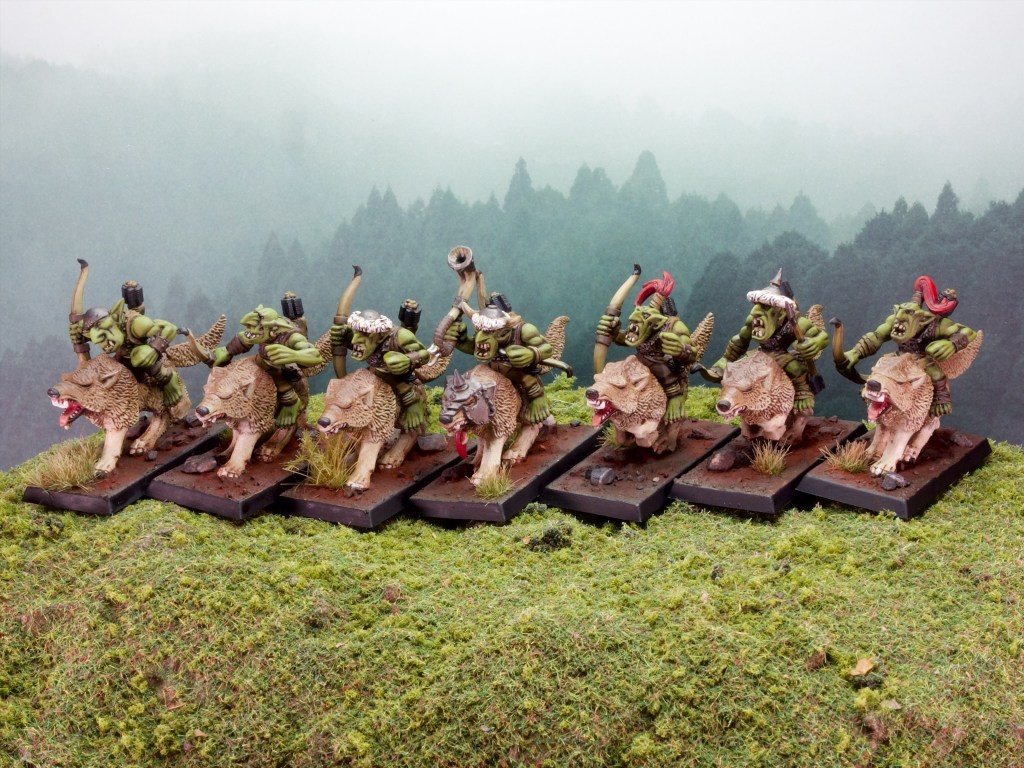
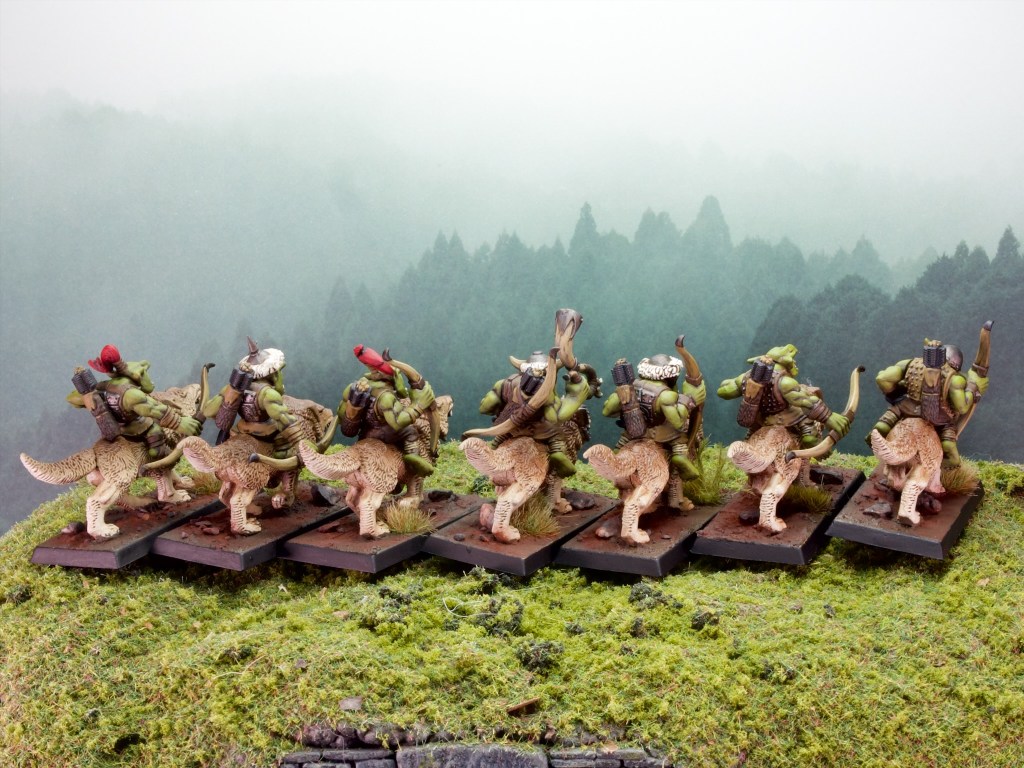
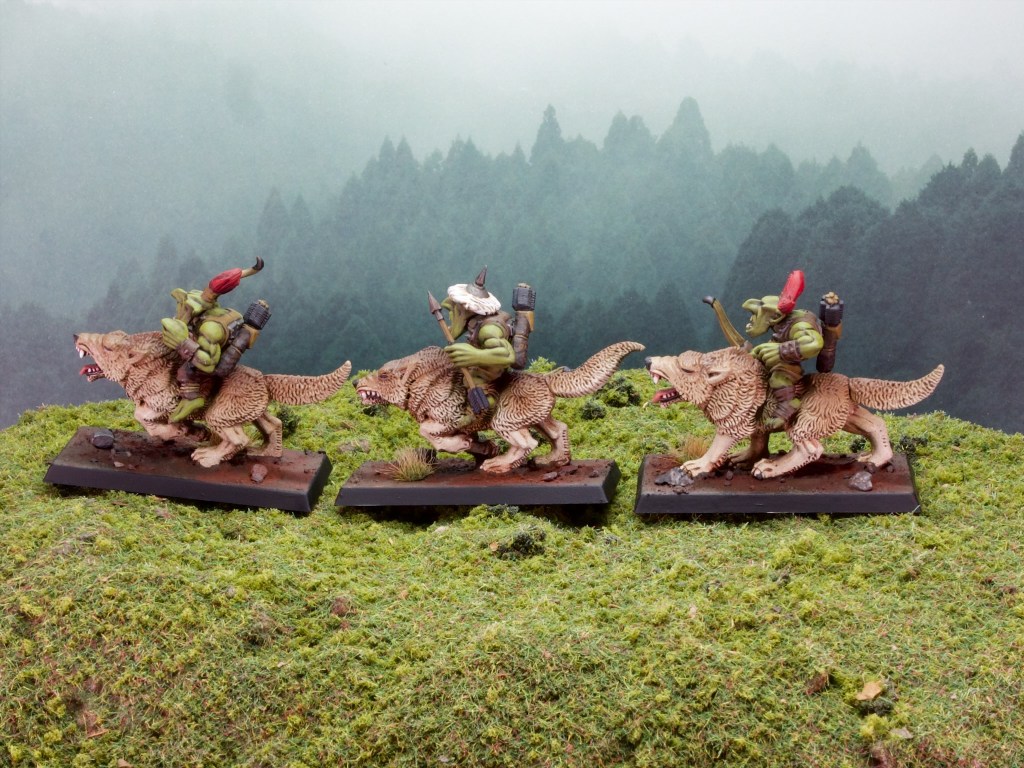
Back this week with more models for my Orcs and Goblins army: some Goblin Wolf Riders!
These are classic models (late 90s I believe!), which have been re-released as part of the current set of Warhammer Old World releases. This might be laziness on GW’s part, but I’m loving the fact you can buy some of these models without having to go through exorbitant eBay prices! These are the models that were current when I started the hobby, and couldn’t afford them at the time so this is very much an exercise in nostalgia for me!
I really enjoyed painting these, the goblin riders are so characterful and the old style “big” detailing is a joy to paint. For the wolves I tried something a little bit different. I really wanted a nice gradient on the furs so I basecoated them using the airbrush, starting with a cream colour all over then doing narrower and narrower bands of darker browns over their backs. I chickened out of doing highlights over this gradient so I decided to use oils to shade the furs so I could wipe them off of the raised areas. You can see the effect in the photo below.
I think that worked out pretty well, it’s not quite as clean as properly highlighting things, but it is much more expedient which is exactly what I’m after when painting army models. I have a second unit of these to paint up for the army, so I’ll be reusing the technique although I will be changing the colours to have some grey wolves for those.
For the Goblins themselves, I reused the recipes I laid out last post for the Warboss, so check that out if you’re interested!
Now I promised a couple of posts ago to post some photos of the first games of our Border Princes campaign and promptly forgot to include them in the last post, so here they are, better late than never!
If you remember the last update, my Dwarfs were attacking the Fortress at the center of the map, defended by the Bretonnian force I’d painted up for this purpose. As I was the attacker, one of the other players stepped in to play the defenders and we had a siege game!
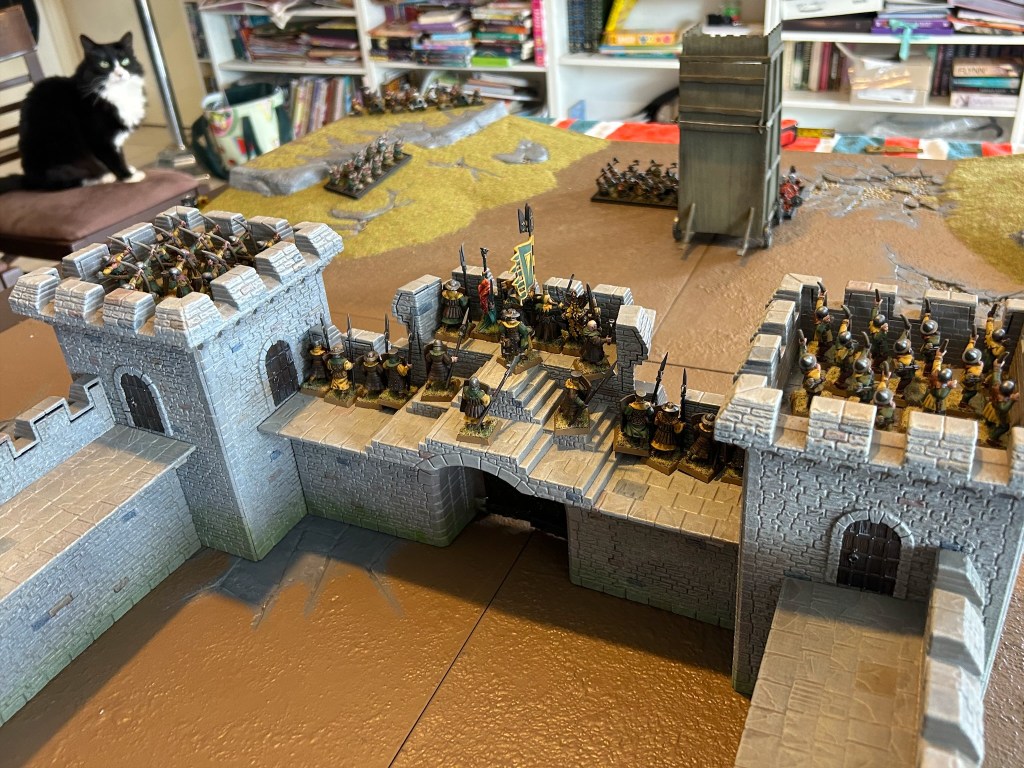
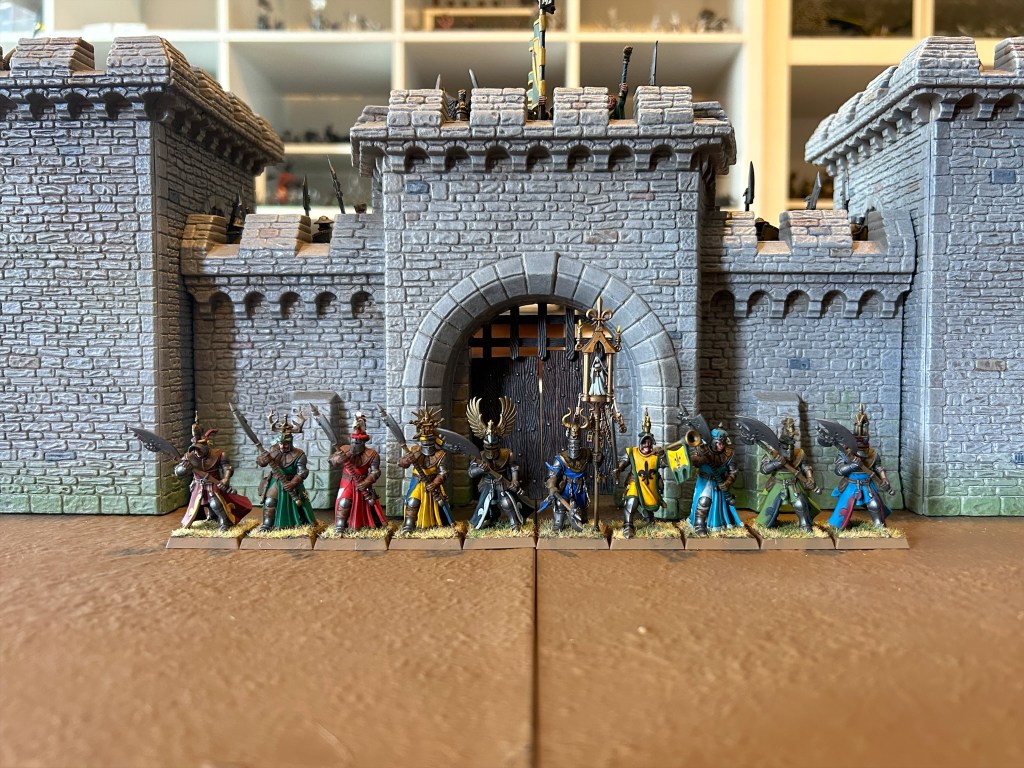
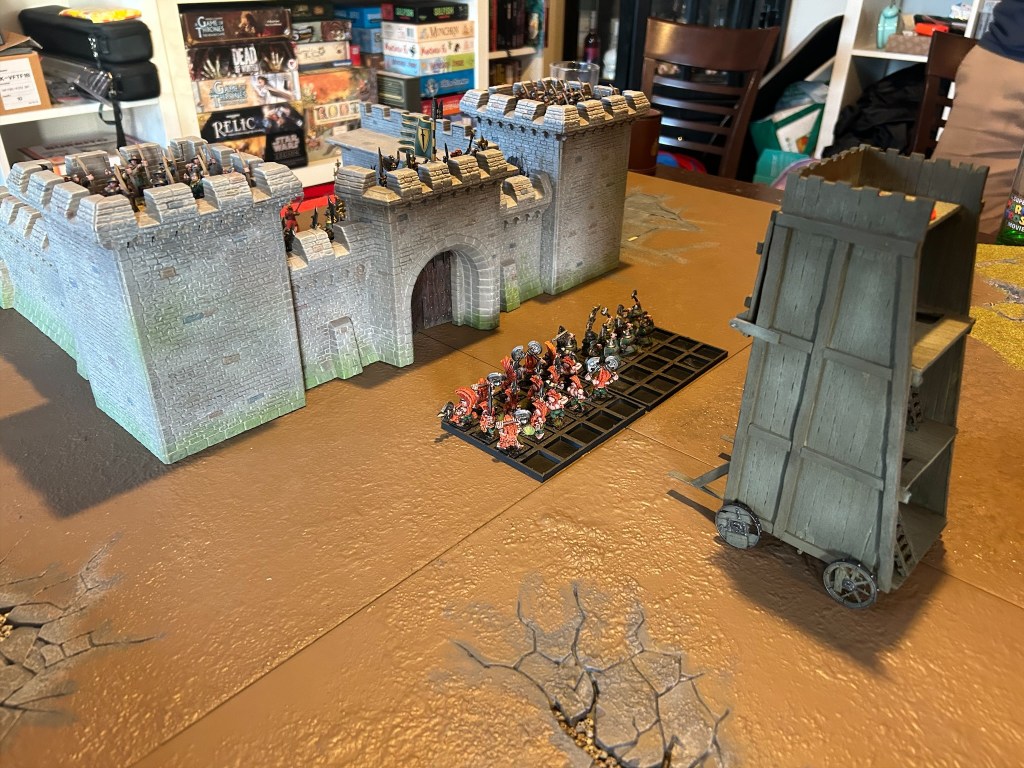
The initial setup: two blocks of dwarf infantry pushing the siege tower and ranged units on the hill. On the defending side the walls are occupied by archers and men-at-arms, and surprising the attackers the unit of knights deployed outside the walls!
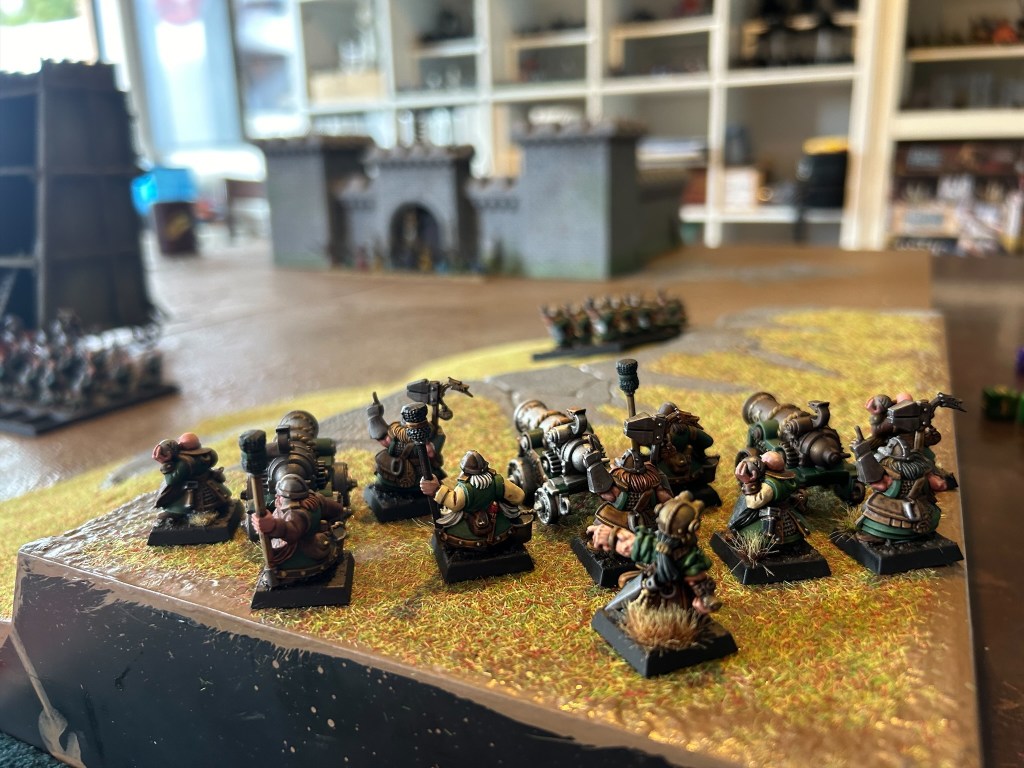
Cannons lining up the castle gate
The defenders look on as the attacking forces assemble.
The knights form up … outside the gates!
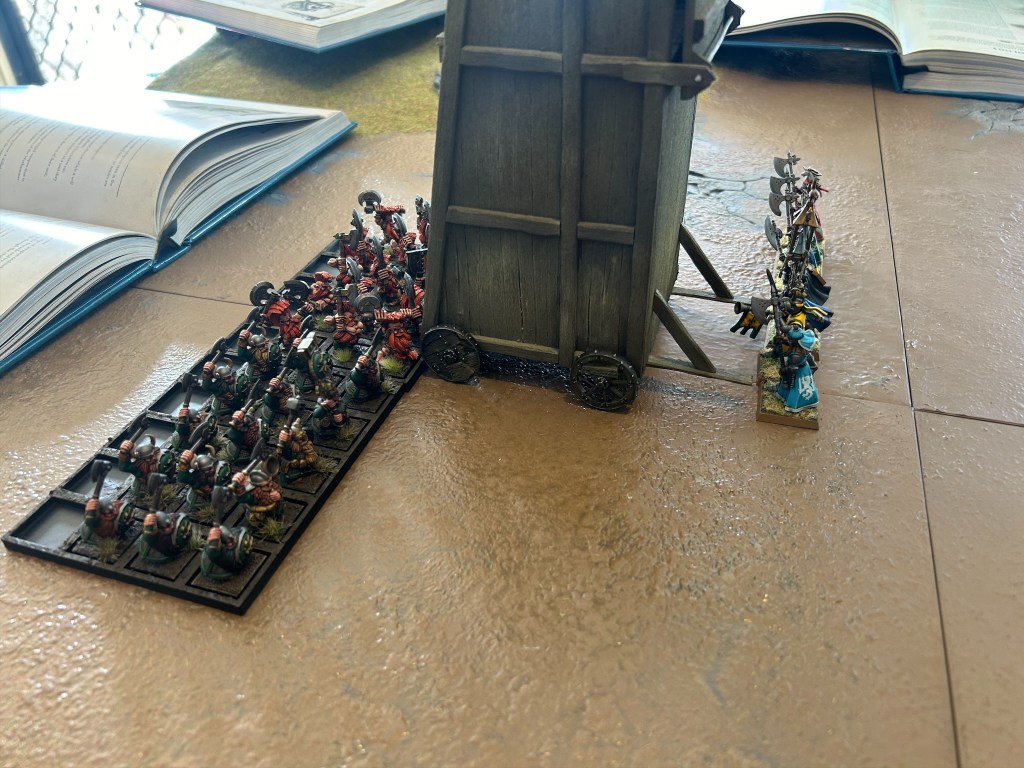
The cannons started shooting the gates, failing to do much and one of them misfired even with the engineer there to give it a re-roll! Luckily it only had to skip a turn, losing a war machine this early in the game would have been dreadful! The Siege tower was pushed forward by the dwarf infantry. On the defending side the knights advanced, resolved to chop that siege tower to scrapwood with their axes! On the walls the archers started shooting at the siege tower and managed to inflict some damage to it (presumably some critical ropes cut!). The following turn the knights managed to close in on the tower and almost destroyed it in combat!
The knights close in on the siege tower… and start hacking!
The dwarfs did not take kindly to this attempt to cut down their handywork and retaliated, closing in on the knights. The Demon Slayer and his rune axe made short work of the knights, but the damage was done, the siege tower on a single wound was more of a liability than anything else at this stag. The dwarfs abandoned it, taking a page out of the Knight’s book and deciding to use their own axes on the fortress gate.
The Dwarfs abandon their tower.
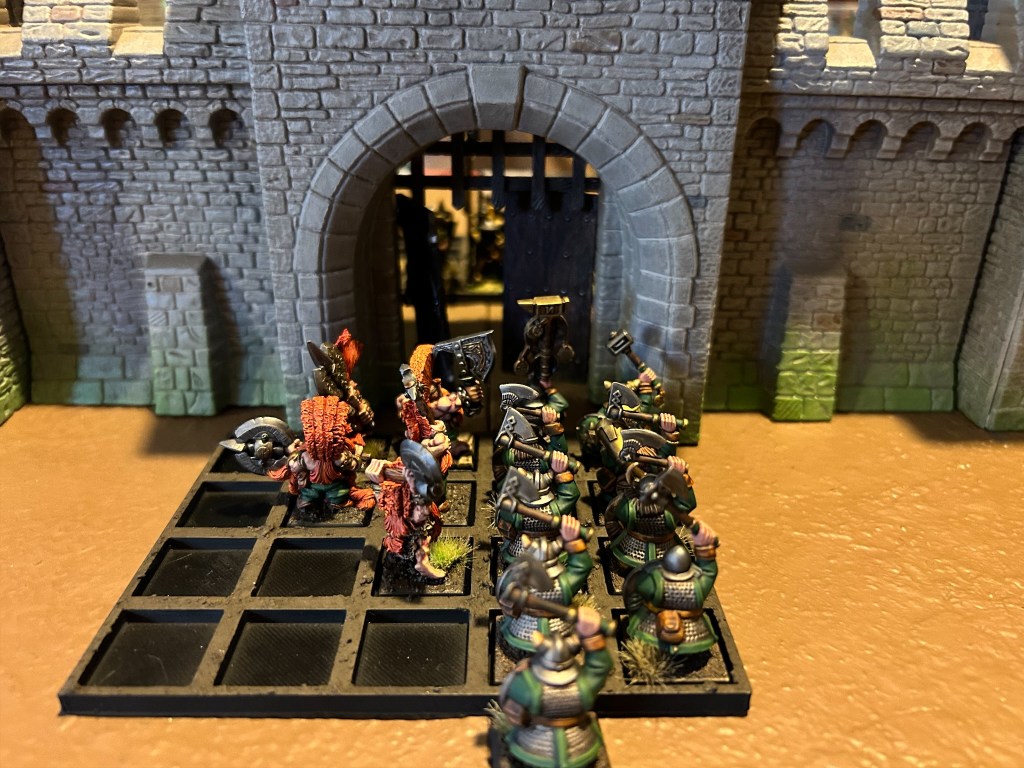
Under a hail of arrows the Dwarfs approached the gatehouse and got to work hacking down the gates. The cannons had finally started doing some damage to the gates and the rune axe of the Demon Slayer crashed through the wood of the gates soon enough.
The gates crash open!
Once inside the walls, a desperate melee started between the Dwarfs and the Men-at-arms led by the Baron started. The combat was inconclusive, but the last turn had arrived and the Dwarfs won the day, having taken the gatehouse and slain the knights for no full units of their own lost (although as you can see above those archers did a lot of work on those units!).
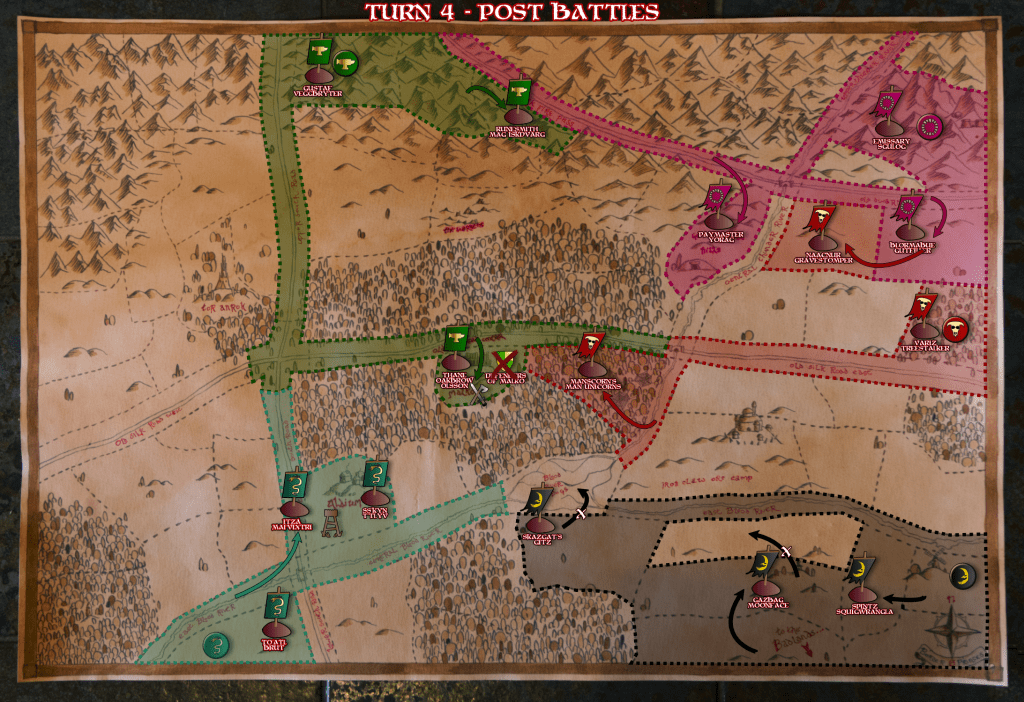
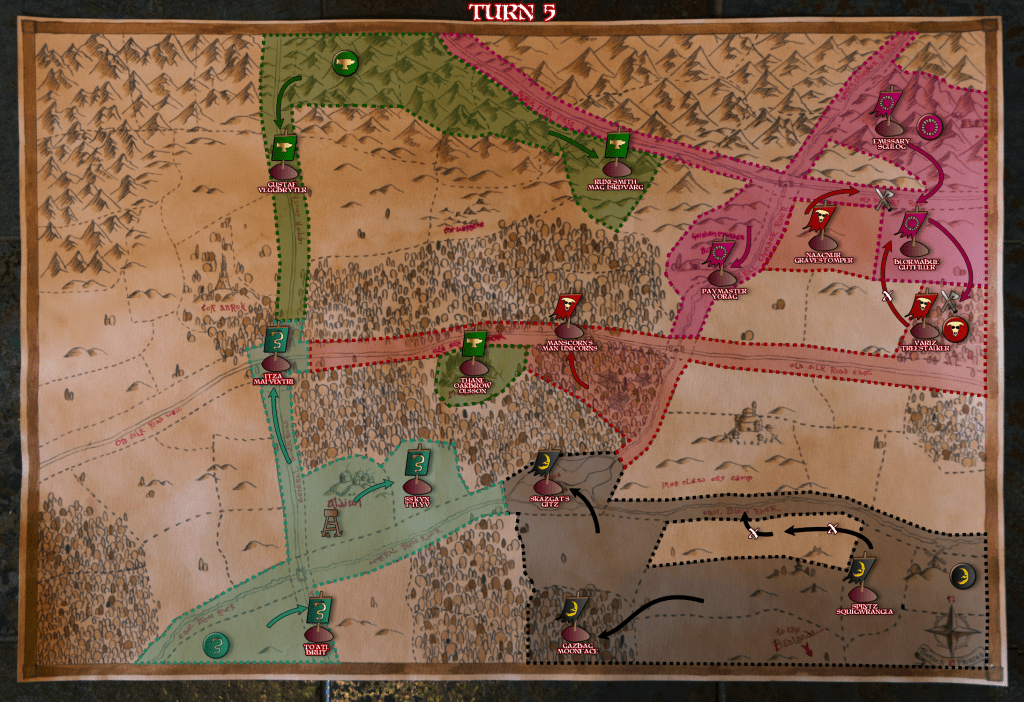
This battle resolves turn 4 and the map above shows the state of things as the turn ends.
The players made their moves for turn 5, and we have two battles lined up for this turn! Both feature the Ogres and the Beastmen, with the Ogres attempting to seize the starting location of the Beastmen, and the Beastmen trying to take the river section off the Ogres.
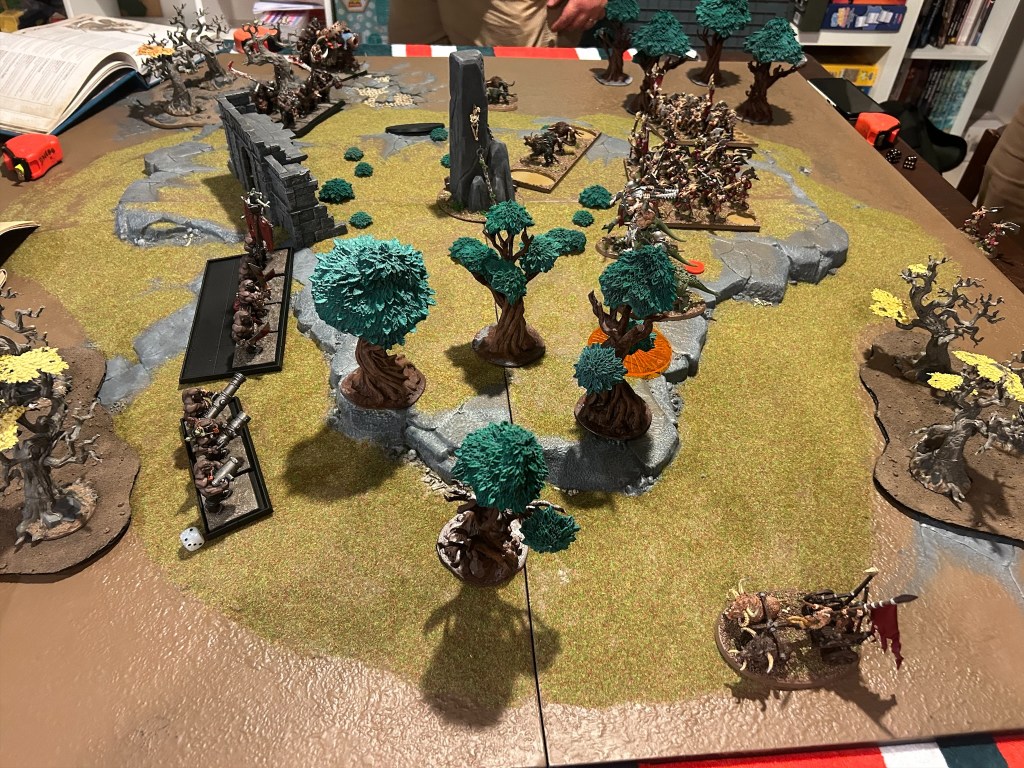
The defense of the Beastmen home territory has already been fought, although unfortunately I did not get to take many photos.
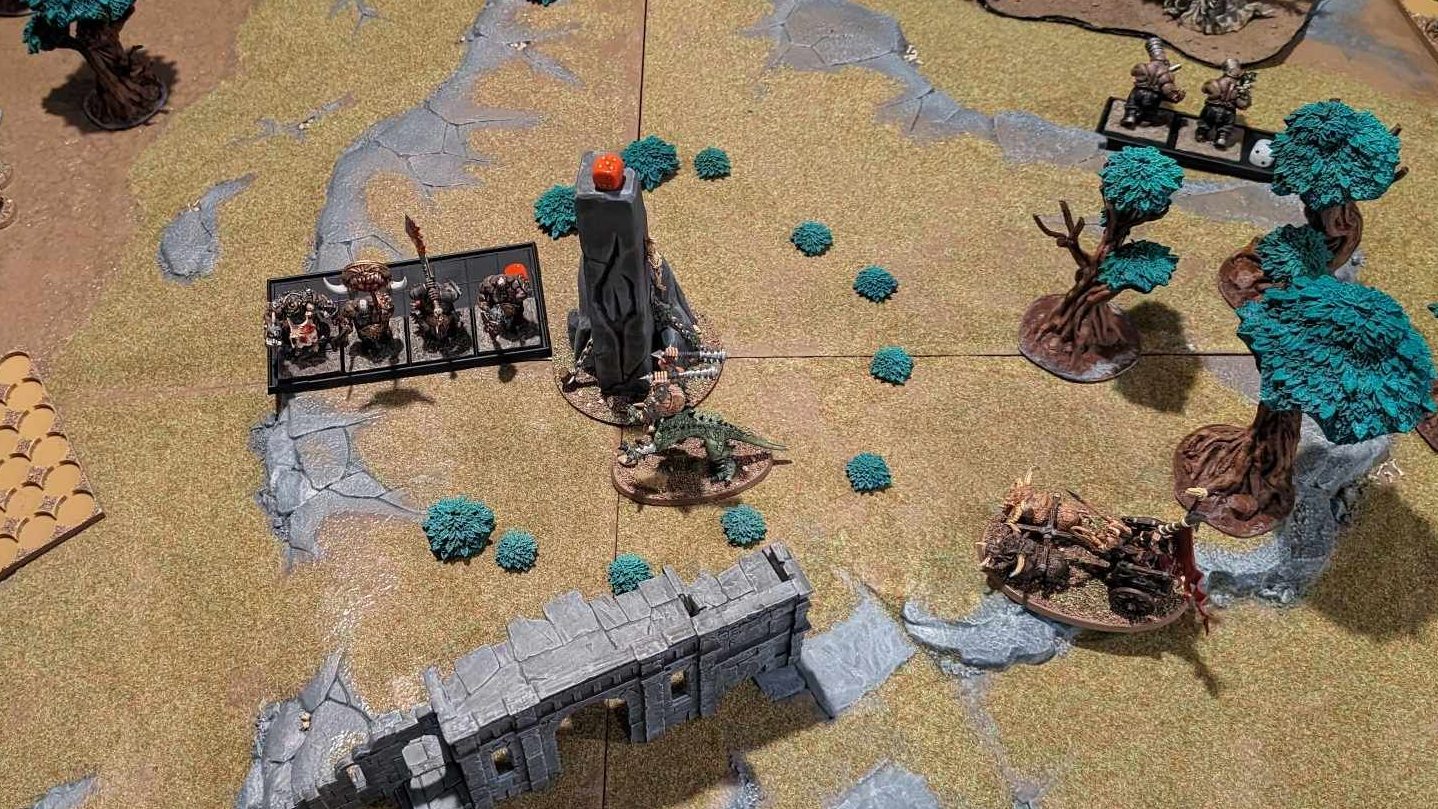
The battle was fought in a heavily wooded board, with the beast’s herdstone as the primary objective.
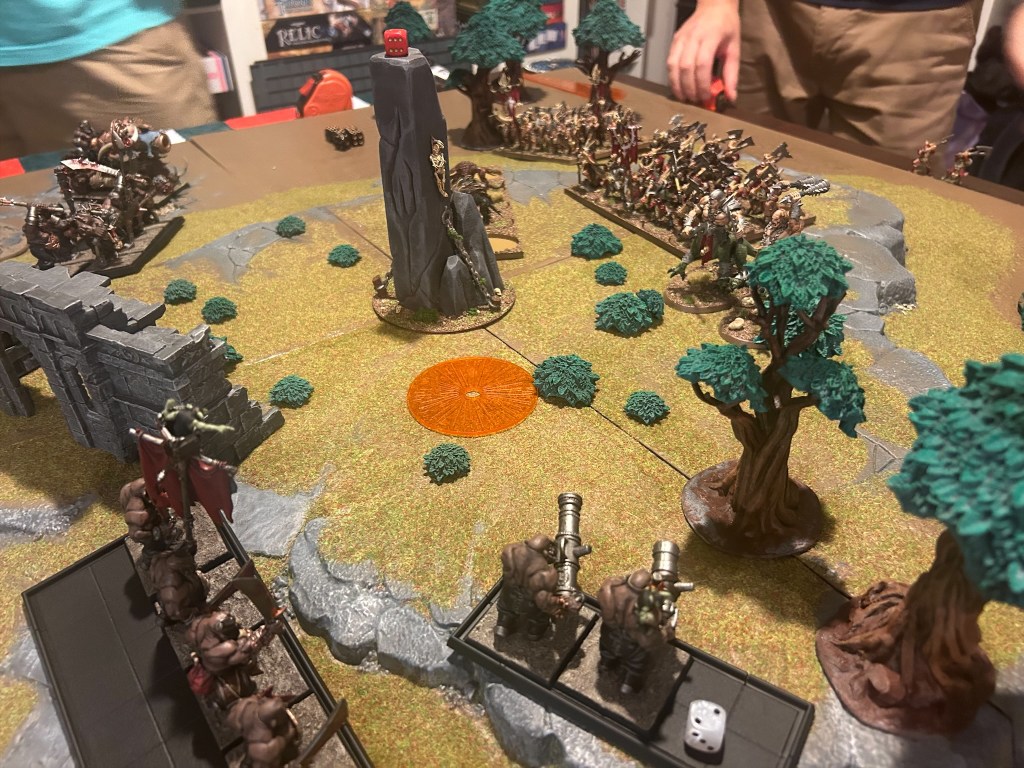
Things got very heated up in the area surrounding the herdstorne as both armies maneuvered to capture it.
Despite a desperate attempt by the beasts to reclaim their herdstone the Ogres won the day.
Hopefully you’ve enjoyed this longer than usual post! Plenty of gaming action in the coming months as this campaign gets played out, and I hope to be able to photograph most of it!
As I mentioned last week, we’re preparing for a siege game as the opening battle in our Border Princes campaign. Last week’s post covered the last of the defenders, and this week’s will cover the preparations I made to the attacking force: my Dwarfs!
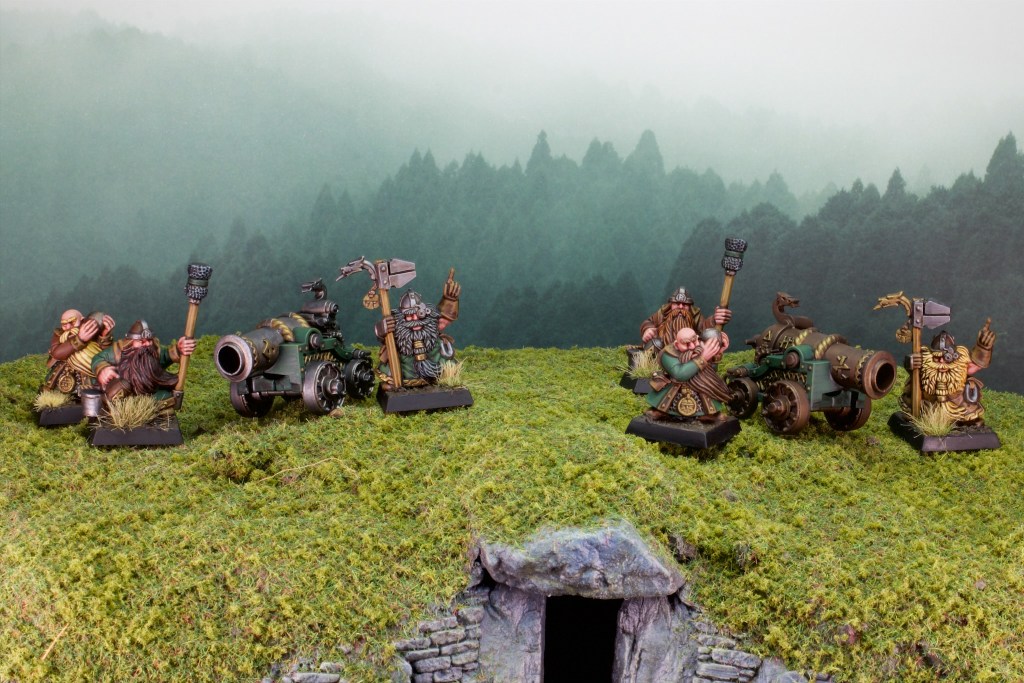
As you can see in the photo above I decided that I needed more firepower! I painted two extra cannons this week to breach the gates of the fortifications, which is one of the main objectives of the scenario.
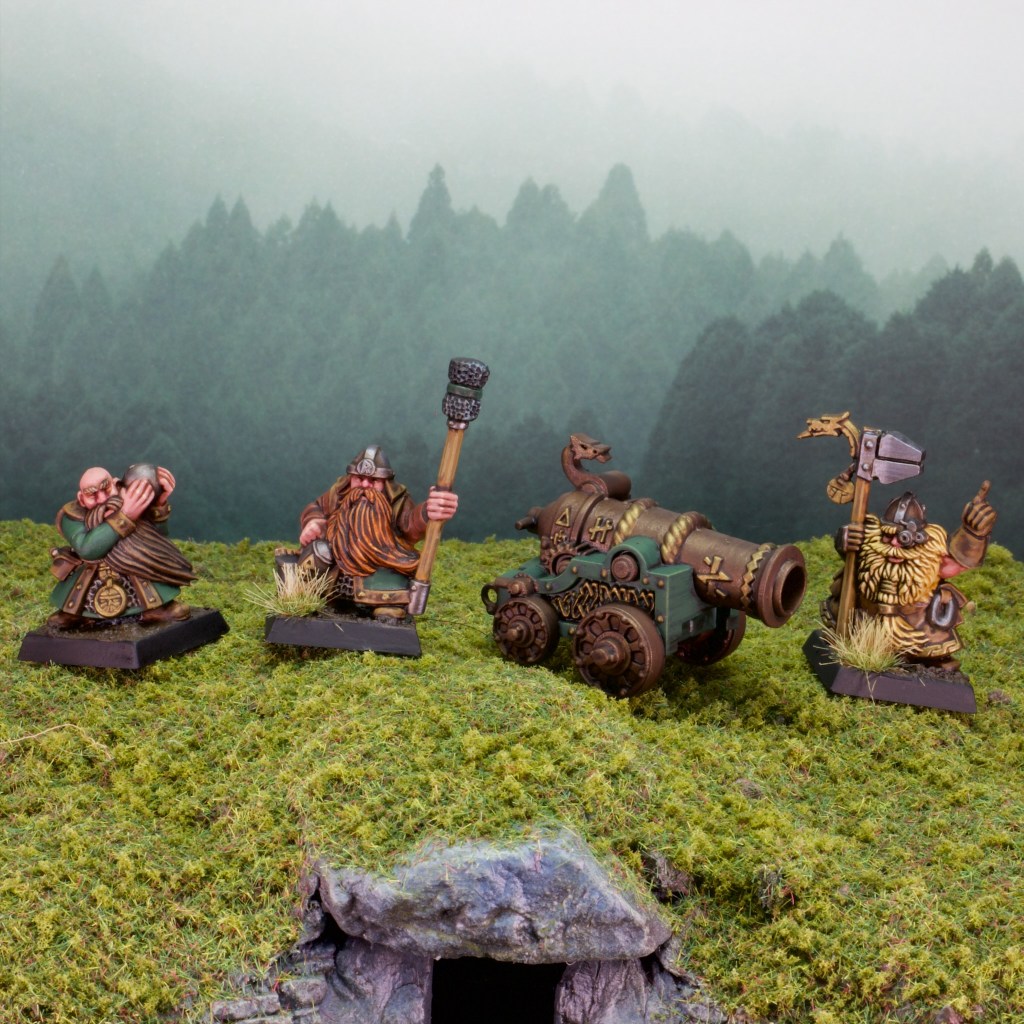
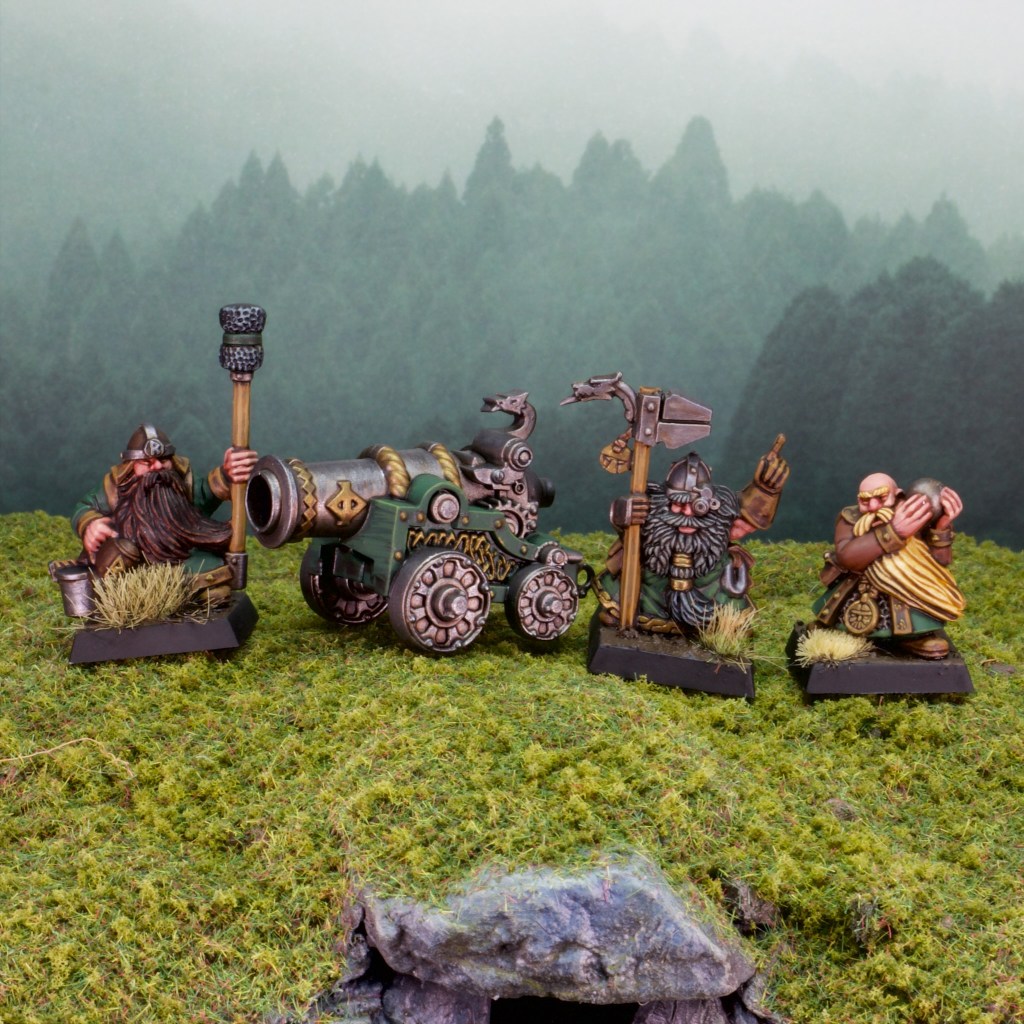
I painted the two cannons different colours to add a bit of variation to the models, considering this is the third of this cannon model I have in the army now. I picture dwarfs as being more artisanal craftspeople and therefore making the cannons as they see fit rather than follow a set pattern.
Of course the crews also being one piece models there is no variation in them, so once again I used colour to differentiate them, mostly through the beards but also by changing the colour of some of the clothes.
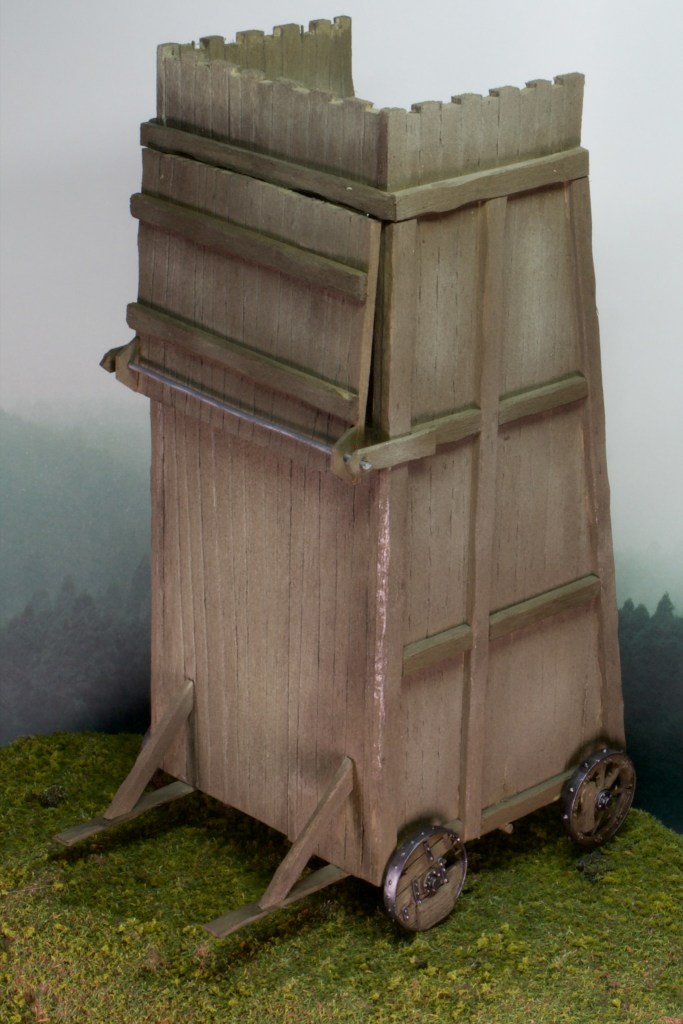
While the cannons attempt to breach the walls, I have another way to cross the walls: a siege tower!
I built this a while back and haven’t had the need until now to paint it. This siege game is the perfect excuse to get it finished and on the table!
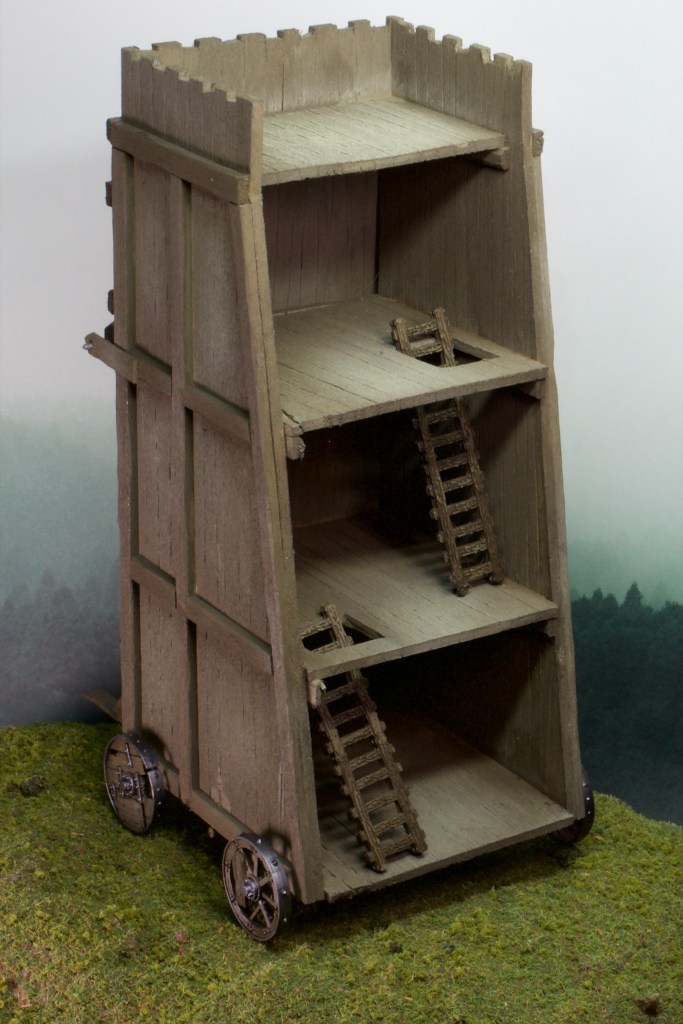
The tower itself is built out of balsa wood, with the wheels from the Skaven warp lightning cannon kit. The ladders are 3D prints I did a long time ago for the This Is Not A Test games we were playing back in 2021. They ended up fitting rather nicely here!
I kept the tower rather faction agnostic so that it can be used for any siege game, it is probably less well constructed than Dwarfs would like, but much better constructed than Orcs could manage!
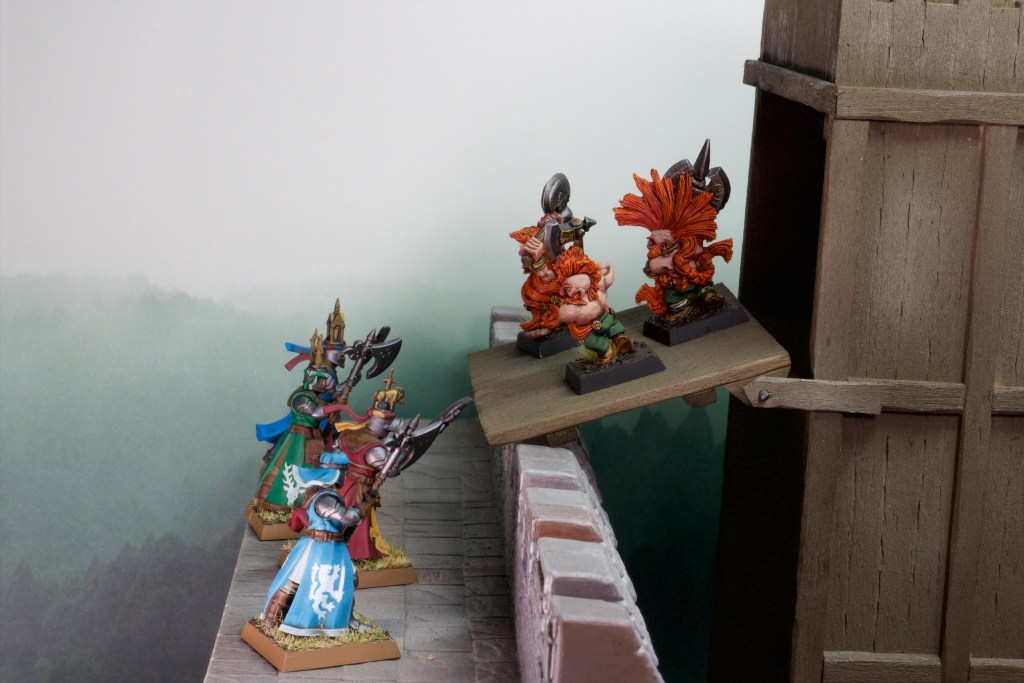
The platform at the front of course pivots, ready to come crashing down on some battlements and disgorge its occupants! I’m planning on filling it with dwarf Troll Slayers, so the above shot is probably a preview of the game to come!
The game is tomorrow and I’ll endeavour to take some photos that I’ll post here.













 Lair of the Lagomorph