Japanese January

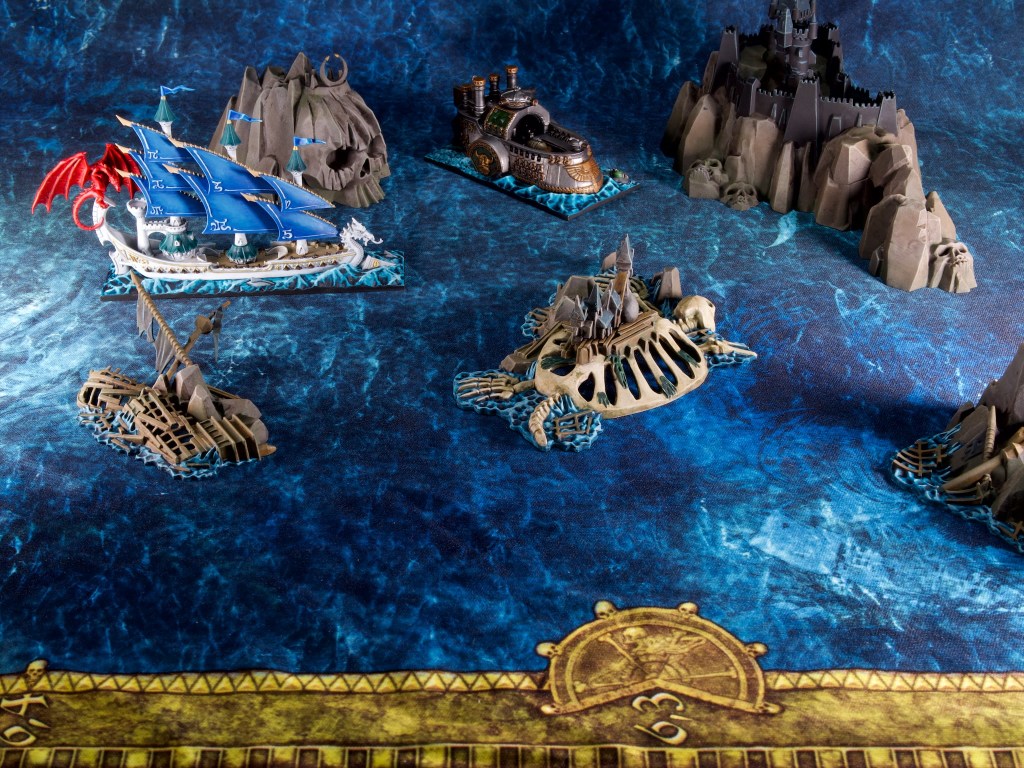
I’ve been in contact for a few months with John over at Just Needs Varnish!, over which time we decided to tackle some of our respective Japanese backlog. He had some turn of the 19th century Japanese forces in need of painting, and I’d been sitting on a collection of unpainted Sengoku era miniatures for a couple of years.

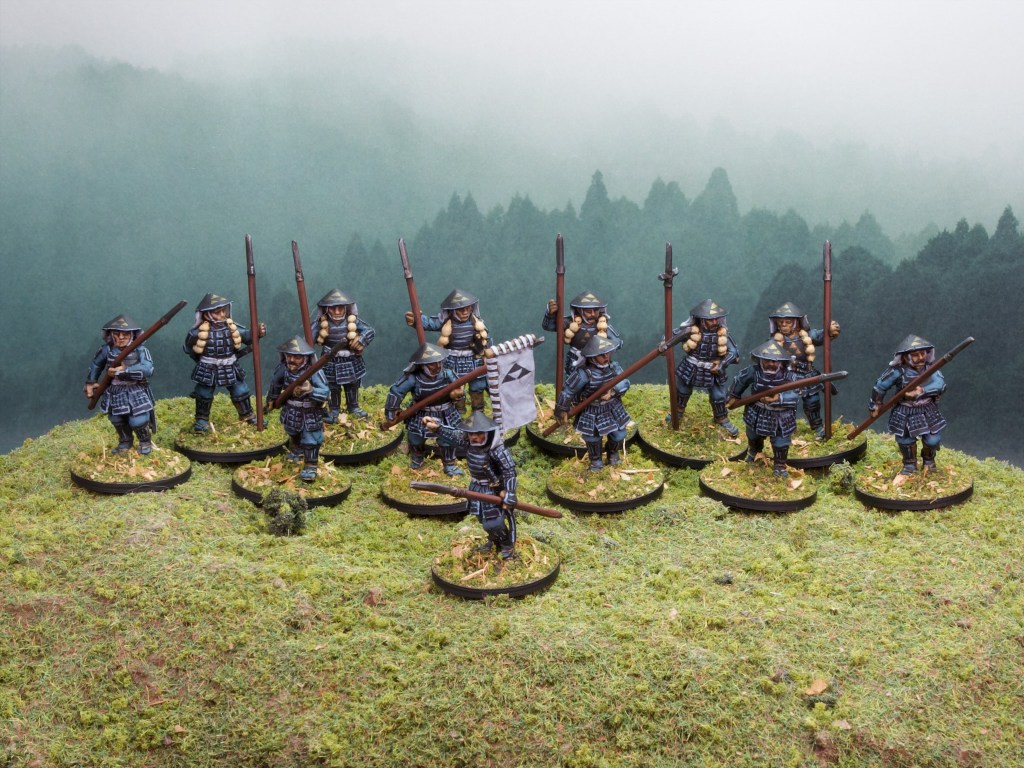
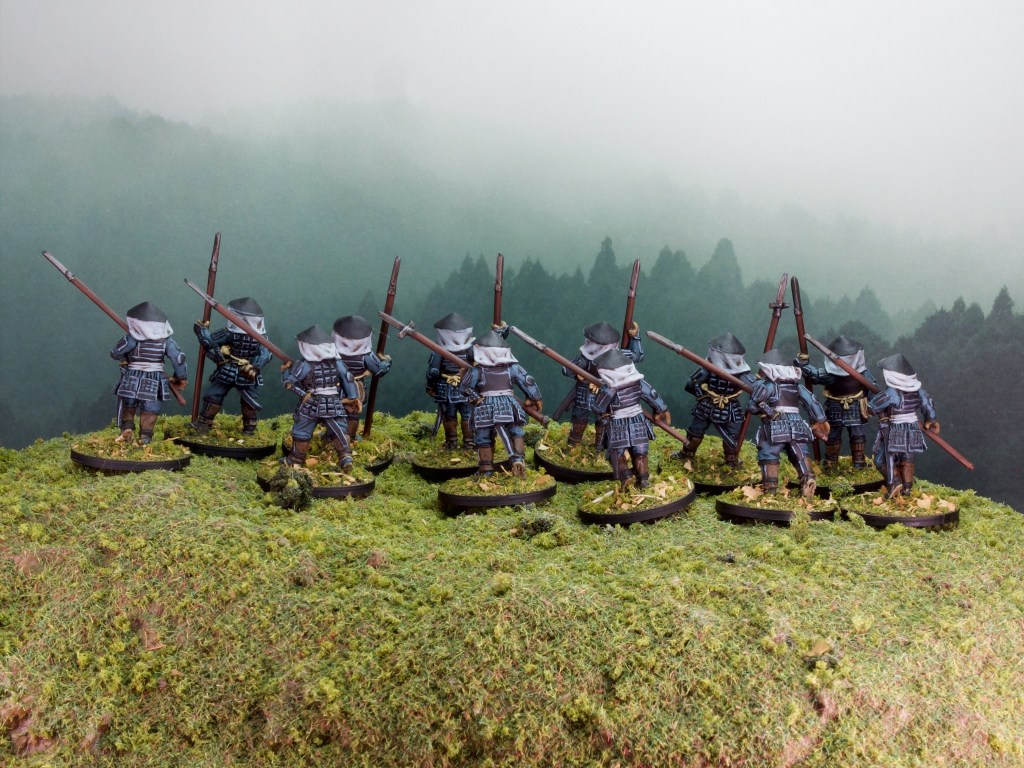
I decided to kick off my Sengoku collection with some spear Ashigaru. The models are from Perry Miniatures and come in boxes of 6 metal miniatures so what you see in the photo above is two boxes of spearmen and a lieutenant from the ashigaru command box also by Perry.

The resulting odd block of 13 models works well for my current target rules system for playing this era: a repurposing of the MESBG ruleset. It’s one of my favourite skirmish systems and I think lends itself very well to historical gaming. The game system is very flexible and makes it easy to represent mixed units as the models are individually placed and moved. In MESBG you pick armies by assembling warbands lead by character models, with 12 models lead by a minor “hero” being pretty standard for the game. This means this group of 13 above makes for a nice warband.
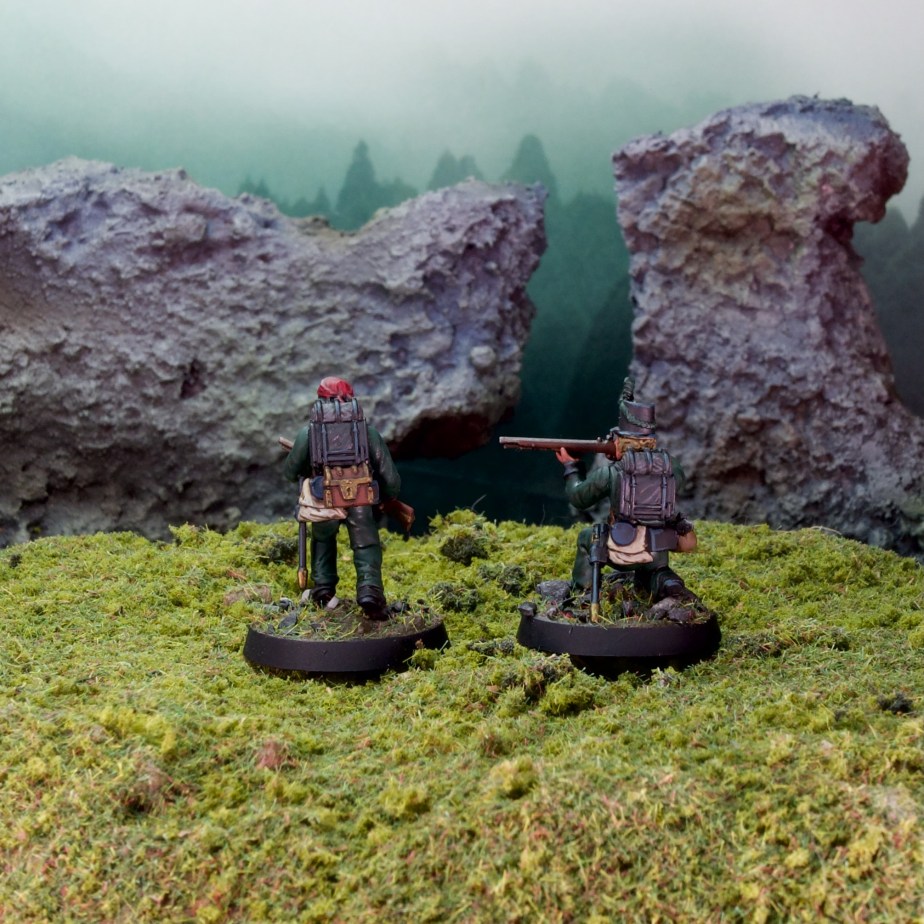
If you’re familiar with the period you might have recognised the mon (emblem) of Clan Hōjō, with it’s three triangles (representing fish scales if I understand rightly!). I decided to go with this clan as I visited some the region they ruled over during my first visit to Japan back in 2015 and really liked it, it’s one of my fondest memories from that trip. In fact the foggy forest photo I’ve been using as a backdrop to my miniature photos for quite a while now was taken there! So the backdrop is very appropriate for these models.

Painting-wise these were relatively simple, with the black and blue scheme heavily reliant on Vallejo’s Dark Sea Blue. I used it both for the cloth areas and the highlights on the black, just mixing in different levels of pale greys in for highlights to differentiate them. For the skin I followed the recipes in my previous Samurai post.

I was planning on tackling some buildings I 3D printed early in the month but simply ran out of time, so they will appear on the blog at a later date when I get around to them!

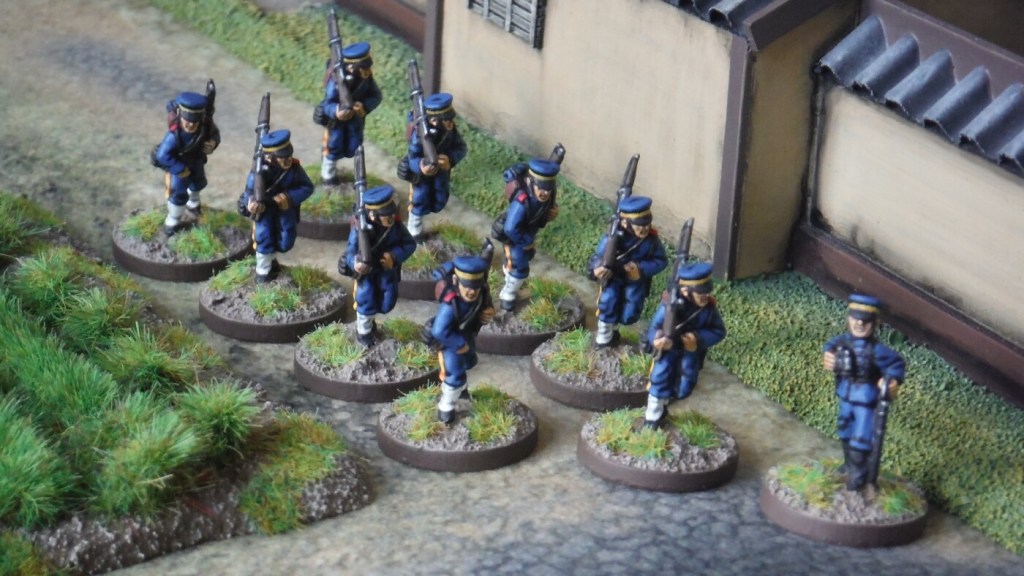
John got some great results out of our themed painting month, painting some very nice cavalry and some matching infantry that you can see pictured above. Overall this was a fun exercise, and got me to paint some models which I had no immediate plans to tackle which is always a nice plus! So thanks John for the motivation, and I recommend you all go check out the models John painted (and generally follow his blog, lots of great stuff on there).

River Trolls

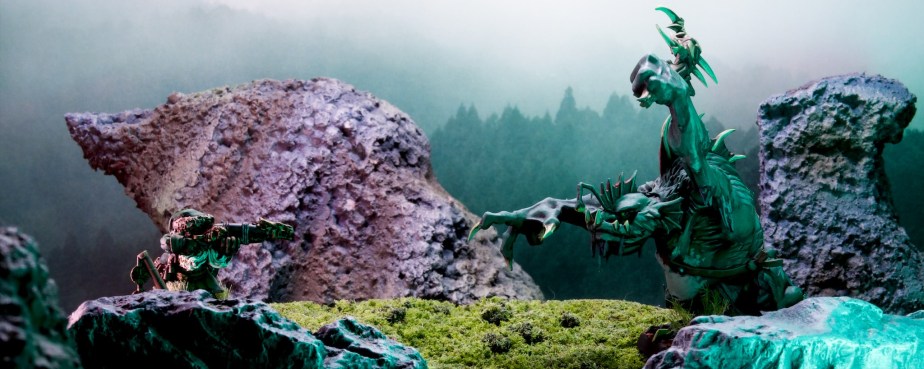
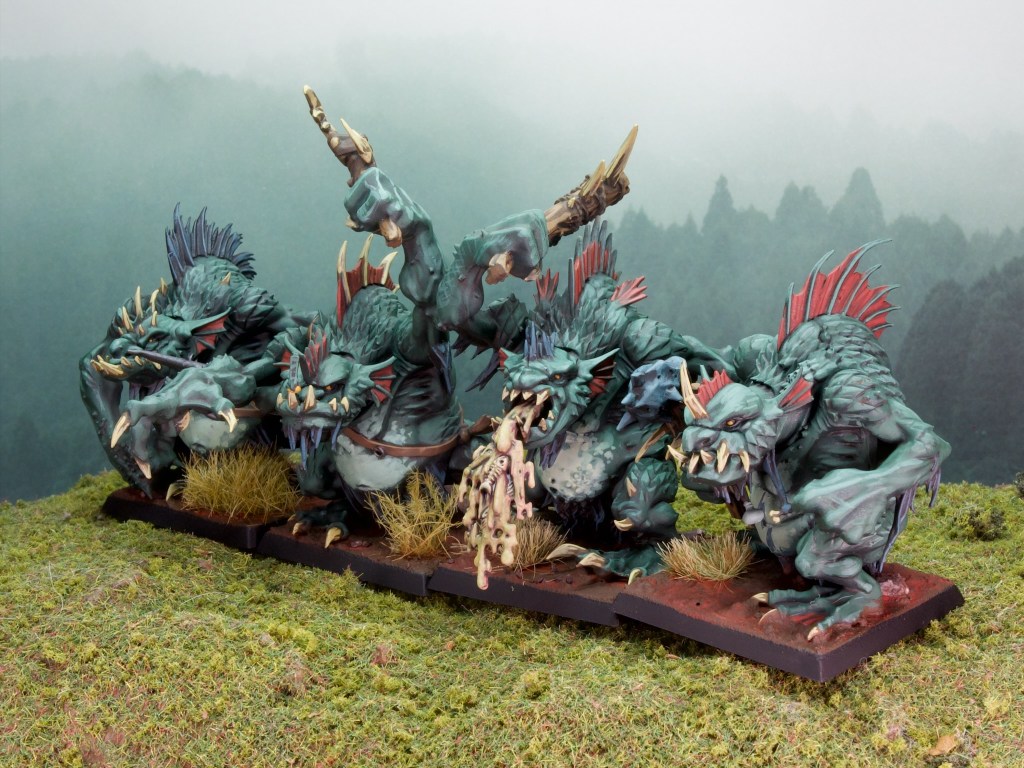
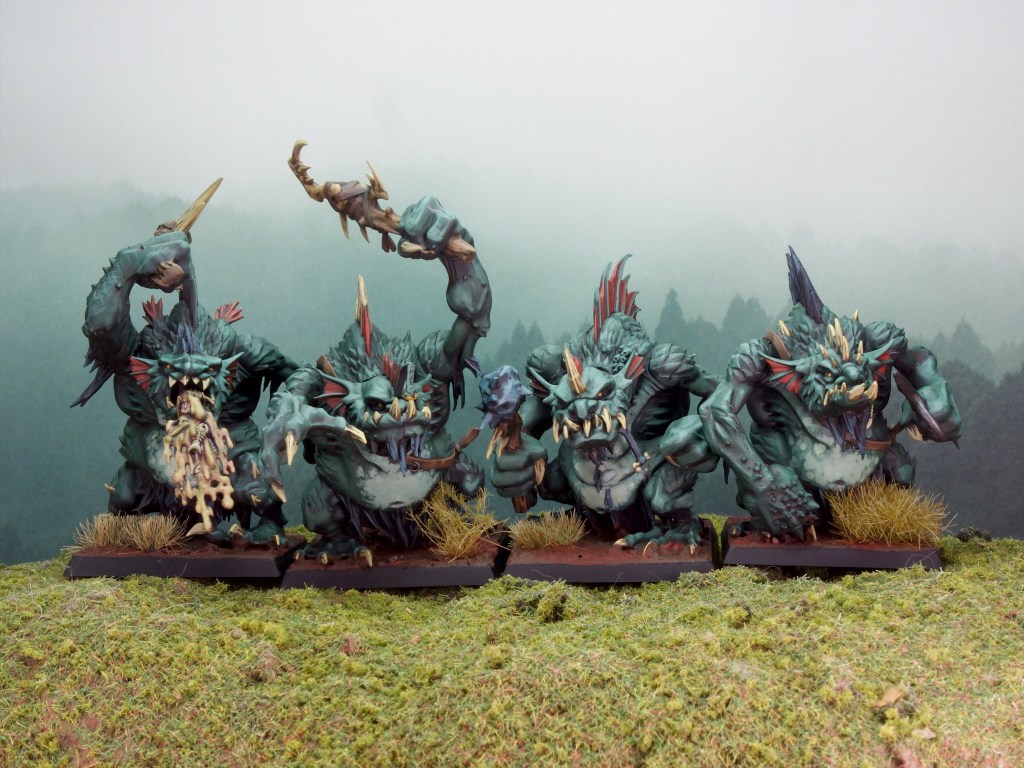
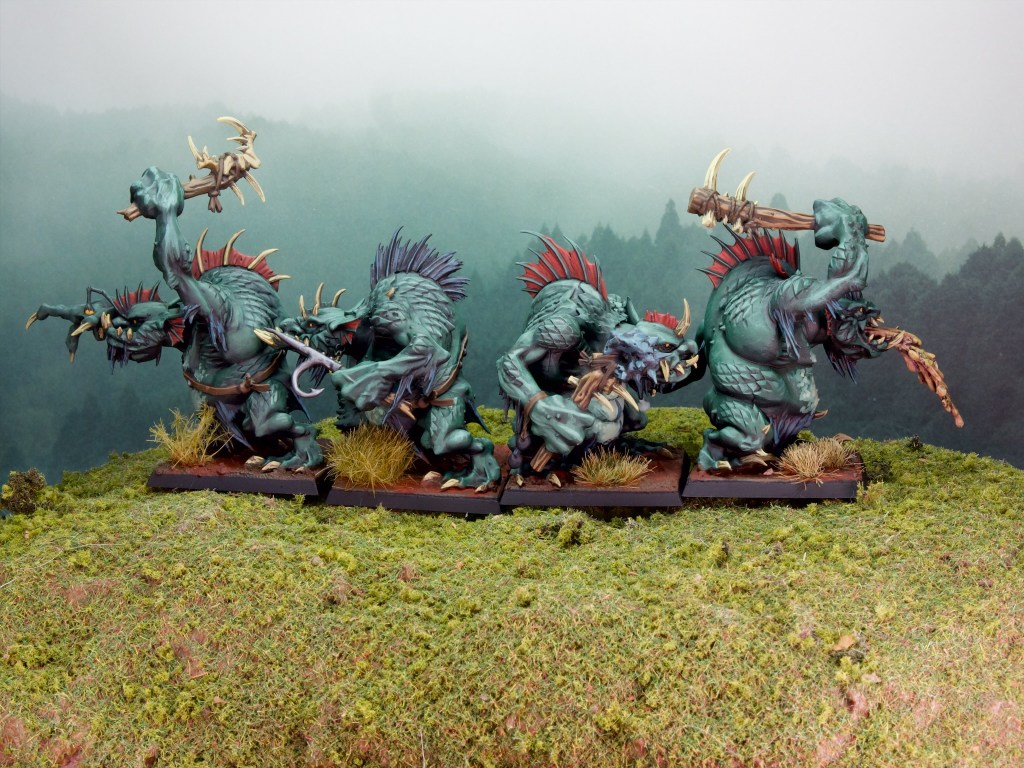
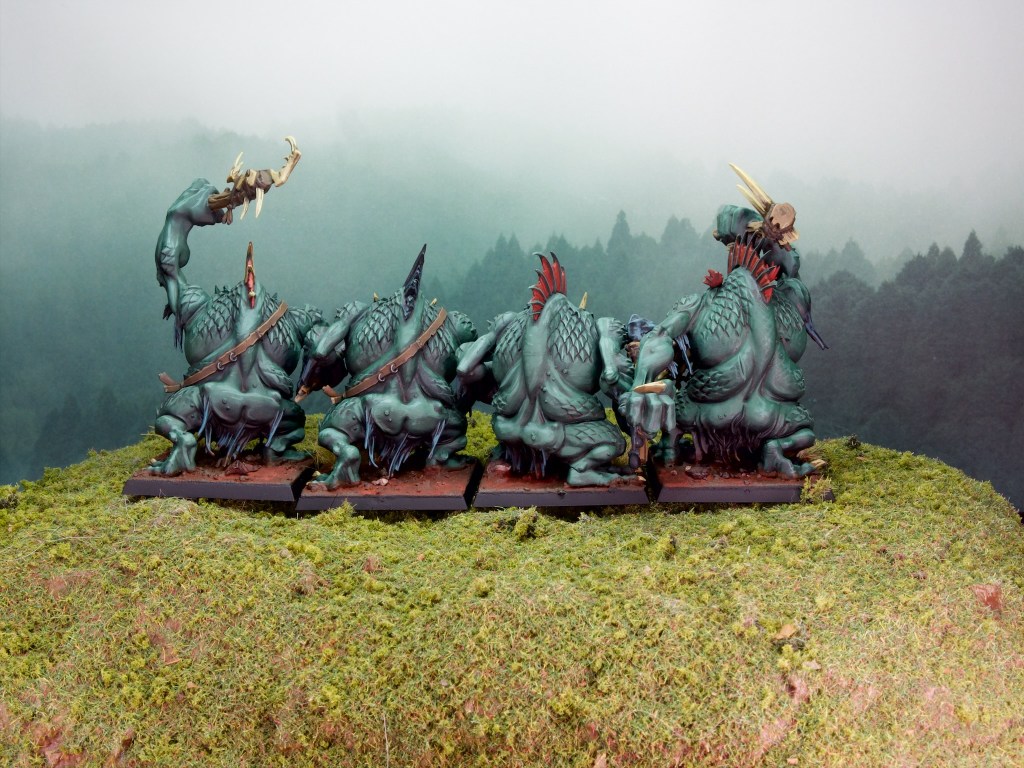
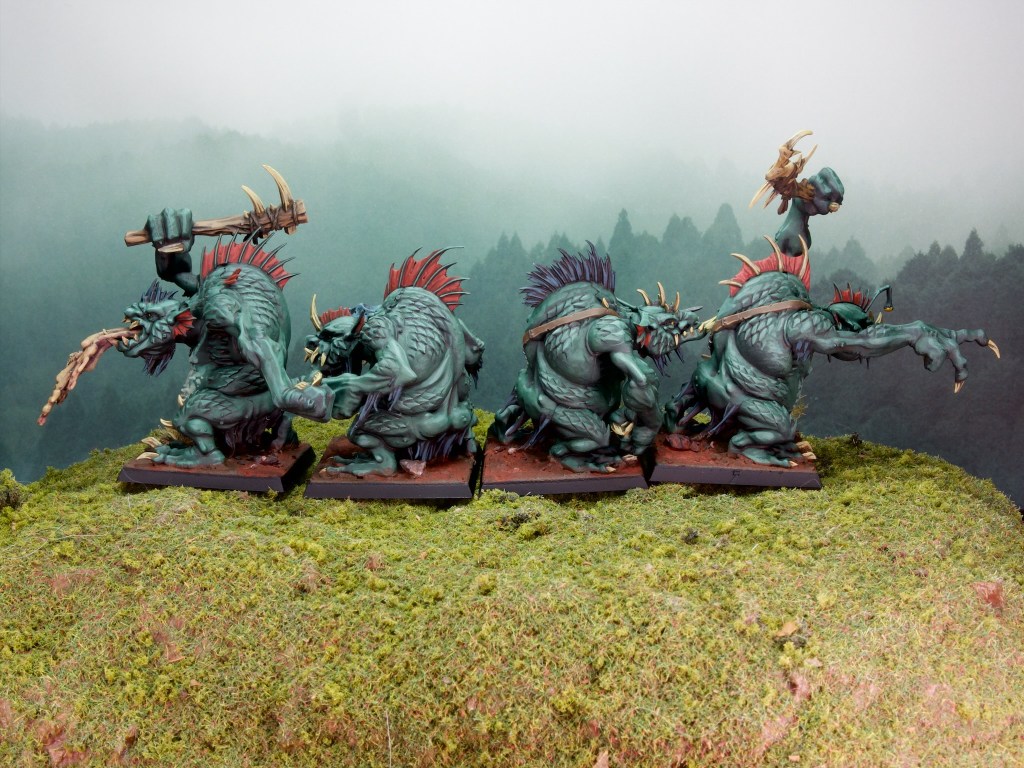
With some leave over the Christmas break I’ve had a bit more time to paint (and game!) and have managed to get through a unit that I’d applied a basecoat to back in September-ish: River Trolls!

I’ve had these models for quite a while. I originally bought them to make Chaos Trolls back in the early 2010s and instead left them unbuilt for 10 years. It’s therefore nice to have them done for this latest project.

The models themselves are quite fun to paint as they have a decent amount of detail, much of which is quite characterful (including the infamous troll vomit!).

For units that are relatively unique in armies (i.e. that I won’t have to paint again) I like to experiment a bit with my painting. In this case I played around with oil washes in a slightly different way than I usually do. Normally I dilute my oils heavily with thinner, apply, blast with the hairdryer for a minute and get wiping the raised areas away with a sponge. I’ve had issues in the past with oil washes looking but not actually being dry by the time I varnish the models and found a few months later that the model has gone a bit tacky. Luckily this is easy to fix with a fresh coat of varnish. Here instead I went for a heavier wash (less diluted) and let it sit for a day or so before touching it. I was a bit worried that would limit my ability to wipe off the excess wash, but those fears were unfounded, and in fact I found it easier to get nice gradients with the wash in this way. To make sure the wash was dry before continuing, I left the models for another day or so, monitoring the areas where the wash had pooled the most. It’s a time consuming process but the results are worth it. Luckily for me I had something else to paint while I was waiting, which I will show later!

I wanted a cold green for these models to match their “riverness”, so I went for a basecoat of Vallejo Game Color (VGC) Heavy Blackgreen, and progressively mixed in more and more Vallejo Model Color (VMC) Pastel Green. The red fins are VMC Mahogany Brown, highlighted with a mix of the same brown and VGC Dead Flesh. The hair/fur is a mix of VMC Dark Sea Grey and VMC Black, highlighted with a mix of VMC Dark Sea Grey and VMC Pastel Green. The teeth/nails were a basecoat of VMC English Uniform, highighted with VGC Dead Flesh. The leather was VMC Chocolate brown, highlighted with a mix of the same and VGC Dead Flesh. All of these received the oil wash discussed above, which was a mix of Abteilung 502 Midnight Blue and Brown Wash oil paints.

Overall I’m very happy with these, nice addition to my Orcs and Goblins army.

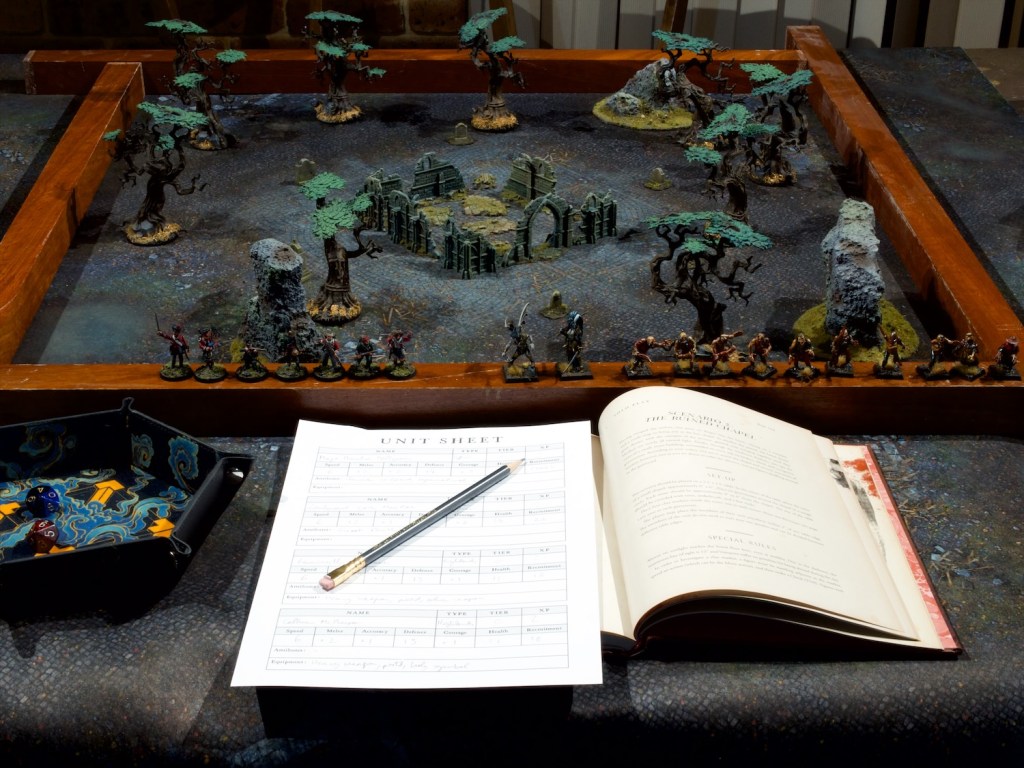
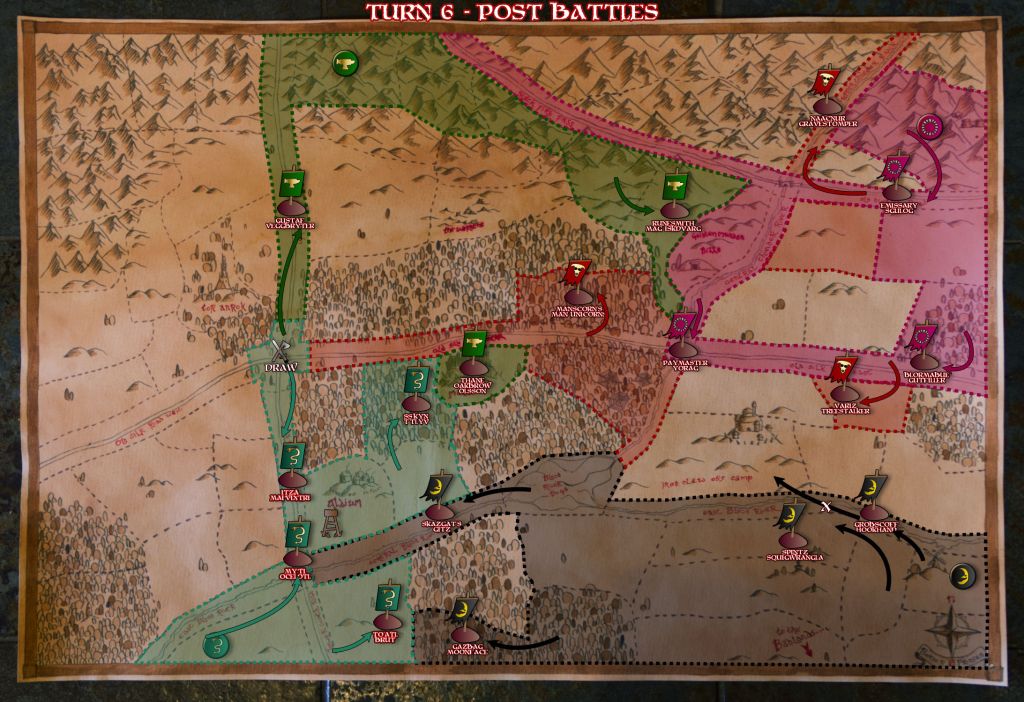
As I said in the opening lines, I got some gaming in too this break, with a campaign game for our Border Princes campaign. The campaign was on a bit of a hiatus after the back end of the year got very busy for most of us (including a few weeks where 3 of us were out of the country!). The next match due was my Dwarfs against the Lizardmen, battling over a major crossroads. The game was a lot of fun and as a result I completely forgot to take photos! The outcome was our first draw of the campaign so far, which results in both armies retreating from the area. Here’s the campaign map at the end of Turn 6.

We’re currently planning our moves for the next turn, so hopefully I should have some updates soon.

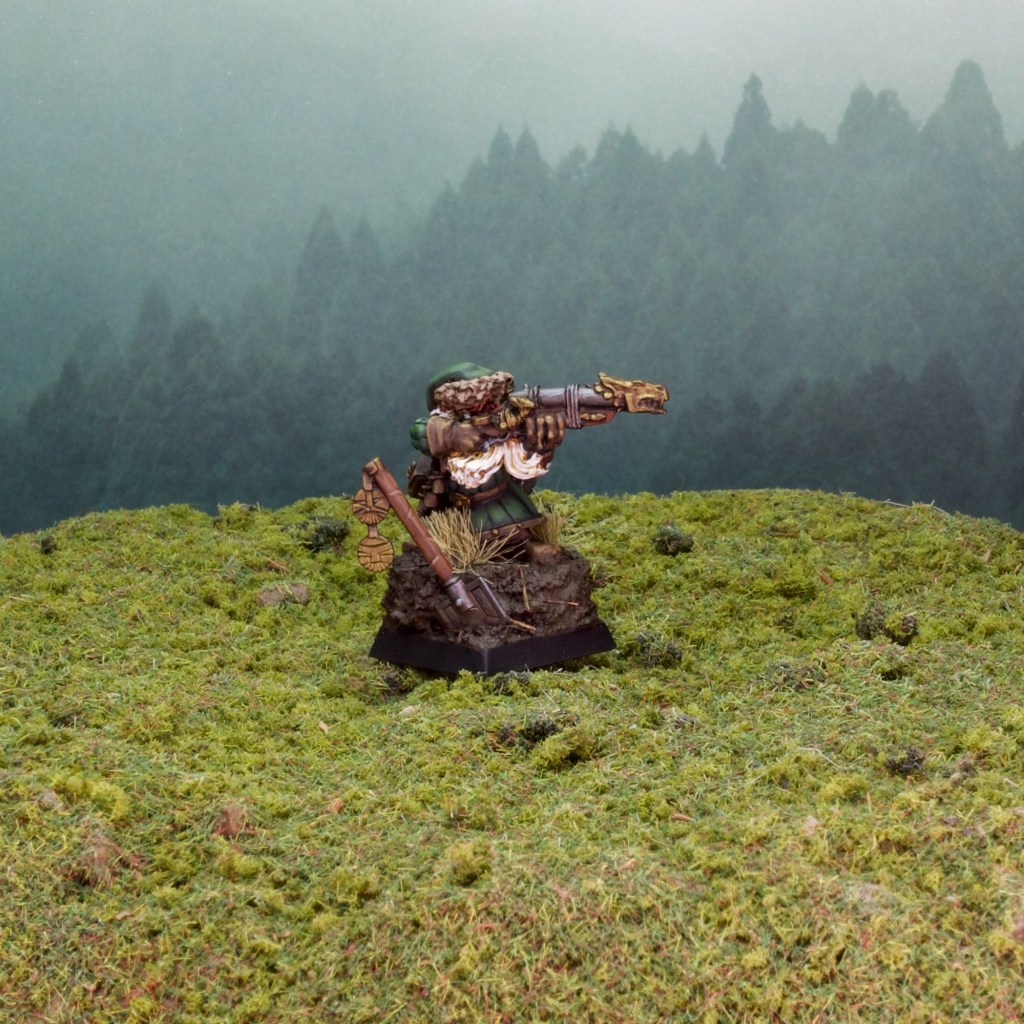
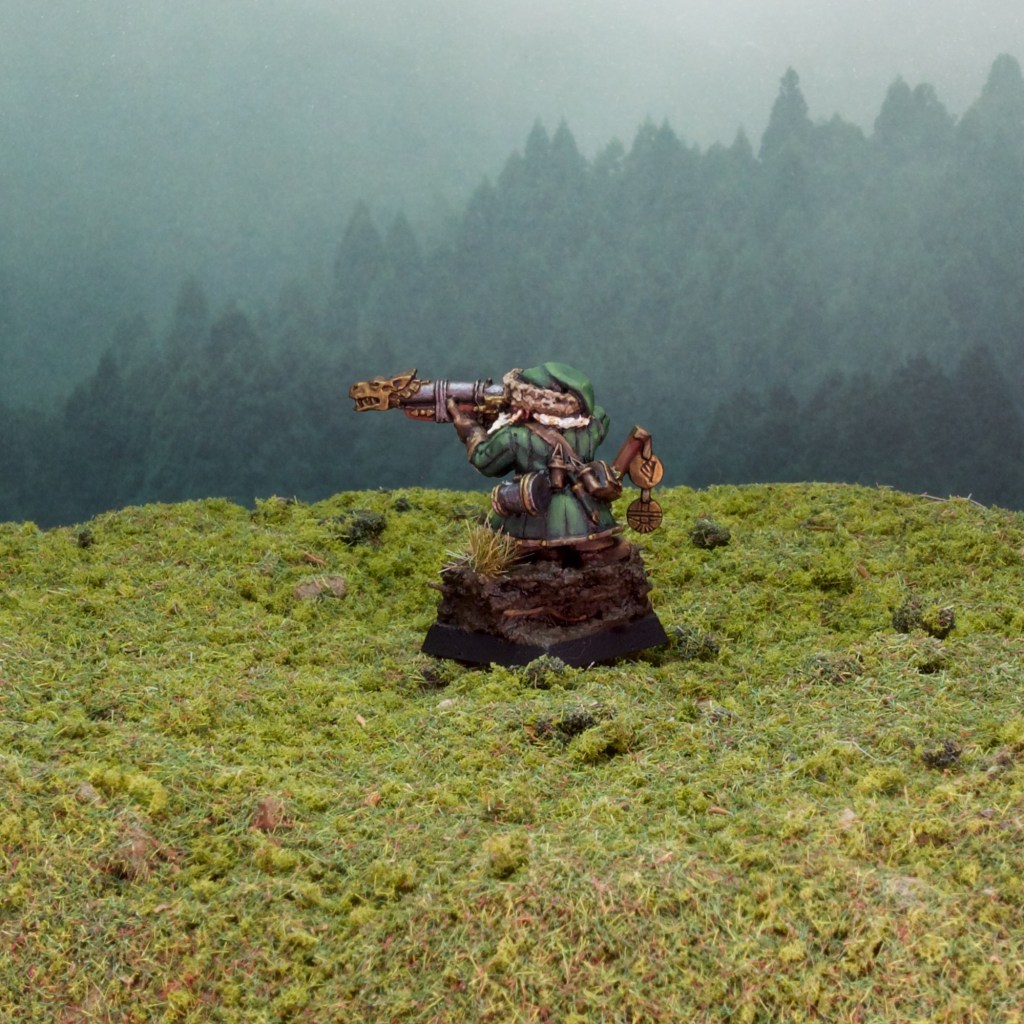
One thing that happened during the game is I tried out the new engineer rules from the Dwarfs Arcane Journal. These allow you to take a Sapper Engineer, which allows all kinds of things such as entrenching your artillery, and booby trapping the battlefield. I equipped said engineer with a handgun inscribed with some of the new ranged weapon runes also found in the book. He then proceeded to cause more damage single-handedly than most of the other units I had in the game! I decided that meant he deserved a proper model and set about to making one as there is no Sapper Engineer model in the range.

I used an old metal dwarf handgunner (one of the first models I ever bought!) which has a really cool dragon head muzzle on his handgun. This looked appropriate as a runic handgun, and I also liked the practical attire he was wearing. One thing that was missing was anything that screamed “sapper”. The distinguishing mark for a sapper in the Napoleonic era (at least for the French army) was the carrying of a great big axe, but a dwarf carrying an axe just blends in so I went for a spade instead.

I wanted to accentuate the digging aspect so I tried to make it look like he’s taking potshots while digging a trench. Hopefully that comes through!

Goblin Archers

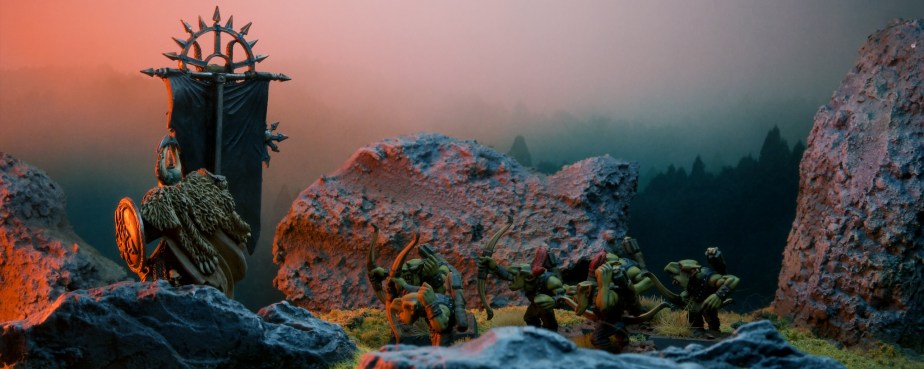
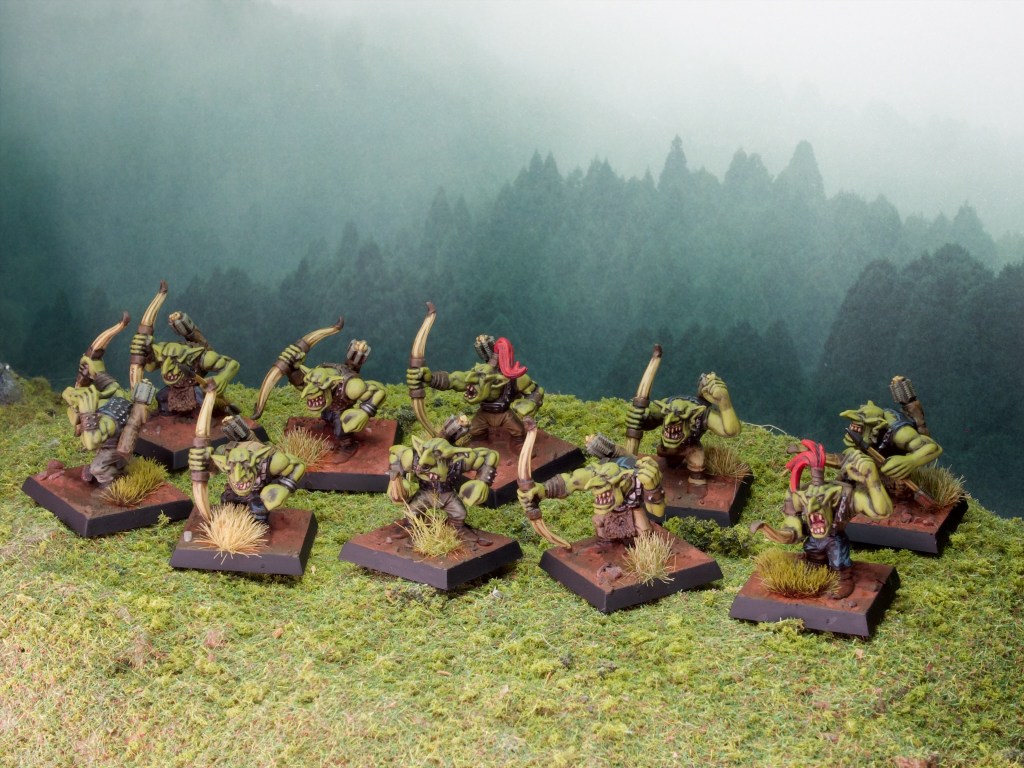
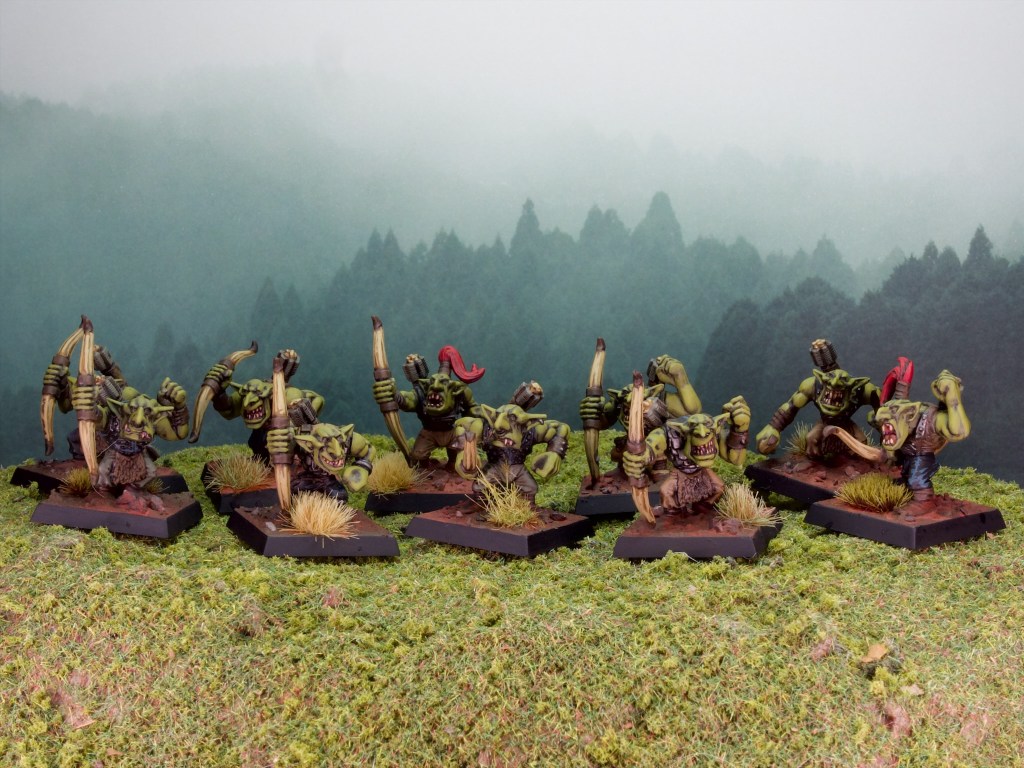
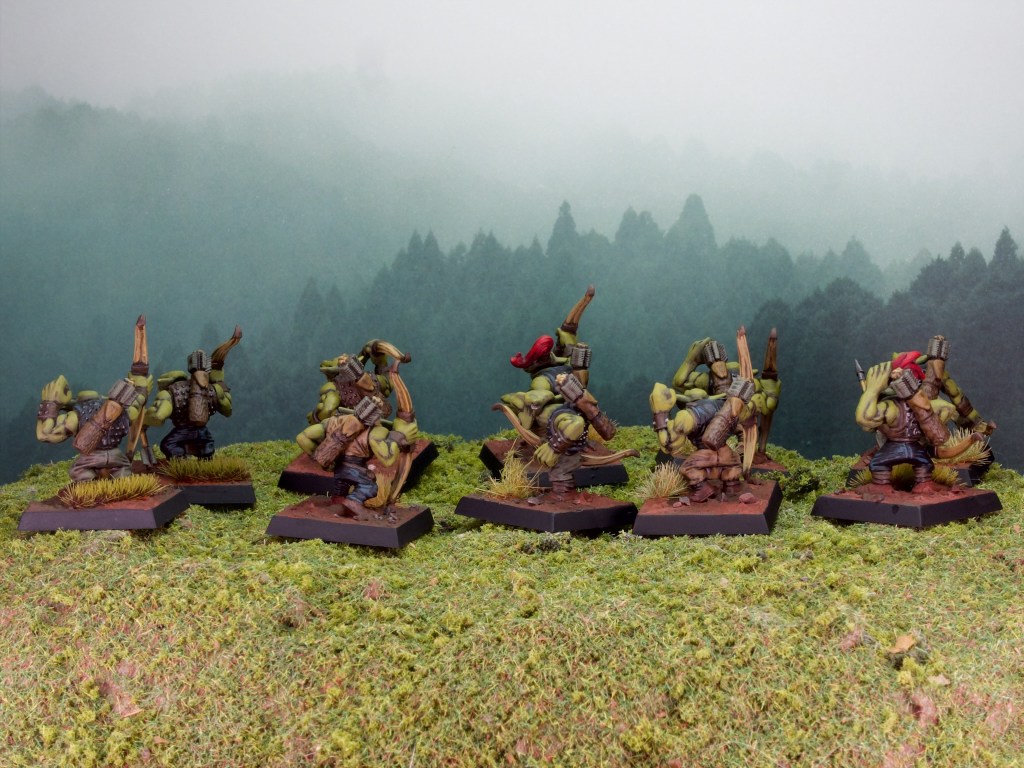
I’ve been chipping away at this small unit of archers for my Orcs and Goblins over the past few weeks. I have not been in any particular rush and it’s been quite nice painting at a sedate pace. I have a tendency to want to get things done fast, but with work quite busy lately it’s been good to do the fun things in life in a more relaxed fashion!

These are new casts of old models like much of the rest of the newly (re)released Orcs and Goblins models for Warhammer The Old World. These are pretty old sculpts now and were current when I started the hobby in the early 2000s. I’m absolutely the demographic for this nostalgia fueled set of releases!

I tried to make them look generally cohesive but in a haphazard manner, picking out their clothes in different colours. For my own future reference (I have plenty more of these to paint!) these are: Vallejo Model Color (VMC) German Fieldgrey WWII (also used for the fletching), VMC US Field Drab, VMC Black, and VMC German Camo Medium Brown (also used for the furs). The rest of the colours used are the same as for the rest of the army as detailed in my Orc Warboss post.

One nice discovery painting these was a new method (new for me at least!) for placing pigment powders on the bases in a much less messy way. So far I’ve been applying them dry, which tends to get them everywhere, and fix them using airbrushed varnish (at low pressure but still very messy). For these I experimented with mixing them with acrylic thinner before applying them in patches to the bases. I then dipped my brush in water and blended the patches into the uncovered section to get an uneven look. This method was much cleaner than dry application and was a lot easier to control. I’d recommend trying it out if you’re using dry pigments on your bases!

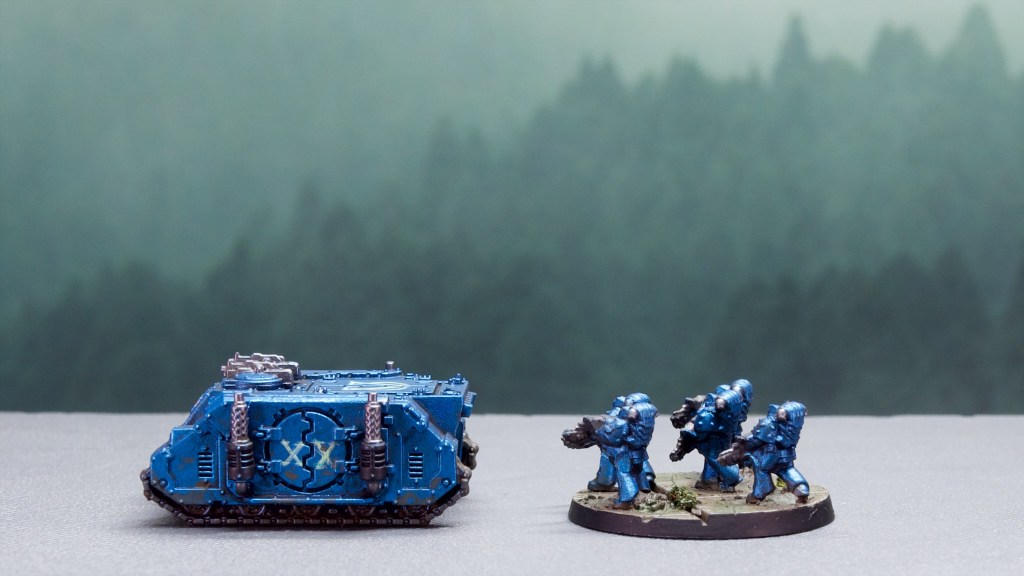
Really Tiny Space Marines

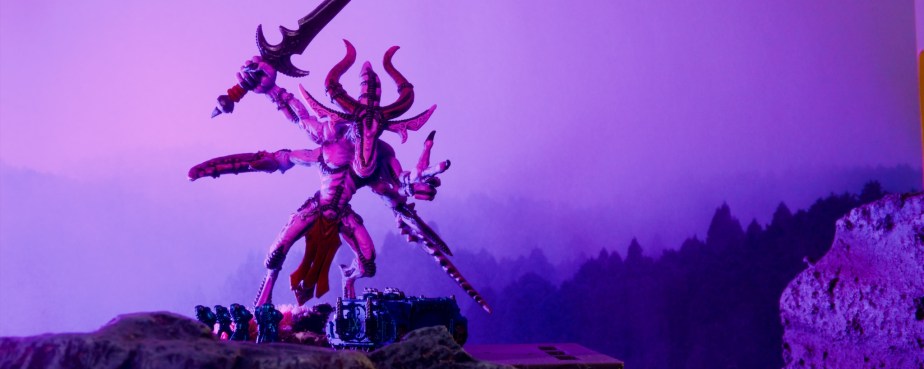
Back after what must have been the biggest break this blog has seen! I’ve been traveling for work and as such have had pretty much no time to paint in October between the trip itself and preparation for said trip. I’m back at home now, and started something I’ve been eyeing off for a while now: Legions Imperialis – the revamp of the old Epic 40,000 game system.

As I mentioned above, I’ve been thinking of getting started in Legions Imperialis since it launched – something about the scale of the battles really appeals to me (For the same reason, I’ve also been eyeing off Warlord’s epic scale offerings). What prompted actually diving in was a couple of happy occurrences: I was lucky enough to stumble on someone selling all of the books second hand for a steal, and my local game store had a sale a few weeks later during which I picked up the Battle Group box for the marines.

While I was travelling I re-read Legion, which might well be my favourite Horus Heresy novel, and (re-)enjoyed it so much that I decided these marines should be painted as Alpha Legion.

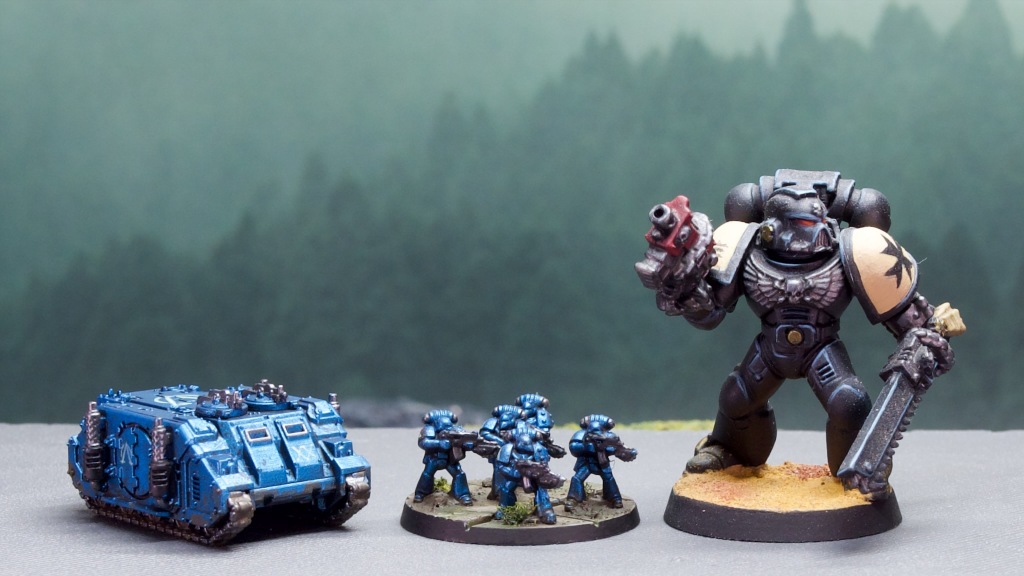
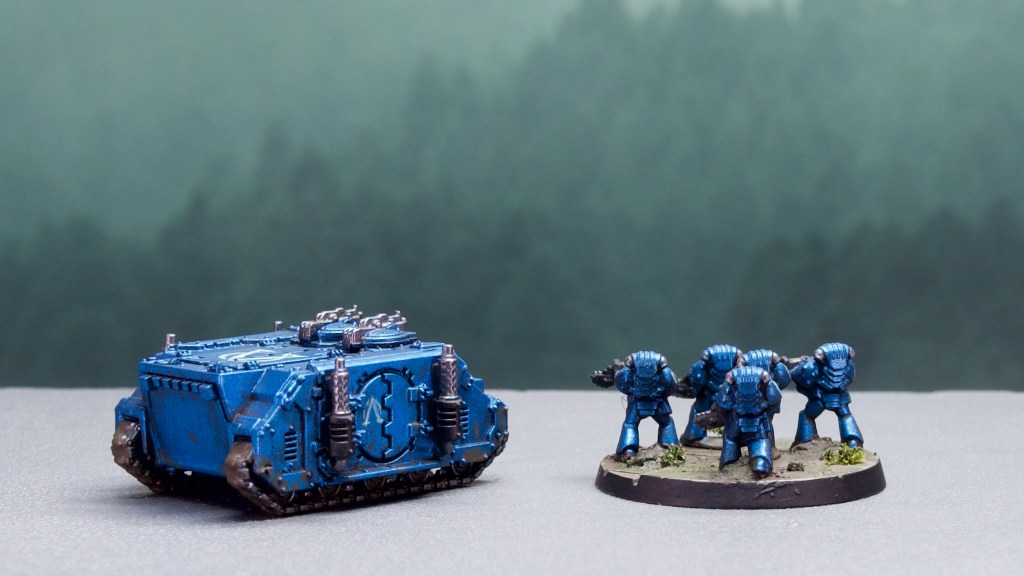
When I popped open the box I finally realised how tiny these models actually are. Looking at pictures online isn’t quite the same as holding the models in your own hands and as you can see from the comparison shot with the 28mm marine above, this is quite a departure from what I’m used to painting!

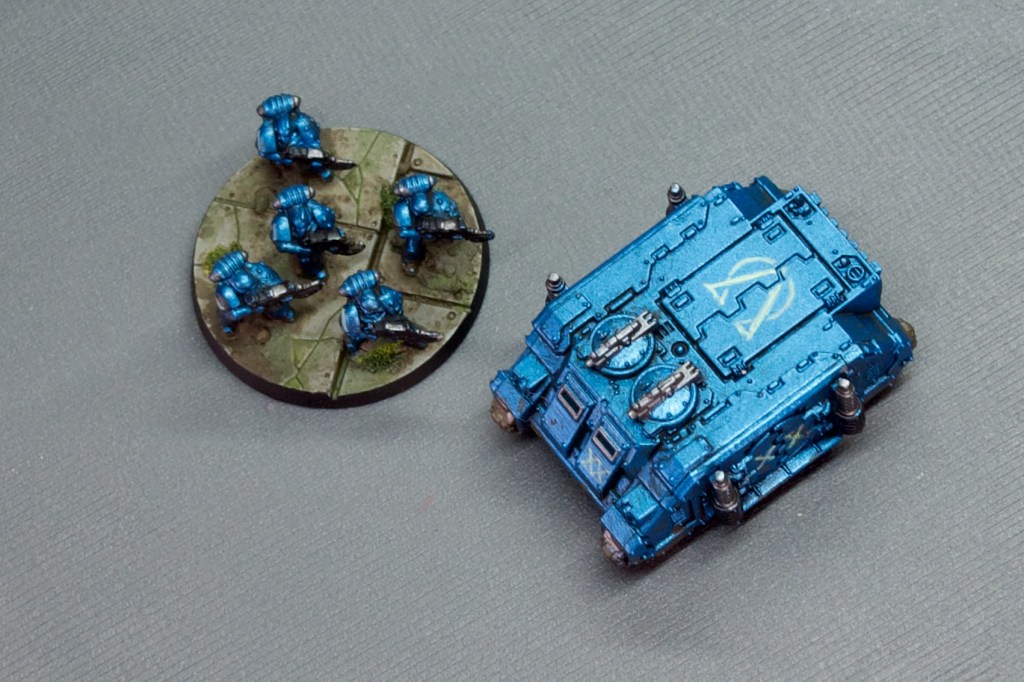
I often see Horus Heresy era Alpha Legion painted in a metallic blue/green colour. I decided to stray closer to blue here, with the markings in a minty green. The painting (by necessity!) is really simple. I started with a black undercoat and airbrushed some Ammo Mig Warhead Metallic Blue all over the models. The exhaust covers on the rhino and the boltguns on the marines were then picked out in Vallejo Model Color Black, and the bare metal details were painted in Scale 75 Black Metal. The markings were painted in Army Painter Kraken Skin. The models then got an all over wash of Ammo Mig Deep Brown Panel Line Wash, which was wiped off the raised areas to keep things clean.

The models come with these nice textured bases that I wanted to use rather than cover up, so I decided to go for an overgrown ruins look. I basecoated the surface with Vallejo Game Color Heavy Bluegrey, followed by the same panel liner as the models. I then applied a wash of heavily diluted AK Muddy Ground texture paint (a tip I picked up from the Cult of Paint youtube channel) all over the base. This adds a bit of texture and a nice gradient brown to the base while not hiding the texture modelled into the base. I then glued on a few bits of foam turf from Woodland Scenics, and applied some light washes of AK Slimy Grime Dark and Slimy Grime Light to add some green colour in patches. I’m satisfied with the outcome, it looks in scale to me, keen to hear what others think.

Overall these were fun and quick to paint, I think the metallic paint does a lot of work here, and makes the models pop despite their size. Unlike pretty much all my other models I did not varnish these as I didn’t want to lose the shine contrast between the marines and the base. I have a whole lot more of these to paint now, but I’m happy with the scheme so can safely proceed from here!

Night Goblins

After a few posts promising a unit of goblins as the next addition to my Orcs and Goblins army (and a few posts apologising for failing to deliver!) I’ve finally finished this large unit of Night Goblins!

With a cool 42 models in it it is one of the largest units I’ve ever painted, and took me quite a while to get through. With its rather sizeable footprint it was a bit awkward to photograph too, a lot like a large terrain piece.

I ended up batch painting the unit row by row (i.e. seven models at a time), except the shields and the basing which were done for the whole unit at once. Each row was relatively quick to do, but together this added up to a lot of work (Basing took me a whole evening!).

The banner was quite fun to paint, although I went in to it without a good idea of what to put on it. I decided a mushroom would be a good option given the Night Goblin moon was already represented at the top of the banner pole. I painted on a mushroom and then wasn’t sure where to go from there. I ended up taking a photo of the banner and doodling on the photo on my iPad to test out designs to add to my mushroom and I settled on what you see below. It was great to be able to experiment with designs without painting over and over again so I’ll do that again, a good lesson learned.

You might have noticed the shaman holding the green-headed staff on the right of the unit. This is one of the army’s characters, in fact the only wizard I have planned in there at the moment. This is a classic model that I picked up on eBay alongside the netters you see in the unit.

The night goblin models are the newly re-released plastics that were the standard kit back in 6th edition. There is a more modern night goblin box which is from the 7th edition era which is now marketed as an Age of Sigmar set. I really like the older plastics and I’d been looking for a second hand box when GW announced they were re-realeasing them. That made me and my wallet very happy, those second hand prices were getting sky high.

This new set came with a transfer sheet with a couple of designs for the shields. I loved the moon design on those transfers so that was an easy pick. I’ve never applied this many transfers in a single sitting!

I’m glad to see the end of this one, I’ve been painting it on and off for what must be a couple of months now (inter-spaced with a few other small projects such as the Fanatics I did a while back, which will be launched from this unit), and it took some determination (and a fair few hours) to get them finished this week. I love the look of these models as a massed unit and am chuffed with how they came out. I’m going to paint up a smaller scale project next I think!

Giant!

It’s been a little while between updates, but I’ve been slowly chipping away at the miniature I’ll be showing today over the past month. Slowly because it’s getting chilly here down under and my hobby table is in a cold part of the house (and therefore is being visited much less often than usual!) and slowly because I’ve been really enjoying the process on this model!

The model as you probably realised from the post title is a giant! This is the plastic Warhammer giant from the mid 2000s, which is still current in the range. I got mine during 8th edition for my Ogre army, and like many other models from that era it has sat mostly unpainted since then. I rebased that army for Age of Sigmar so this model was transplanted onto an oval base, before being cut off that and put back on a square base for the return to classic Warhammer.

As I mentioned above, I thoroughly enjoyed myself painting this model and I went probably above and beyond what I would usually do for an army model, although I always do tend to try to spice up centerpiece models!

I really wanted to make it look like his pants were made from banners he’d collected over the years, so I painted them in a patchwork of colours, and applied transfers from all kinds of sheets I’d collected over the years to add some interesting patterns to the patches. From memory there are transfers from the Bretonnian, Eldar, Imperial Knights, and Space Wolf ranges on his pants.

Another detail I enjoyed painting because of the scale of the model was the nails, I tried to go for a dirty nail look with some muck caught under there. This might be a bit hard to see in the photos though, I think the best example is in that top photo on the hand that is holding the hapless man.

I spent a bit of time on his face, I don’t get to paint large scale heads very often given my usual subjects, so this was a fun new thing for me to do. I tried to go for the classic pale/red/blue zones on the face which I think worked out nicely, but I’m keen to see how you find it.

Overall I had a great time painting this giant, but it’s time to move on to smaller models again! I have the largest unit in the army lined up next, a big unit of night goblins which will likely keep me busy for quite a while so the next post may also be a bit further away than usual!

Goblin Wolf Riders – Part 1

Back this week with more models for my Orcs and Goblins army: some Goblin Wolf Riders!

These are classic models (late 90s I believe!), which have been re-released as part of the current set of Warhammer Old World releases. This might be laziness on GW’s part, but I’m loving the fact you can buy some of these models without having to go through exorbitant eBay prices! These are the models that were current when I started the hobby, and couldn’t afford them at the time so this is very much an exercise in nostalgia for me!

I really enjoyed painting these, the goblin riders are so characterful and the old style “big” detailing is a joy to paint. For the wolves I tried something a little bit different. I really wanted a nice gradient on the furs so I basecoated them using the airbrush, starting with a cream colour all over then doing narrower and narrower bands of darker browns over their backs. I chickened out of doing highlights over this gradient so I decided to use oils to shade the furs so I could wipe them off of the raised areas. You can see the effect in the photo below.

I think that worked out pretty well, it’s not quite as clean as properly highlighting things, but it is much more expedient which is exactly what I’m after when painting army models. I have a second unit of these to paint up for the army, so I’ll be reusing the technique although I will be changing the colours to have some grey wolves for those.

For the Goblins themselves, I reused the recipes I laid out last post for the Warboss, so check that out if you’re interested!

Now I promised a couple of posts ago to post some photos of the first games of our Border Princes campaign and promptly forgot to include them in the last post, so here they are, better late than never!

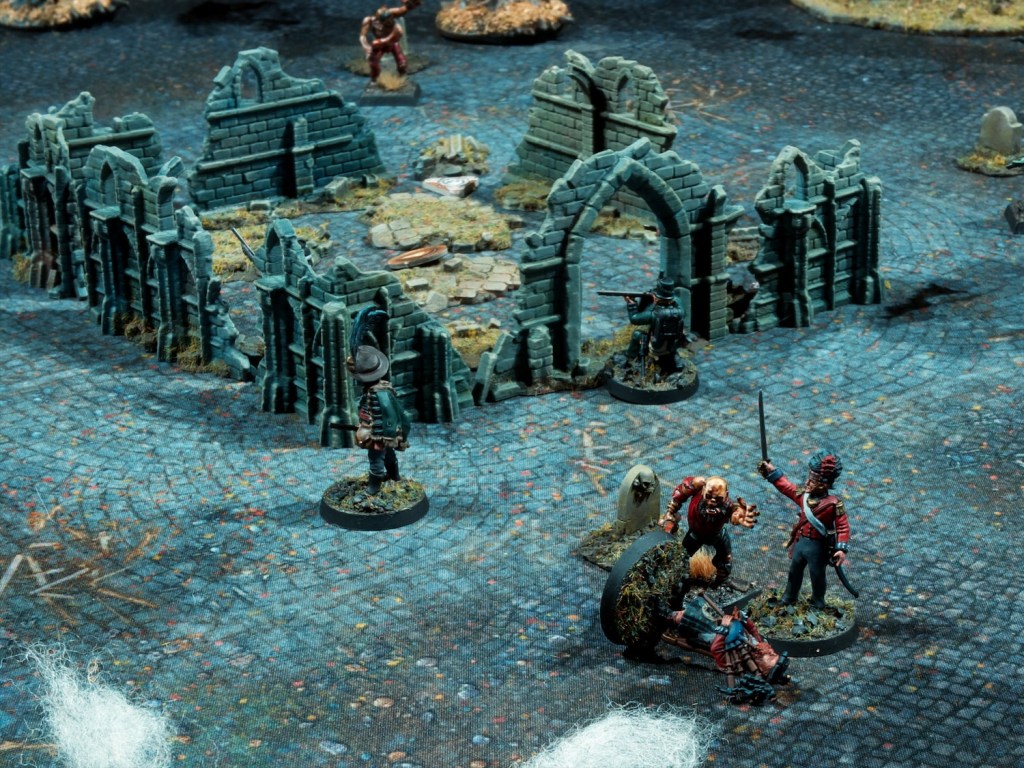
If you remember the last update, my Dwarfs were attacking the Fortress at the center of the map, defended by the Bretonnian force I’d painted up for this purpose. As I was the attacker, one of the other players stepped in to play the defenders and we had a siege game!


The initial setup: two blocks of dwarf infantry pushing the siege tower and ranged units on the hill. On the defending side the walls are occupied by archers and men-at-arms, and surprising the attackers the unit of knights deployed outside the walls!
Cannons lining up the castle gate
The defenders look on as the attacking forces assemble.
The knights form up … outside the gates!

The cannons started shooting the gates, failing to do much and one of them misfired even with the engineer there to give it a re-roll! Luckily it only had to skip a turn, losing a war machine this early in the game would have been dreadful! The Siege tower was pushed forward by the dwarf infantry. On the defending side the knights advanced, resolved to chop that siege tower to scrapwood with their axes! On the walls the archers started shooting at the siege tower and managed to inflict some damage to it (presumably some critical ropes cut!). The following turn the knights managed to close in on the tower and almost destroyed it in combat!

The knights close in on the siege tower… and start hacking!

The dwarfs did not take kindly to this attempt to cut down their handywork and retaliated, closing in on the knights. The Demon Slayer and his rune axe made short work of the knights, but the damage was done, the siege tower on a single wound was more of a liability than anything else at this stag. The dwarfs abandoned it, taking a page out of the Knight’s book and deciding to use their own axes on the fortress gate.

The Dwarfs abandon their tower.

Under a hail of arrows the Dwarfs approached the gatehouse and got to work hacking down the gates. The cannons had finally started doing some damage to the gates and the rune axe of the Demon Slayer crashed through the wood of the gates soon enough.

The gates crash open!

Once inside the walls, a desperate melee started between the Dwarfs and the Men-at-arms led by the Baron started. The combat was inconclusive, but the last turn had arrived and the Dwarfs won the day, having taken the gatehouse and slain the knights for no full units of their own lost (although as you can see above those archers did a lot of work on those units!).

This battle resolves turn 4 and the map above shows the state of things as the turn ends.

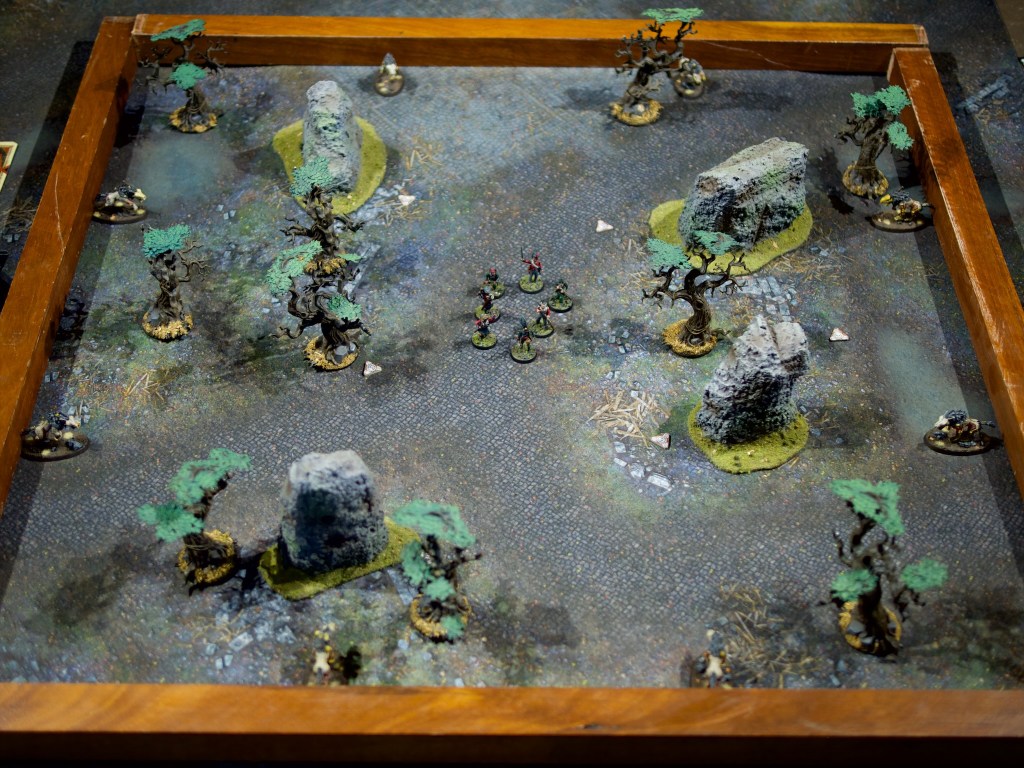
The players made their moves for turn 5, and we have two battles lined up for this turn! Both feature the Ogres and the Beastmen, with the Ogres attempting to seize the starting location of the Beastmen, and the Beastmen trying to take the river section off the Ogres.

The defense of the Beastmen home territory has already been fought, although unfortunately I did not get to take many photos.

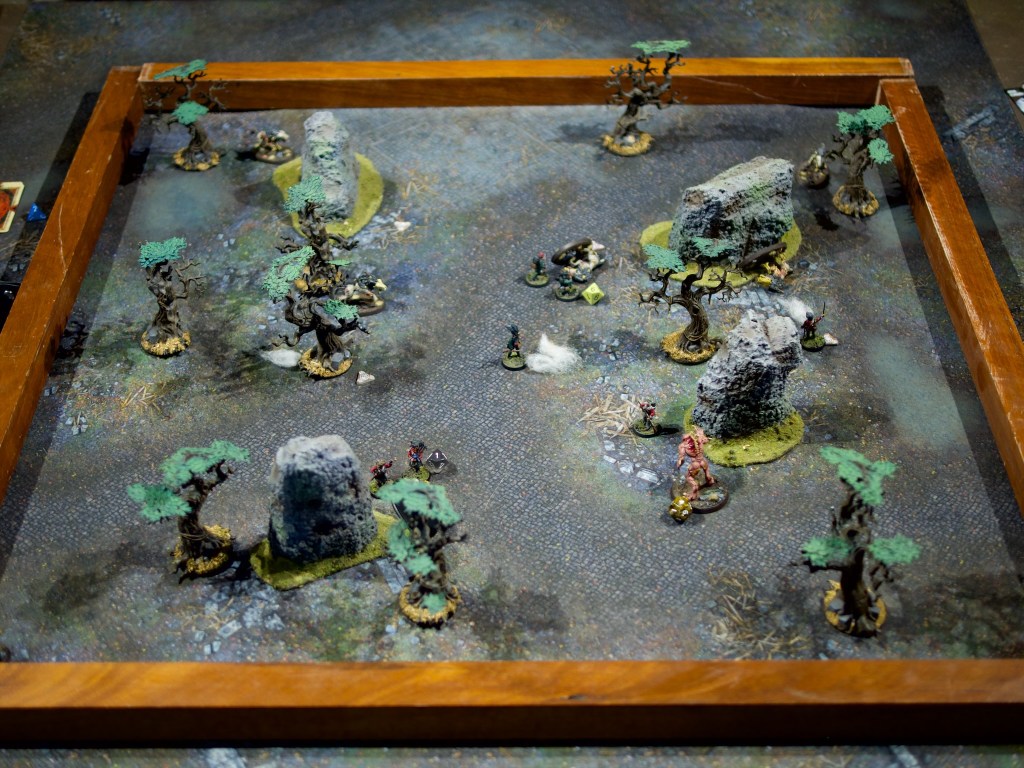
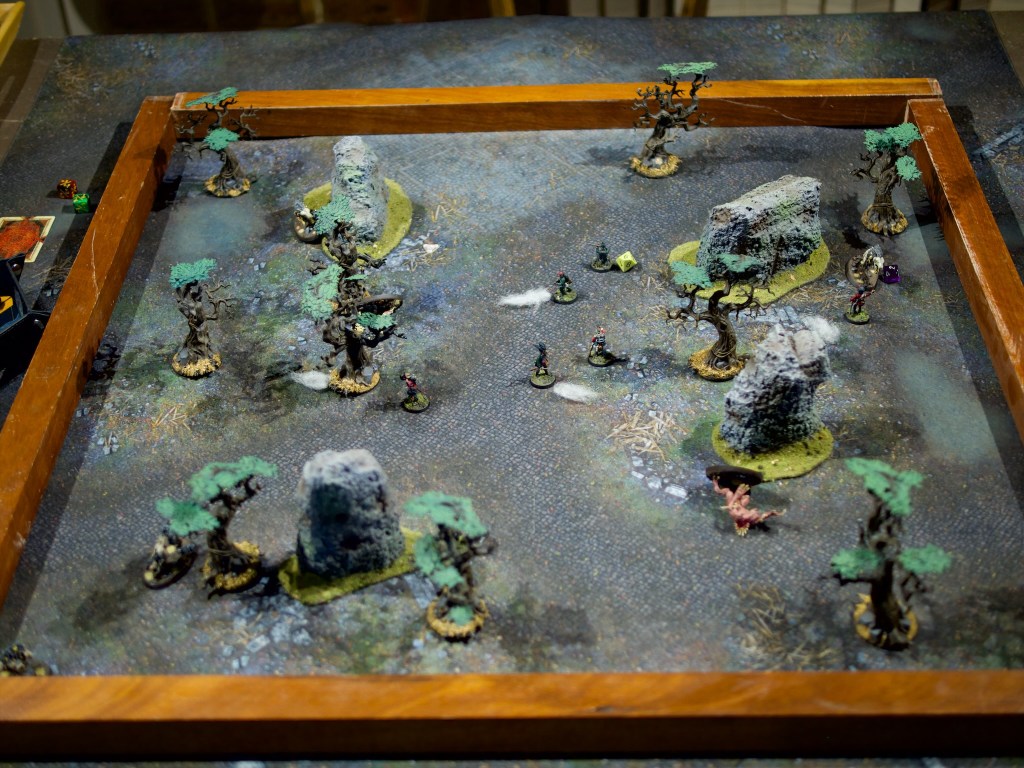
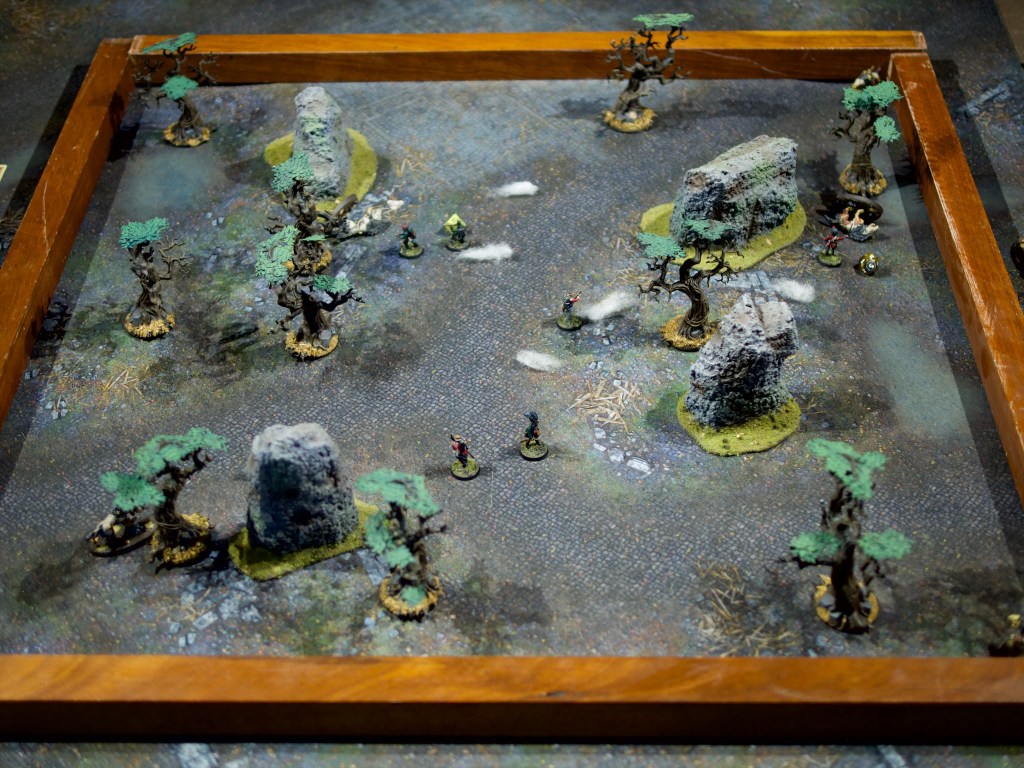
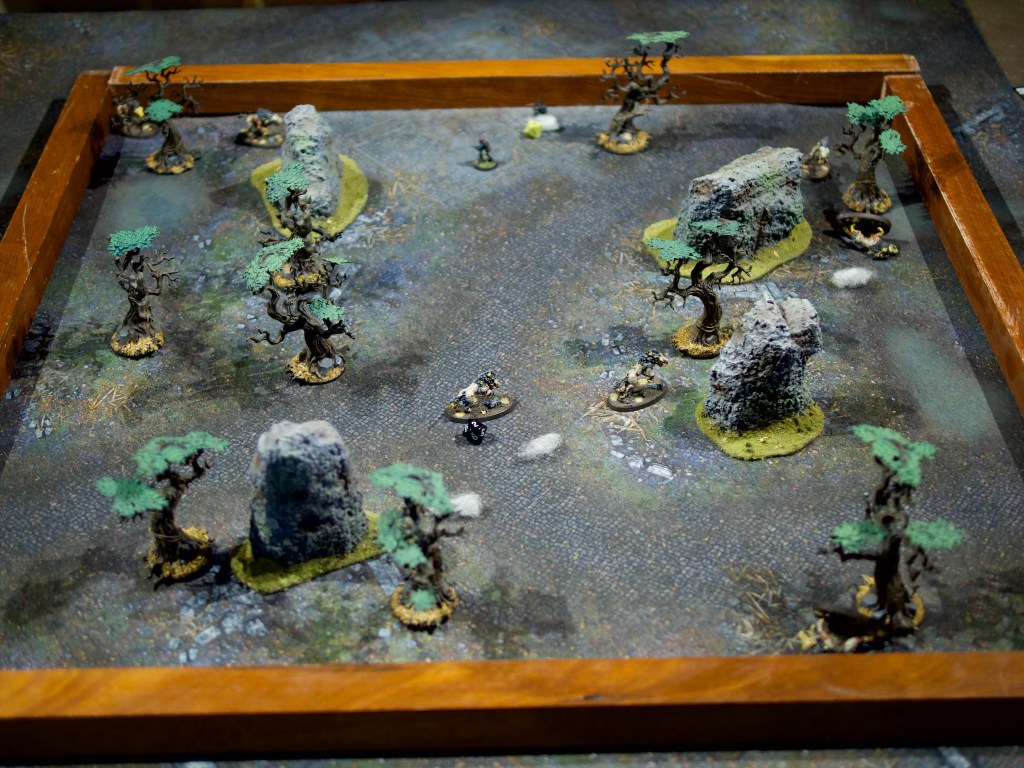
The battle was fought in a heavily wooded board, with the beast’s herdstone as the primary objective.
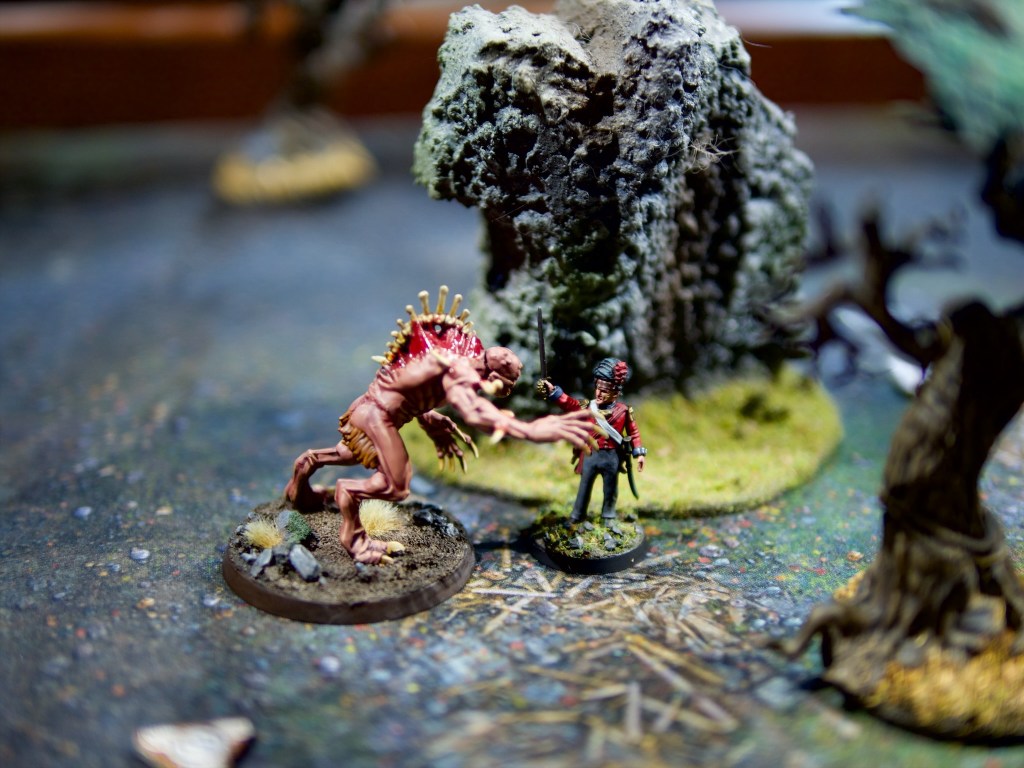
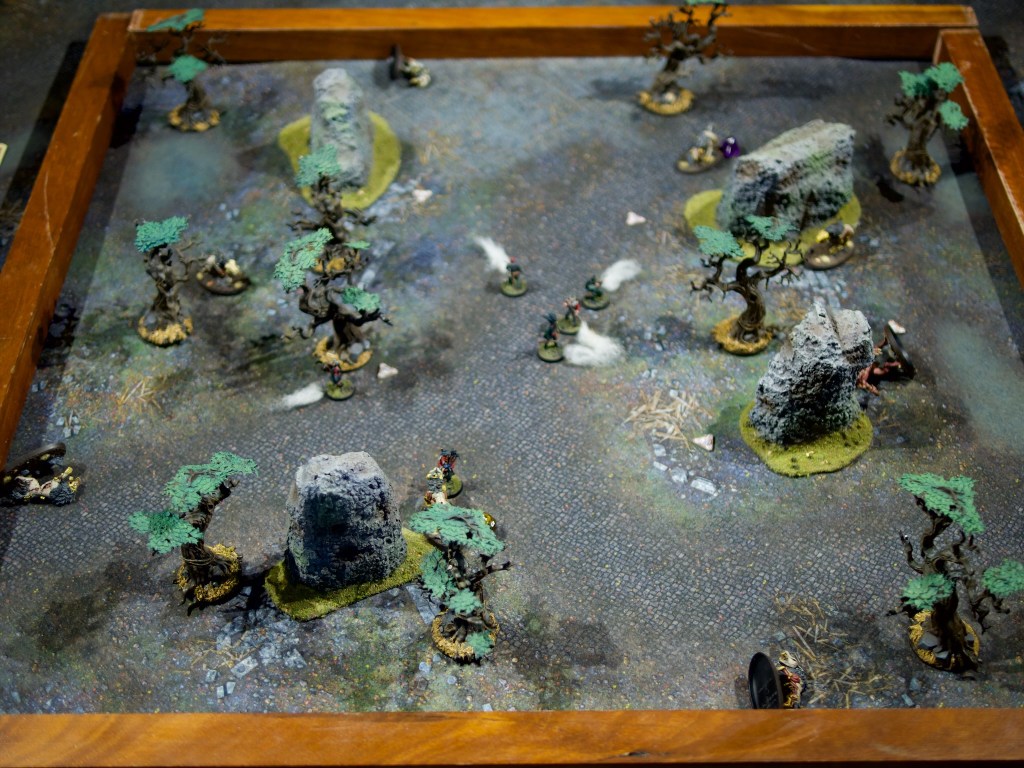
Things got very heated up in the area surrounding the herdstorne as both armies maneuvered to capture it.
Despite a desperate attempt by the beasts to reclaim their herdstone the Ogres won the day.

Hopefully you’ve enjoyed this longer than usual post! Plenty of gaming action in the coming months as this campaign gets played out, and I hope to be able to photograph most of it!

Orc Warboss

This week I have something else than Dwarfs for you, in fact something that Dwarfs really don’t like: a big green orc!

This model originally came with the limited edition version of the Warhammer Online video game. I never got the game but I did pick up this model at the time (can’t remember where from!). This orc is massive, much bigger than the average character model of orcs for the Warhammer fantasy universe, although probably in line with the Ork bosses in Warhammer 40,000 which are much bigger for some reason.

Regardless of the size, the model is packed with details and was really fun to paint. As this model will be leading my Orcs and Goblins army (another army!!?), I wanted to make sure he showed off the colours of the army: black, red, and yellow. These colours were not chosen at random, but rather they feature heavily in one of my favourite Warhammer arts of all time: the night goblin painting that graced the Night Goblin box for a while as well as the Ravening Hordes supplement for 6th edition. I’ve taken a photo of my copy you can see below for reference. I believe this is by Adrian Smith, who has done some of my favourite art for the setting.

As well as the main colours, I decided to match the skin tone from the painting, which is a yellower green than I’ve used on orcs in the past (see my Orks for reference). This model of course is mostly covered in armour so I used the freehand on the armour to make use of those colours, with the goblin on his shoulder directly matching the colours of the Night Goblin champion in the painting.

As is usual now for the first model(s) of a new army, I write down my recipes so I don’t forget them. Hopefully they can be of use to you too.

  • Skin: Vallejo Game Color Cayman Green, GW Agrax Earthshade, Vallejo Game Color Cayman Green, Vallejo Model Color Green Yellow, Scale75 Sherwood Green
  • Leather: Vallejo Model Color Chocolate Brown, GW Agrax Eathshade, 50/50 Vallejo Model Color Chocolate Brown/Vallejo Model Color English Uniform, Vallejo Model Color English Uniform
  • Bone/Wood: Vallejo Model Color English Uniform, GW Agrax Eathshade, Vallejo Model Color English Uniform, 50/50 Vallejo Model Color English Uniform/AK Ivory, 25/75 Vallejo Model Color English Uniform/AK Ivory
  • Silver: Scale75 Black Metal, GW Agrax Eathshade, Scale75 Black Metal, Vallejo Game Air Silver (This last one just on blade edges)
  • Light Bronze: Scale75 Necro Gold, GW Agrax Earthshade, Scale75 Necro Gold
  • Dark Bronze: Scale75 Decayed Metal, GW Agrax Earthshade, Scale75 Decayed Metal
  • Red: Vallejo Game Color Heavy Red, GW Agrax Earthshade, 50/50 Vallejo Game Color Heavy Red/Kimera “The Red”, Kimera “The Red”
  • Yellow: Vallejo Game Color Heavy Goldbrown, GW Agrax Earthshade, Vallejo Game Color Heavy Goldbrown, GW Contrast Imperial Fist
  • Black: Vallejo Model Colour Black, Vallejo Model Color Dark Sea Blue, 50/50 Vallejo Model Color Dark Sea Blue/AK Ivory
  • White: AK Ivory
  • Basing – Rocks: Vallejo Model Color Dark Sea Blue, Vallejo Model Color Light Sea Grey (Drybrush), GW Agrax Earthshade, Ammo Mig Medium Rust Pigment
  • Basing – Dirt: AK Muddy Ground Diorama Texture, Ammo Mig Medium Rust Pigment

I’m quite excited to paint Orcs/Orks again, the new release has made a lot of the older models for the range accessible again which is great news for someone nostalgic for the era of Warhammer in which they started, i.e. me!

The Geistenmunden Hills

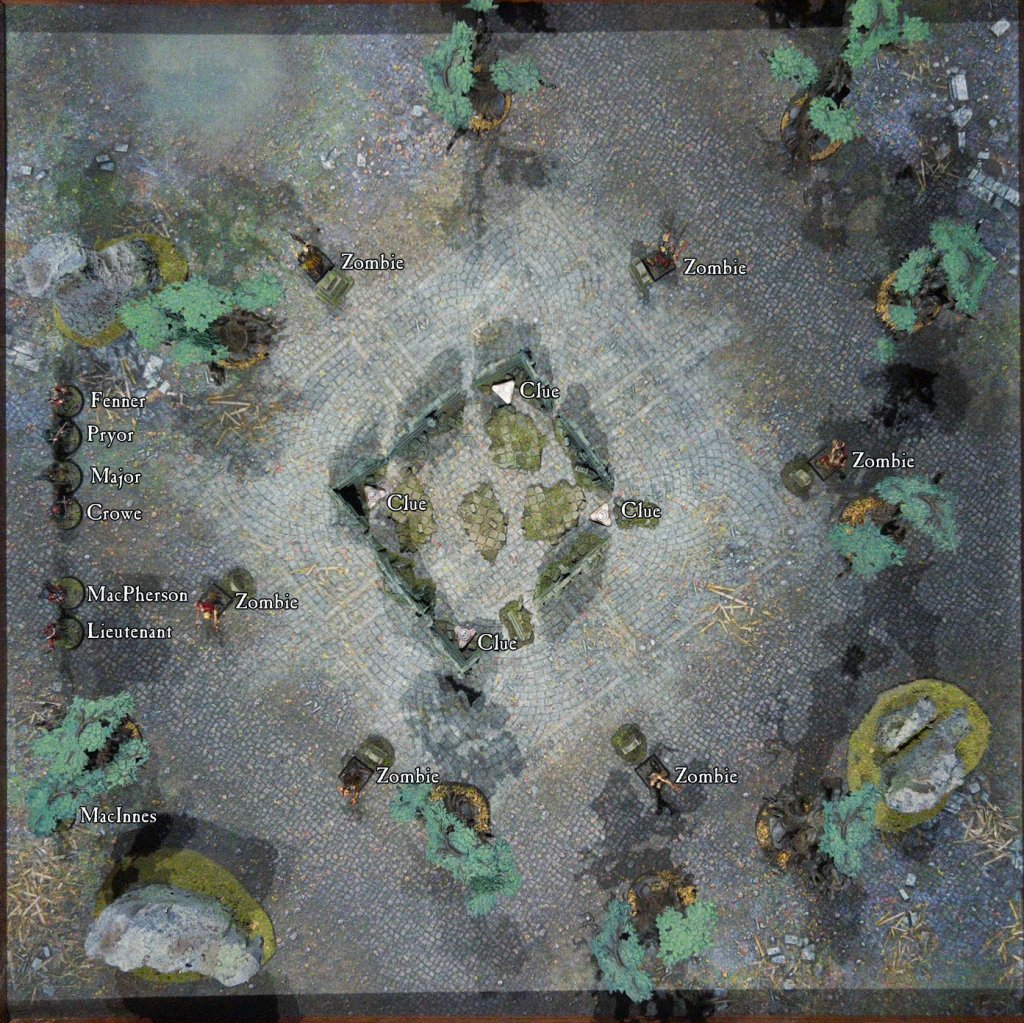
It’s been a fair while between posts, over a month in fact! Over this period I’ve been on holidays and busy with work so haven’t had much time to get things painted, but I’ve still been chipping away in the background. Here’s something I’ve been working on for a little while: a set of terrain for the Geistenmunden Hills area of the Border Princes campaign map.

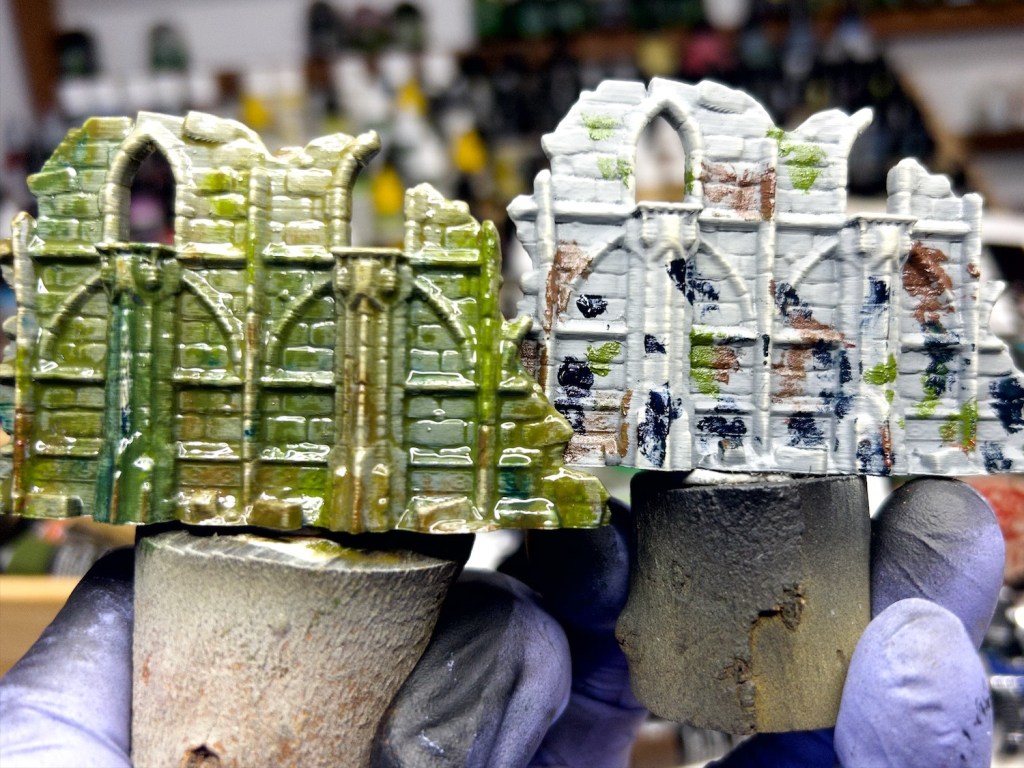
As you can see from the illustration, this is going to require some barrows! Luckily for me back over the Christmas break I’d ordered some terrain from https://www.fogoumodels.co.uk/ including a set of resin barrow entrances (well not so lucky, I ordered these for this very purpose!).

There are some other bits and bobs there that I’ll get to painting at some stage. Overall the quality of these models is excellent, the stone textures are really nice. I’d been waiting for an excuse to order from them for a while, and this was it!

Entrances are all well and good, but they need some burial mounds attached to them, and that’s what I busied myself at next. I took some photos of the process so I thought I’d make this post a bit of a tutorial.

I started by cutting some rough shapes out of MDF for the bases and matching smaller shapes out of insulation foam to make the main shape of the hills. I also cut a notch out of each of the hills to make the tunnels behind the entrances. You can see said notch in the smallest hill at the top of the pile. I then covered the undersides of my foam shapes with PVA glue and glued them down, and weighed them down with some small weights.

Next step was to put a roof on my hills. For this I used foamcore cut to match the hills. I also glued this down with PVA glue, but before I did this I painted my “tunnels” with some dark brown paint as I wasn’t going to be able to get to these once the entrances were glued on.

Once the glue was dry (read a few months later!) I carved my hills using a snap blade/retractable blade knife, with a special focus on making sure the entrances lined up neatly with my hills. For the big hill the entrance was taller than my foam assembly so I added some cork pieces to create a gradient to match the entrance. I used masking tape to patch any gaps, and glued the entrances down to the MDF using super glue (watch the foam doing this, super glue melts it!).

Following on from this I used Sculptamold (plaster with paper fiber mixed in) to cover the foam forms and blending in the entrances, taking care not to cover them up. This added some variation to the shapes and smoothed everything down, making them look much more like hills.

That’s it for the build side of things, now onto painting!

I don’t really have photos of the painting process apart from this one. I’m finding terrain has been a good fun way to get my son to join into the hobby side of things. He’s 3 and miniatures are a bit too small, but he’s fine getting some paint down on larger objects (including himself)!

Once the base colours were down, I gave the entrances a few drybrushes of greys and some green and brown washes to add a bit of colour in there. Once that was done I covered them using the flock mix I’ve been playing with for a while, a mix of Woodland Scenics foams and GW static grass.

Here are the finished barrows:

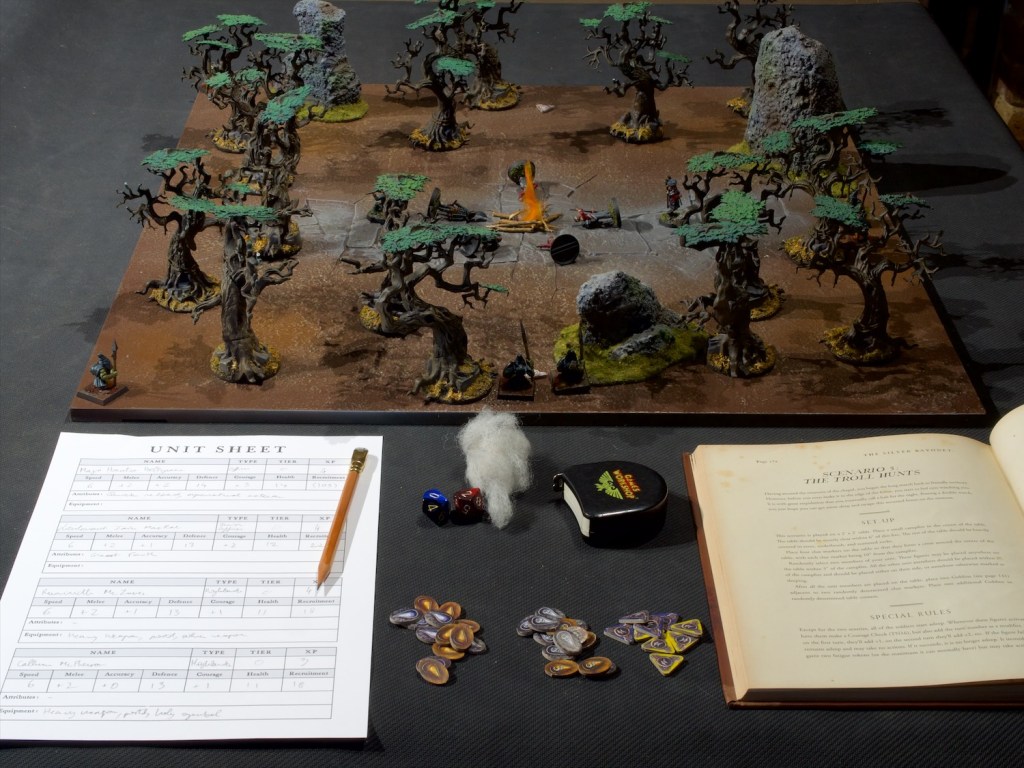
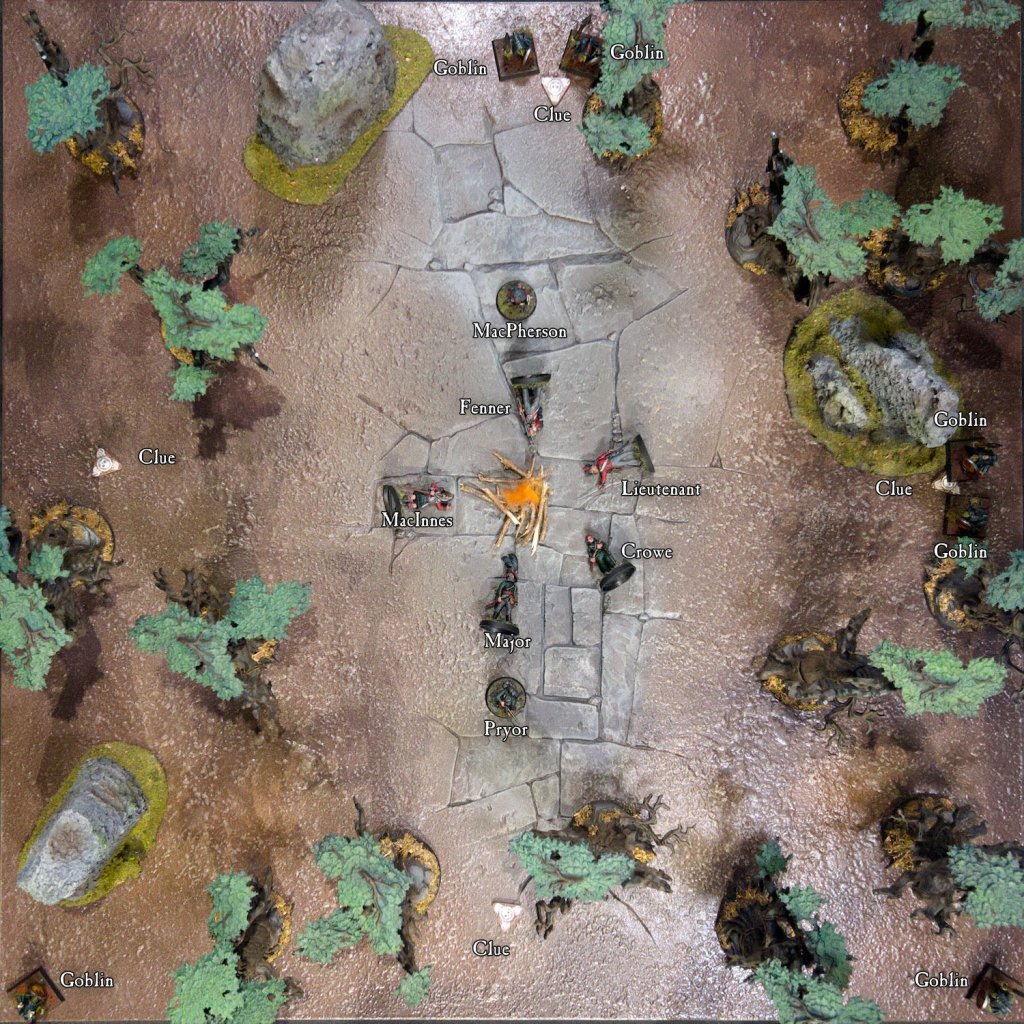
The Geistmunden Hills scenario calls for a piece of terrain to sit in the center of the board, and they suggest amongst other things a stone circle. This appealed to me, and I used some pine bark I had lying around to make an altar of sorts surrounded by standing stones. I painted these to match the stone of the barrows.

Overall here’s how these all fit on a 6ft x 4ft board:

These were lots of fun to put together, and I’m excited to use them in games. The motivation for these was this Warhammer campaign, but I can easily see using these for historicals or Middle-Earth games.

Until next time!

Tree Kin

Back again with more forest spirits, this time Tree Kin, smaller than Treemen, but bigger than Dryads!

I’ve had half of these models for quite a long time now, as part of the wood elf army I put together around 2007. The other half I recently inherited from a friend who generously gave me his. Both sets needed some care after years of neglect, but nothing a trip in the stripping bath and some fresh glue couldn’t fix! My models were built as is, but he’d done some cool conversions on his to spice them up a bit (there only being 3 variants, it’s nice to have some extra variety in a unit of 6!).

I painted these in the same manner as my Dryads and Treemen, hitting them with the airbrush in random patches of greens, browns, and blues, then highlighting them as guided by this eclectic mix. See those posts for more detail on this.

These models are covered in little critters (called spites!), which were quite fun to pick out in various colours. I decided to stick to a blueish/greenish range for these to make them relate to each other while still having some variation.

As I’ll be moving on to the elvish side of the army now, I thought it would be fun to have a family portrait of all the forest spirits I’ve painted so far.

I won’t be able to run all 4 treemen till I paint a lot more models for the army, but I’m planning to run one in the first thousand points. I suppose I can rotate them between games for now! As I said above I’ll start painting elves next, and have some archers ready to start painting now. Presumably those will for the focus of the next post unless I get distracted which is always a possibility!