Cold Forests

In what is the final post of my holiday-driven burst of activity we have quite a few trees!

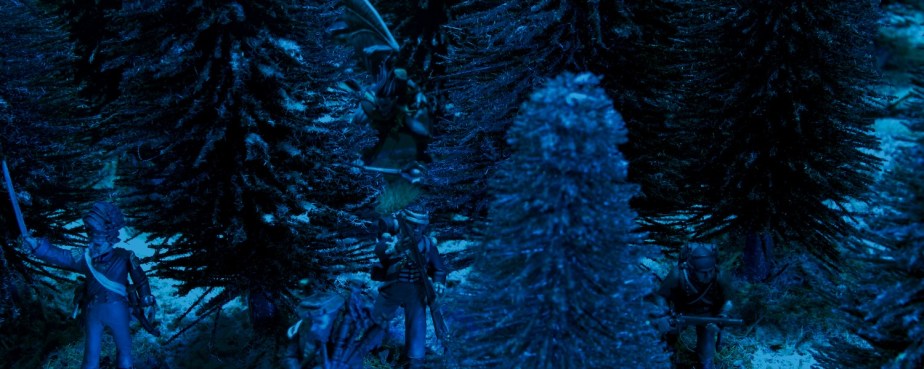
As I’ve mentioned a few times in the last few posts, I’m planning on running a game of Chain of Command for some friends in the coming weeks, and the setting is the Eastern Front, sometime in winter 1944. Having no winter terrain was going to make that a bit difficult, so I decided to paint up a few pieces to populate the table. The main thing I wanted was to have some nice pine forests, so I set about finding some suitable trees.
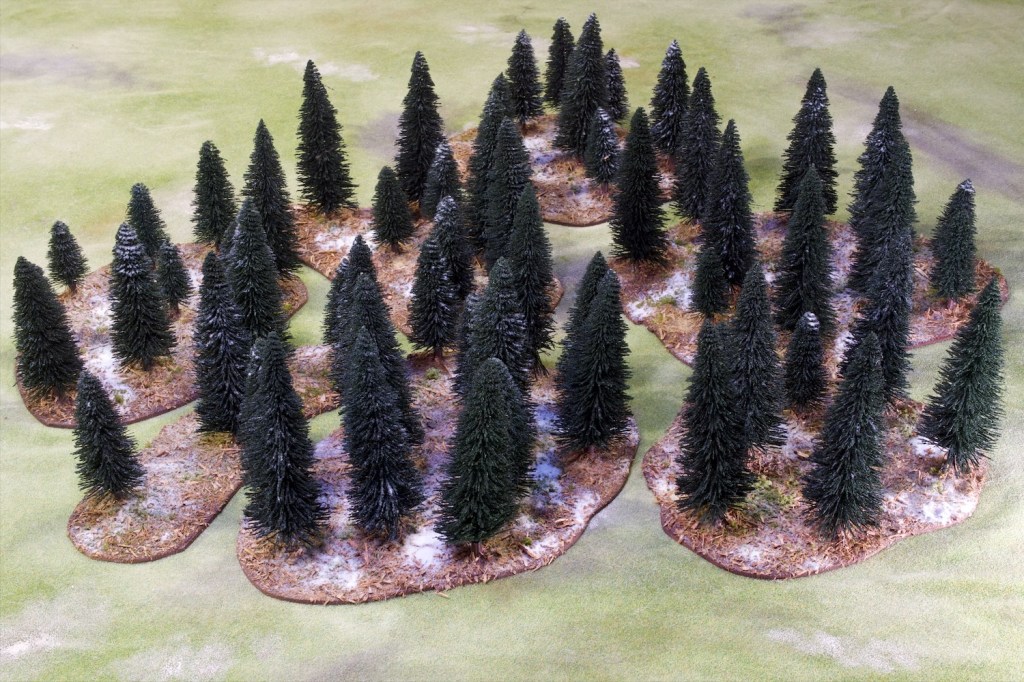
The trees you see above were cheap ones from Amazon which came in big batches with some variety in sizes which was quite nice. 60 of them cost me just below $60 (Australian dollars that is!) which seemed like a nice rate. They are a basic shaped and flocked bottlebrush style pine trees, nothing fancy but they do the trick. The flock was not glued on great but I knew I was going to spray them with varnish to get some snow on there too so was not too worried. The “trunks” of the trees were bare wire twists so I needed to make some holders for them, to make the trees more realistic and allow them to be removed for gaming and storage purposes.
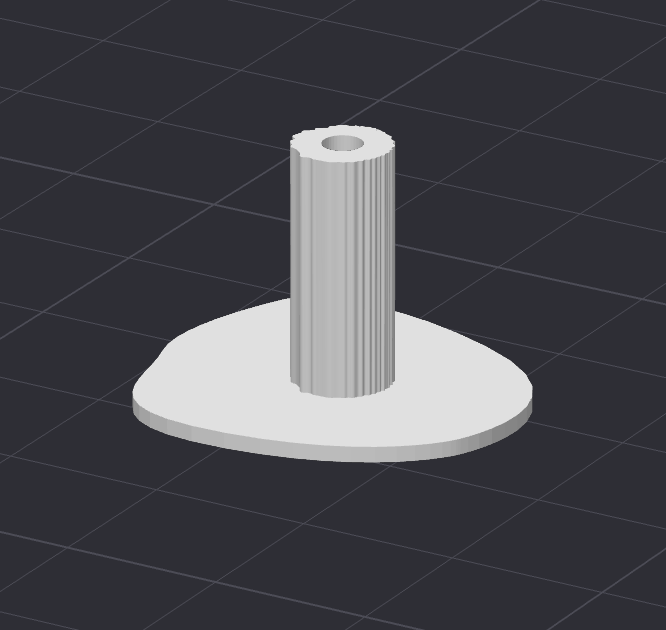
I made a very rough trunk shape in tinkercad and 3D printed the 60 I needed. I then glued them down in a semi-random pattern to some MDF bases I cut out of the back of an old bookshelf (never throw anything away!), and was ready for basing.
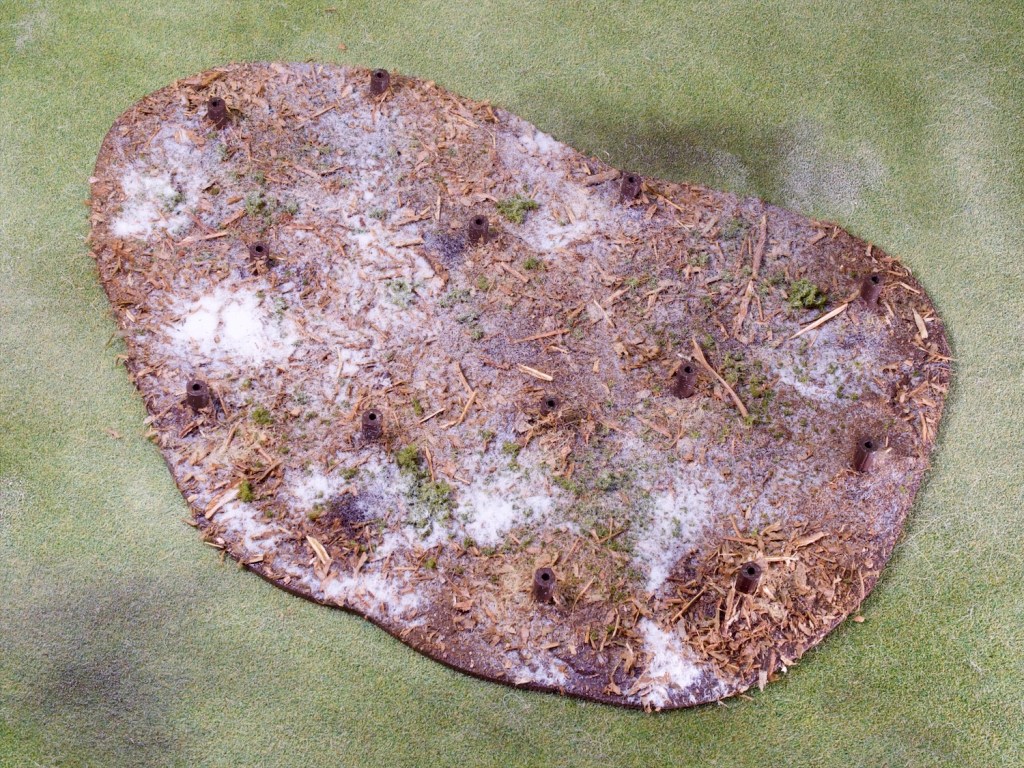
I wanted a forest floor look but wanted to stay away from a leafy look as befits a pine forest. As a result while I went my usual route of blending up some leaf litter as I did for these citadel woods and for my endor table I stayed away from soft leaves (european style!) and went for dried eucalyptus leaves which are much harder and blend down to a powder. That mixed with small twigs gave a nice finish that I think does a decent job of impersonating dropped branches and bark at the scale.
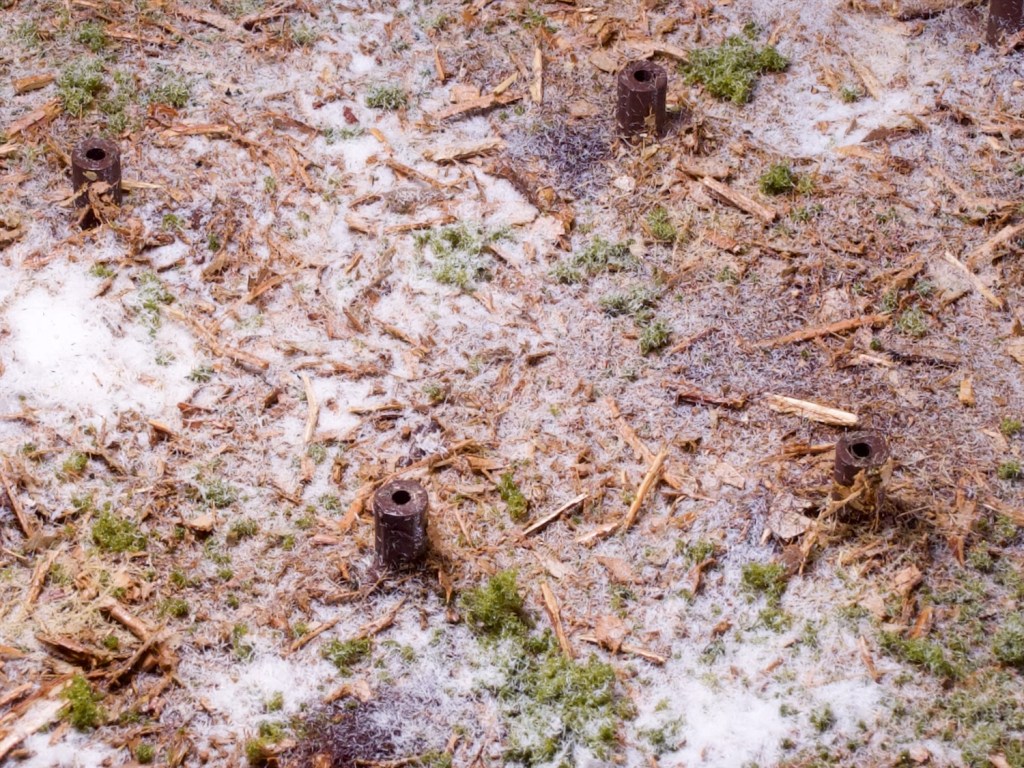
To finish the look I added some green foam from woodland scenics to represent small vegetation on the forest floor. I tried adding some dark and some dry static grass to look like dropped needles, but I don’t think they’re very visible. To top it off I sprinkled some snow flock over the trees and bases (over wet hairspray), then sealed the lot with some spray varnish.
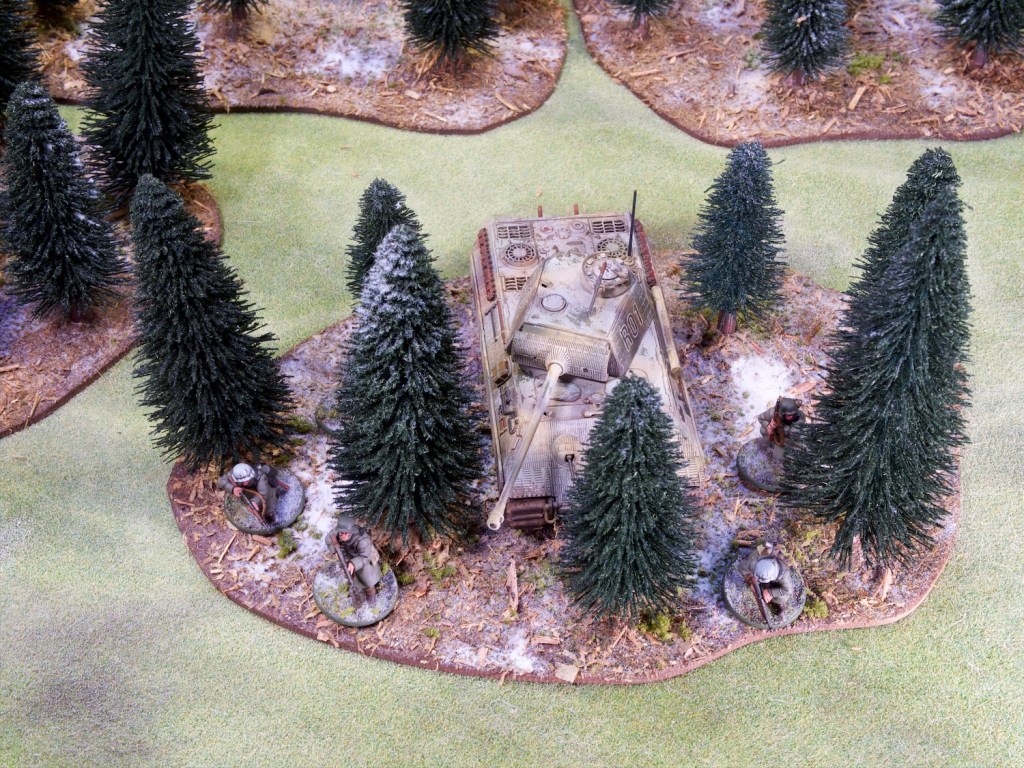
Keeping the trees removable is quite practical for gaming purposes, especially for those game systems that treat forests slightly abstractly as an area of terrain rather than individual trees.
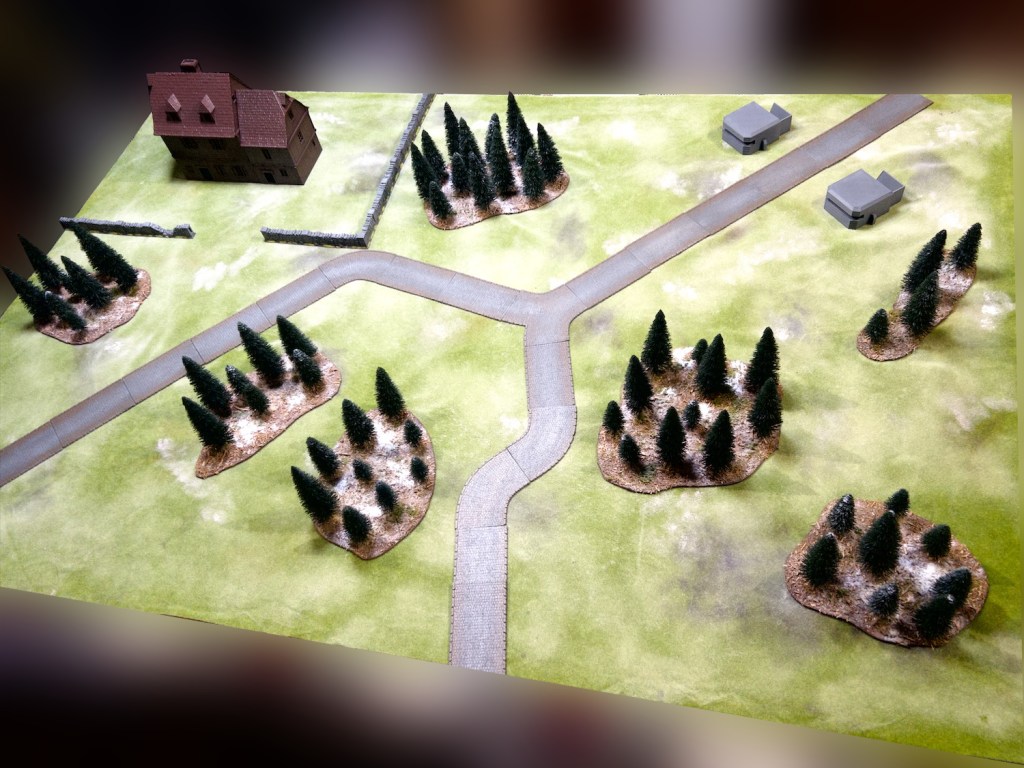
The trees make up most of the terrain I needed ready for this game as you can see from the layout I set up above. You get a sneak preview of the remainder of the terrain which is the large house in the left corner and the two small bunkers to the right.

You also get to see my attempts at repurposing my old Citadel grass mat, which has sat unused for years since I’ve move on to printed neoprene battlemats. It seemed a waste to not use it, so I decided to see if I could convert it for this cold setting. I hit it with patches of brown and white and then “frosted” it with a light pass of white spray paint to get that frozen grass look.

I wanted the table to have a frosty morning with some light snow look rather than a full on snow storm, hence the light use of snow flock on the forests and the light dusting of white on the mat. I’m hoping to communicate the cold through the mat and the tree stands only, allowing me to place terrain pieces I painted for my other settings over it and having them not look out of place. For example I’m planning on using the cobblestone road I painted for my Normandy games in this game as you can see above.

I hope you like the look of these, and I’ll be likely back onto my slower pace of posts as I head back to work next week!

Desert Ruins

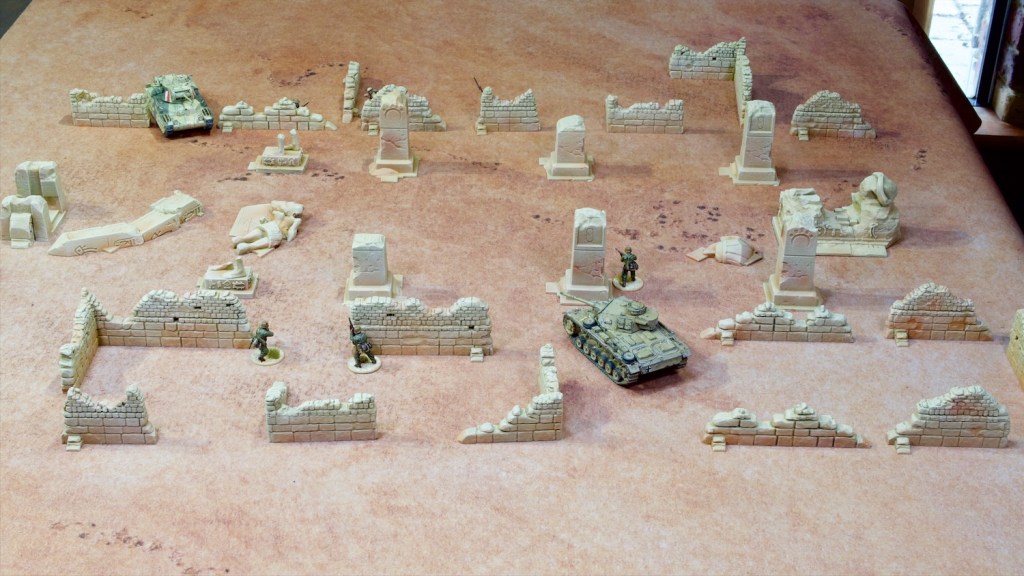
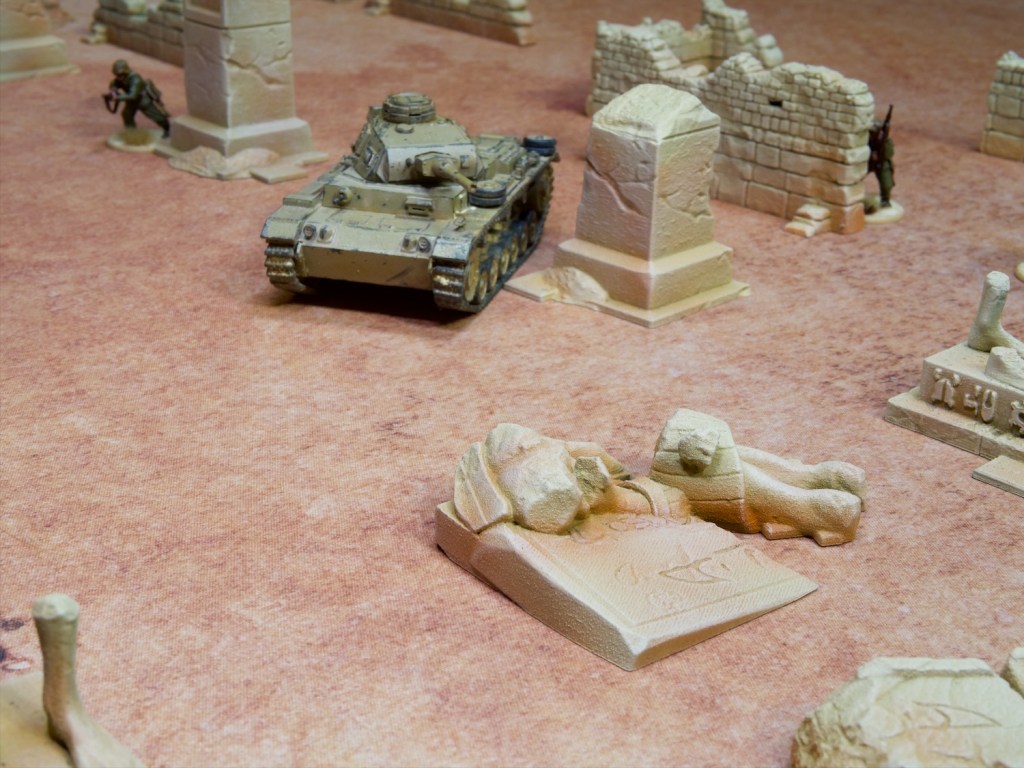
My 3D printer has been very busy these last two weeks, producing enough scatter terrain to cover a densely packed 3’x3′ area, or a more loosely covered 6’x4′ board. The theme: desert ruins, more specifically Egypt-like ruins.

The primary motivation for this effort has been the Silver Bayonet, I picked up the Egypt supplement a few weeks back and one of the North Star units for the game, and needed a nice set of terrain to play some of the missions. The good news is that I have a fair few other games that require desert terrain, such as Bolt Action for my North African forces, and Warhammer of course for my Tomb Kings.

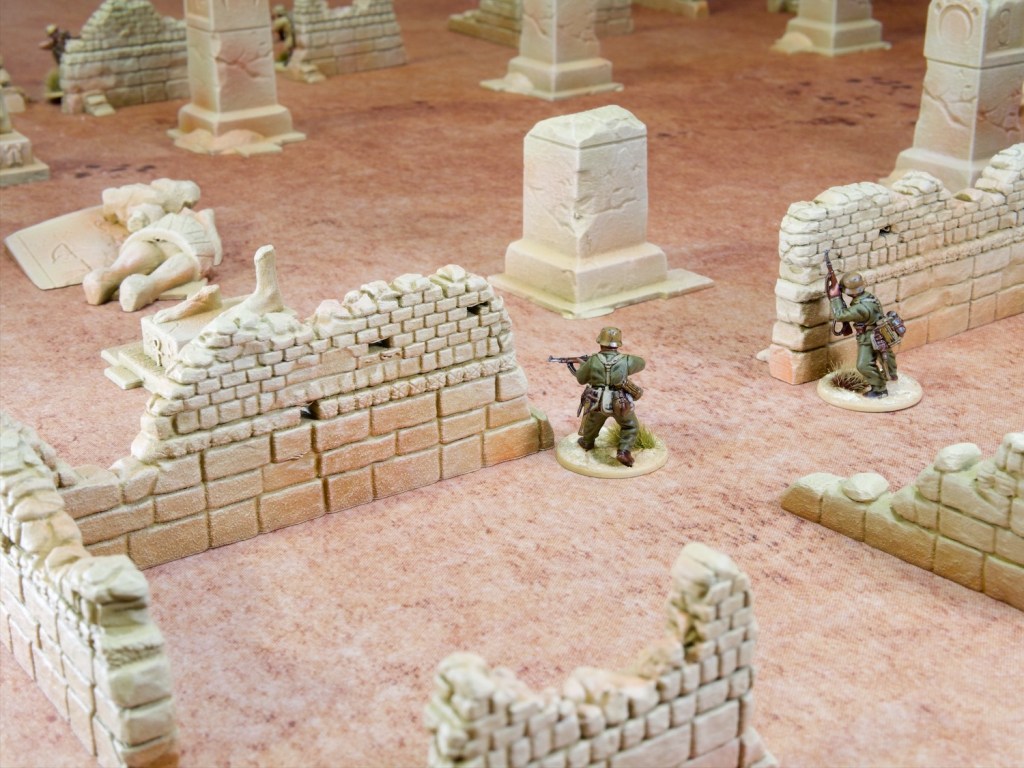
The models I printed were from two sets: the ruined walls are by The Lost Adventures Co., and the Egyptian statues/columns etc are by Txarli Factory. I printed the walls at 65% scale to make them a nice size for my historical miniatures, allowing them to peek over the lower sections of wall.

I undercoated all the pieces with an old can of Citadel Roughcoat which is a spraycan-based texture paint (and long out of production, I’d love to find a good replacement). This had the dual effect of hiding the print lines on the models, and adding some nice grit for that sandstone look.

Painting-wise these were pretty straightforward. I sprayed Vallejo Primer German Dark Yellow all over, followed by a top down spray of Vallejo Model Colour Dark Sand through the airbrush. I then drybrushed Vallejo Model Colour Dark Sand, followed by another drybrush of Vallejo Game Color Bonewhite. At this stage I popped the pieces onto my desert mat and realised they looked out of place as the mat has quite a bit of red to it. To remedy this, I added patches of Vallejo Skin Wash Ink using the airbrush, followed by another drybrush of Vallejo Game Color Bonewhite. I would probably have skipped the first Bonewhite drybrush if I’d known I’d be doing another, but sometimes you find things out and need to go again!

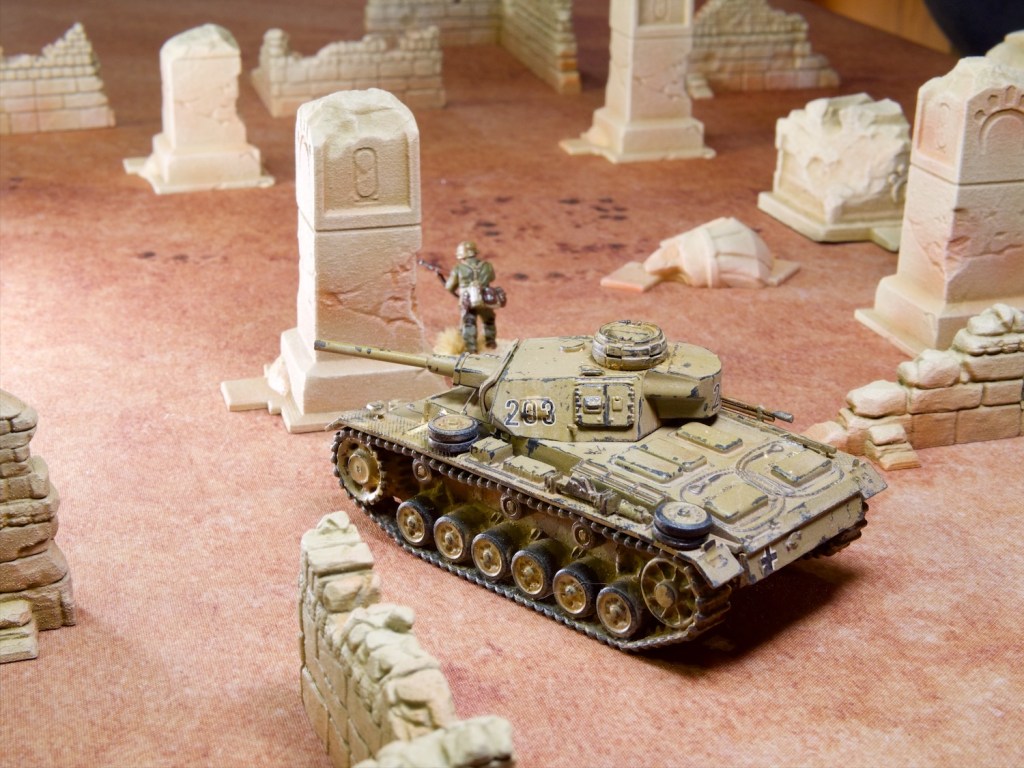
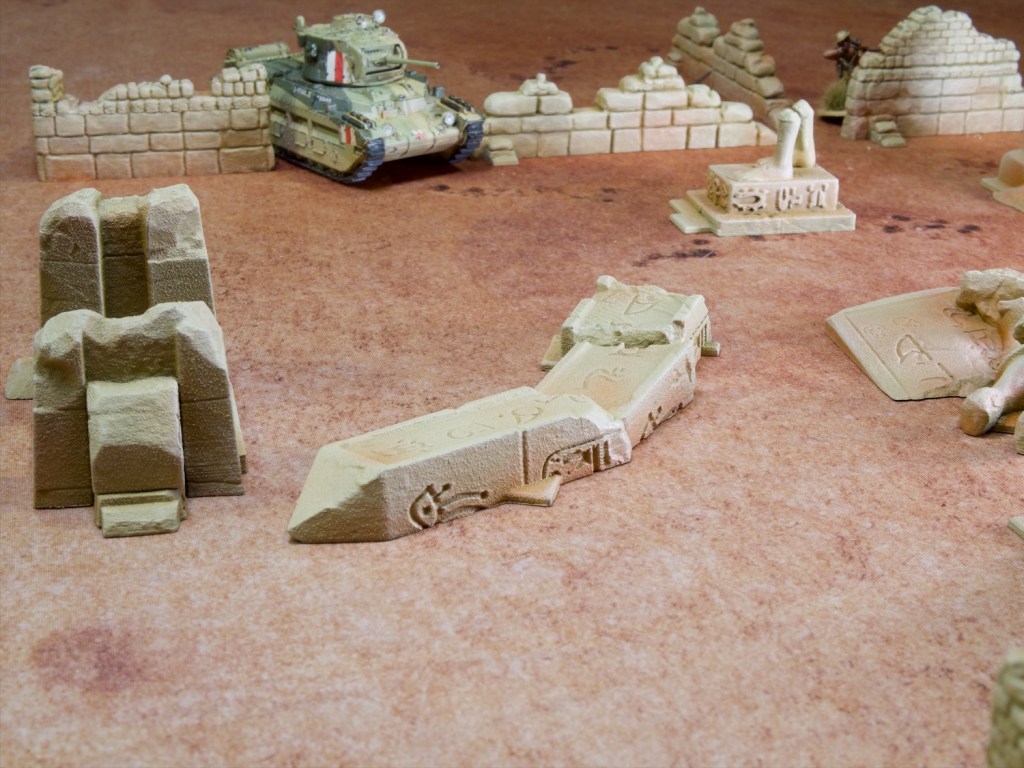
I’m really pleased with how these came out, the roughcoat really did a nice job of making the 3D prints more stonelike. The reddish tones also really tie the pieces to the game mat. Here’s a few more closeups showing off the different pieces:

A nice quick update after the longer last few posts. I do enjoy panting terrain as a nice break from more involved models. I’m currently painting up my Egypt campaign unit for Silver Bayonet (guess what nation!), and looking forward to playing some game with this new terrain. The Egypt 3D model set also comes with a sphinx and a pyramid so if I feel like filling out a bigger table I have what I need!

Beehive Hut

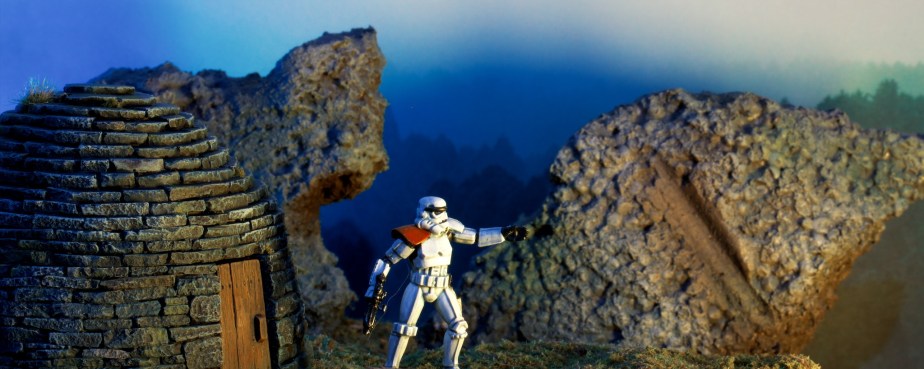
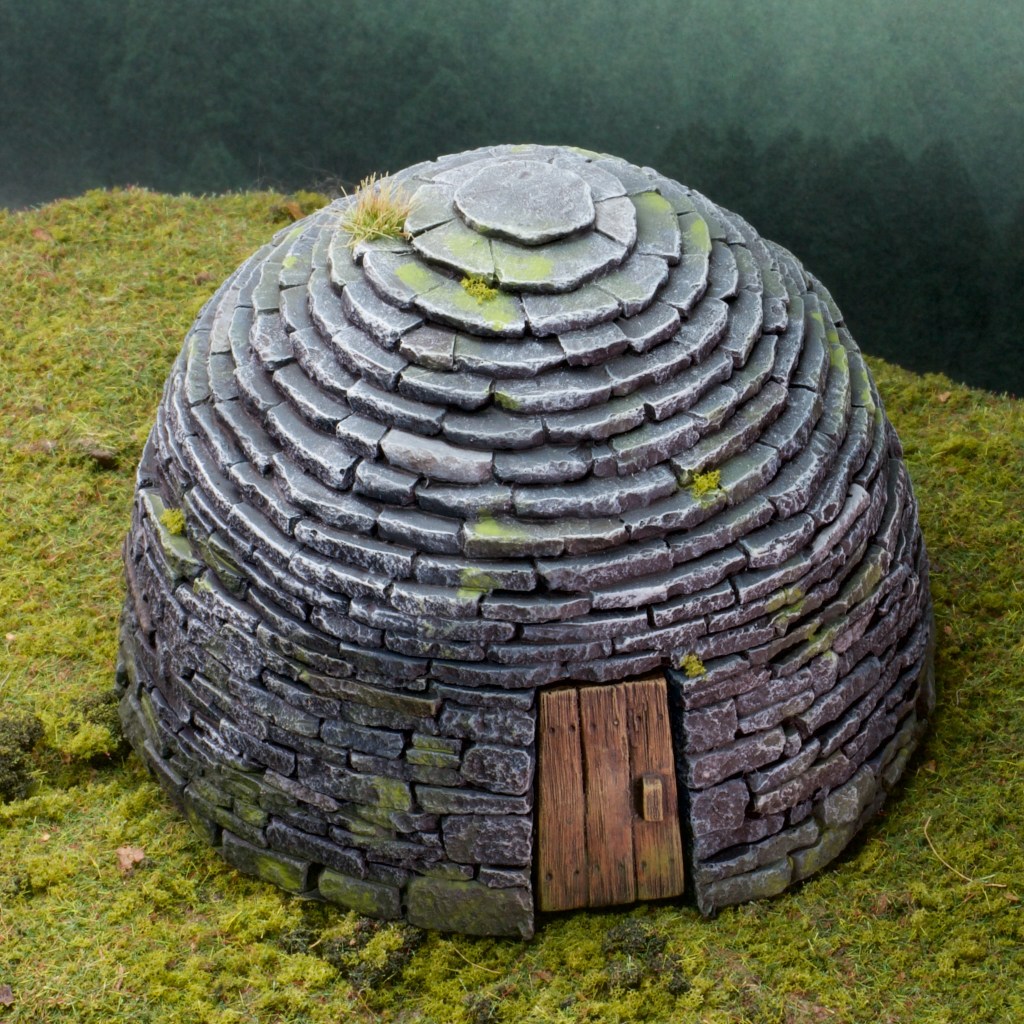
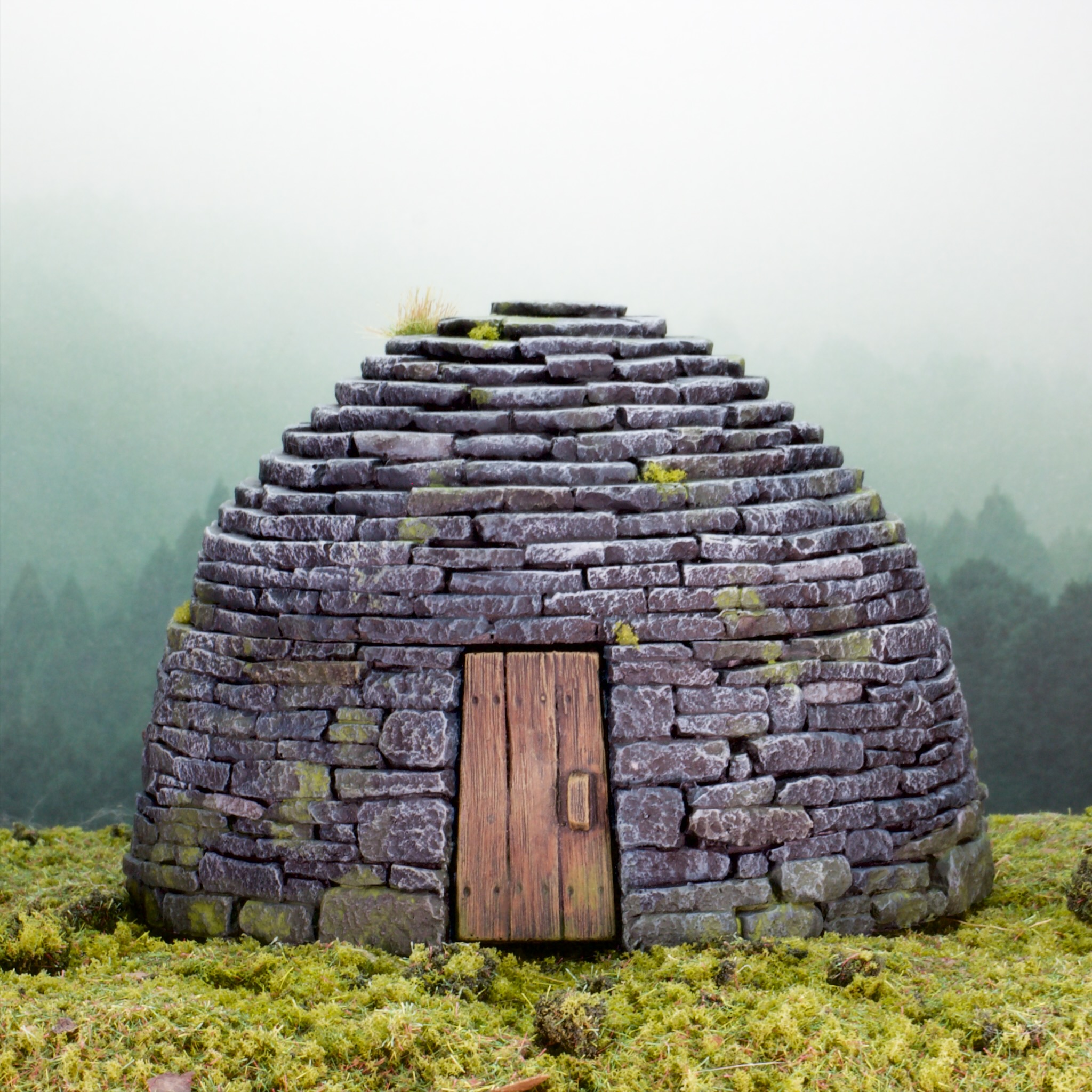
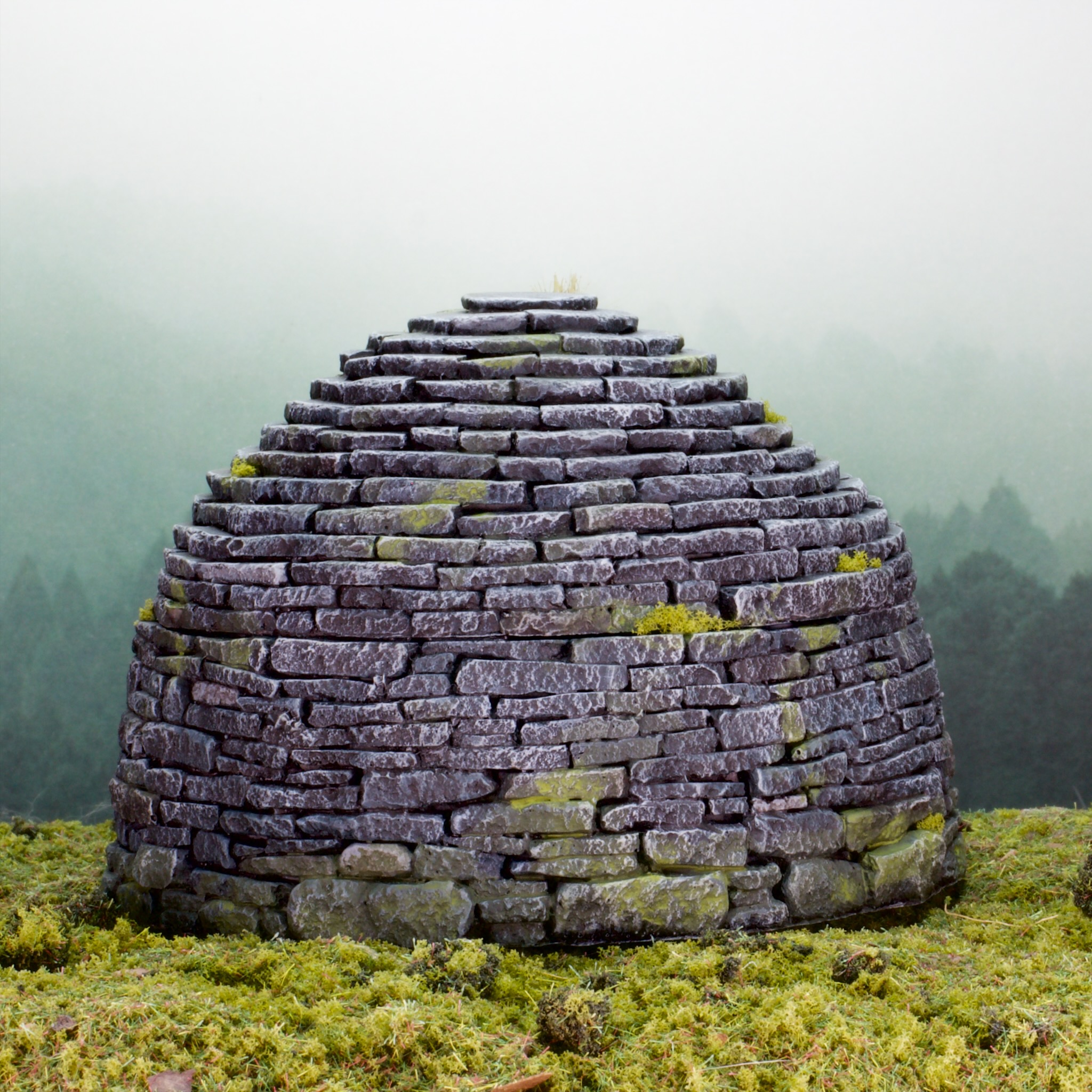
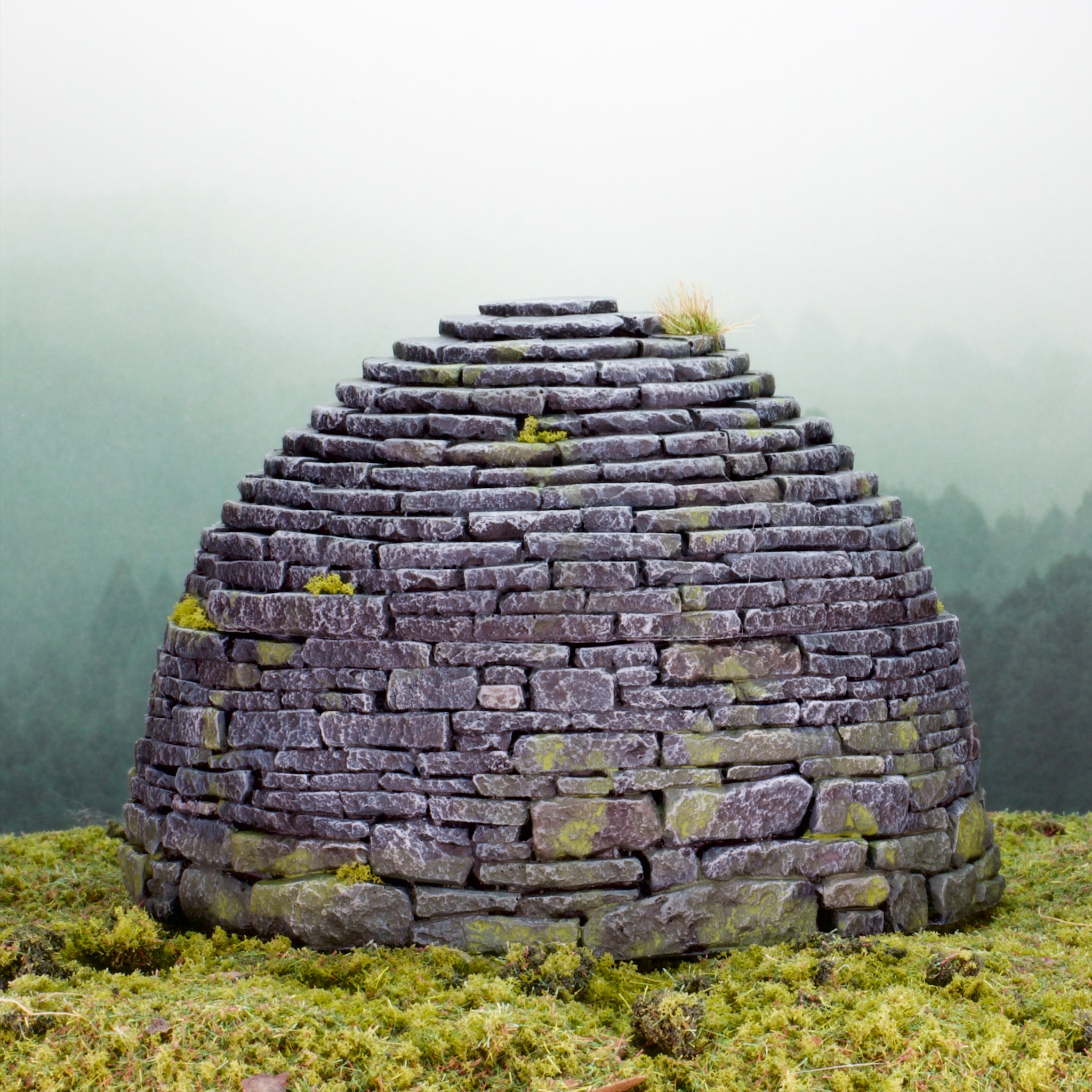
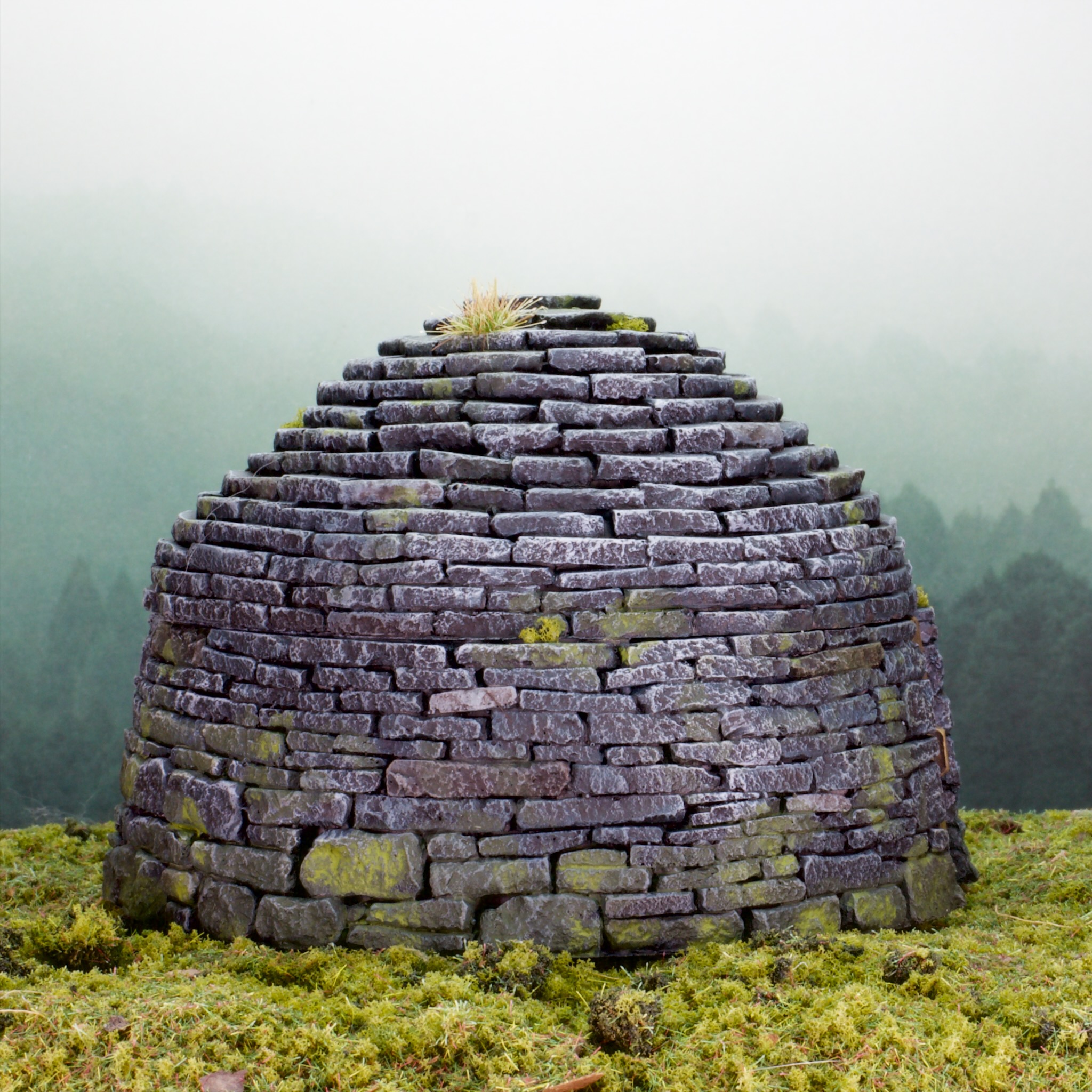
I’ve been off traveling for work so haven’t had much painting time in the last few weeks, but I felt like getting something done so turned to some terrain painting. I’ve had this beehive hut for a little while, it arrived alongside my barrow pieces from Fogou models and like everything I’ve gotten from there is a really cool model.

It was pretty fun and fast to paint, I followed my usual stone building paintjob, which is inspired by an old White Dwarf article.

I generally start with a basecoat of Vallejo Codel Color Dark Sea Grey, followed by successive drybrushes of Dark Sea Grey mixed with more and more of a light grey (Vallejo Game Color Heavy Bluegrey in this case). I then picked out some random stones with the Heavy Bluegrey, and tinted some random other with Citadel Fyreslayer Flesh Contrast and Citadel Aggaroth Dunes to add a bit of variety to the stones.

I then apply my homemade terrain wash (50/25/25 black ink, green ink, red ink, with water, flow aid, matte medium to taste) all over. The flow aid could be dish soap, I find that bubbles up a bit when I mix the wash up and apply it so I tend to avoid it, but it does the same thing at the end of the day! After that dries I hit the building with another drybrush of the light grey, followed by a more patchy drybrush of an off-white (AK Ivory White here). That finishes up the stone and I move on to the mossy areas. Those are done with enamel washes: AK Slimy Grime Dark and AK Slimy Grime Light. I generally start with the dark grime and apply it quite liberally to the lower areas, and in smaller patches to higher areas. The light grime is then plopped on top of areas of dark grime while those are still wet to get them to bleed into each other.

The painting stage is then followed by some foam moss to get a 3D effect in there and I decided to add a grass tuft to add to the overgrown look.

I have a few more pieces from Fogou I need to paint up and I’m sure they’ll be this fun to paint as well. The details on these models are really nice and they take paint very well.

In other news I got a notification from WordPress that the blog is now 4 years old, which is a nice little achievement. I started the blog as I missed the hobby blogging community, a lot of that content having moved to social media over the years (understandably, for those that want to try to make a living out of this social media is where the large audiences are). I’d enjoyed reading hobby blogs back in the early/mid 2000s, and gotten a lot out of them as the blog format in my opinion is very well suited for teaching. Funnily enough making this blog has led me to discover some phenomenal blogs which has been fantastic. Here’s to many more years!

Siege Preparations

As I mentioned last week, we’re preparing for a siege game as the opening battle in our Border Princes campaign. Last week’s post covered the last of the defenders, and this week’s will cover the preparations I made to the attacking force: my Dwarfs!

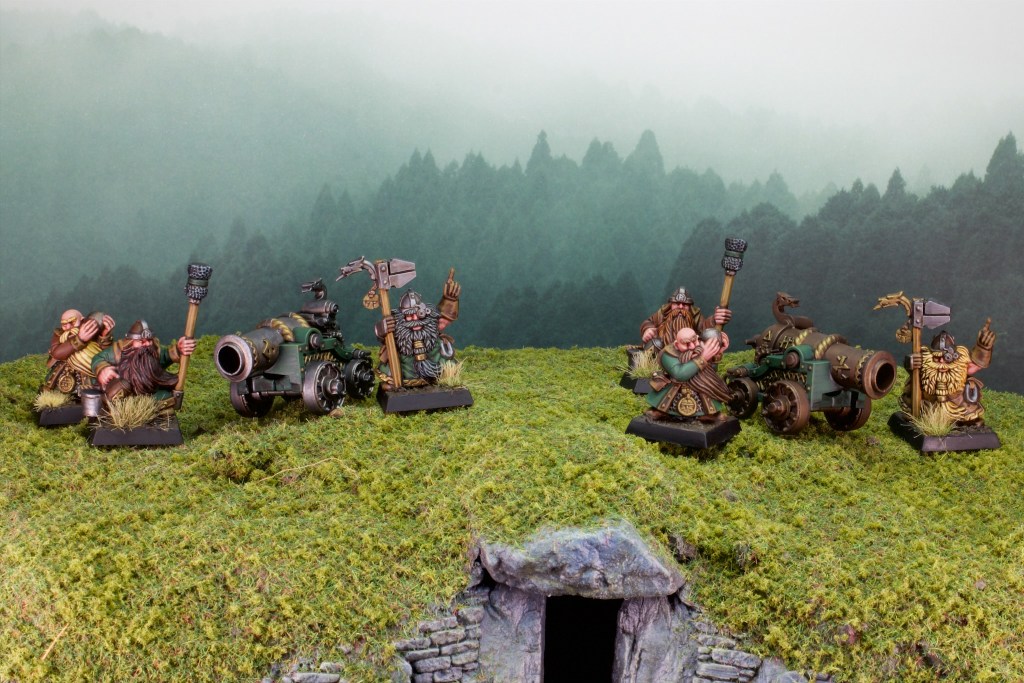
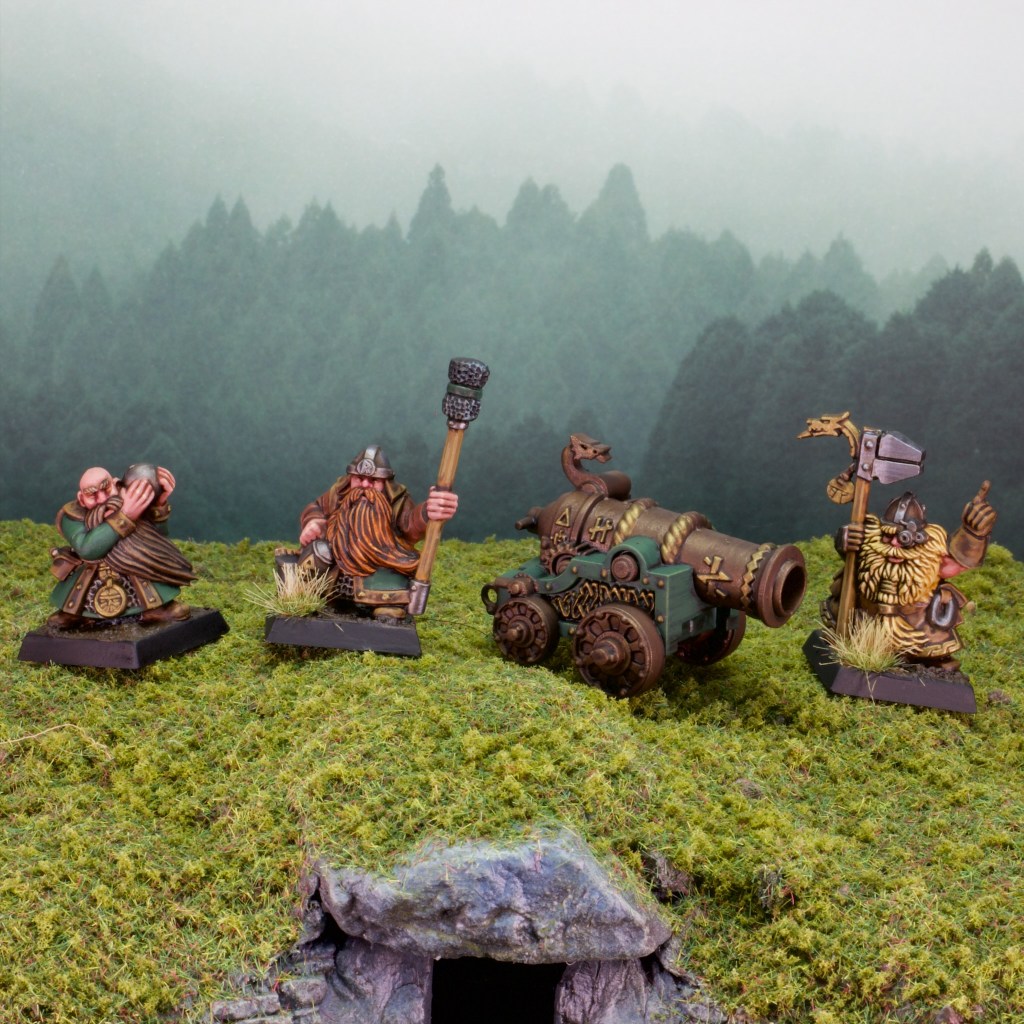
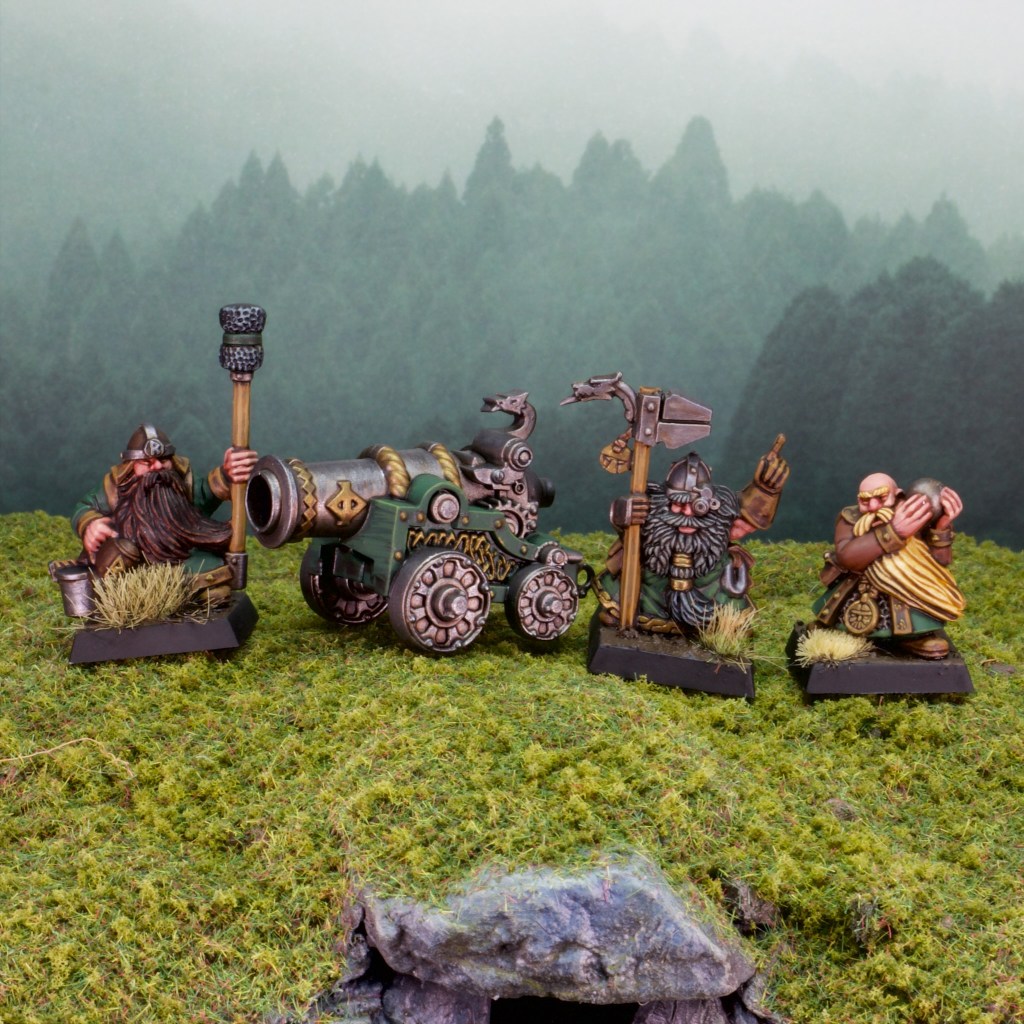
As you can see in the photo above I decided that I needed more firepower! I painted two extra cannons this week to breach the gates of the fortifications, which is one of the main objectives of the scenario.

I painted the two cannons different colours to add a bit of variation to the models, considering this is the third of this cannon model I have in the army now. I picture dwarfs as being more artisanal craftspeople and therefore making the cannons as they see fit rather than follow a set pattern.

Of course the crews also being one piece models there is no variation in them, so once again I used colour to differentiate them, mostly through the beards but also by changing the colour of some of the clothes.

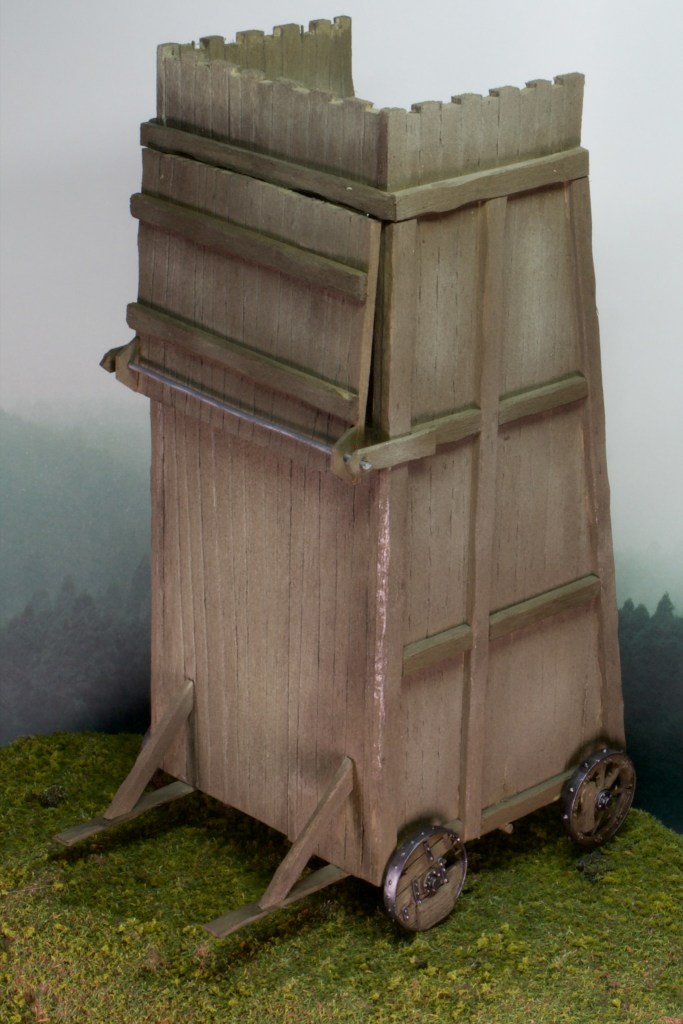
While the cannons attempt to breach the walls, I have another way to cross the walls: a siege tower!

I built this a while back and haven’t had the need until now to paint it. This siege game is the perfect excuse to get it finished and on the table!

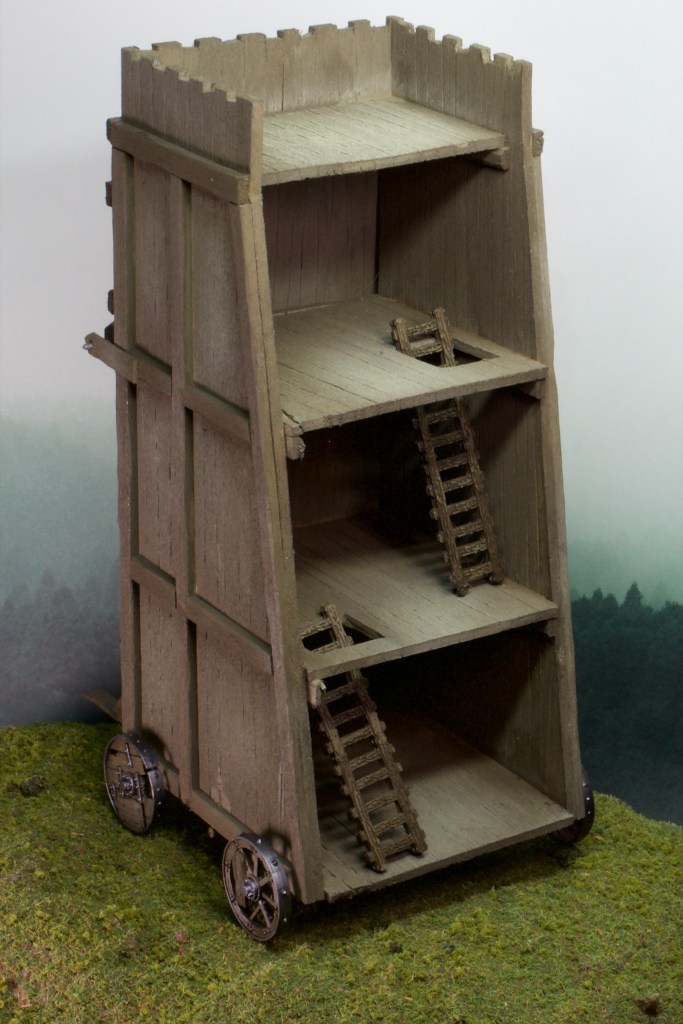
The tower itself is built out of balsa wood, with the wheels from the Skaven warp lightning cannon kit. The ladders are 3D prints I did a long time ago for the This Is Not A Test games we were playing back in 2021. They ended up fitting rather nicely here!

I kept the tower rather faction agnostic so that it can be used for any siege game, it is probably less well constructed than Dwarfs would like, but much better constructed than Orcs could manage!

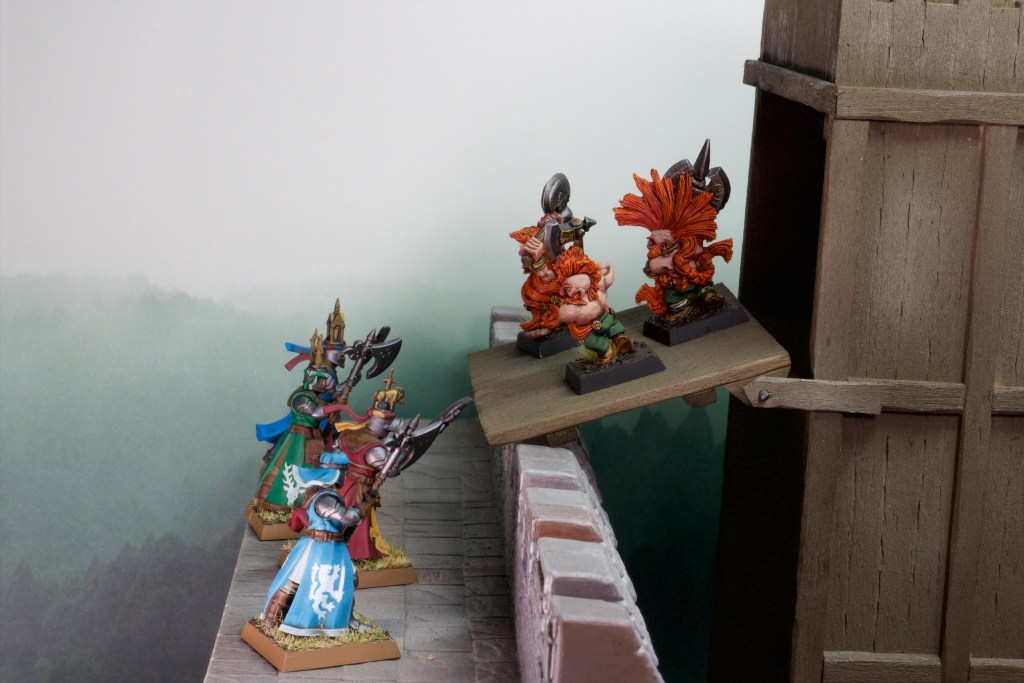
The platform at the front of course pivots, ready to come crashing down on some battlements and disgorge its occupants! I’m planning on filling it with dwarf Troll Slayers, so the above shot is probably a preview of the game to come!

The game is tomorrow and I’ll endeavour to take some photos that I’ll post here.

The Geistenmunden Hills

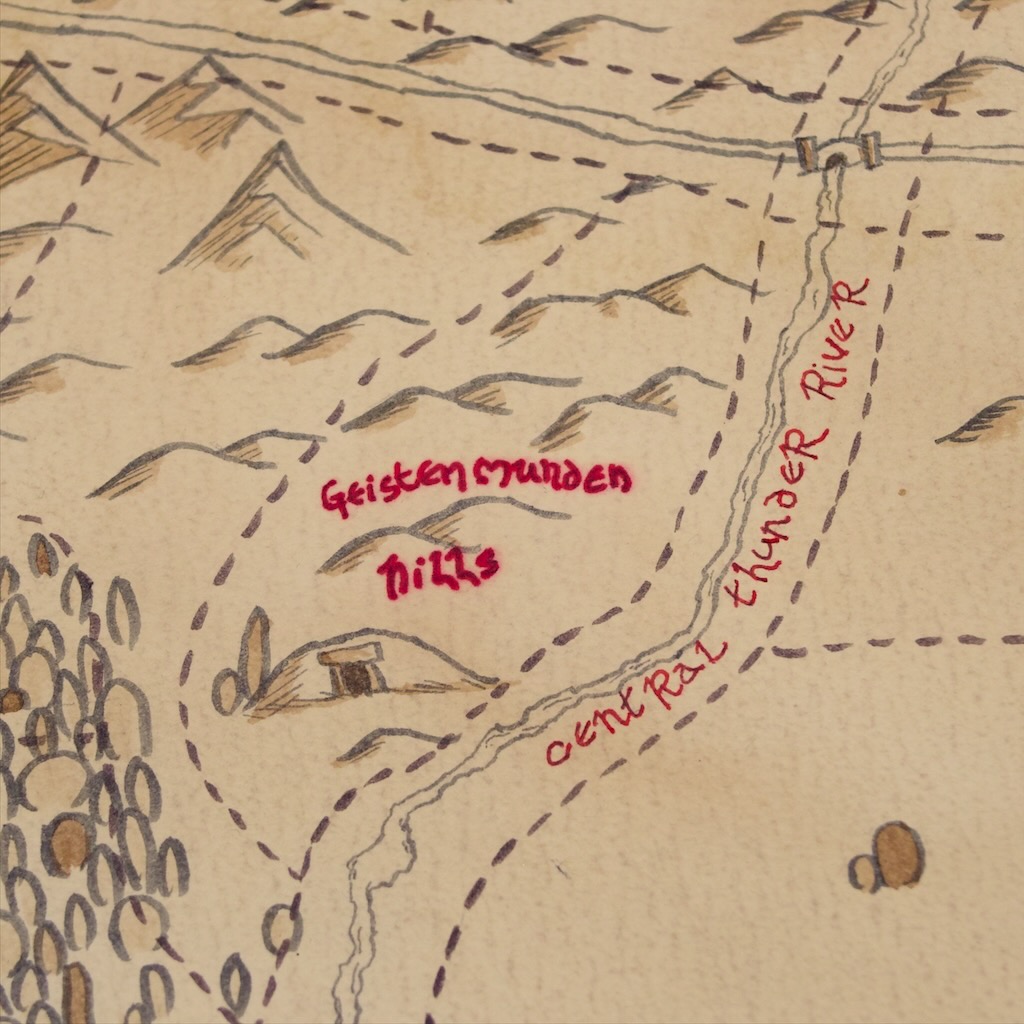
It’s been a fair while between posts, over a month in fact! Over this period I’ve been on holidays and busy with work so haven’t had much time to get things painted, but I’ve still been chipping away in the background. Here’s something I’ve been working on for a little while: a set of terrain for the Geistenmunden Hills area of the Border Princes campaign map.

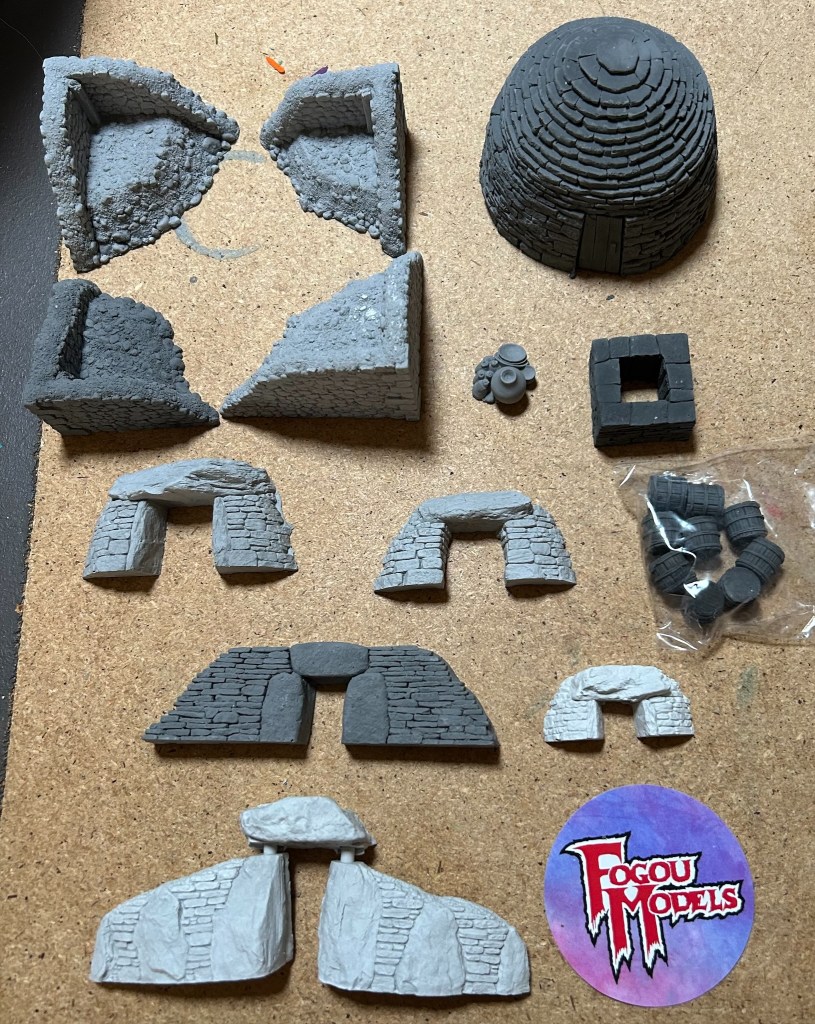
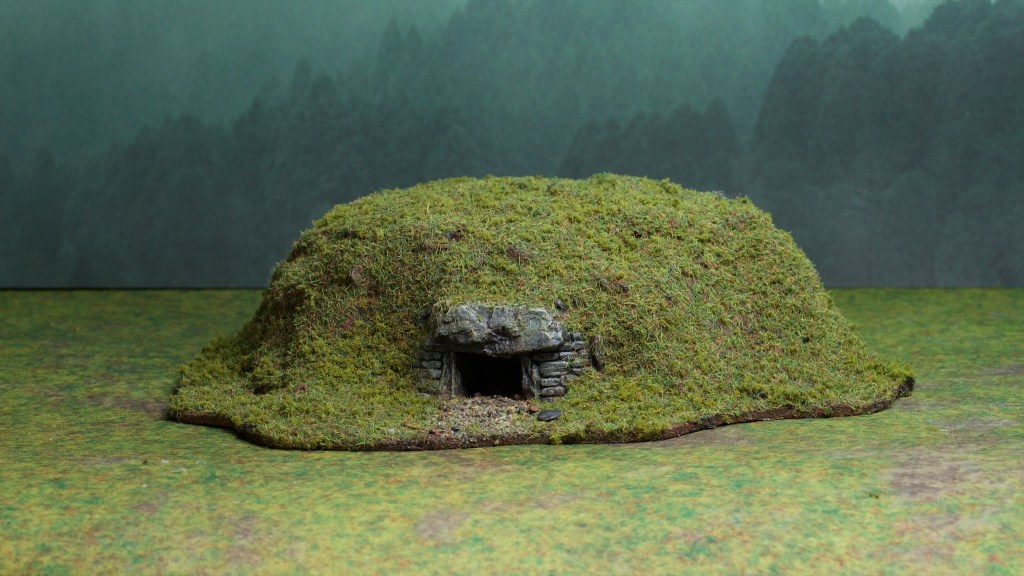
As you can see from the illustration, this is going to require some barrows! Luckily for me back over the Christmas break I’d ordered some terrain from https://www.fogoumodels.co.uk/ including a set of resin barrow entrances (well not so lucky, I ordered these for this very purpose!).

There are some other bits and bobs there that I’ll get to painting at some stage. Overall the quality of these models is excellent, the stone textures are really nice. I’d been waiting for an excuse to order from them for a while, and this was it!

Entrances are all well and good, but they need some burial mounds attached to them, and that’s what I busied myself at next. I took some photos of the process so I thought I’d make this post a bit of a tutorial.

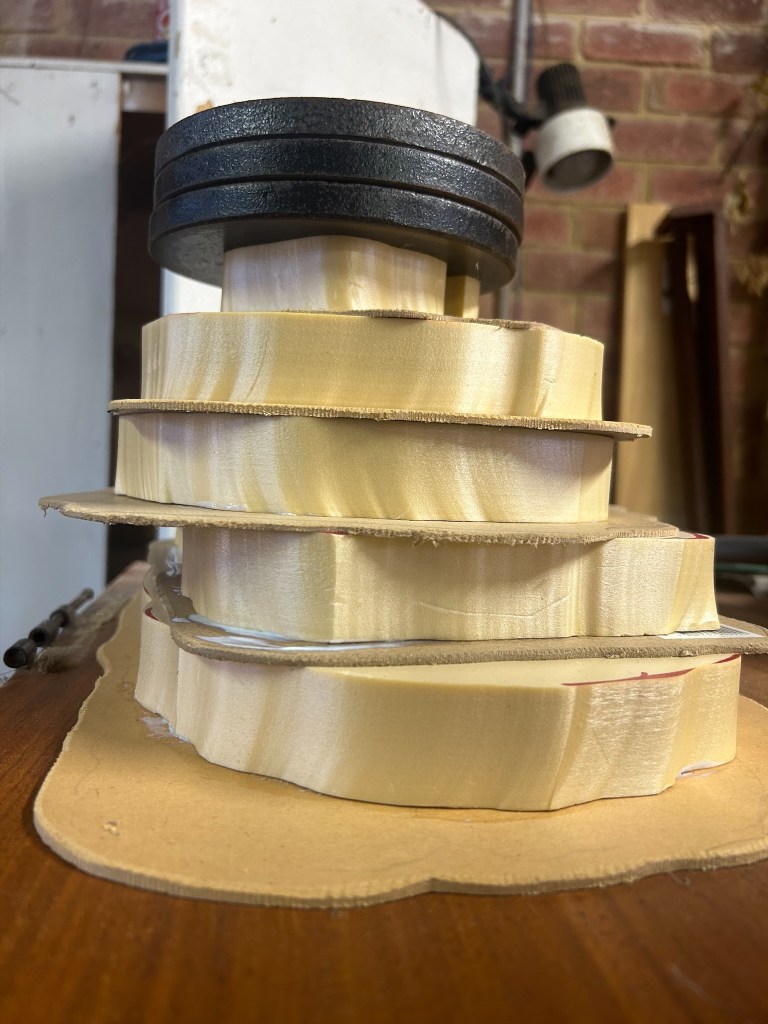
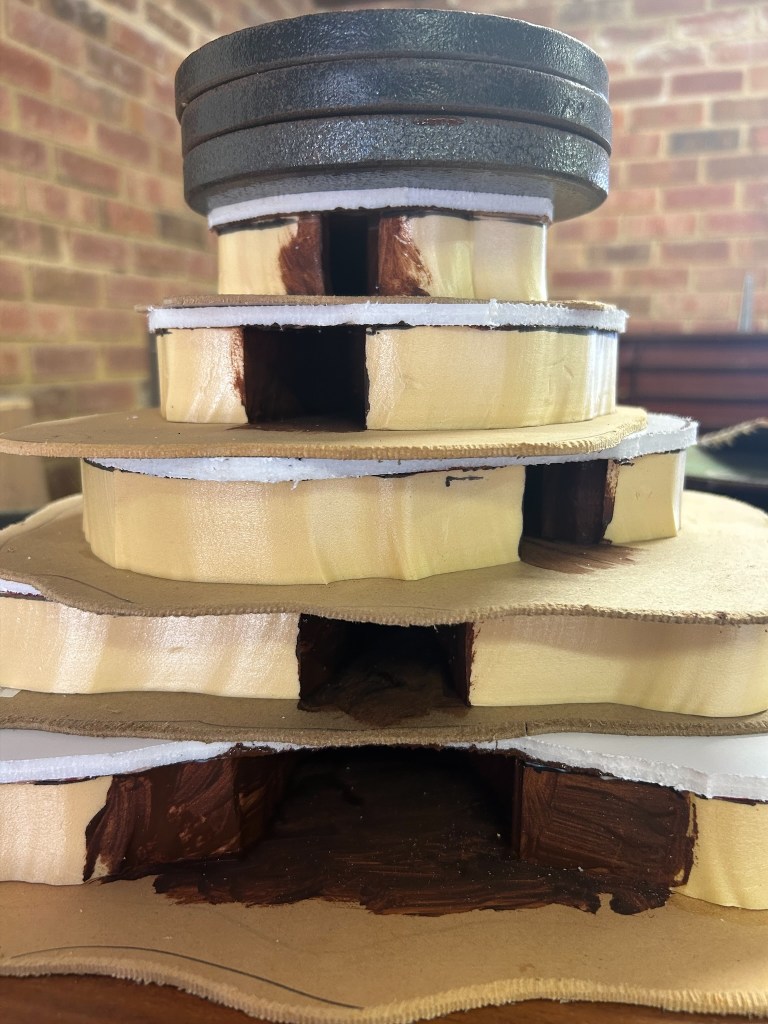
I started by cutting some rough shapes out of MDF for the bases and matching smaller shapes out of insulation foam to make the main shape of the hills. I also cut a notch out of each of the hills to make the tunnels behind the entrances. You can see said notch in the smallest hill at the top of the pile. I then covered the undersides of my foam shapes with PVA glue and glued them down, and weighed them down with some small weights.

Next step was to put a roof on my hills. For this I used foamcore cut to match the hills. I also glued this down with PVA glue, but before I did this I painted my “tunnels” with some dark brown paint as I wasn’t going to be able to get to these once the entrances were glued on.

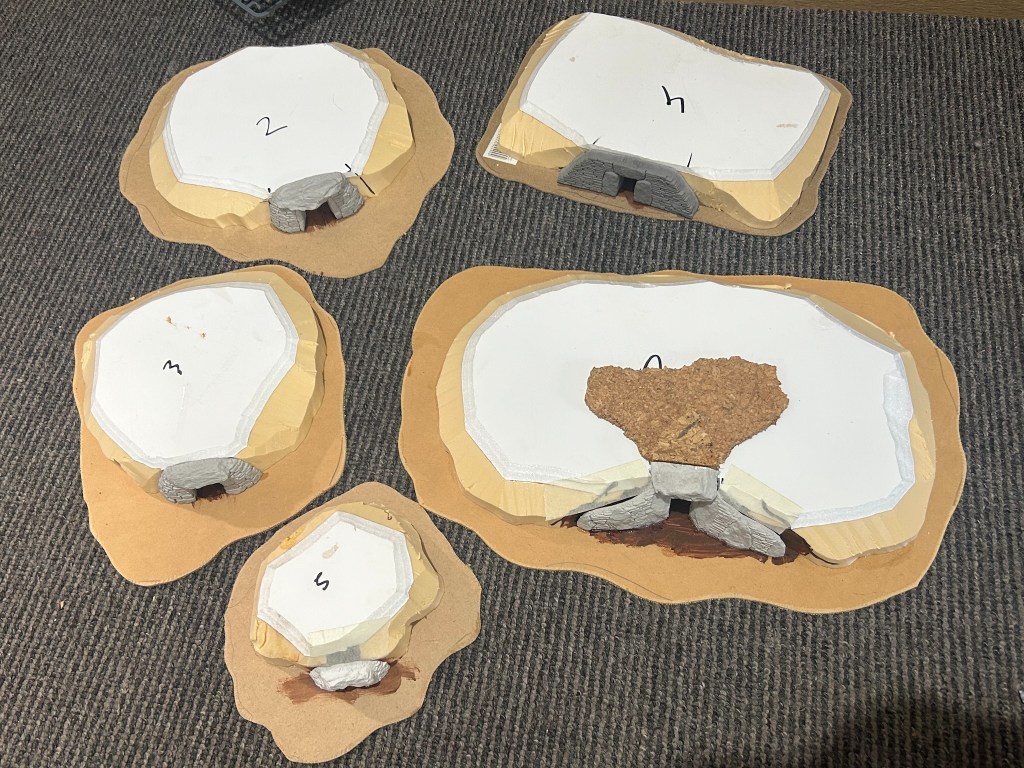
Once the glue was dry (read a few months later!) I carved my hills using a snap blade/retractable blade knife, with a special focus on making sure the entrances lined up neatly with my hills. For the big hill the entrance was taller than my foam assembly so I added some cork pieces to create a gradient to match the entrance. I used masking tape to patch any gaps, and glued the entrances down to the MDF using super glue (watch the foam doing this, super glue melts it!).

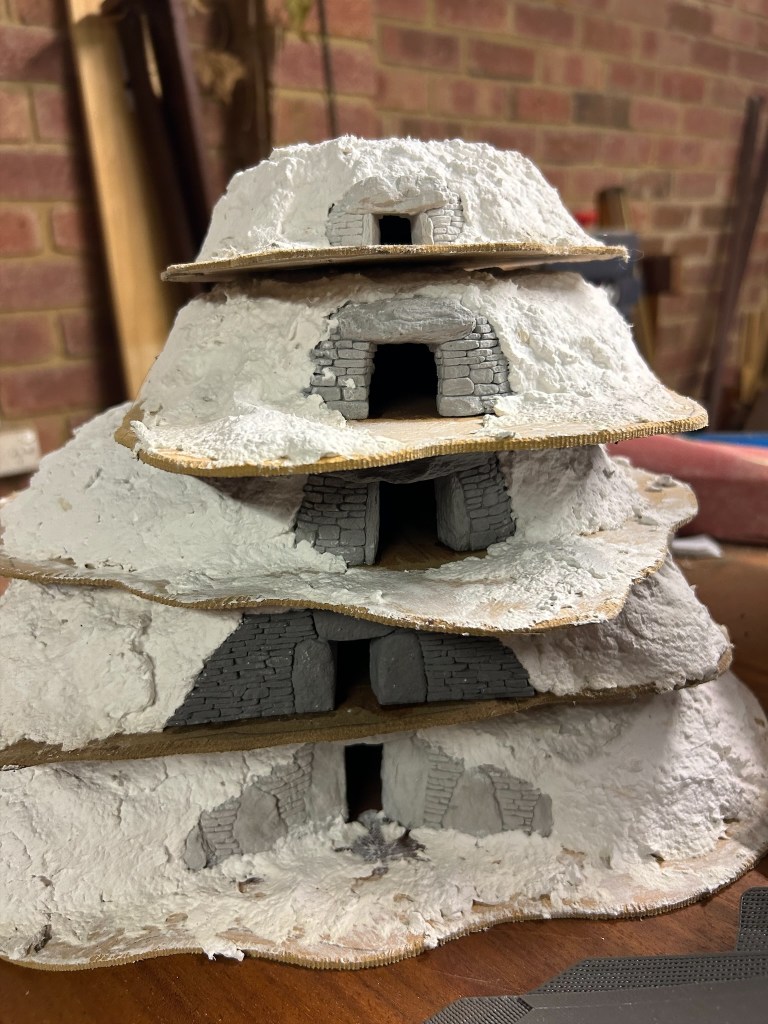
Following on from this I used Sculptamold (plaster with paper fiber mixed in) to cover the foam forms and blending in the entrances, taking care not to cover them up. This added some variation to the shapes and smoothed everything down, making them look much more like hills.

That’s it for the build side of things, now onto painting!

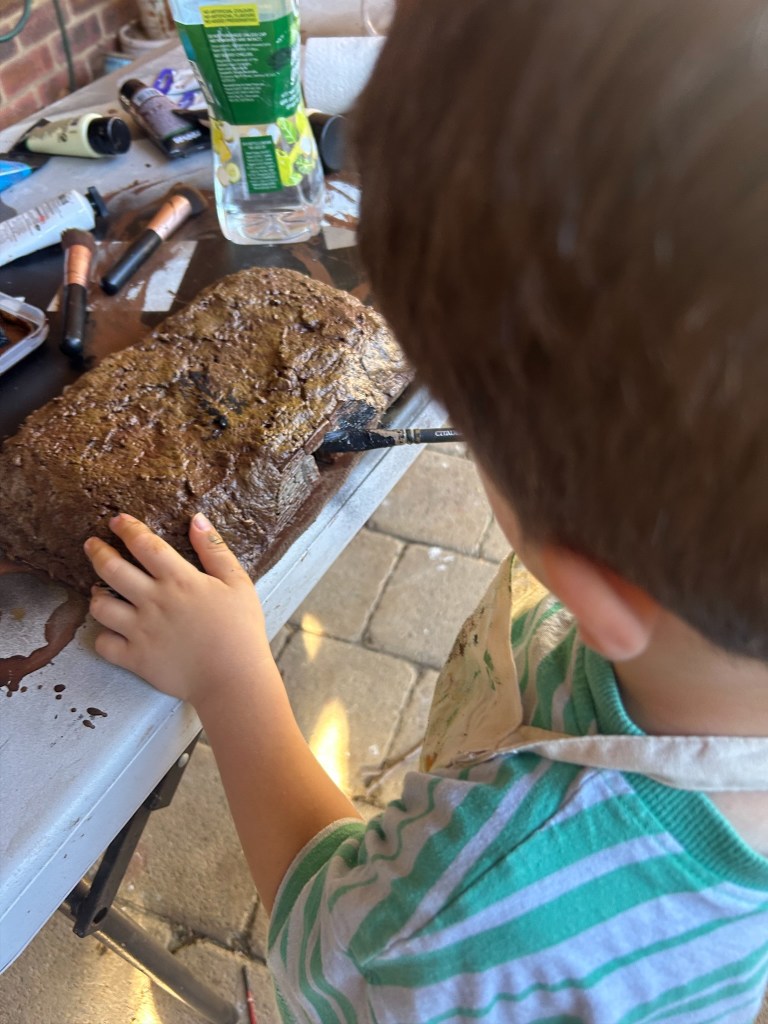
I don’t really have photos of the painting process apart from this one. I’m finding terrain has been a good fun way to get my son to join into the hobby side of things. He’s 3 and miniatures are a bit too small, but he’s fine getting some paint down on larger objects (including himself)!

Once the base colours were down, I gave the entrances a few drybrushes of greys and some green and brown washes to add a bit of colour in there. Once that was done I covered them using the flock mix I’ve been playing with for a while, a mix of Woodland Scenics foams and GW static grass.

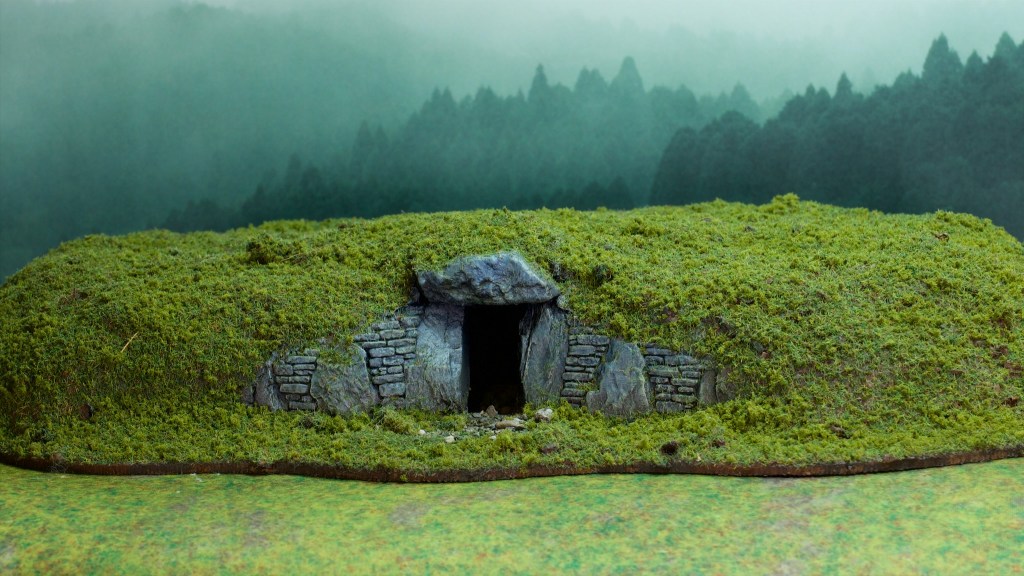
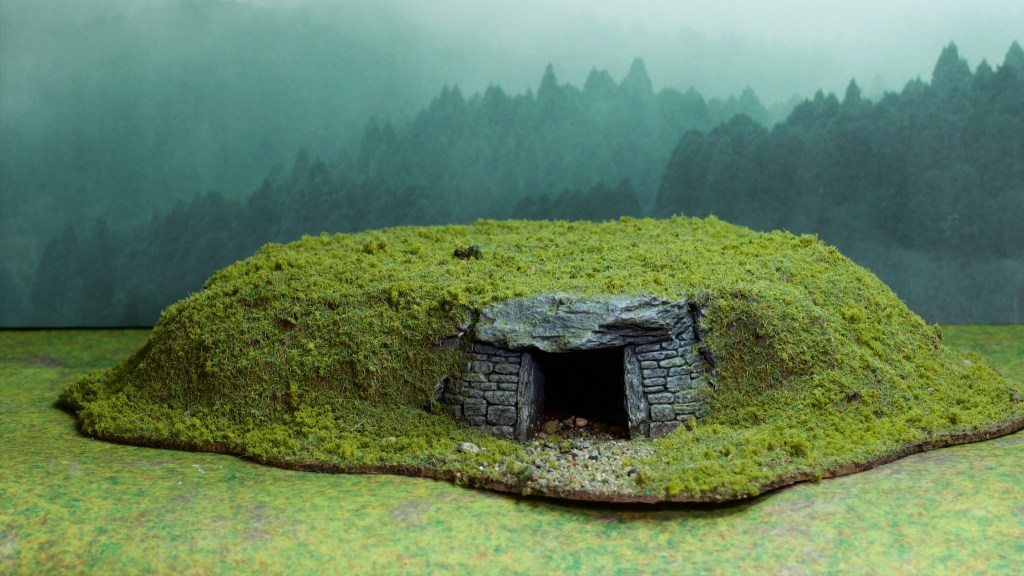
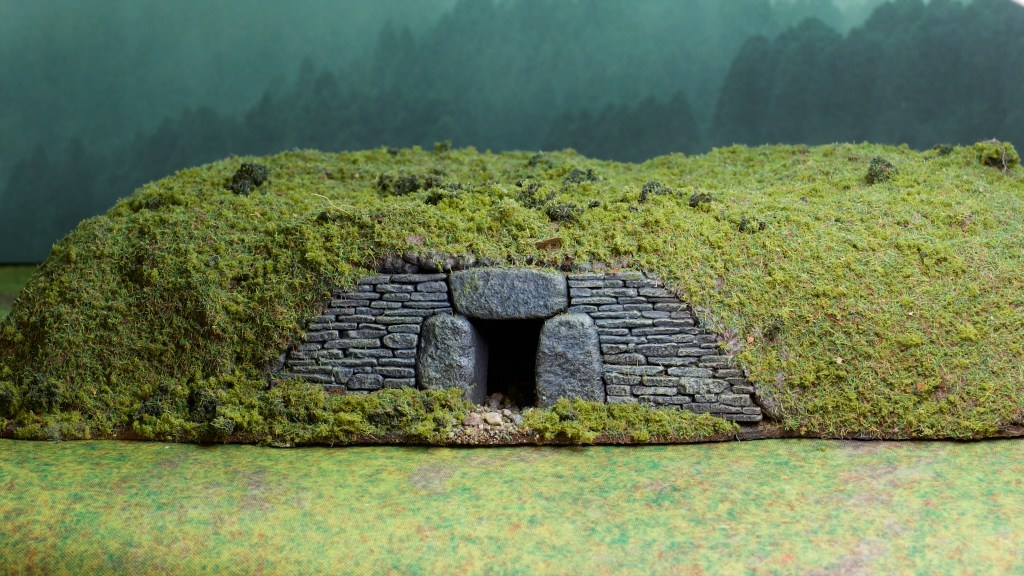
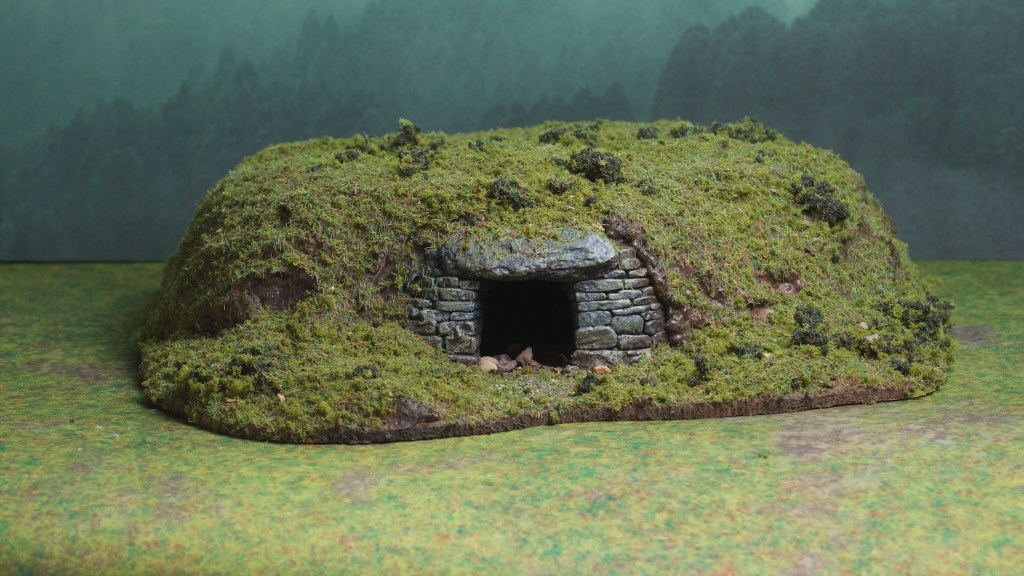
Here are the finished barrows:

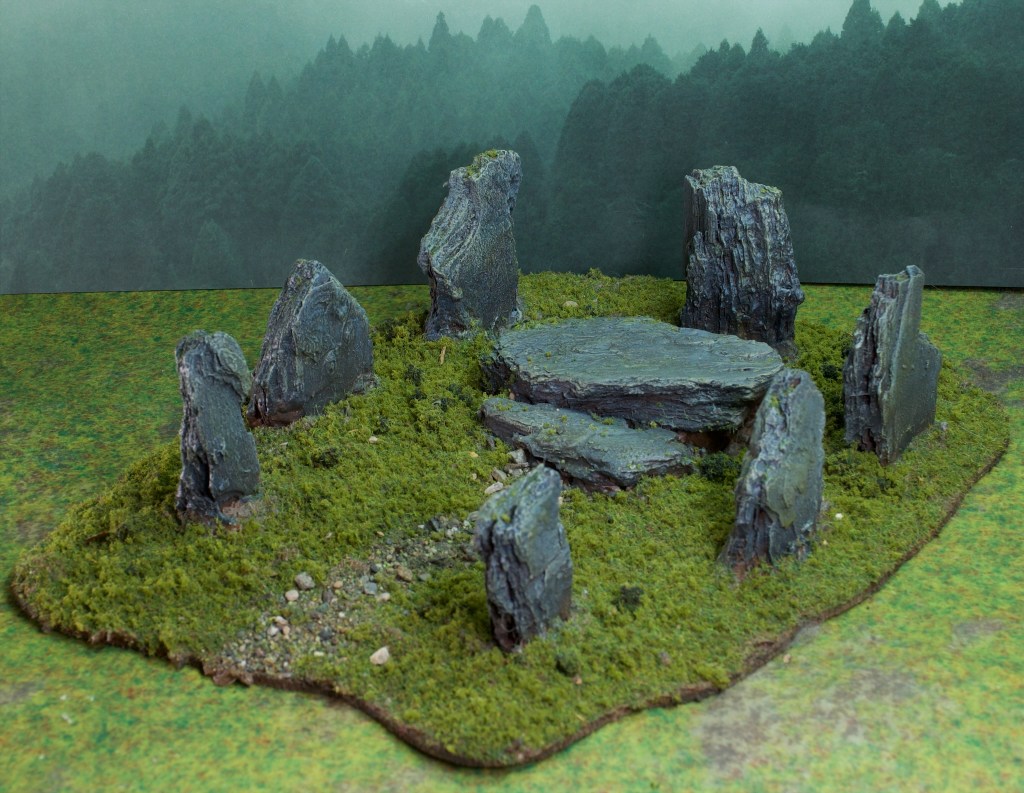
The Geistmunden Hills scenario calls for a piece of terrain to sit in the center of the board, and they suggest amongst other things a stone circle. This appealed to me, and I used some pine bark I had lying around to make an altar of sorts surrounded by standing stones. I painted these to match the stone of the barrows.

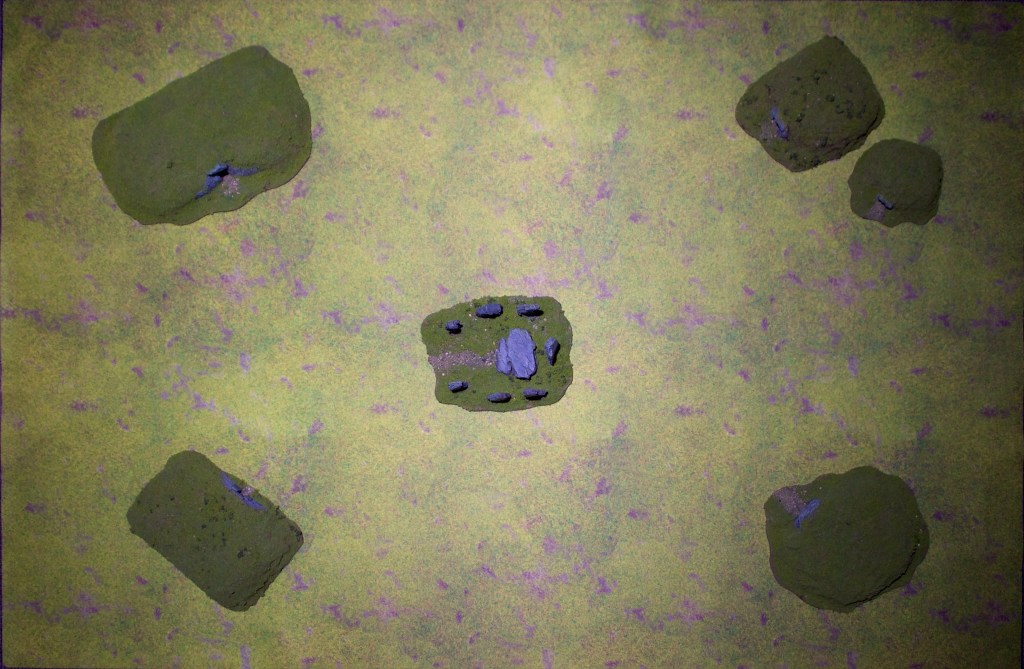
Overall here’s how these all fit on a 6ft x 4ft board:

These were lots of fun to put together, and I’m excited to use them in games. The motivation for these was this Warhammer campaign, but I can easily see using these for historicals or Middle-Earth games.

Until next time!