Playing Warhammer with Midgard Heroic Battles

I’ve been talking a decent amount about Midgard Heroic Battles over the last few posts, and that’s unlikely to change as I’ve been thoroughly enjoying the game. Part of what’s made it fun for me has been the flexibility and general simplicity of the ruleset. It’s meant that for the last few weeks, units that I haven’t put on the battlefield for years have been taking part in some really fun games.

While most games we’ve played so far have been Lord of the Rings themed, we’ve been wondering if the rules would work well for games in the Warhammer setting. While we enjoy the new Warhammer the Old World rules, they’re quite complex and don’t necessarily make for a beginner friendly game. We have a few friends in our gaming group that are not wargamers (board games and roleplaying games are their usual fare), and haven’t really been interested in playing Warhammer before. They have however been enjoying the games of Midgard we’ve been playing, and have been happy to play more, which is great news for me!

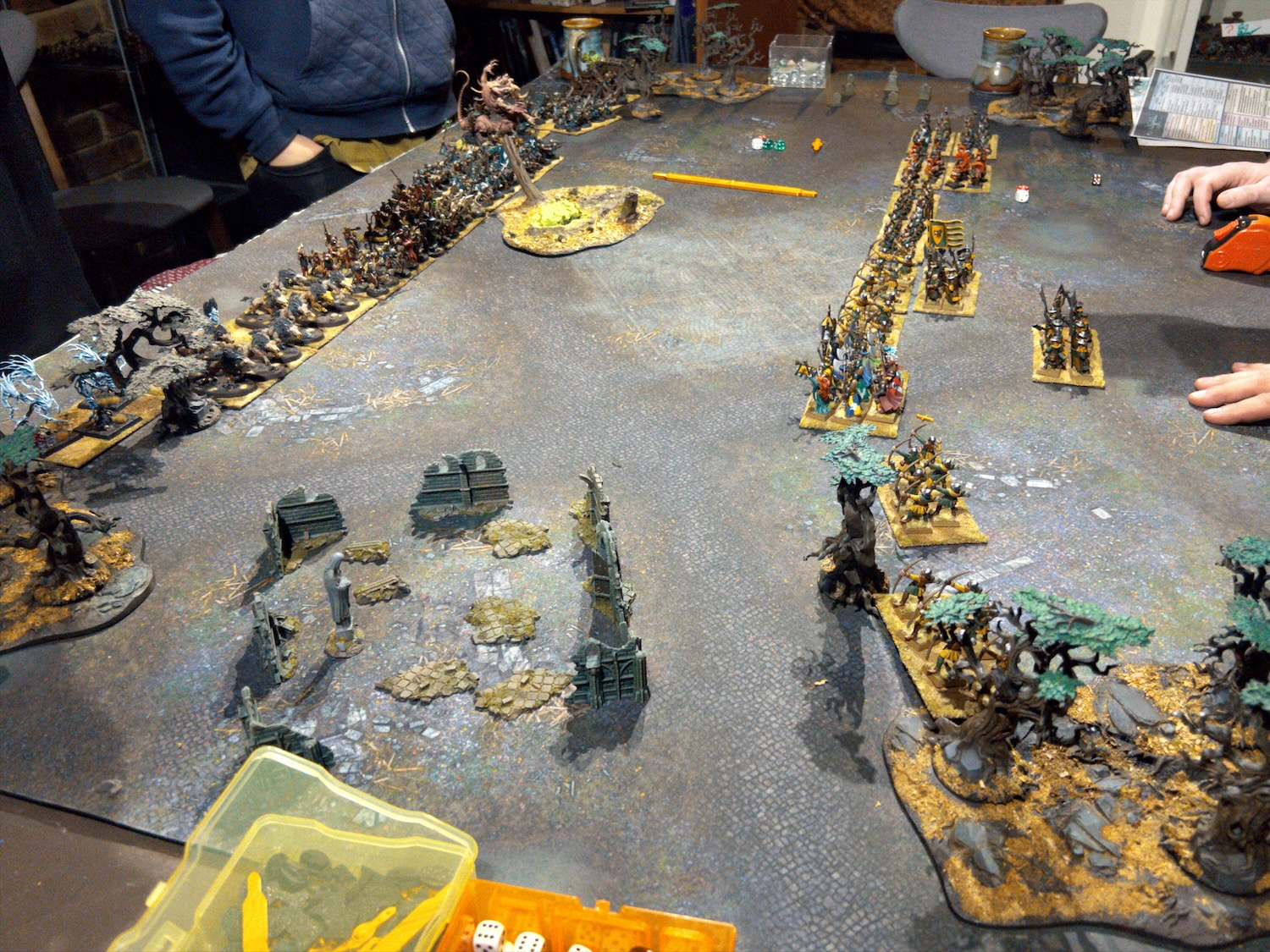
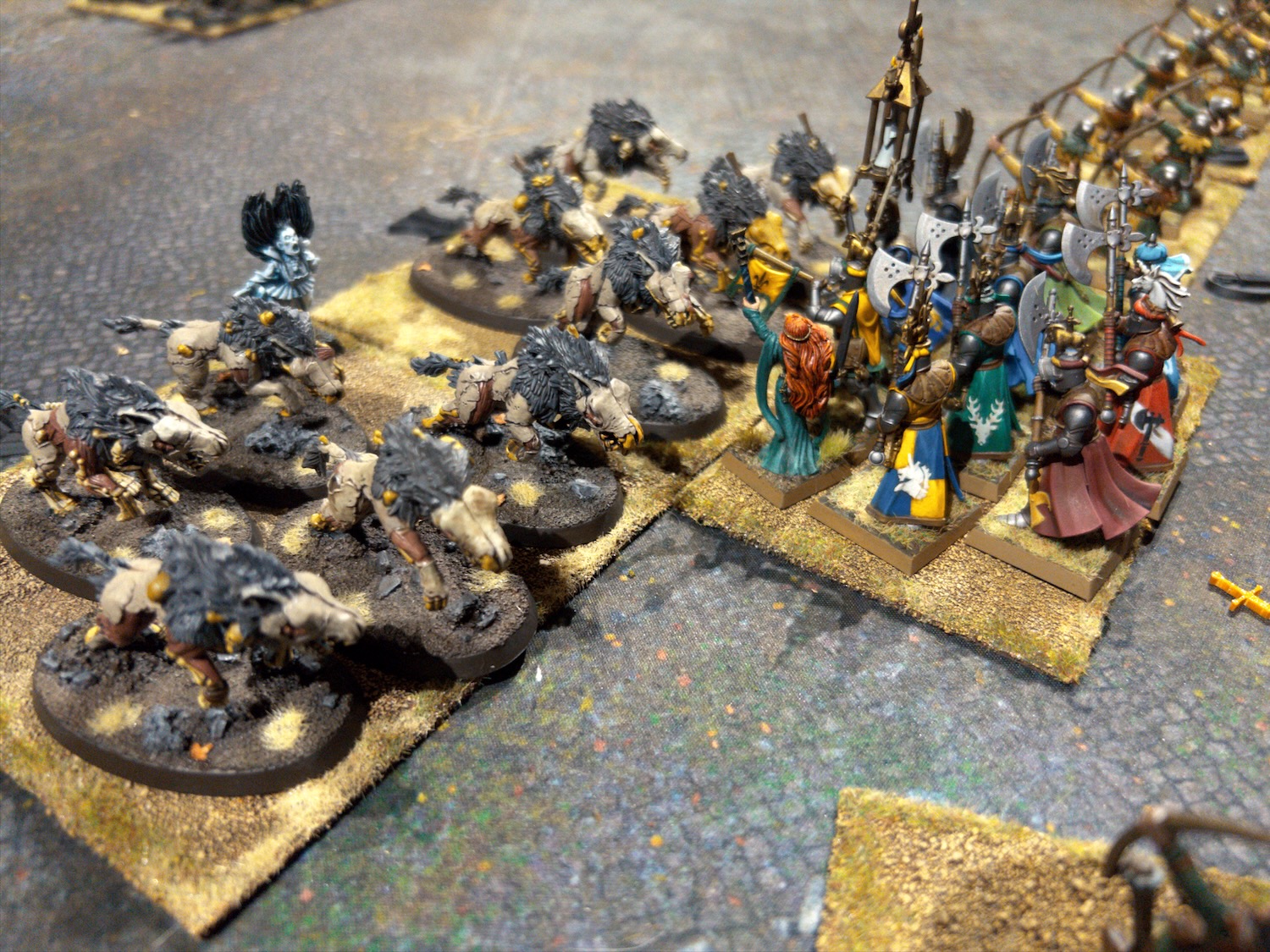
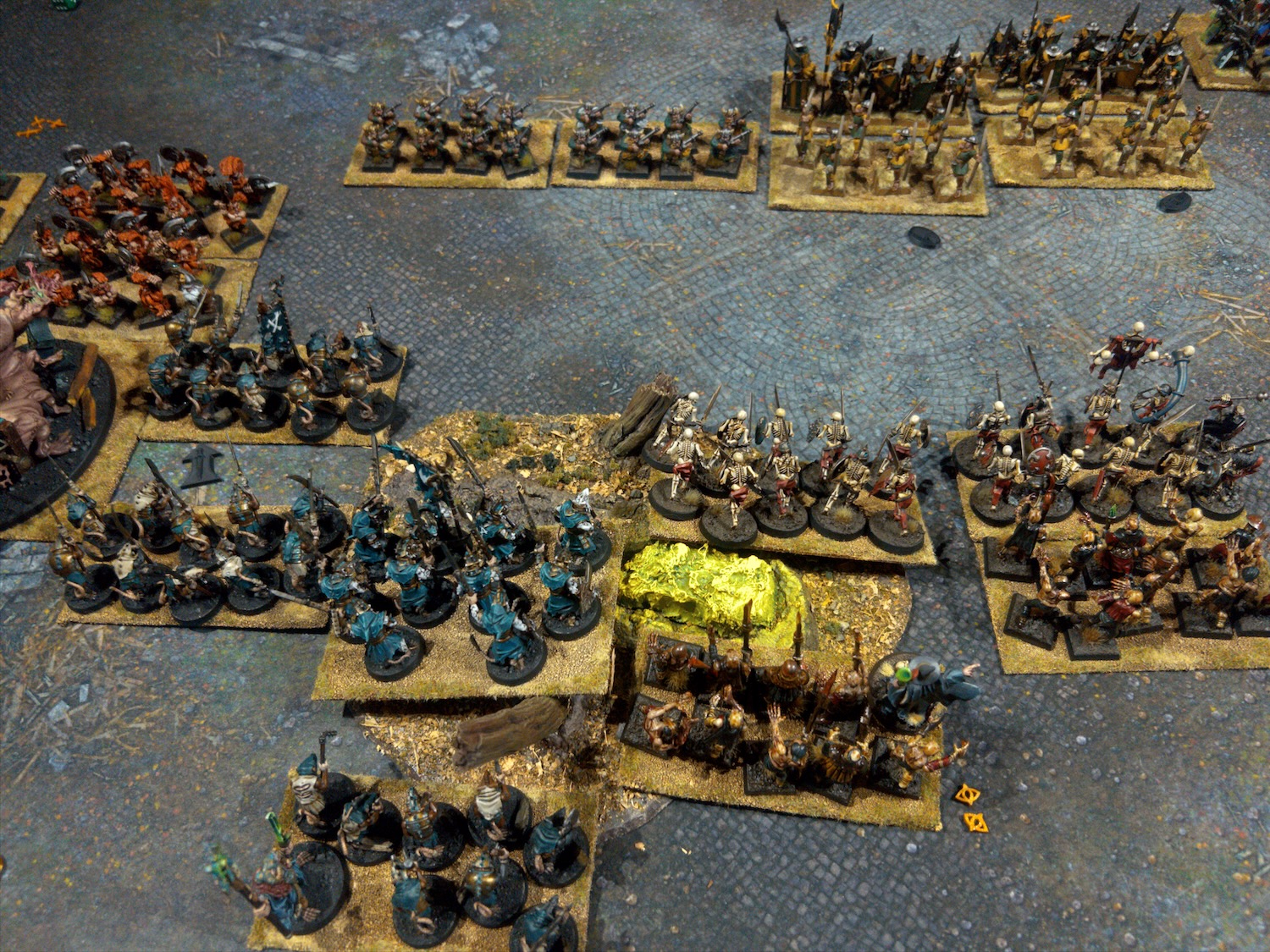
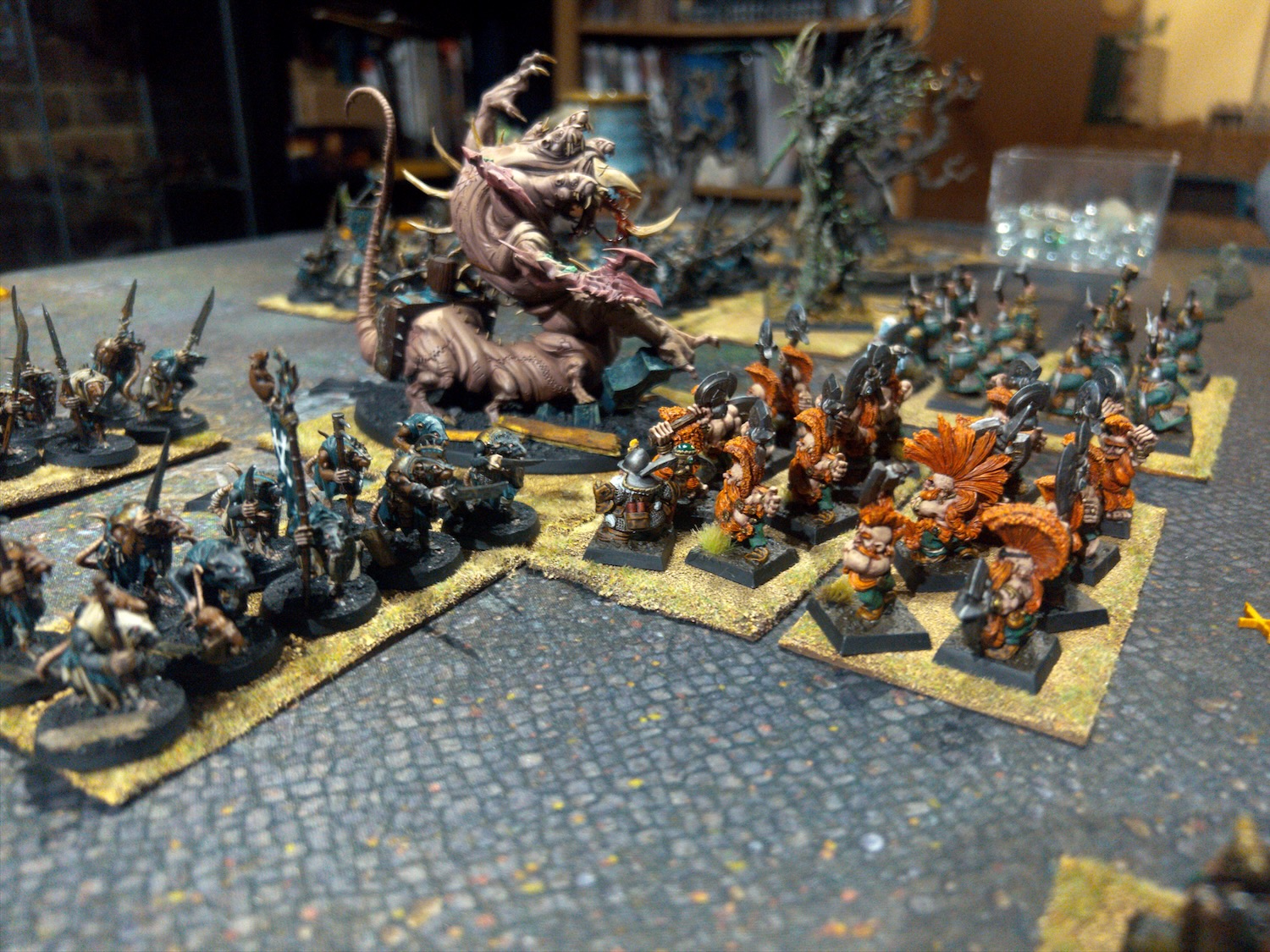
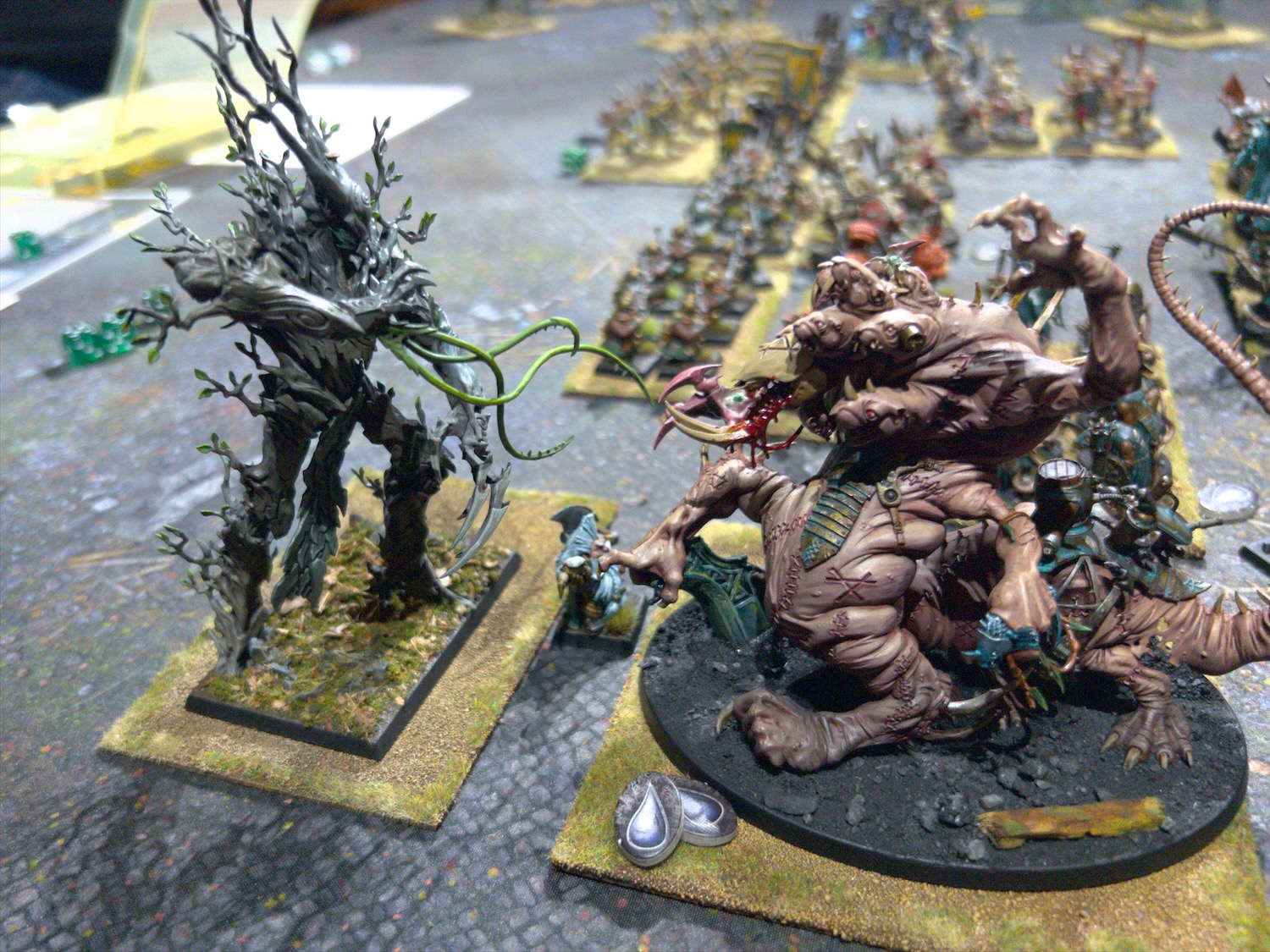
This week I had a few of those friends over and we played a big game involving four armies: a loose alliance of Skaven and Undead against Dwarves and Bretonnians. Two of the players were wargaming novices, one is relatively new, and one is an enfranchised wargamer. I was running the game as a games master. Despite the lack of experience of most of the players, and the relatively large size of the game, we comfortably got through the game in an evening which is a testament to the rules.

The scenario I set up was as follows: the Skaven and Undead armies needed to hold onto a warpstone meteor while the Dwarf/Bretonnian alliance needed to get them clear of it. To spice things up some, I placed four isolated trees on the board (i.e. not on the forest bases), and after turn one revealed them to actually be treemen who were generally opposed to the idea of big battles being fought in their forests and went after whatever unit was closest. Despite this extra chaos the game was extremely close and ended with both sides within a single reputation point of each other (reputation tracks your force morale, if it’s at or below 0 at the end of the turn, you lose the game). The Skaven/Undead forces won the day, but it really could have gone either way.

Overall, the game was a success I’d say, all the players enjoyed themselves, the game was fun, and it generally felt like playing Warhammer without the big rules overhead. What was missing however was some of that Warhammer atmosphere that is generated by things such as wizards miscasting and Skaven wargear blowing up. Midgard as a low-fantasy/historical wargame does not really cater for this out of the box, but it is easy enough to add some house rules to capture this, and I’ll be doing that going forwards.

After this successful foray into playing Warhammer with Midgard, I’ve been excited about the possibilities. As I said in the opener, Midgard is a very flexible game system, and looks to be able to cater for some of the more esoteric things that can be found in the Warhammer setting and are not catered for in the normal Warhammer rules. With that in mind I’ve been reading through the late 80s/early 90s Realm of Chaos books which are probably about as esoteric as Warhammer gets (I’m sure I’ll be shown something more esoteric in the comments!), and having a great time imagining what that could look like in a game of Midgard.

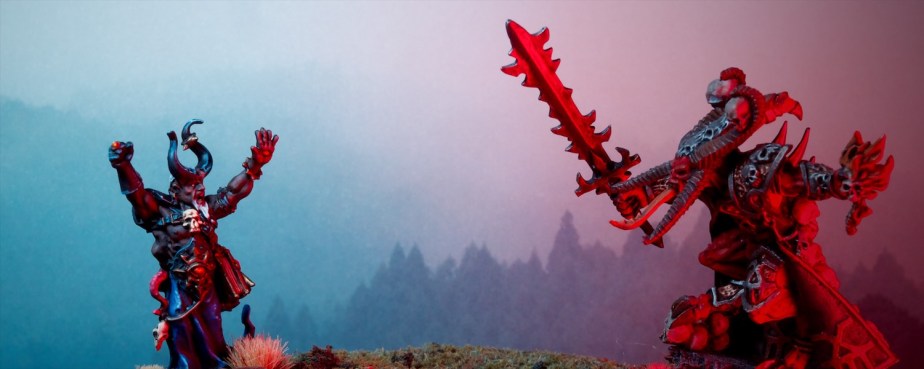
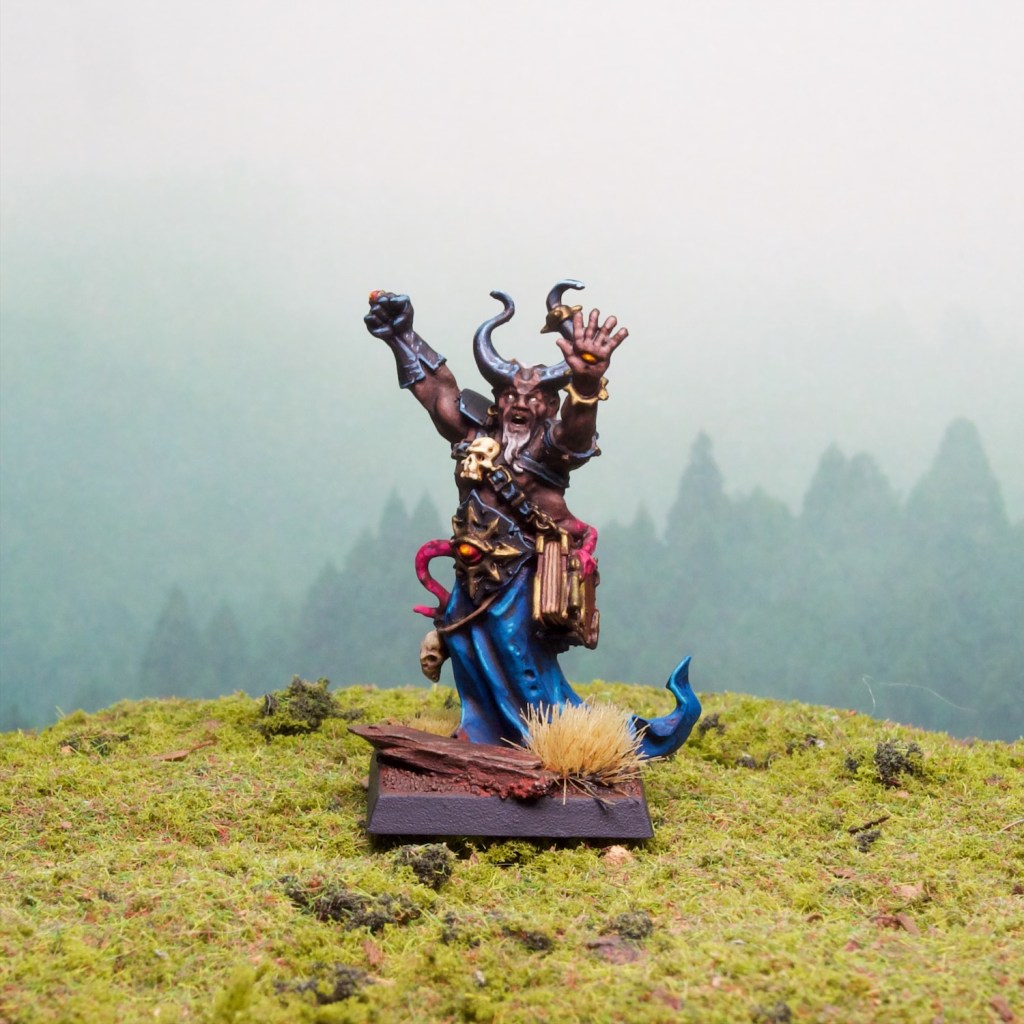
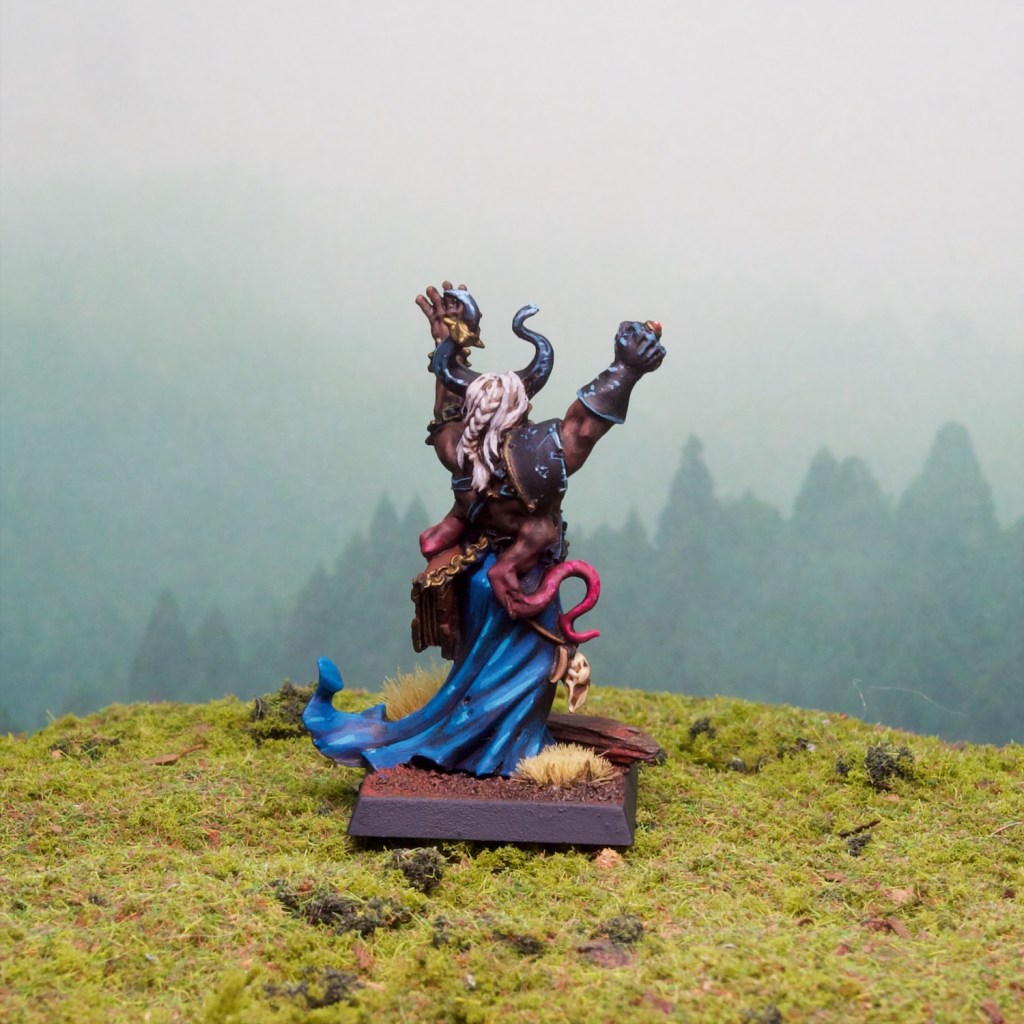
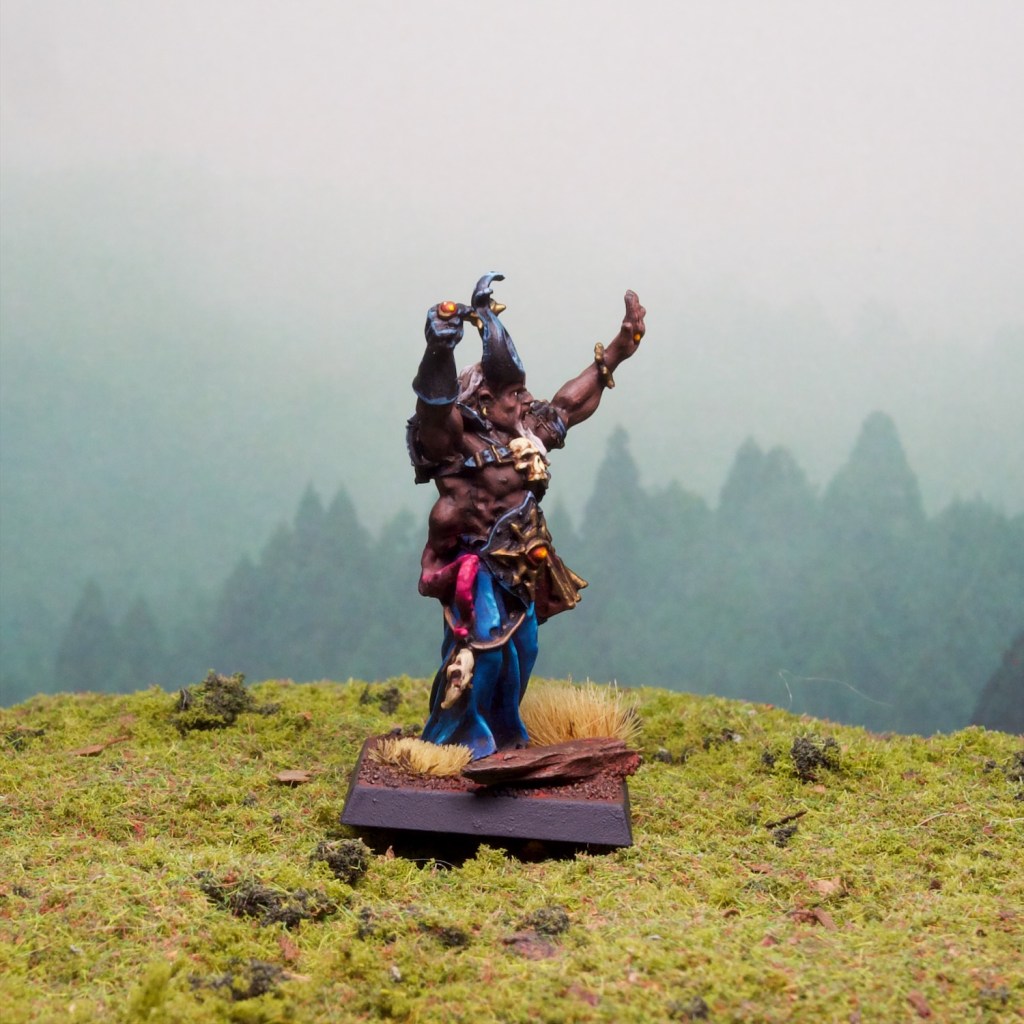
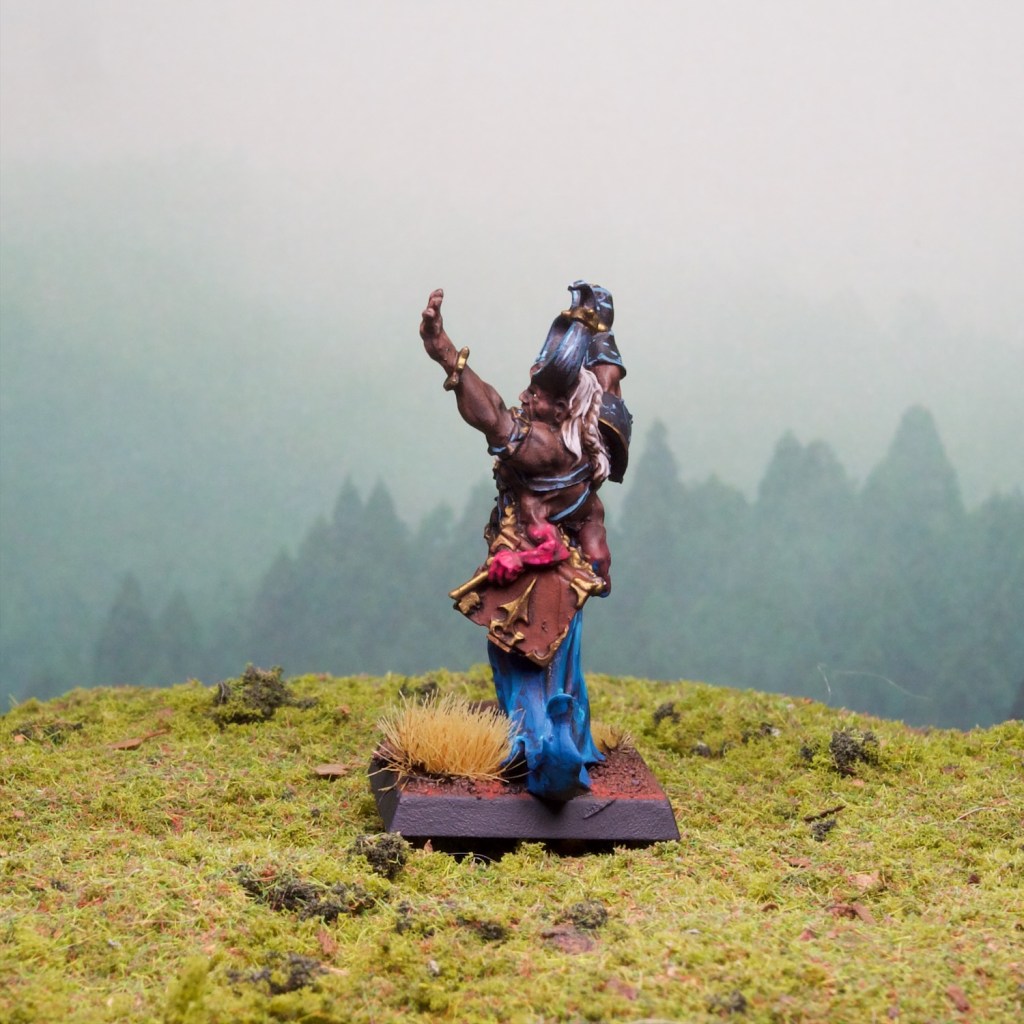
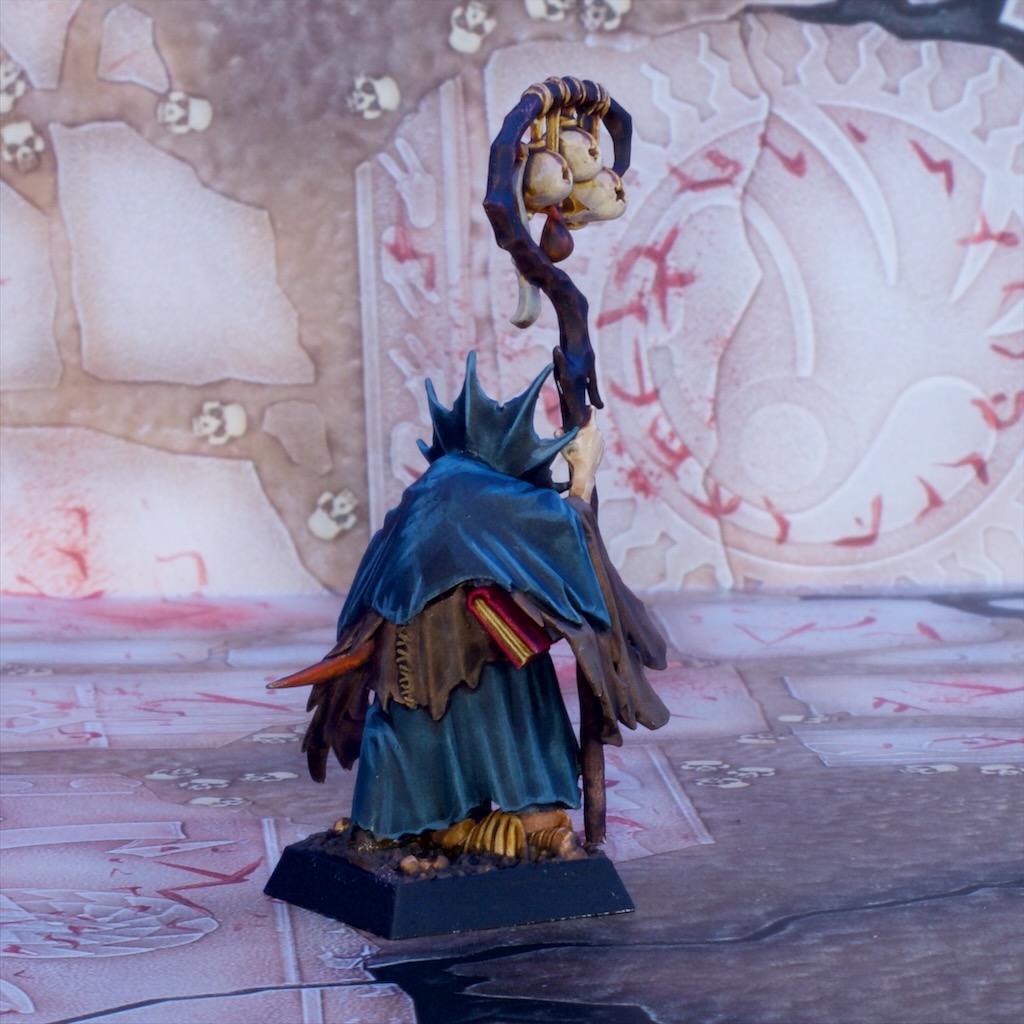
Needless to say some of this energy was redirected towards miniature painting, and in this case towards this Chaos Sorcerer that I found in a case while scrounging for Chaos models for my Midgard/Realm of Chaos plans.

This is a really cool model that was released for Games Day 2010, and that I bought back then. It’s therefore been undercoated in a case for 15 years, and I was well past time I got some paint on him!

I had some fun with the skin (especially the parts with the extra limbs!). I’ve been trying to work on painting darker skin tones and I’d picked up some of the Duncan Rhodes/Two Thin Coats paints made for this purpose (Druid Flesh and Bard Skin). I really like how they worked, although I did feel they needed a touch of extra warmth so I glazed some Citadel Contrast Wyldwood over the top which did the trick.

The model has a lot of nice little details on it which were great fun to paint, the small hand holding the key to the book being my favourite.

I’m sure we’ll see this Sorcerer lead a Midgard contingent at some stage!

Terrorgheist

Back much sooner this time, with just the one model, but a big one at that!
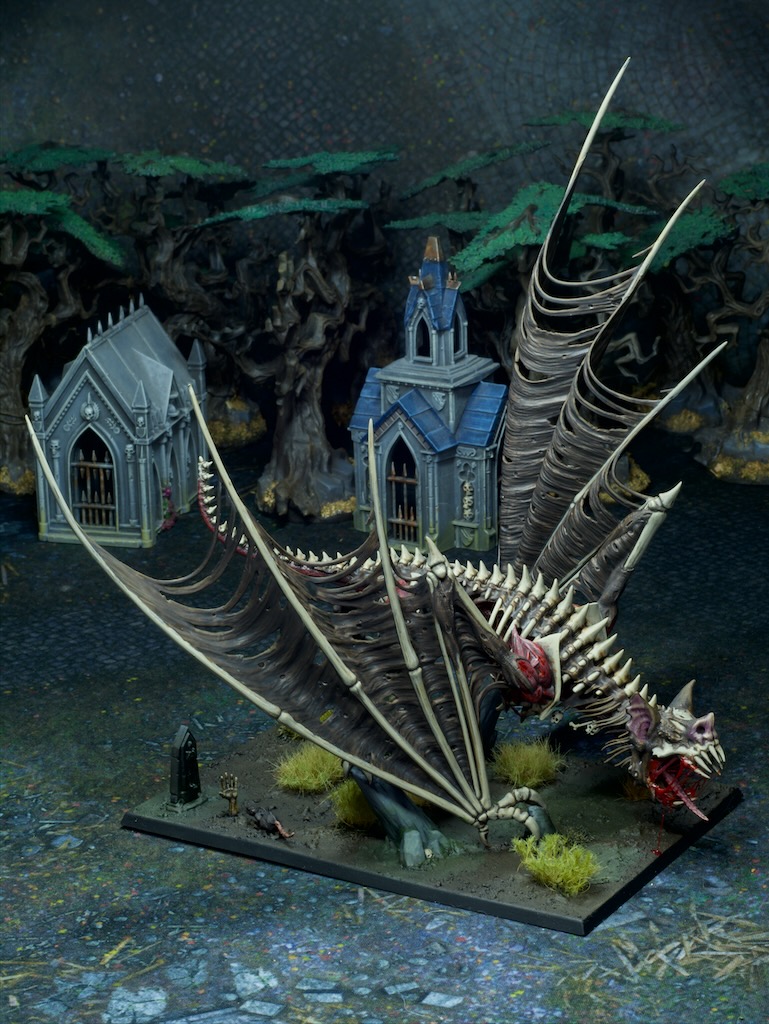
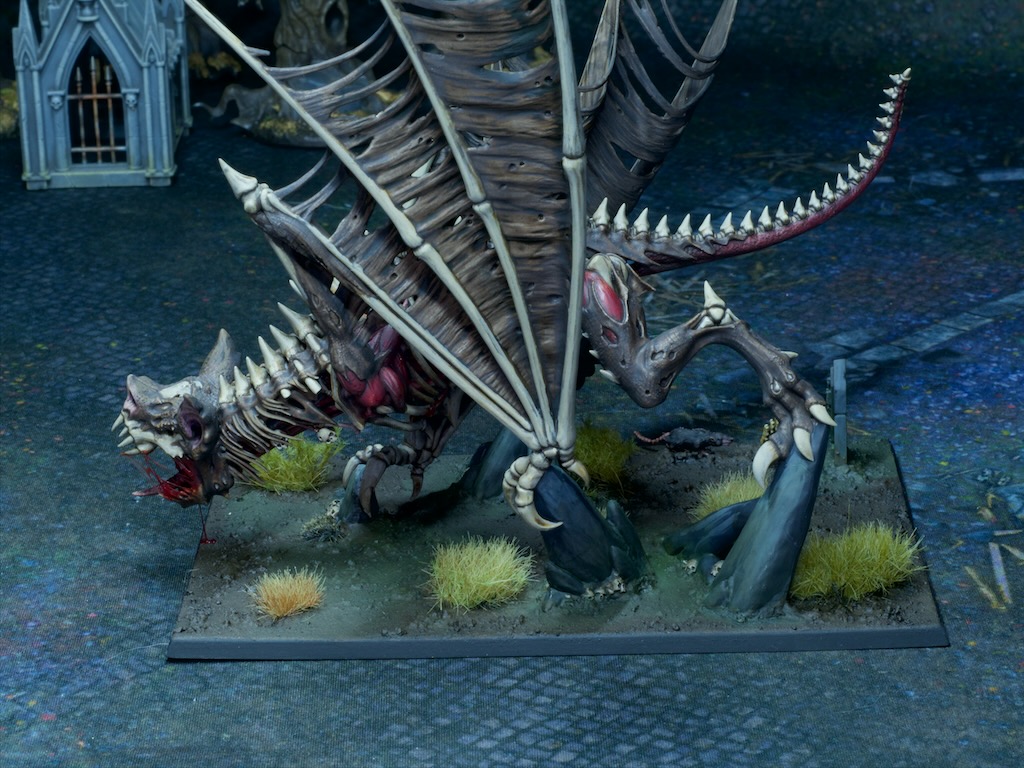
Sorry for the “Inception” style floor rising up into the sky on this shot! This is a very tall model and I didn’t have any terrain tall enough to act as a backdrop!

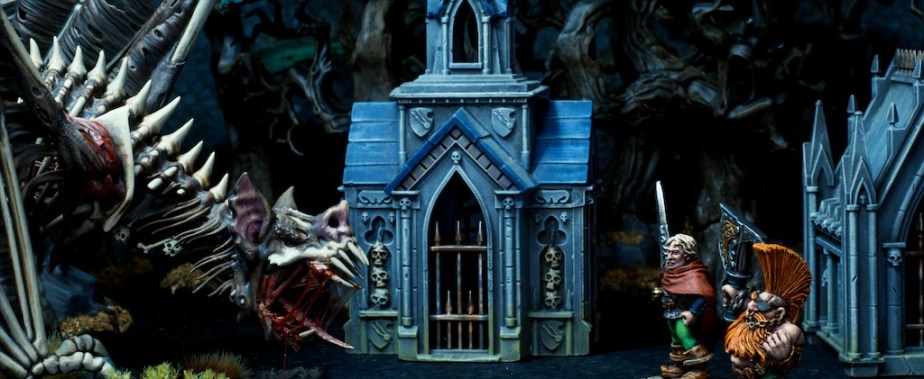
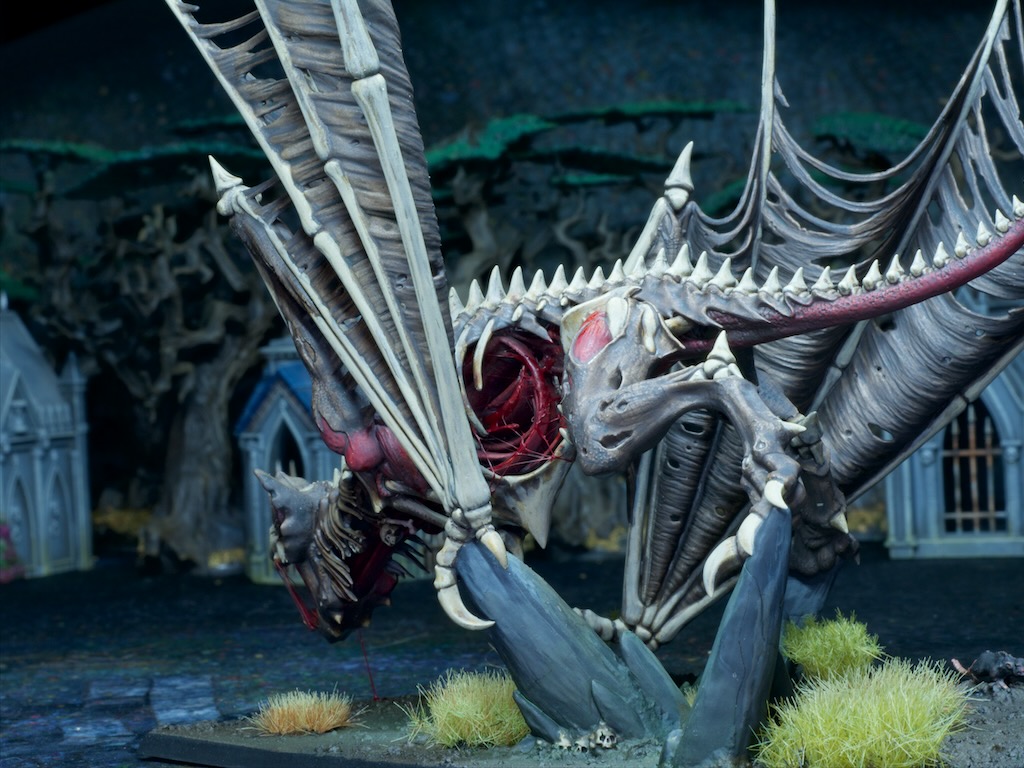
This is one of the biggest monsters Games Workshop produced for the old Warhammer world back in the day, a Terrorgheist! Effectively a really, really, big undead bat that has unnatural terror causing powers (I’d be terrorised quite naturally if I saw one of these!). I’ve always loved this model and at the same time been extremely daunted by the idea of painting it, hence this model staying as bare plastic for the last 10 or so years…

Scary!

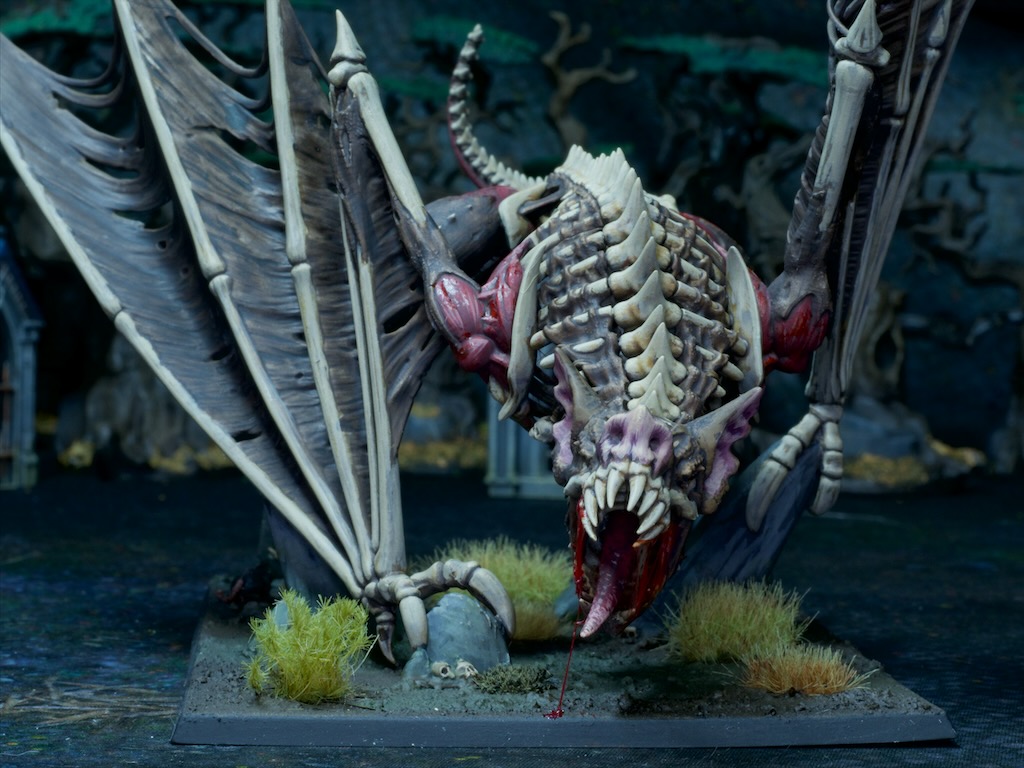
After painting my unit of slayers, I wanted to paint something a bit more loosely and settled on this big bag of bones. With that in mind, the painting ended up being very straightforward: Wildwood contrast on all the leathery skin bits, Skeleton Horde contrast on all the bone bits, and Flesh Tearers Red contrast on the exposed fleshy bits and the mouth. The model then got an all over dousing of a wash made from Brown and Grey oil paints. I left it to sit around for most of a day and then picked out all the bone areas in Vallejo Model Colour German Came Beige WWII and highlighted them with a mix of the aforementioned beige and Vallejo Model Colour Bonewhite. The ears and nose were picked out in GW Bugman’s Glow, washed with GW Druchii Violet, and highlighted with a mix of GW Bugman’s Glow and Vallejo Model Colour Dead Flesh. Quite simple and quick overall!

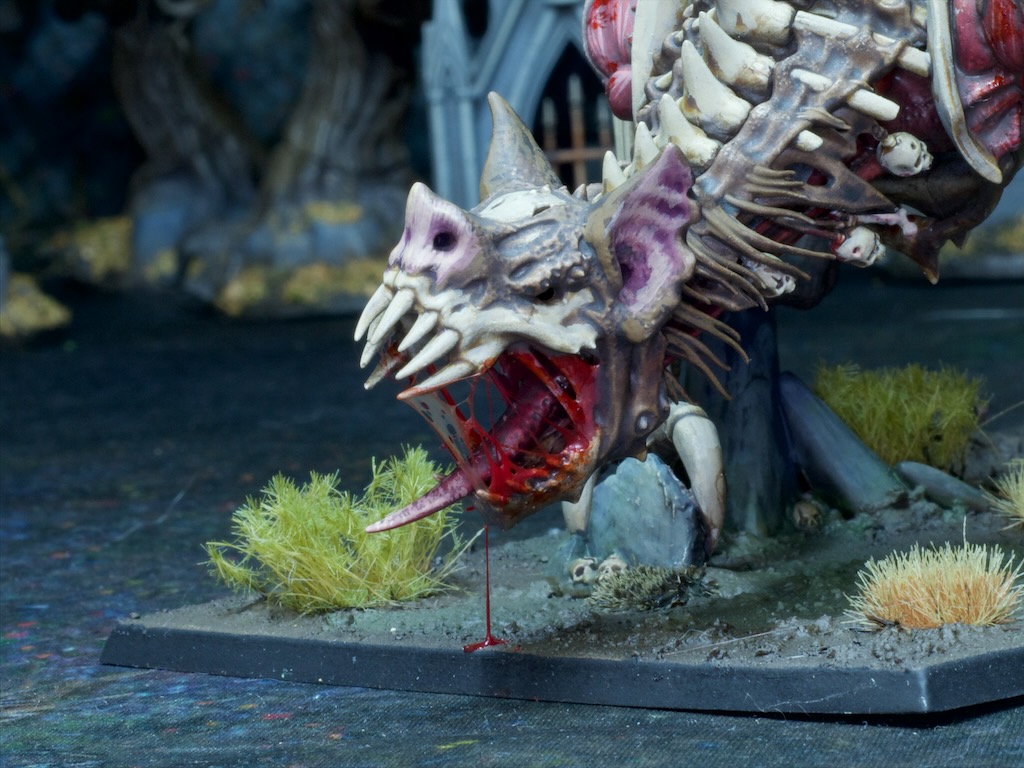
You may have noticed some red goopy bits all over the mouth of the beast in the photos so far! This was my first attempt at trying out the stringy gore effect I’ve seen quite a bit in other painter’s photos. It’s quite simple to achieve really, get some UHU tube glue (the transparent gel-like version you squeeze out of a tube) and mix in some red (I found GW Flesh Tearers Contrast worked best for me, I also tried GW’s Blood for the Blood Good, but that seemed to react with the glue and dry too fast to be useful). Use a wooden skewer or toothpick to then pick up your red sticky blob and start tacking it on a part of the model and stretch to another. Repeat until sufficient horror has been achieved!

The mouth wasn’t the only area getting this treatment, the model has these exposed innards that seemed like another appropriate spot to use this!

I’m interested to see how resilient this ends up being on what is a gaming model, it could be this is only a useful technique for display models that can expect a lot less handling. I’ll report my findings at some stage in the future! Regardless, it’s quite easy to do and looks great I think.

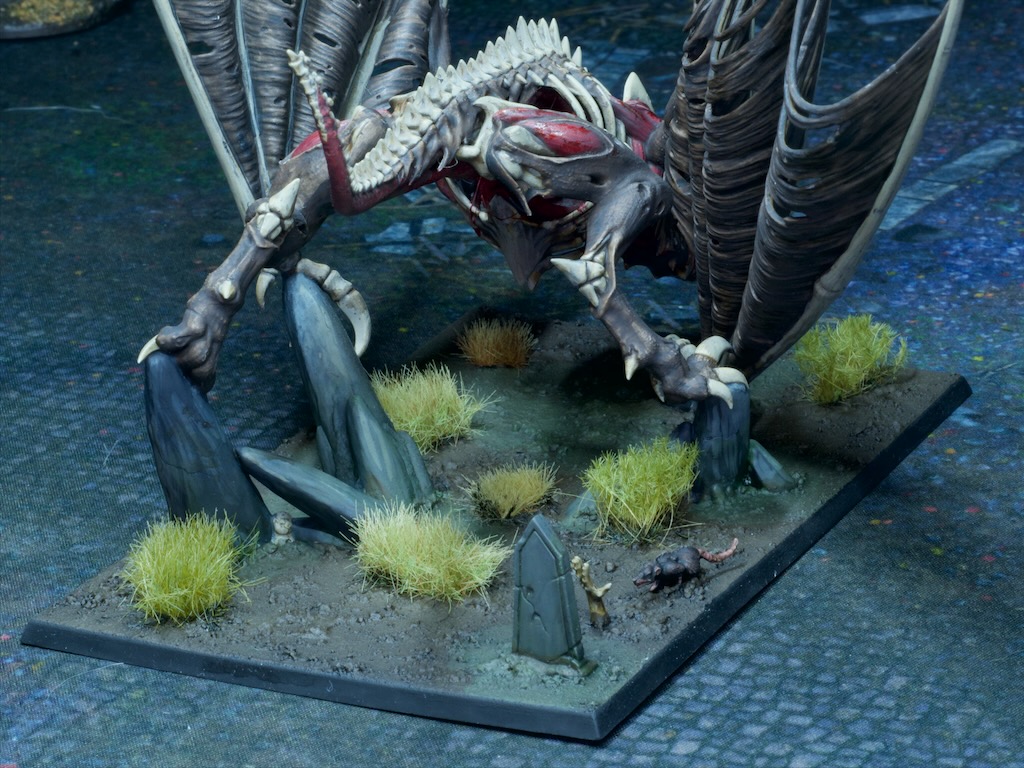
This model comes with a humongous base (which as you can see is nicely warped), and while the model comes with these rocks that do a neat job of starting to fill it, I knew I was going to need something else on there to break it up some more.

As a start I put in this mini scene of a zombie starting to pop out of the ground, although clearly this rat thinks that breakfast was just delivered! For the rest of the space, I broke out my big tufts. These are mostly leftovers from sets of tufts that are too big to fit on regular bases and have been piling up in my tufts box for a while now. Nice to have something to use them on.

The more Warhammer savvy of you might have recognised that I’ve talked about using 6th edition Warhammer for this campaign and that this model didn’t arrive till 8th edition (if memory serves!). My Vampire Counts for the campaign are themed around the Necrarch bloodline, and the Necrarch specific army list at the back of the 6th edition army book allows them to take unridden zombie dragons as a rare choice (normally these require a vampire to ride them) to represent their mastery of necromancy. This seems like a great way to run this model without having to make up rules so that’s what I’m doing!

That’s it for this update, I had a lot of fun painting this model and I get to pivot onto another faction after this. Something I haven’t posted anything about yet!

Poltergeists!

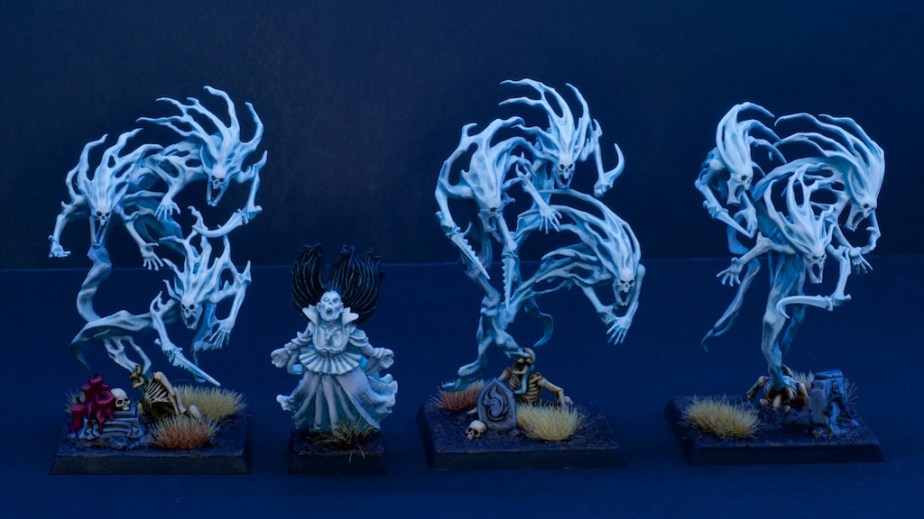
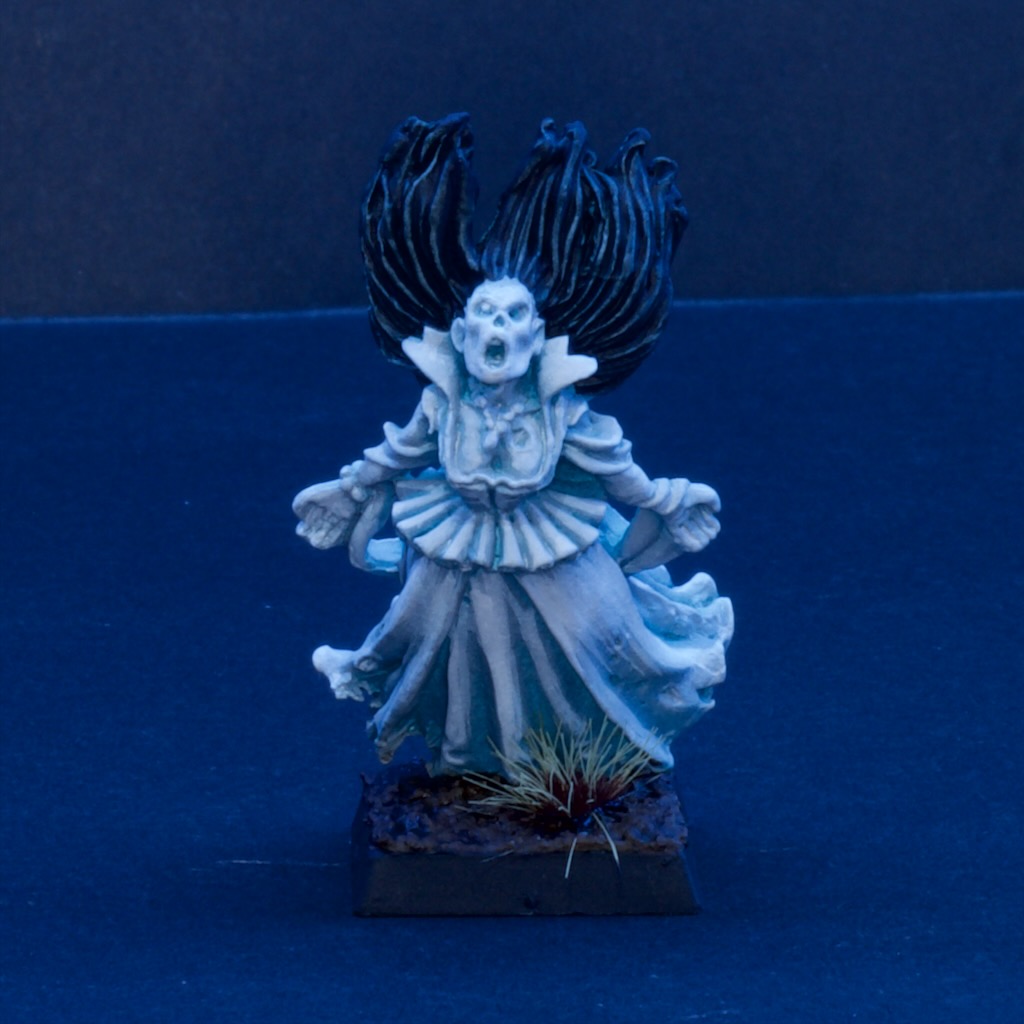
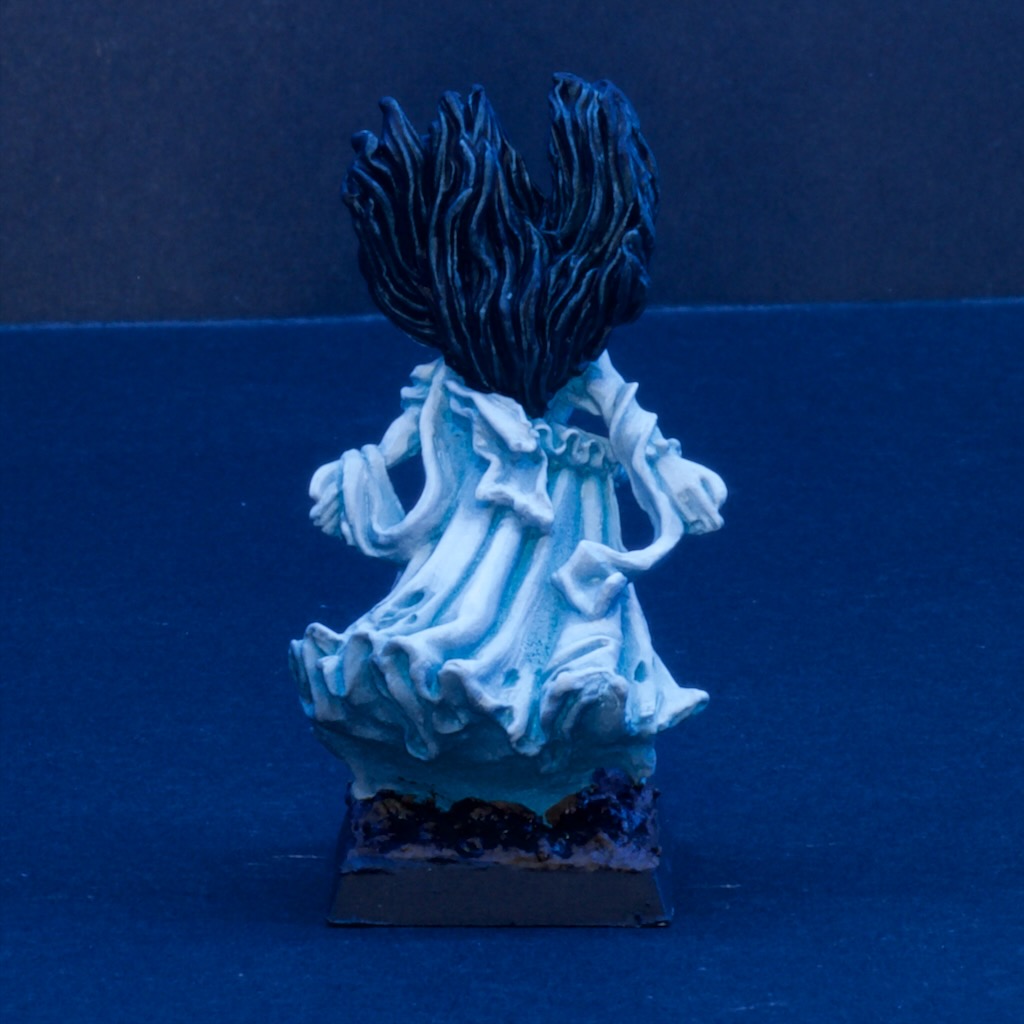
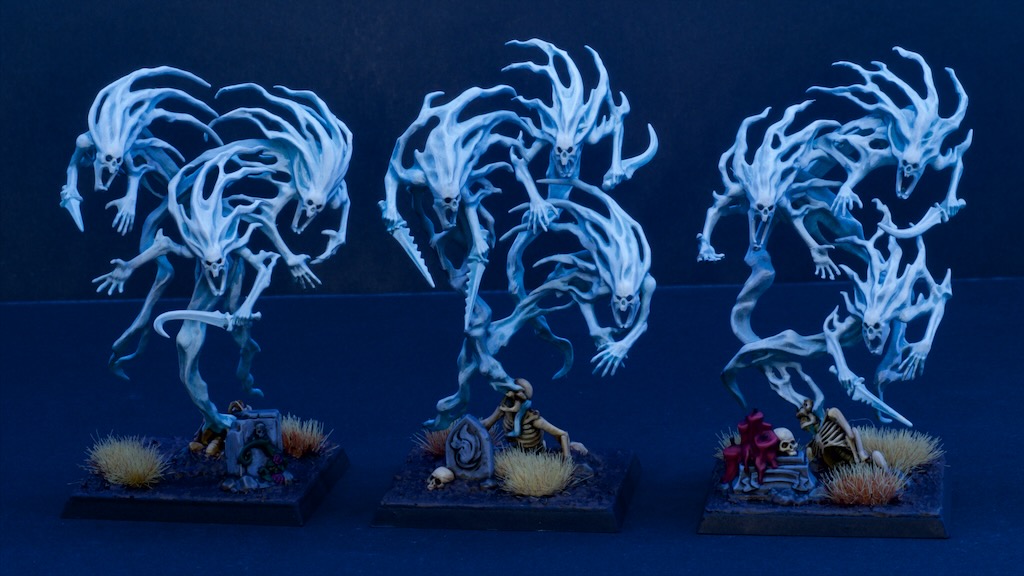
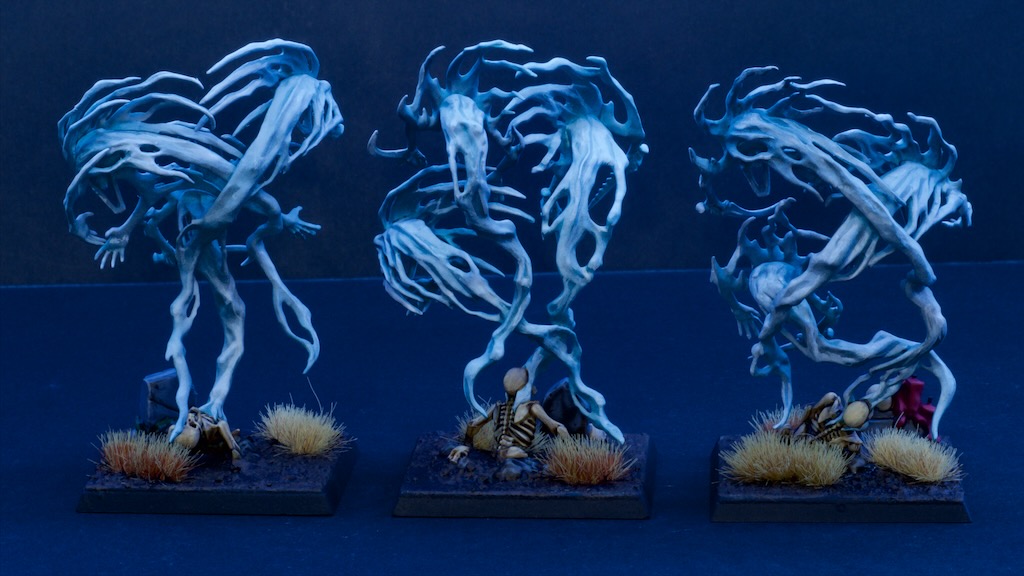
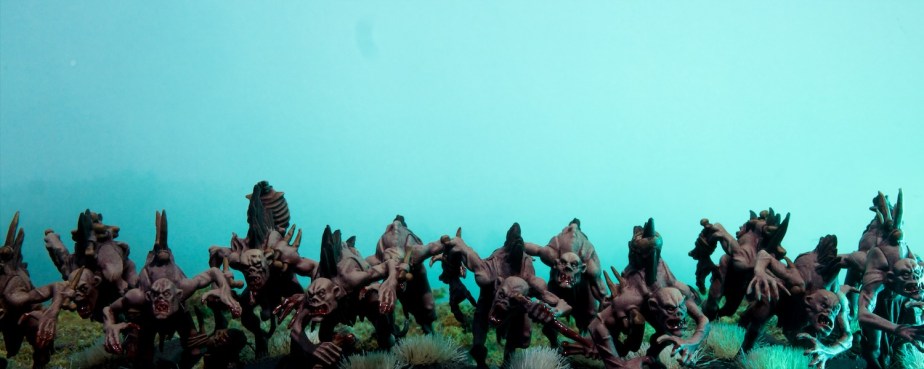
The dead are back once more, this time less corporeal than the last few times! For this post we have a collection of ghastly ghosts, for my Border Princes Campaign Vampire Counts army. There are two units here, a Banshee and a unit of Spirit Hosts. I painted them both at the same time as I wanted them to match.

First up let’s take a look at the Banshee! She’s a relatively old model, still being metal and from a few editions of the game ago, but quite a cool one I think.

I quite enjoyed painting the folds in all the cloth she’s wearing, although the blends look a bit smoother in person than they do in the photos I think (or at least they’re smoother when not being lit properly!).

The Spirit Hosts are much newer models, and are plastic (hence the crazy top heavy poses!). I do love the story these models tell, with the hosts pouring out of skeletons. Very cool models.

Painting-wise, both the Banshee and the Spirit Hosts were painted in much the same way. I started with my usual very light grey undercoat, followed by an all over spray of GW Akhelian Green Contrast through the airbrush. The contrasts through the airbrush go on as a translucent but relatively even coat, so this gave me a nice blue green colour all over the models. I then misted some very dilute Vallejo Model Air White over the models to starts the highlighting process. This gave me a slightly lighter blue layer to start brush highlighting over. A handy first step that also gives the areas on the models that are hard to reach with a brush (plenty on these as you can tell!) some highlights so I could lazily ignore them later. I then worked through highlights of the appropriately named Vallejo Game Air Ghost Grey, followed by highlights of fairly dilute Scale75 White.

These were nice and quick, painted in two sittings just how I like it!

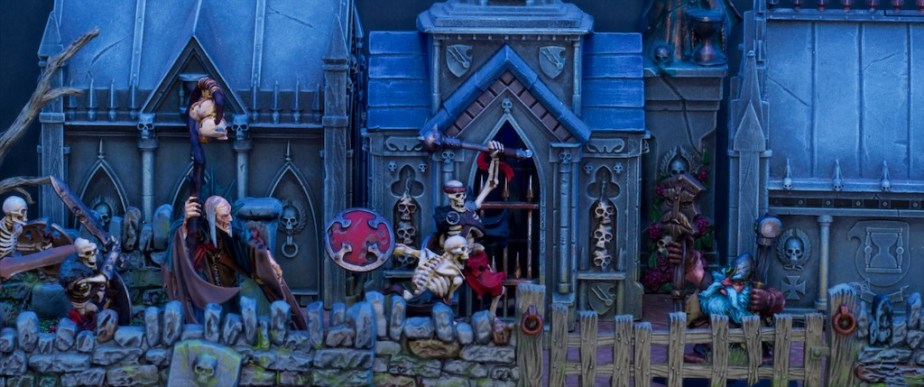
A Runesmith Walks Into a Graveyard

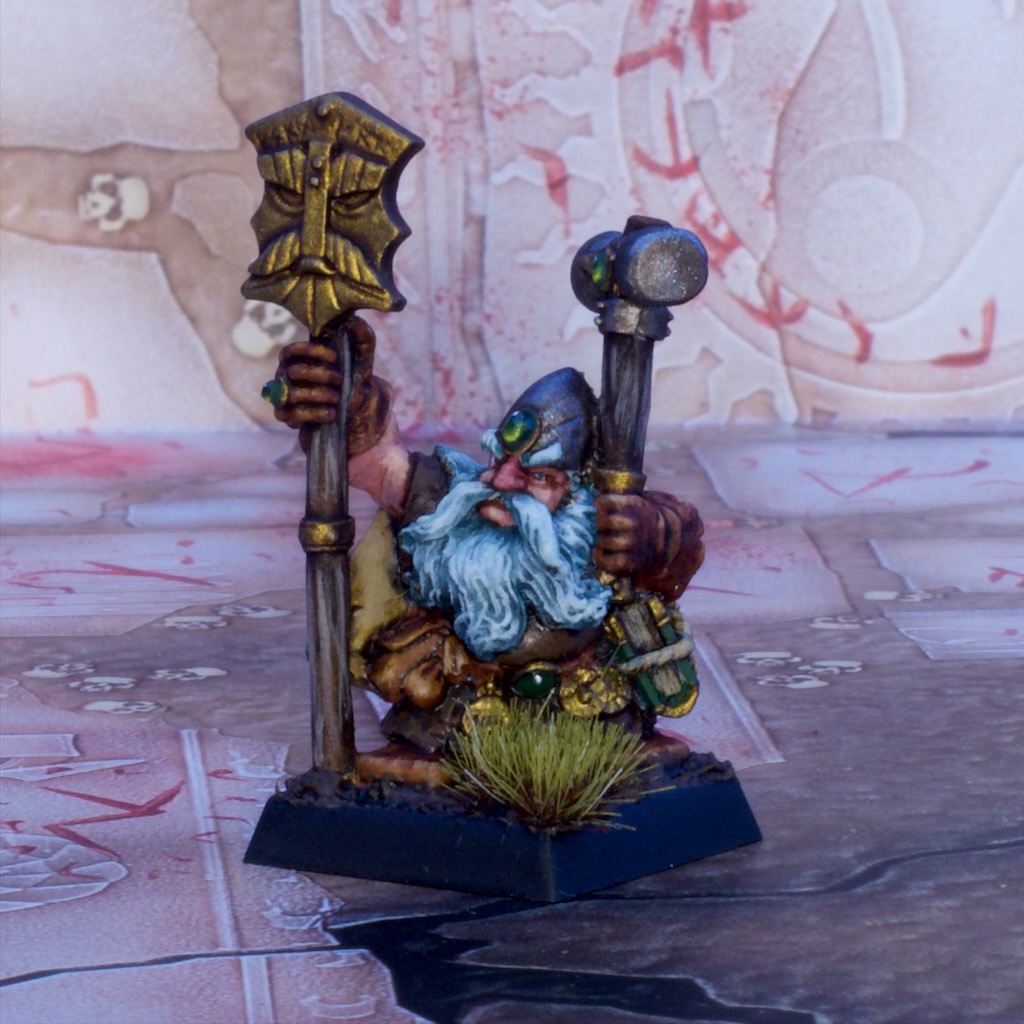
Back again with some more Border Campaigns updates! This time around with a character each for my Dwarf and Vampire Counts armies, and some troop reinforcements for the latter. I decided to paint a couple of character models to break up all the infantry I’ve been painting lately, and settled on a Runesmith for my Dwarfs and a Necromancer for my Vampire Counts.

First up let’s cover the dwarf as the rest of this post is firmly focused on the undead!

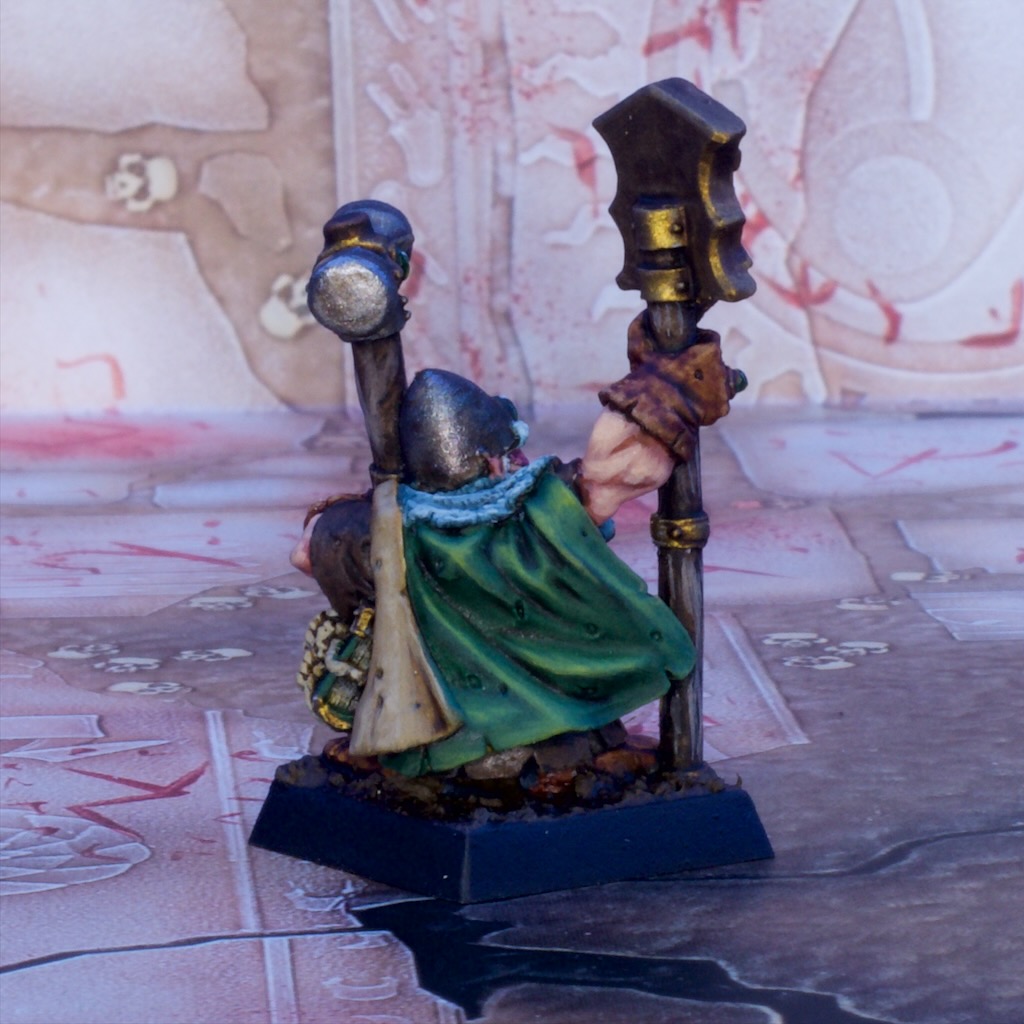
This Runesmith model is a classic one, and one of the first Warhammer models I ever bought. I’ve made a few attempts at painting him over the years, but like most of my early models he’s ended up in a box and battered! He gets a fresh paint job for this campaign and it’s nice to see him finished after all these years. What a cool model and a joy to paint.

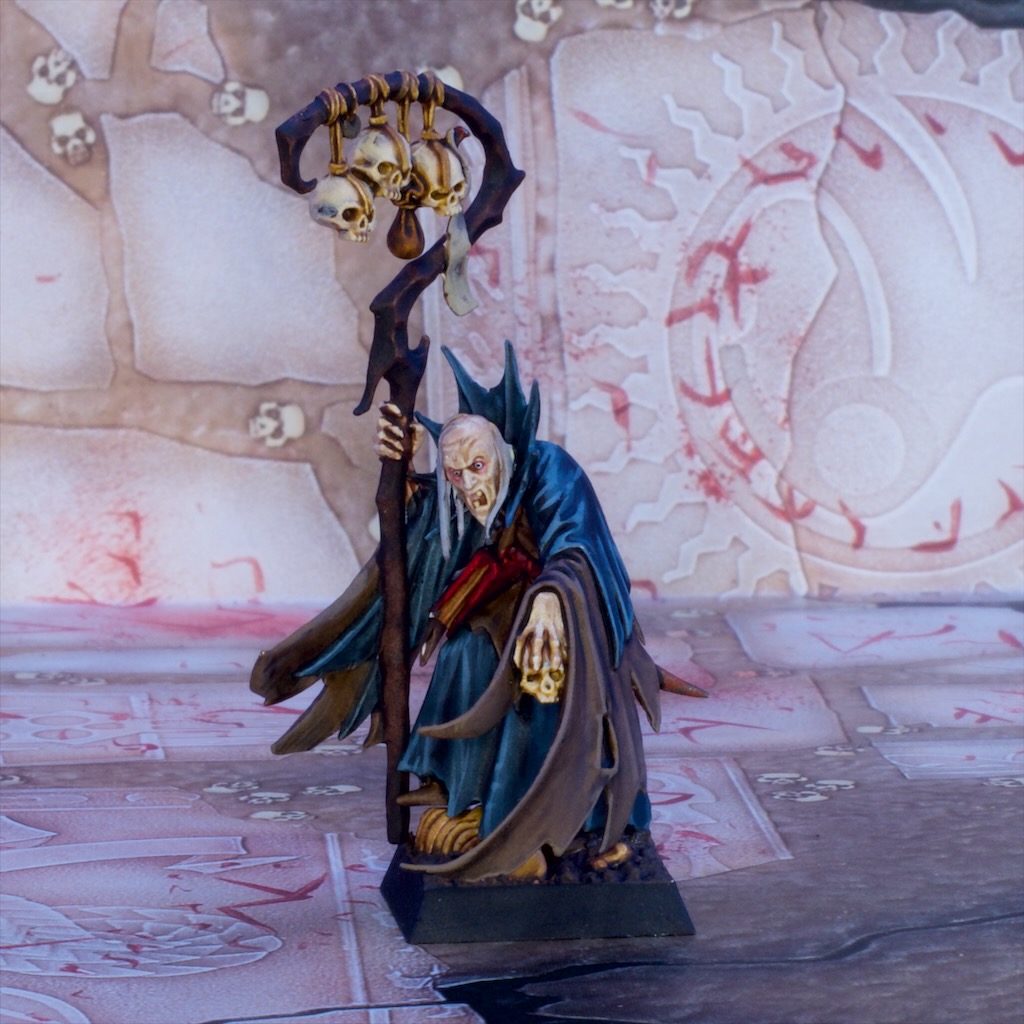
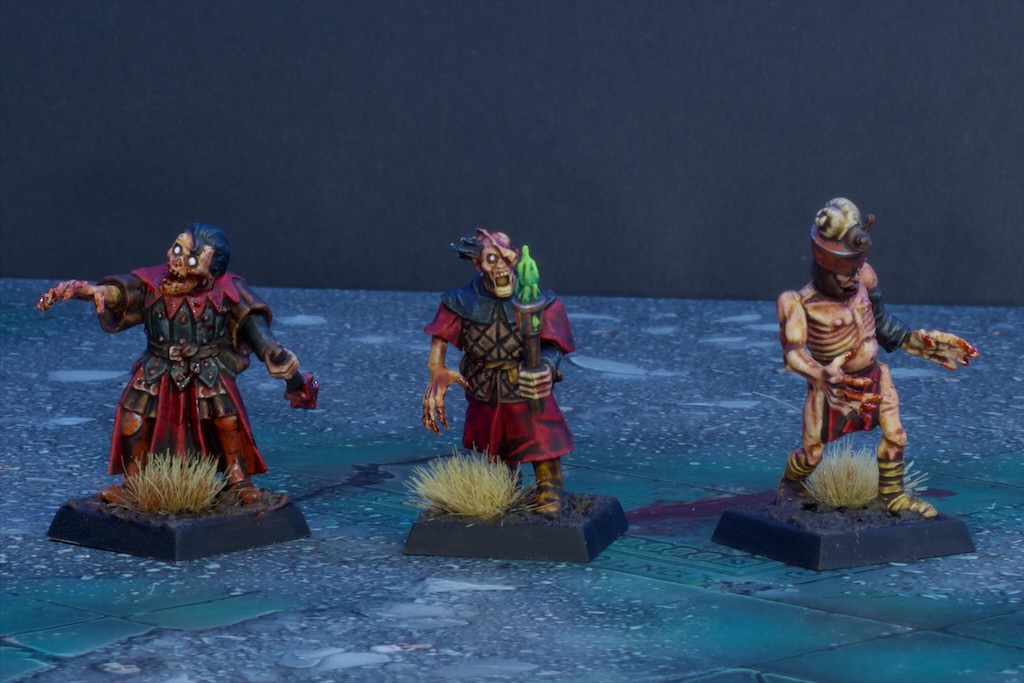
At the same time as the Runesmith I painted this necromancer model (I like painting more than one model at once so I have something to do during drying times!). This is one of the first modern plastic characters to come out if memory serves, maybe alongside the 7th edition release?

Great model as well, although much more modern looking. I had fun painting him too, especially the eyes. He’s ended up with a bit of a crazy look which is spot on for a necromancer I think!

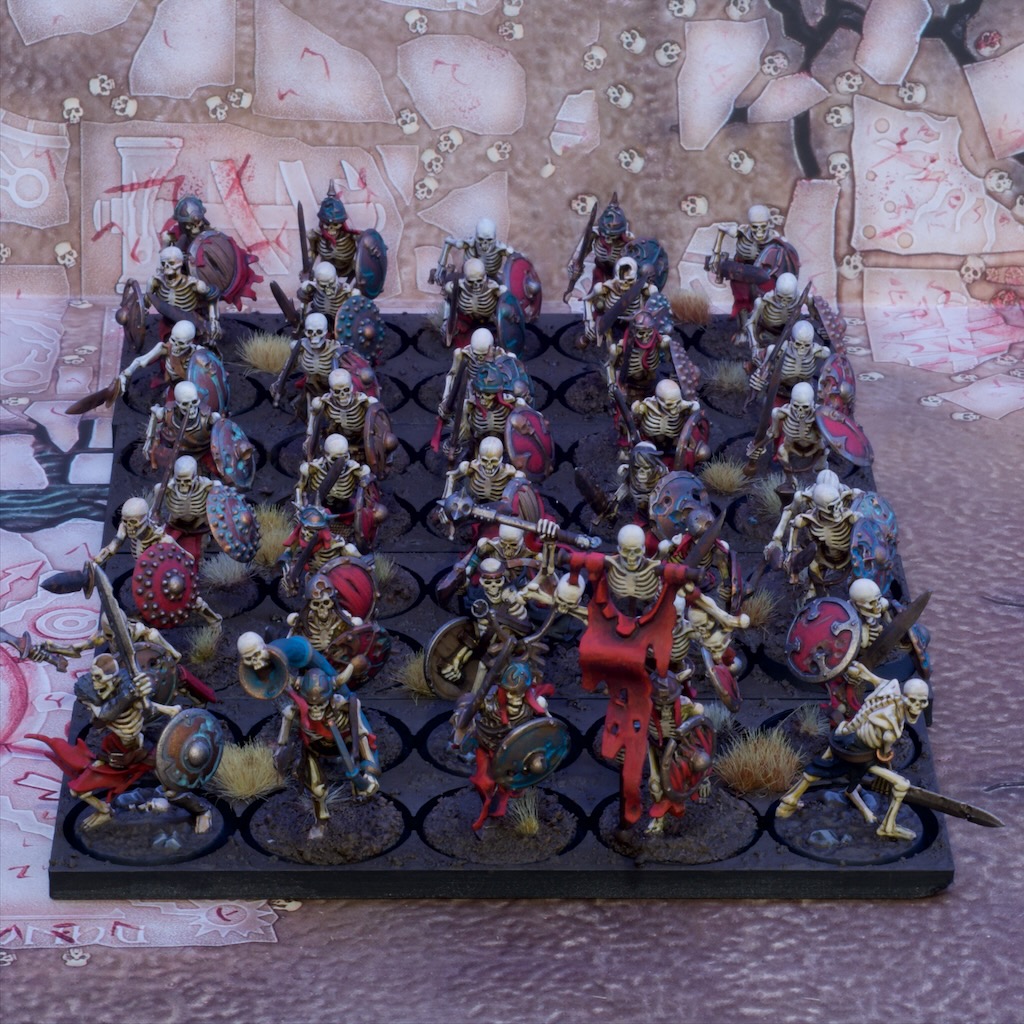
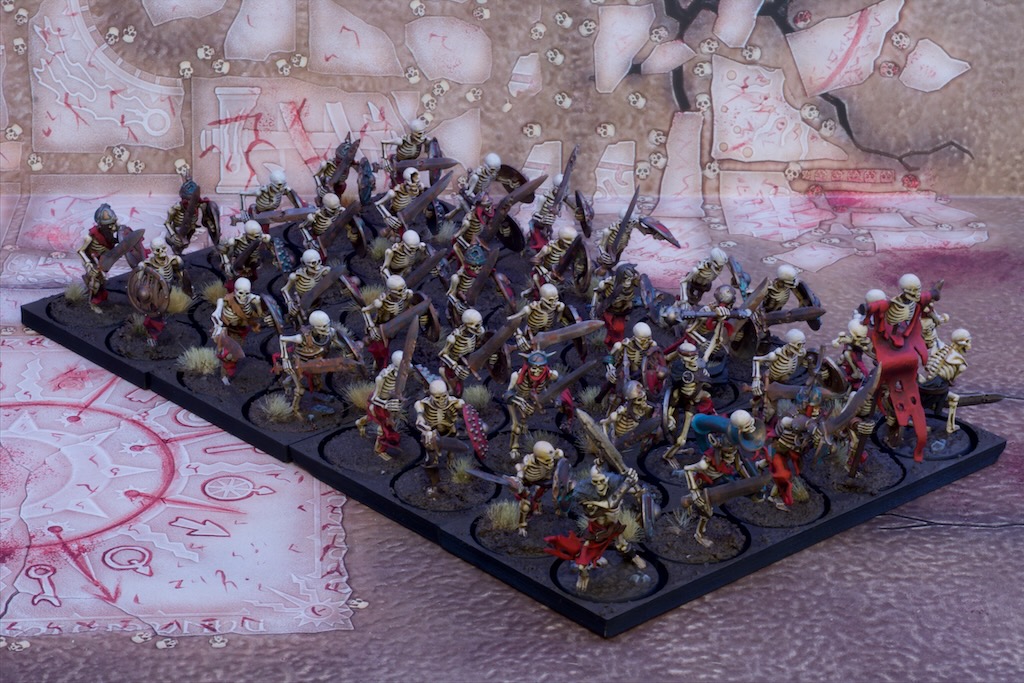
Following on from the necromancer are a horde of Skeletons (rather appropriate!). I didn’t paint all these in the last week, that would be a bit much, but I did finish painting them after having not touched them for a good 4-5 years!

You’ll notice that these are on round bases unlike every other model I’ve show for this army so far. These were at one time on square bases, Vampire Counts being one of my Main armies during the 8th edition of the game. When the Old World blew up and Age of Sigmar was born I rebased these skeletons onto round bases to suit the game (well 20 of them at any rate, I built 20 more straight onto round bases at a later date!). I couldn’t face rebasing them a second time, and with the recent announcement that 20mm based infantry are moving up to 25mm bases in the new edition of the game I decided that I could just rank them up as is and make trays to have them neatly arranged.

As I said above, while I didn’t fully paint these in the last week, I did do some painting to finish them. The 20 skeletons that were added during the Age of Sigmar era were done so for a tournament and I did not have time in the lead up of that event to fully highlight them to match the original twenty. This week I finished those 20, highlighting them to match the originals and I repainted the bases on all 4o to match this latest incarnation of my vampire counts.

The trays you see them on I designed in Tinkercad (great for these simple jobs!) and printed on my 3d printer. I also designed and printed a second set of trays.

This second set is for 20mm square bases, taking them up to the same frontage as 25mm base infantry, so they’ll match my skeletons. You’ll notice the big slot in one of the bases, and if you read my The Living Dead! post you’ll know what that’s for!

Zombies!

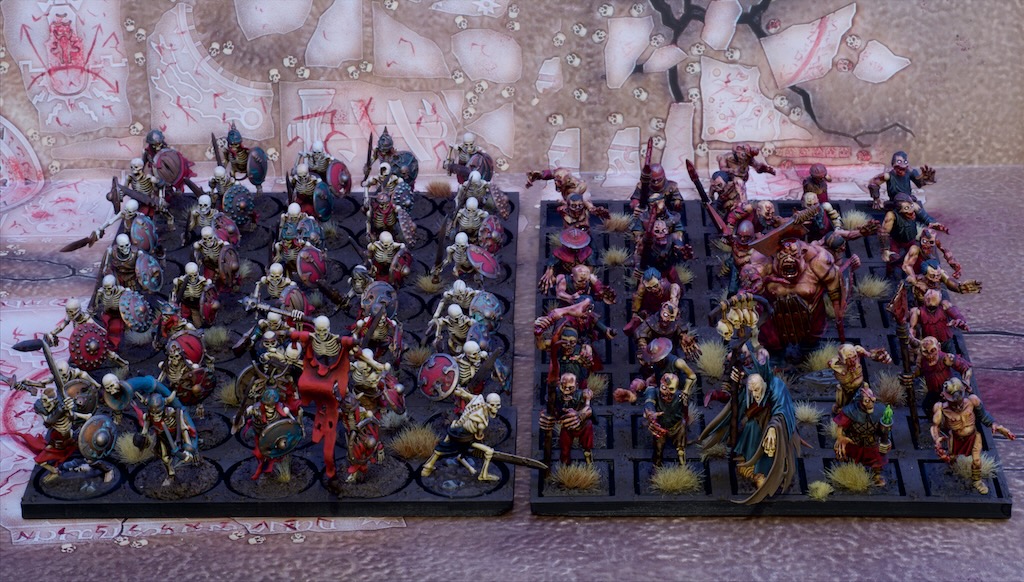
After I decided to not rebase my skeletons, I wanted my zombies to match them so made them a set of trays to match so the army would look somewhat cohesive. The round bases do stand out somewhat, but I think it’s not too bad and the two units look like they belong together. I’m keen to get impressions on this so feel free to let me know what you think in the comments.

That’s it for this update, I’ve also been working on some terrain for the campaign, but I’ll show that at a later date when it’s all done!

The Living Dead!

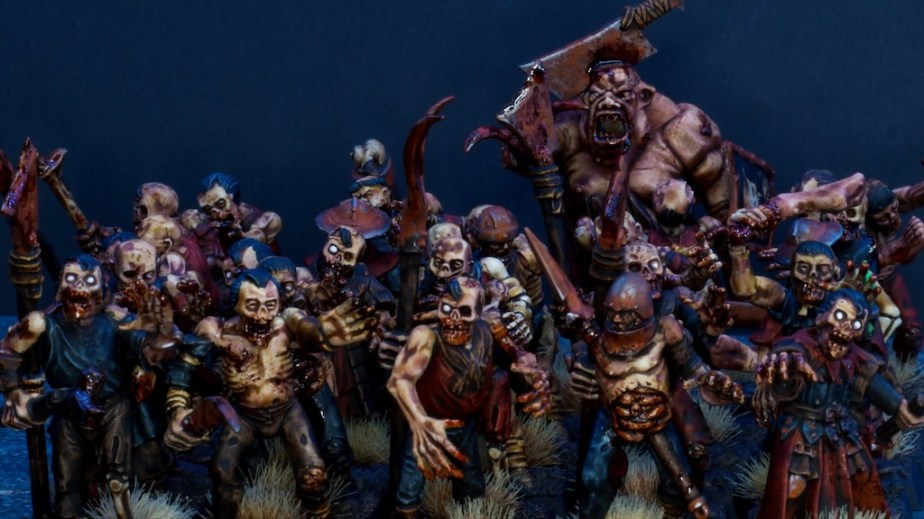
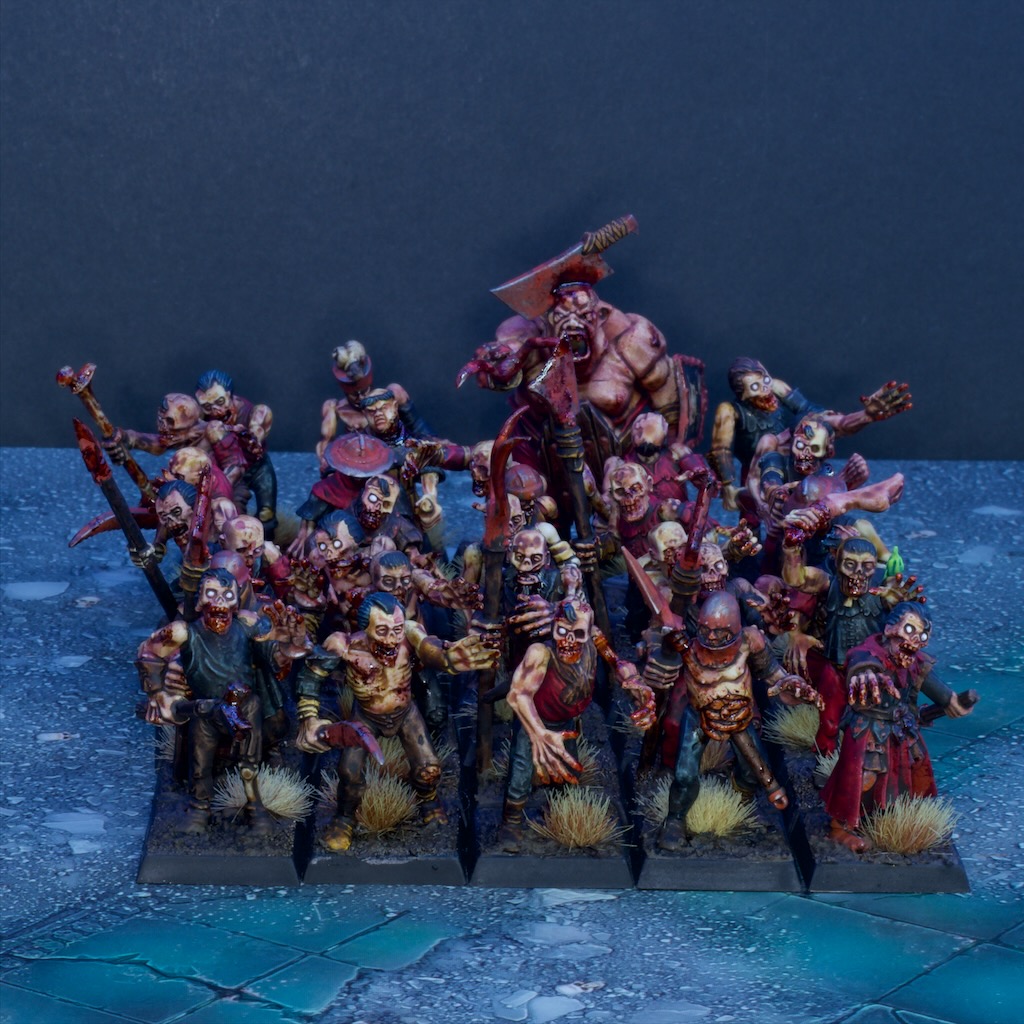
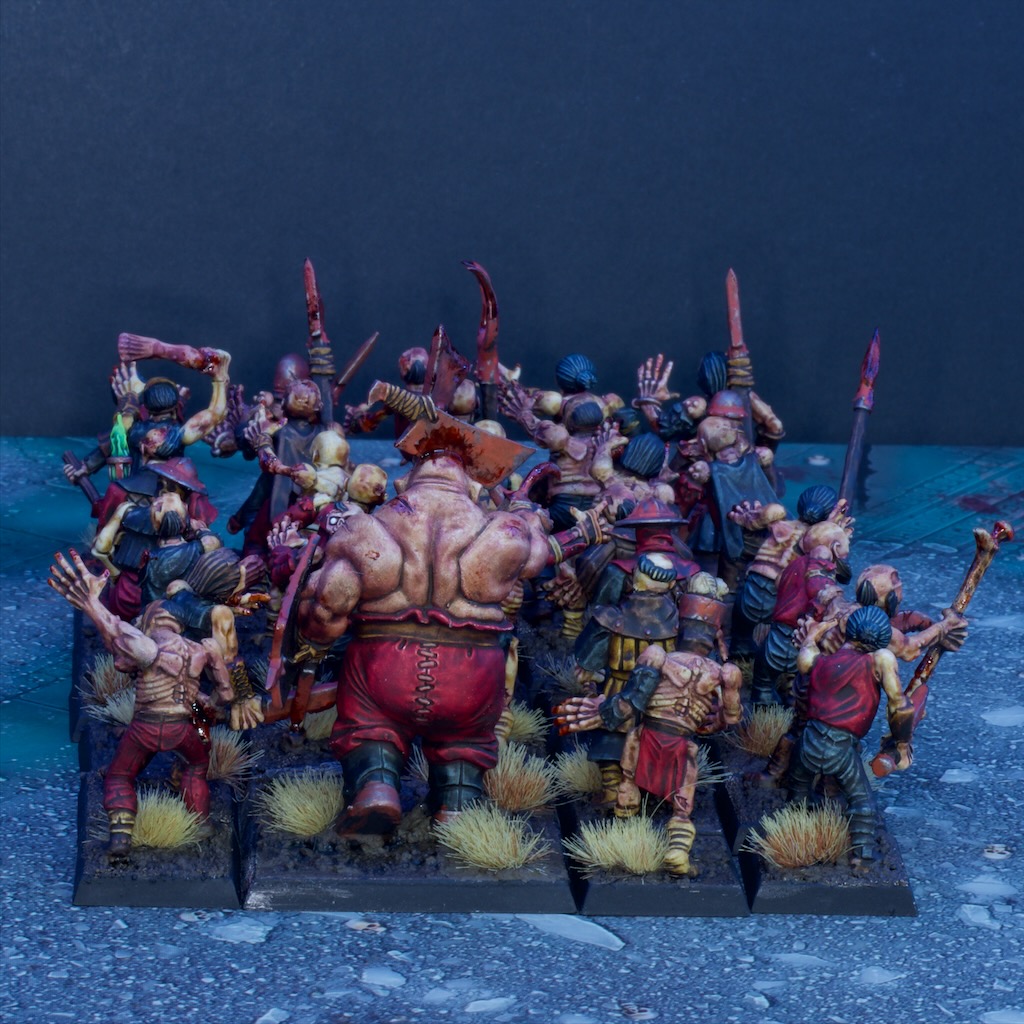
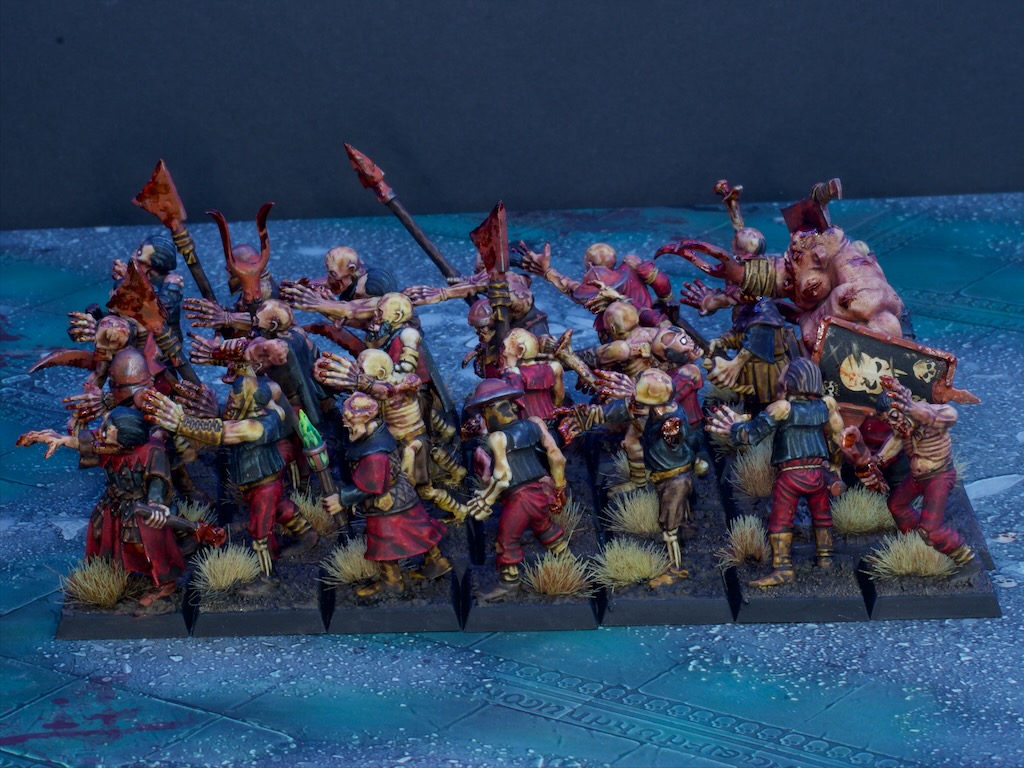
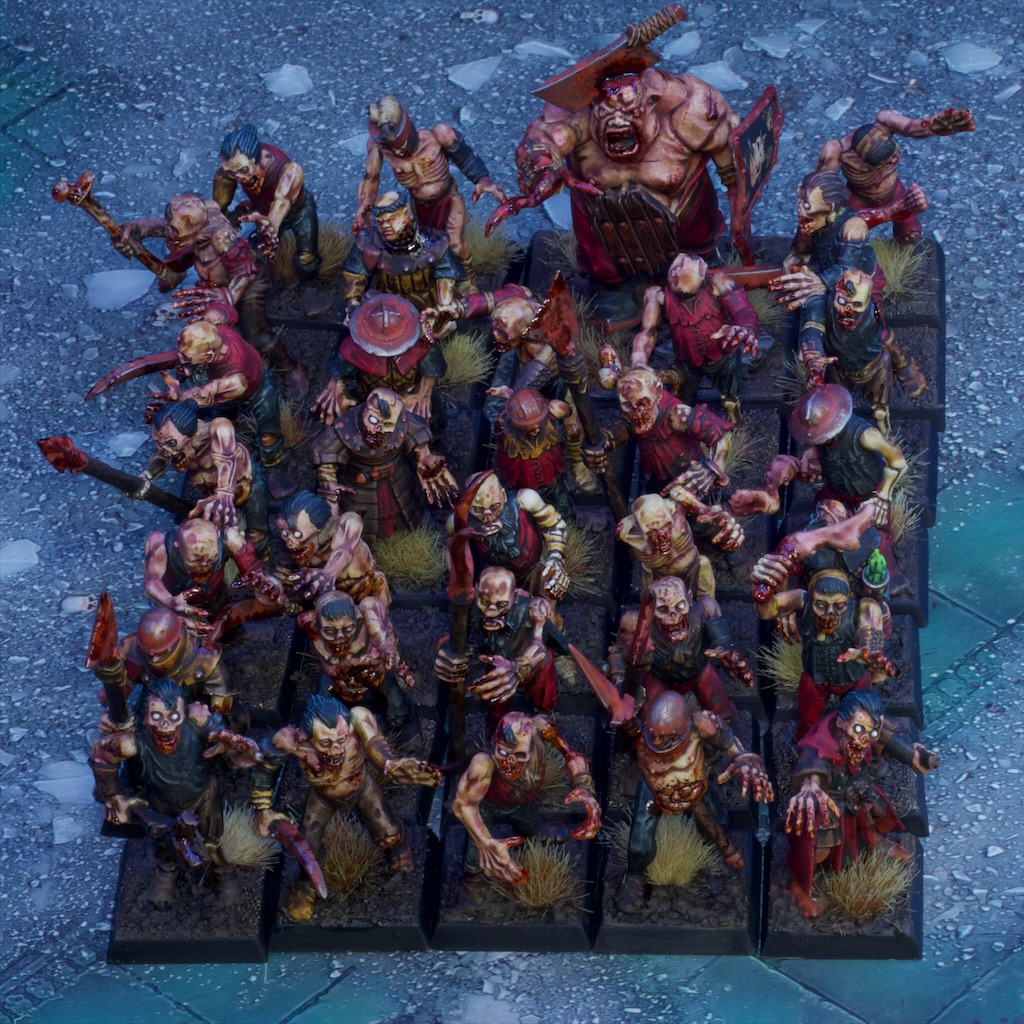
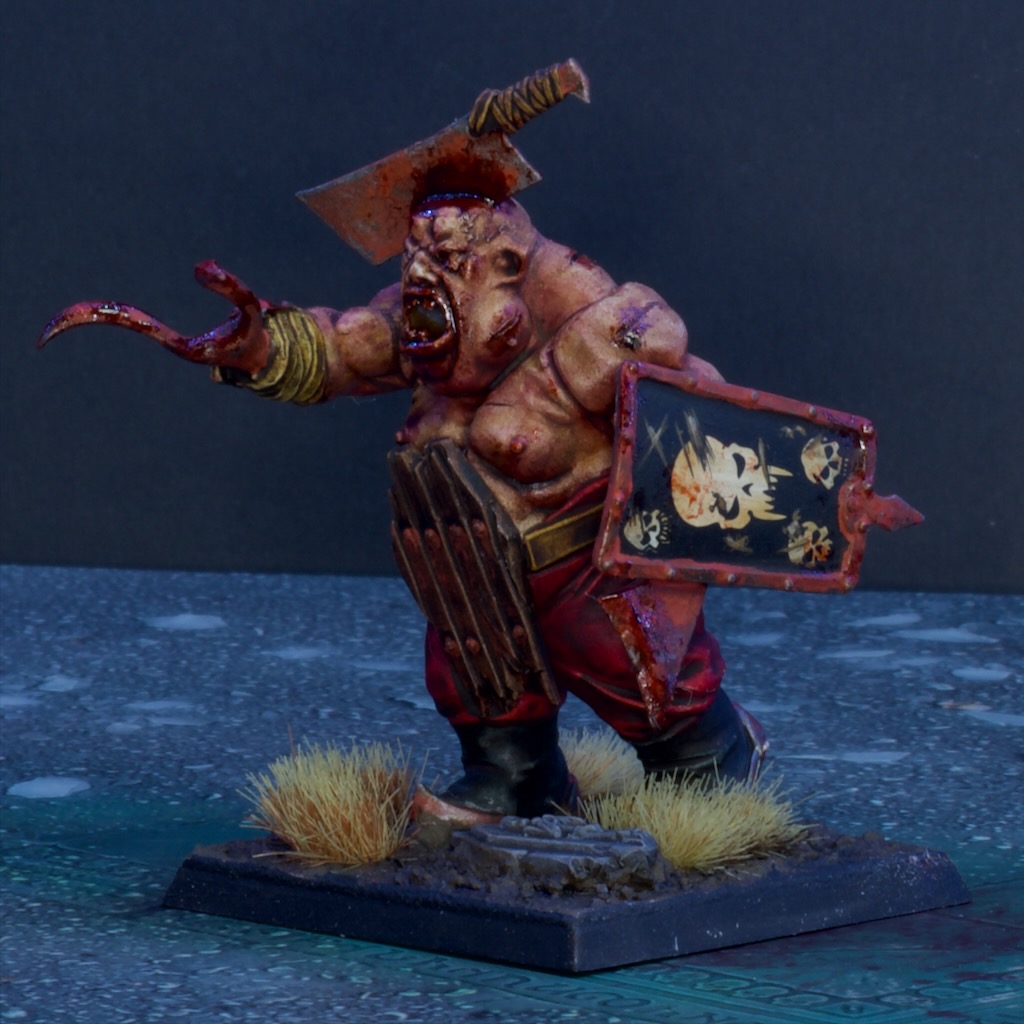
If you read my last few posts you’ll know I’m preparing to play in a map based campaign set in the Border Princes with some friends. For this campaign I’m fielding a Dwarf army and a Vampire counts army. After painting some of the Dwarfs last time around I decided to switch over to my Vampire Counts to keep things fun. The zombies seemed like a good place to start so I painted up a nice big batch of them. All up there’s “35” zombies there (32 really but the ogre counts as 4!), giving me enough for a unit of 20 and 15 summons.

I actually built these models a long time ago, during the 8th edition of Warhammer, so somewhere around 10 years ago. They were built by mashing together a zombie box and a Bretonnian men-at-arms set, as well as the addition of a spare ogre from my Ogre Kingdoms army. It’s about time these got some paint on them!

Painting wise I knew I wanted to go fast, the goal being to paint the 32 models in the time it would normally take me to paint a unit of 10 models. That meant leaning heavily on contrast paints, aiming for as many parts as possible to be done in single coats of contrast paints.

The skin was done with a 50/50 mix of Plaguebearer Flesh contrast and Fyreslayer Flesh contrast. I tried to mix these somewhat unevenly to get a bit of variation when applying the paint. The skin then got a patchy application of Carroburg Crimson wash to add a bit of red to some sections for even more variation.

The cloth, leather, and bone areas were done with a variety of contrasts including Flesh Tearers Red, Cygor Brown, Wyldwood, Black Templar, Aggaros Dunes, Skeleton Horde, and Snakebite Leather. These non flesh areas then got an all over wash of brown enamel (MIG Brown Panel Wash) for an easy dirtying.

The metal areas were painted with Scale 75 Black Metal, then covered in Khimera Red Oxide and Khimera Orange patchily and wiped away somewhat messily to get a worn rusty look.

The blood you see on the models was done after my usual coat of Matte Varnish to retain the glossy look. The blood was done using an old technique I picked up from one of the more successful Australian display painters back in the day. The technique makes use of Tamiya Clear Red acrylic paint mixed with some regular black acrylic (in this case I used Vallejo). The clear red is alcohol based and dries very quickly into a pretty tacky substance that can be applied to models in a quite realistic way, giving some nice texture as well as colour for the blood effect. By varying the amount of black mixed in you can go from a nice fresh blood all the way to coagulated blood. Lots of fun!

These were tremendous fun to paint. Much like Nurgle models they are very freeing in that it’s possible to go a bit crazy with washes and get something reasonable looking at the other end. They won’t win me any awards, but they look nice and icky and grimy and I don’t think I can ask more of zombies!