Campaigning in the Border Princes

In my last post (Dwarven Cannon) I mentioned that my friends and I were thinking of embarking on a map-based campaign for classic Warhammer (6th/7th edition era). Enthusiasm has not waned and we’re tentatively up to four players interested! We’re still likely to want to have 6 factions involved to flesh things out so it’s likely a couple of us will play 2 factions. What the factions are is likely to be decided over the next few weeks, so an update on that will happen at some stage! To play a map-based campaign one needs a map, and I turned my attention to that this week.

One of the lingering questions after the initial discussions last week was whether to play the campaign presented in the book as is or to use the rules to create our own campaign. In the end we decided to play the Border Princes campaign from the General’s Compendium with a few tweaks. The map locations are really nicely fleshed out and we thought we could learn from it to allow us a good chance of creating a good campaign of our own in the future. While the book originally came with a poster map of the region to use for campaigning, the second hand copy of the book I got did not have the map with it (lost a long time ago presumably!), and I set about replacing it.

I tried scanning the small version of the map shown in the book with a view of printing it on a few A3 sheets to make a map large enough to hold models. Unfortunately while my scanner has high enough resolution to provide images that would work blown up to that size, the source image was to small and scaling it up just made the printing dots very visible. SO I decided to do the next best thing: draw my own version of the map!
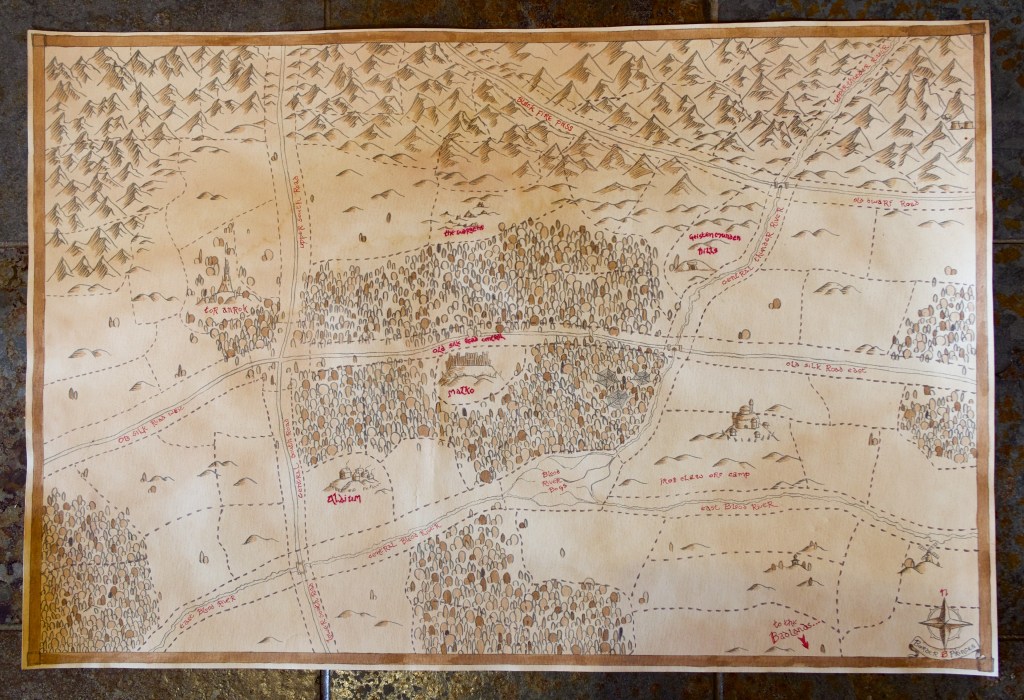
I uploaded this photo at a higher resolution than I usually do, should let you zoom in if you feel like it!

This then is a bit of an unusual post, not about model painting by about map making! I spent most of my spare time over the last week putting this together, thoroughly enjoying the process. The General’s Compendium actually provides pretty good instructions on how to draw your own maps and I mostly followed that process supplemented by helpful advice from my wife who is an artist.
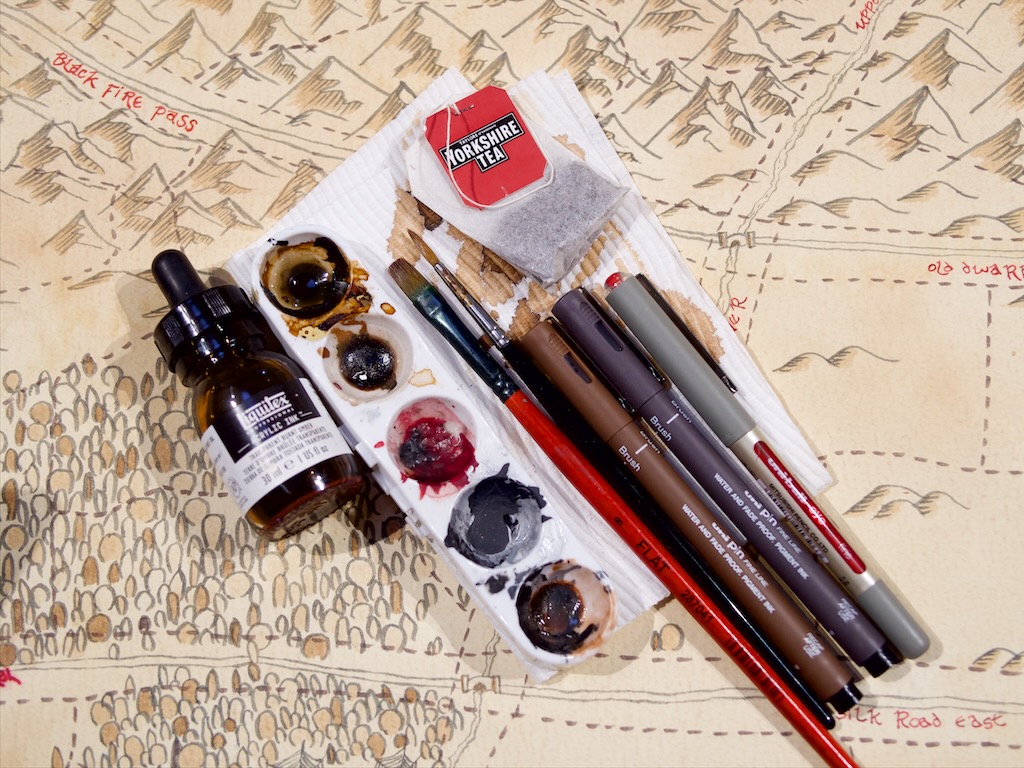
Tools of the trade!

I started by drawing a grid on the map, and overlaying a matching grid on the scan I’d taken of the map in the book. This let me roughly copy the layout of the original which I pencilled in using an HB pencil (the book recommends using a light pencil to avoid smudging – HB was the lightest I had but the book suggests 2H!). With the layout marked out (I mostly just drew the roads and river sections to get my bearings) I started adding details. I started with the mountain sections, as there was a lot to fill out. I generally tried to replicate the style displayed on the original map but ended up making it my own by adding shading in the line work. At this stage I was pencilling in sections of mountain and then tracing that pencil line with a the grey Uni pin brush marker you see in the photo above. These are pigment based and water resistant once dry, very important for a later stage!
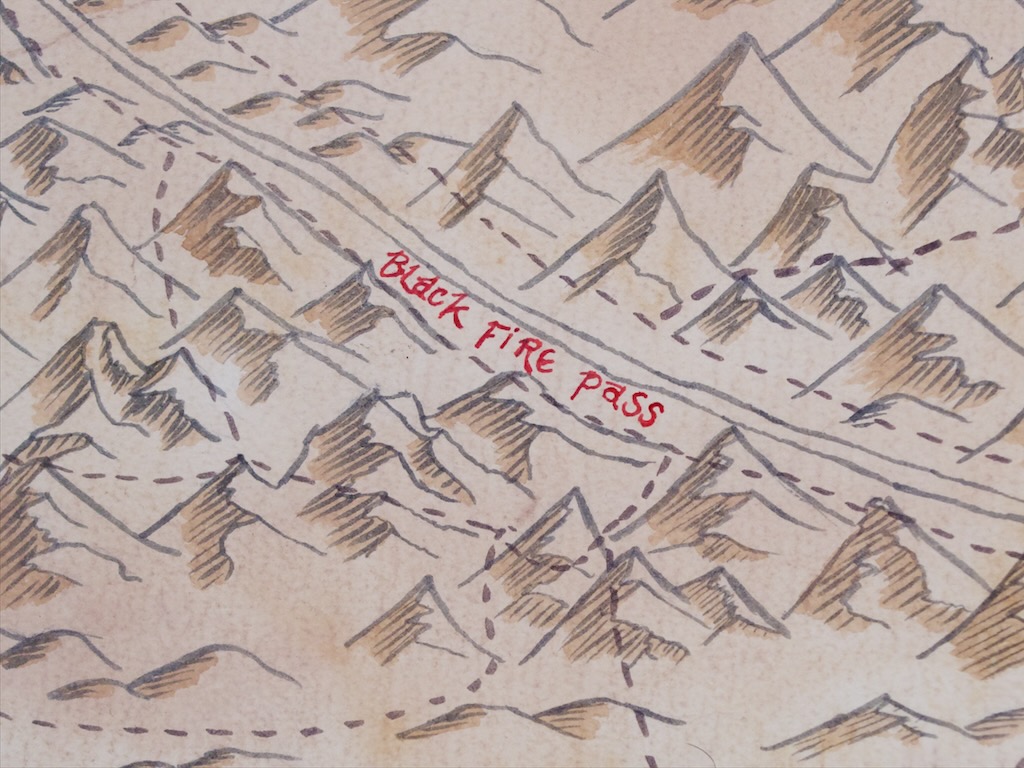
I tried to keep an eye on where the original map had place location names to make sure I left space for them. I made a few mistakes there and decided to write place names before drawing detail to avoid doing that again! I initially used a permanent marker to write location names, but that ended up bleeding in the paper a bit and generally looking a bit icky so I switched over to the red Uniball pen you see in the tools photo.
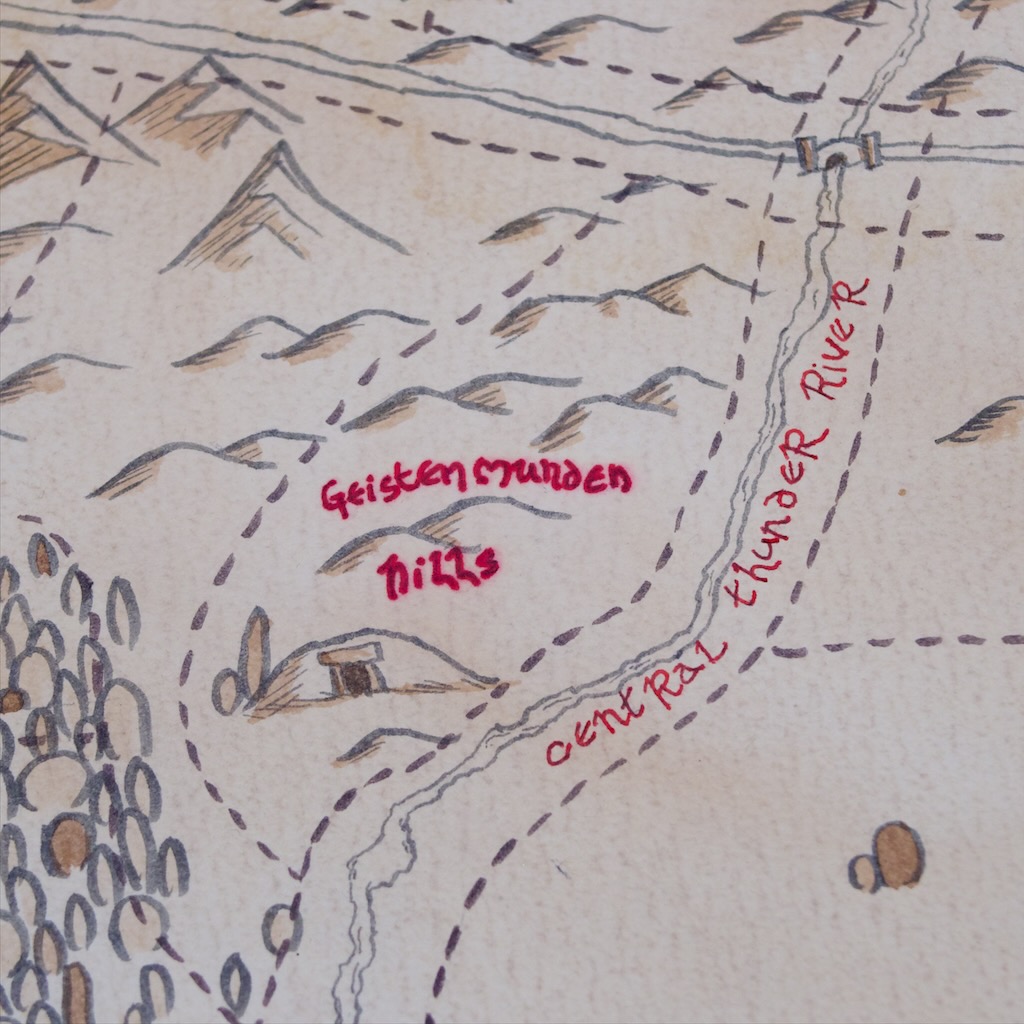
The photo above shows the difference between my two pens. The uniball pen ended up much cleaner and I wish I’d done some trials before diving in … but what are you going to do, this project was powered by enthusiasm and enthusiasm has no time for trials! The lettering was based on the original map, I tried to copy the letters best I could, and am ok with the outcome. Anyone who knows me in person knows I have dreadful handwriting, so the fact these are mostly legible is a good outcome!
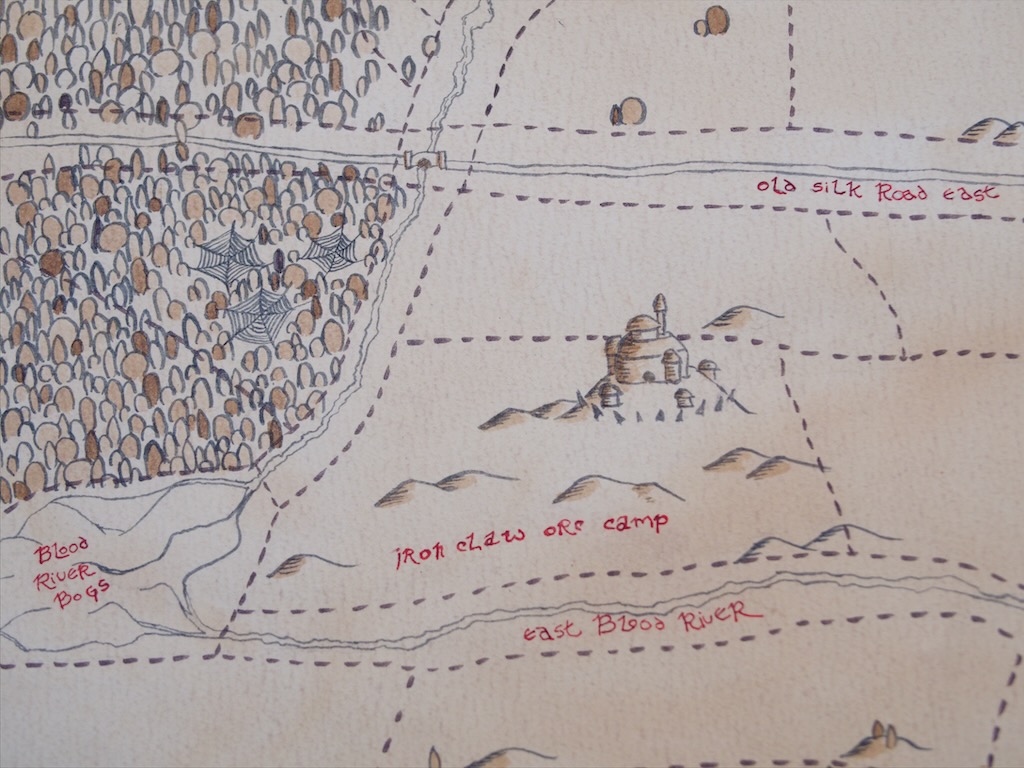
I’m also no illustrator, and I tried best I could to replicate the illustrations that were on the original map. They’re a bit crude but they’ll do! The original map had forests as collections of roundish shapes and I went for a similar look which was quite the effort. That was a lot of repetitive drawing which given my recent bout of RSI meant frequent breaks and lots of stretches.
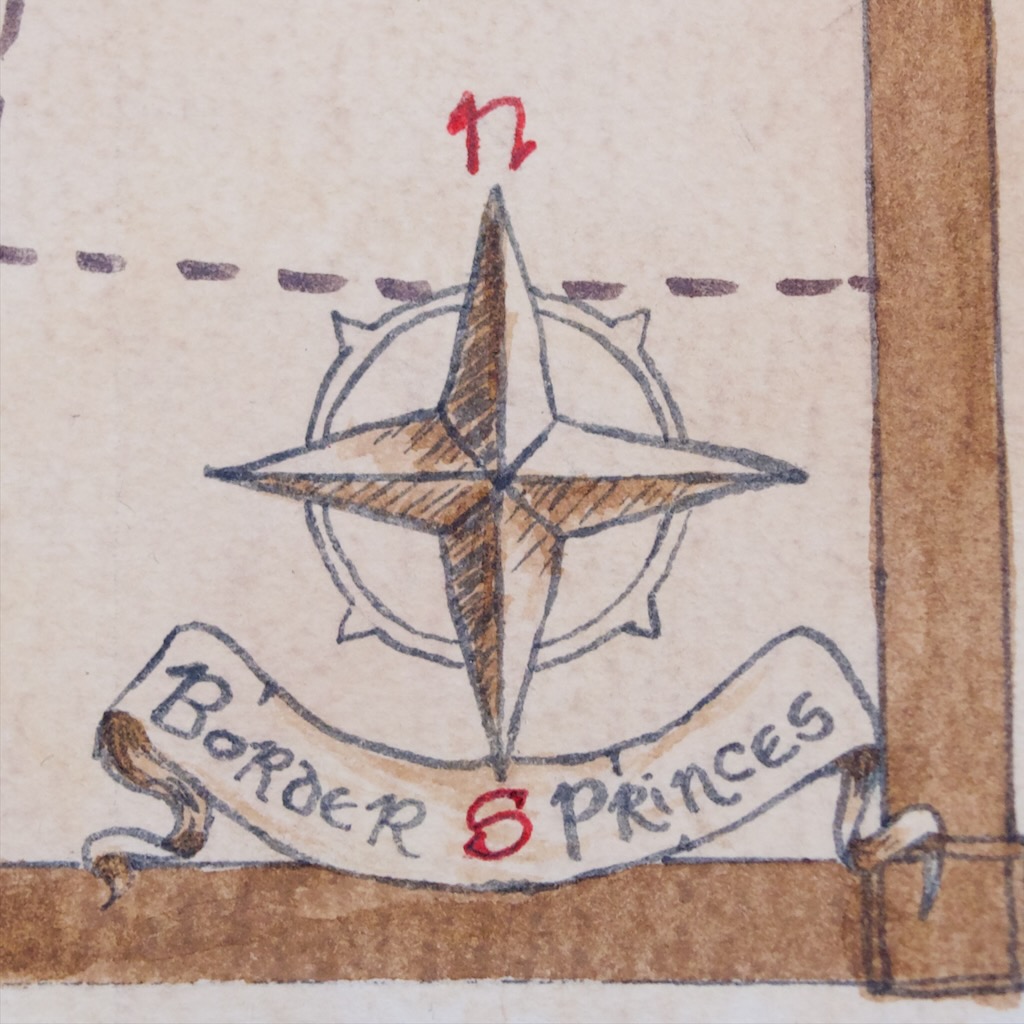
Just in case we forget where we’re campaigning!

Once all the line art was done, I sponged on a large amount of tea water (hence the need for water resistant ink!) and let the map sit overnight. The book suggested using water colour paints for this step but I’m a veteran of a great many childhood pirate maps and knew I could get a good outcome out of the humble tea bag. This gave that nice creamy-brown base all over the map, which provided the first stage of colour. The next day I used Burnt Umber ink to paint in the shading on all the details. I did this in multiple passes with different dilutions of ink, with the forest sections getting the most variations in intensities. The original map did this for its forests and I thought the look was very effective.

Overall I’m very happy with the outcome, we’ve ended up with a very practical map and I really enjoyed myself making this. I’ll have to try map-making again.

Dwarven Cannon

With my newly refound ability to paint, I’ve been looking for things to paint (which I’m not short of) and where better to direct that energy than at a new project rather than work towards finishing one of the many existing ones I have!

I got a book in the mail last week I’ve been looking for for a while, and said book triggered a flurry of conversation between my regular gaming partner and I about campaigns in the Warhammer world. The book in question is The General’s Compendium, a book published during the 6th edition of the game which contains a lot of ideas for what we now call narrative games, including a whole three ways to run wargaming campaigns. I read the book cover to cover over the last few days, and I really want to run a campaign now!

One of the map-based campaign systems in the book has the factions involved in the campaign have “banners” on the map, each representing an army. Rather than tracking army composition, the players just pick a game size they want for the campaign and each time enemy banners meet on the map, a game of Warhammer is played at the size specified at the start. The players are free to alter their army lists between games, that being rationalised away by reinforcements and units being shuffled between banners.

The details are still fuzzy, but the leading idea for our campaign is to each have a number of factions under our control. As we are just two and that will be a lot of games and a lot of painting, we decided to keep the point size for the banners to 1000 points. The opportunity to paint multiple small armies is one that I very much welcome, and here’s the start of that:

This cannon and its crew are models from the Battle For Skull Pass starter set which was released for the 7th edition of the game. I’ve had these dwarves for quite a long time now, and in fact dwarves were my first ever Warhammer models way back when (over 20 years ago)! It’s one of my biggest Warhammer regrets to not actually have a painted dwarf army considering how long I’ve owned some of these models. Time to fix that!

I decided to go with the Karak Hirn colour scheme (i.e. green), as that was the studio army that was done up in the army book back then, and I have fond memories of looking at those pages back in the day. It’s also the scheme that I used for that first box of Dwarf Warriors I got at the time.

Most of the painting was done using contrast paints as a base coat, with the exception of the green tunics which these models acted as a testing grounds for. I wanted to make sure I matched the green of the studio paint job back then, and luckily for me the army book had a nice guide on how to paint it … with 20 year old paints. Luckily I was able to match the paints with some in my collection, and it’s quite simply Vallejo Heavy Black Green as a base coat followed by successive highlights of that same colour with more and more Scale75 Sherwood Green. I’ll do up a proper painting guide when I paint up the first block unit and have finalised how all of this is going to look.

Anyhow that’s it for this update, these models were very quick to paint, upside of their relative lack of detail due to being ~15 year old single piece plastic models. I have plenty more from that starter set to get through, so expect some more stiffly posed dwarves to grace these pages soon!

Dusty Panzers

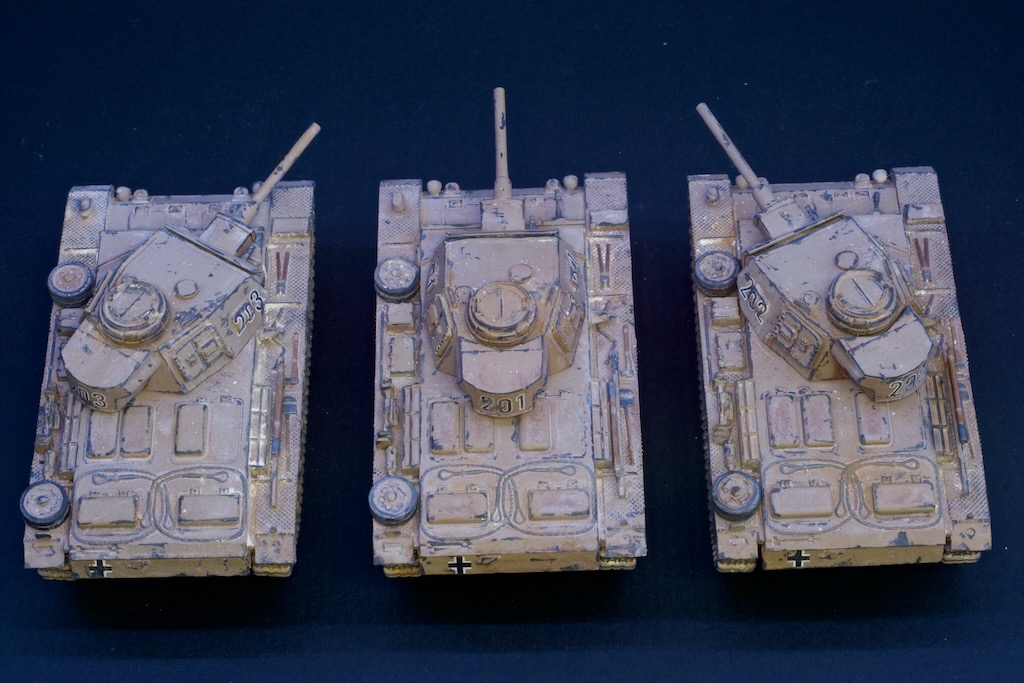
With the wrist on the mend and itching to get back into some painting I decided to tackle something with limited amounts of brushwork: tanks!

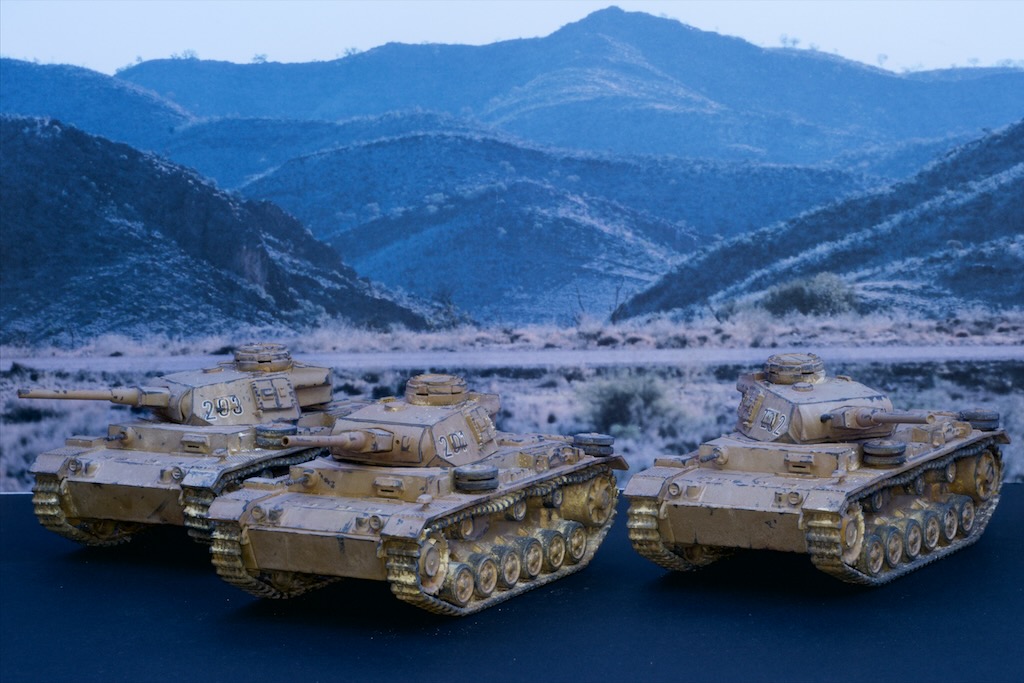
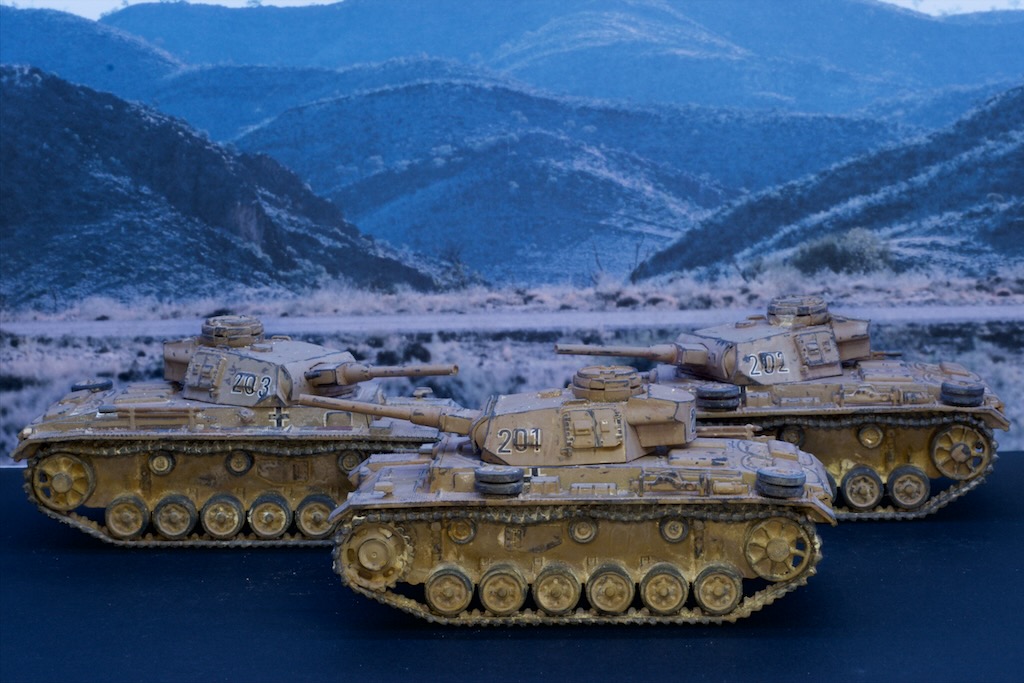
I’ve had a Panzer 3 half built for my North Africa Germans sitting in a box for a while and this seemed like a good occasion to finish it up. I then decided that the two P3s I painted for my late war Germans would make much more sense as reinforcements for North Africa, so decided to repaint them as well.

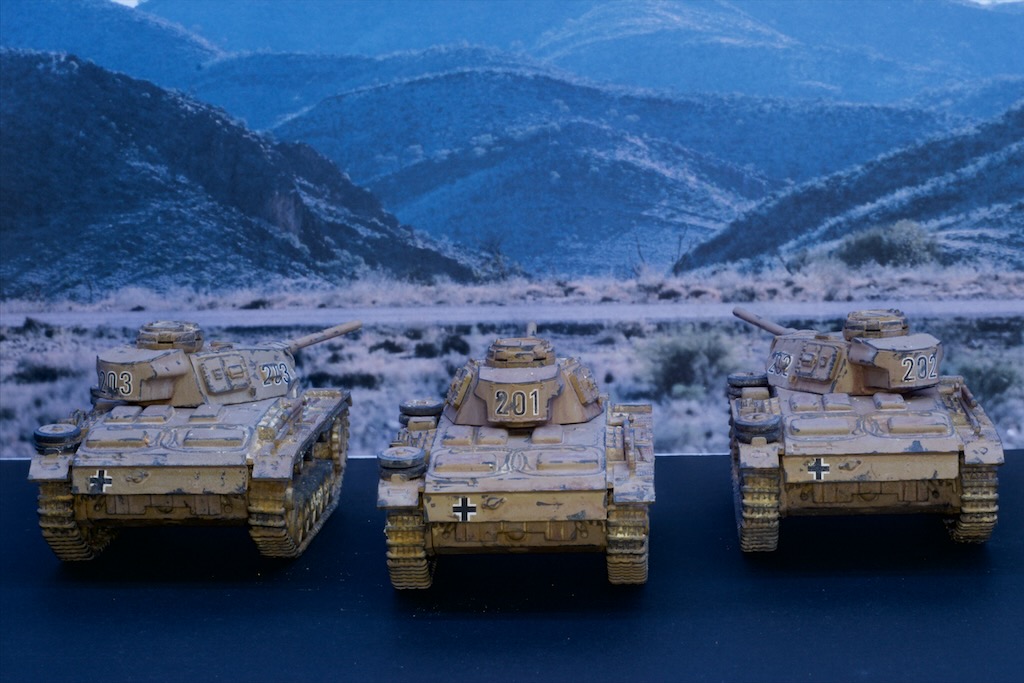
The two already painted had the longer later barrels, so step one was a bit of surgery to shorten them down to match the new one. I think it turned out pretty well, can you tell which are the cut down ones*?

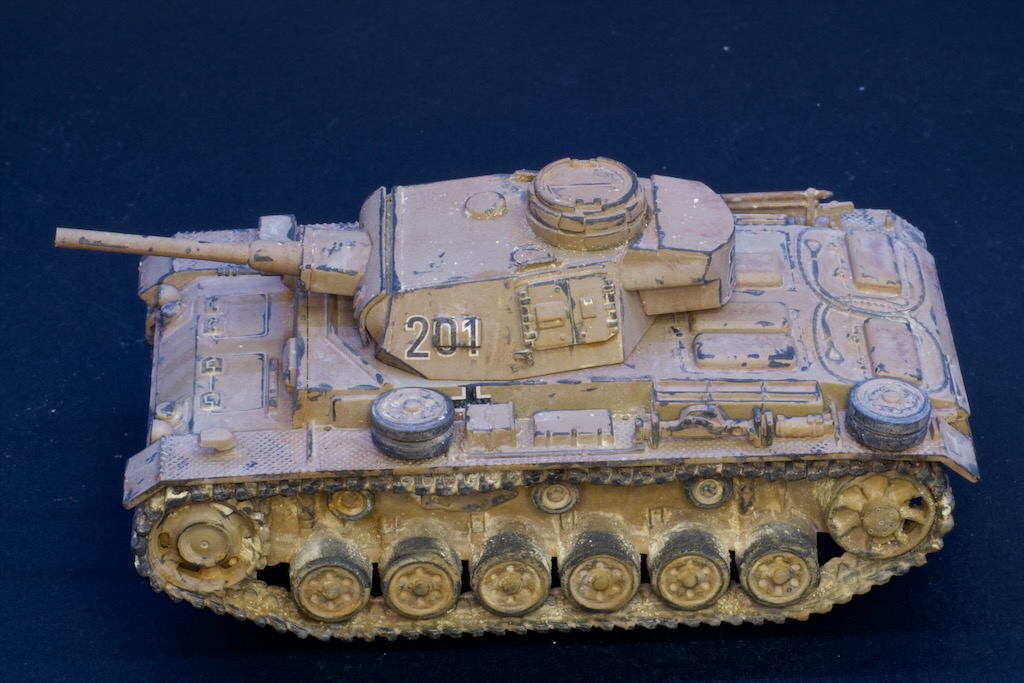
Painting-wise these were pretty straightforward, just an all-over coat of Vallejo Model Air Sand Yellow, followed by painting the tools attached to the outside of the tanks, and a lot of chipping and the rubber wheels with Vallejo German Grey. The fun came from the oils and the pigments, I wanted these to be very dusty so I went much heavier than I have on tanks in the past. These are covered in a variety of sandy/cream oils, and covered all over with pigments in the same kind of colours.

I did not enjoy putting on the turret decals last time, and was dreading it again this time! Things went much the same: a lot of repositioning and dousing on decal setter and crossing my fingers in hope! Overall though, I can’t complain with the outcome, I think they turned out pretty good.

Good to be back at the painting table, and I hope to be able to keep going!

* 201 is the new tank, and 202 and 203 are the repaints.

Intermission: Archers of the Living City

I’ve unfortunately suffered from an inflammation of my wrist for the last few weeks and have not been able to paint while I wait for it to recover. While the cause was my work and some heavy mouse use, the repetitive motions of painting also trigger those bits of my arm that are currently inflamed. I figure then that I may as well show some old work while I can’t produce anything new. Fingers crossed this is the only such post I’ll have to make, but we’ll see how we go!

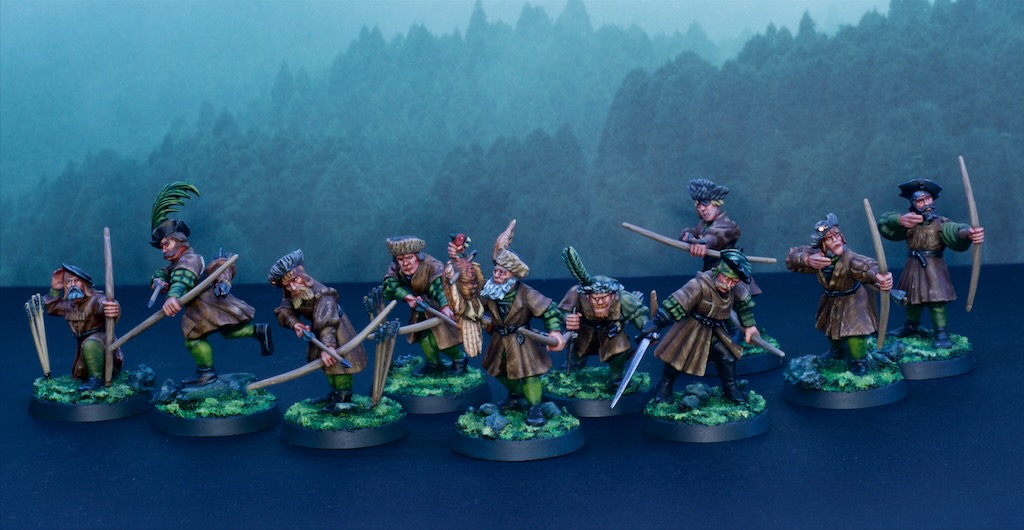
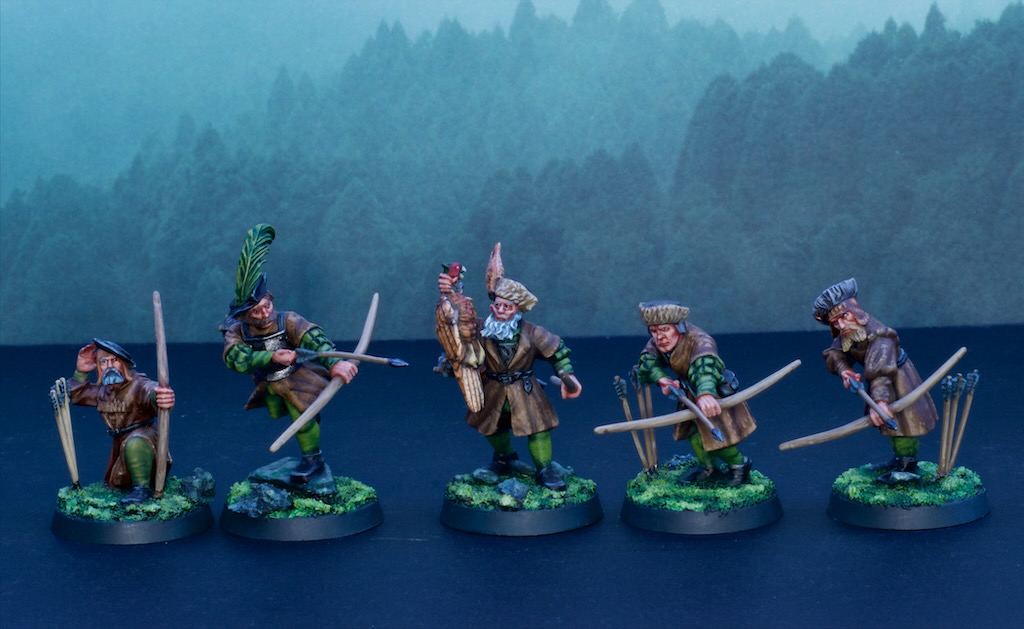
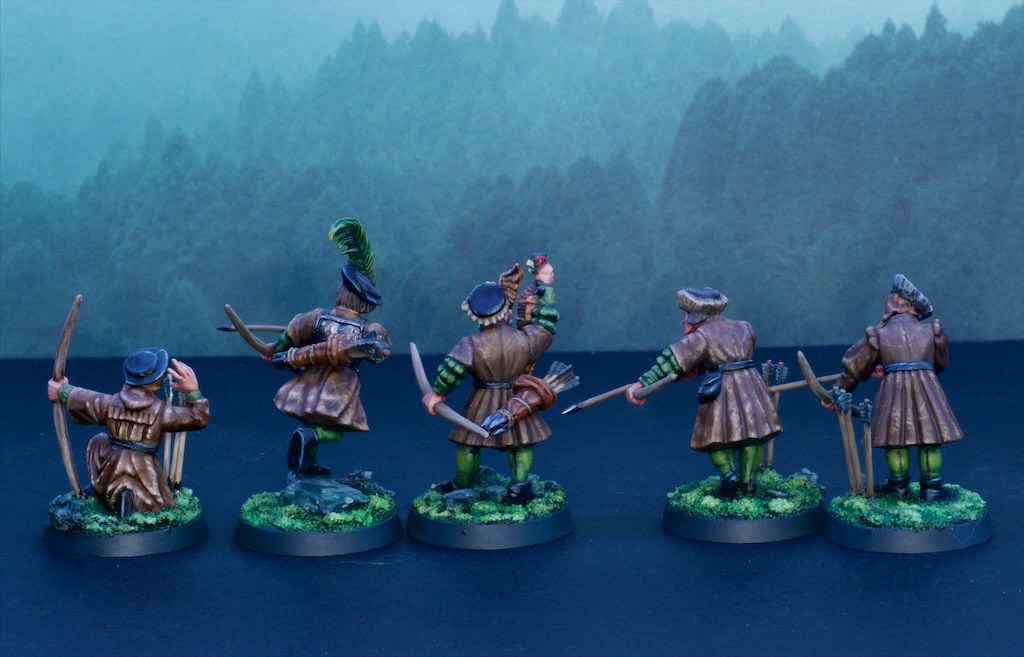
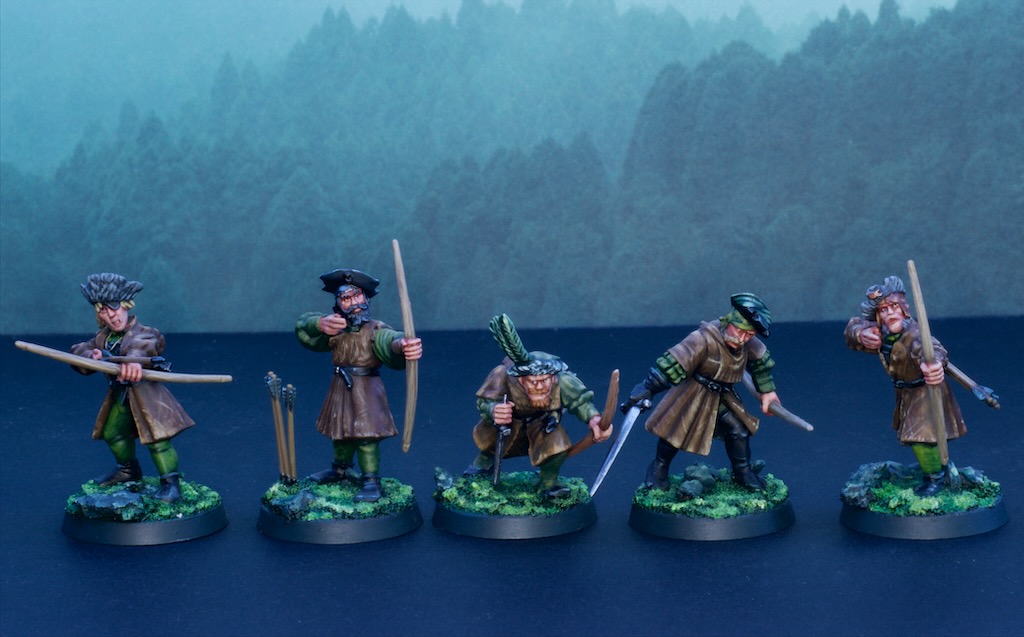
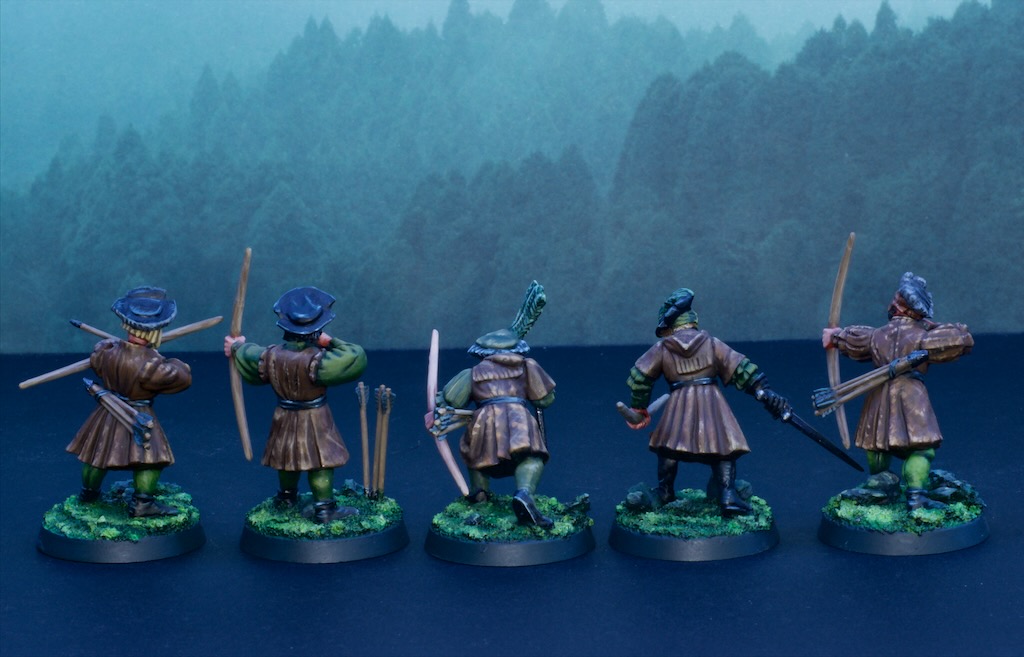
Today I’ll showcase this unit of archers I painted a few months before I started this blog. I painted these just before my son was born, and therefore was at home a lot with a heavily pregnant wife and had a lot of painting time on my hands (This was 2020 and I was in full work from home mode due to covid too which meant I was basically at home 7 days a week). I’ve always loved these Empire archers, I think the models are extremely characterful and they were a joy to paint. I spent “character” amounts of time on each effectively painting them one by one, which meant I wasn’t particularly quick, but it was a very enjoyable process.

At the time I was really enjoying the background of the Cities of Sigmar faction for Age of Sigmar, especially with the idea of the Living City, a city in the realm of life, part human-built, part elf-built, and overgrown with trees. I decided to paint these archers as if they can from there, hence the greens of their tunics and the mossy basing.

The mossy bases were done by painting sand in greens, which was quite a lot of fun and I quite like the effect. If you’ve followed the blog for a bit you might have noticed I quite like my forest bases, and this was another attempt at trying something different in that genre.

I spent a lot of time on the tunics, having a few weeks before watched a video by Sergio Calvo on YouTube where he ran through his process for leather. Going from cold brown, to warm brown, followed by ochre and bone for the final highlights. I loved the look and wanted to try it hence why these models are covered in scratched up leather!

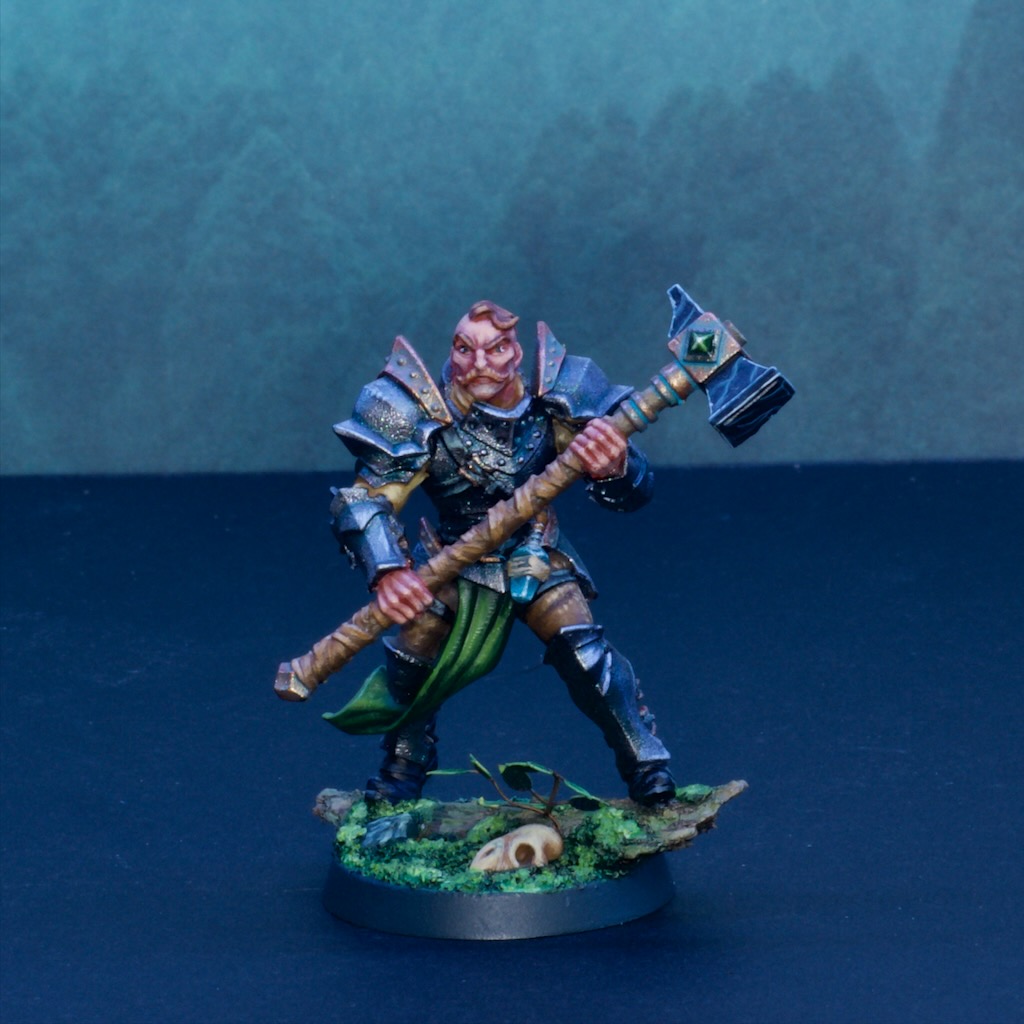
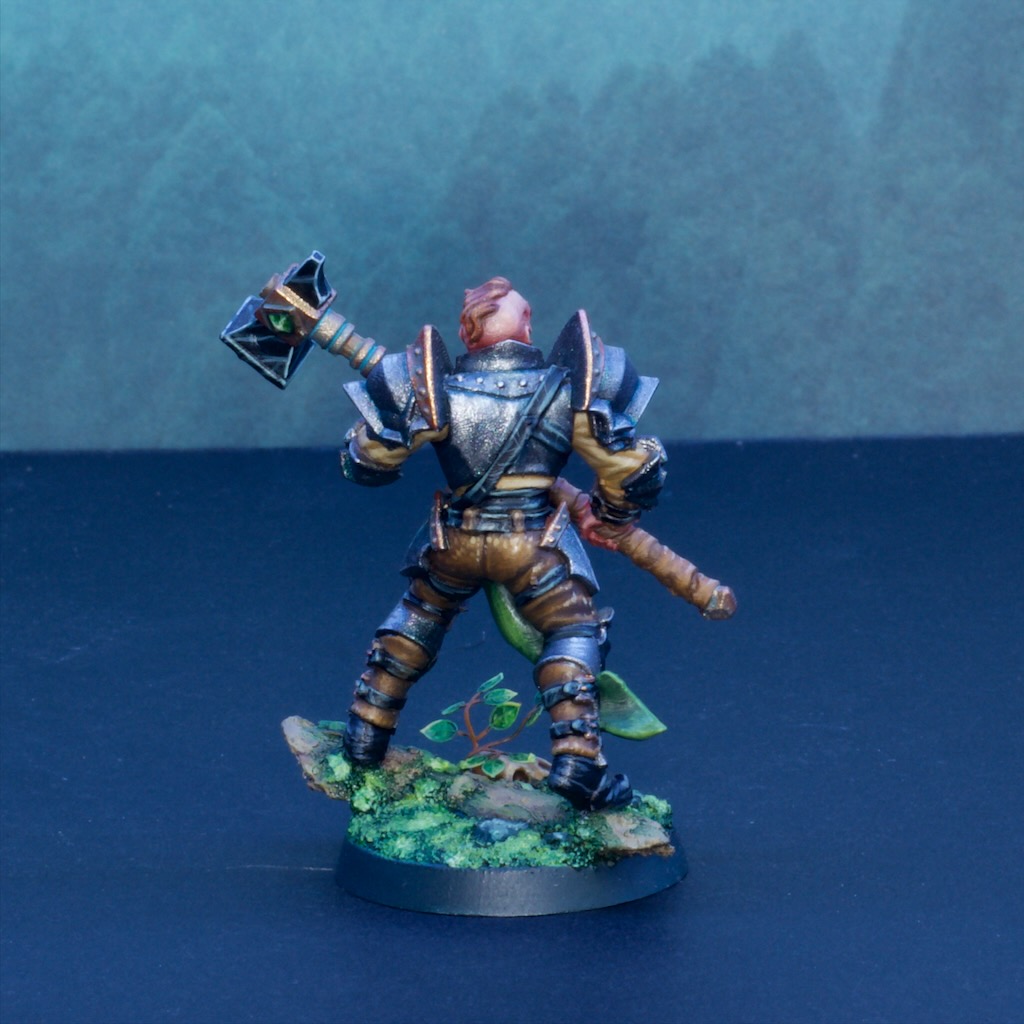
After painting these models and having enjoyed the process so much I toyed with the idea of making a full army for the Living City and I painted up a couple more models, first up this character model my brother in law printed for me as a gift (thanks!).

This was my first time painting a resin 3D printed model and I was blown away by the detail available on what was a relatively cheap resin 3D printer.

This was a very fun model to paint, lots of details. If you look really closely you can see some of the print lines but you have to know where to look.

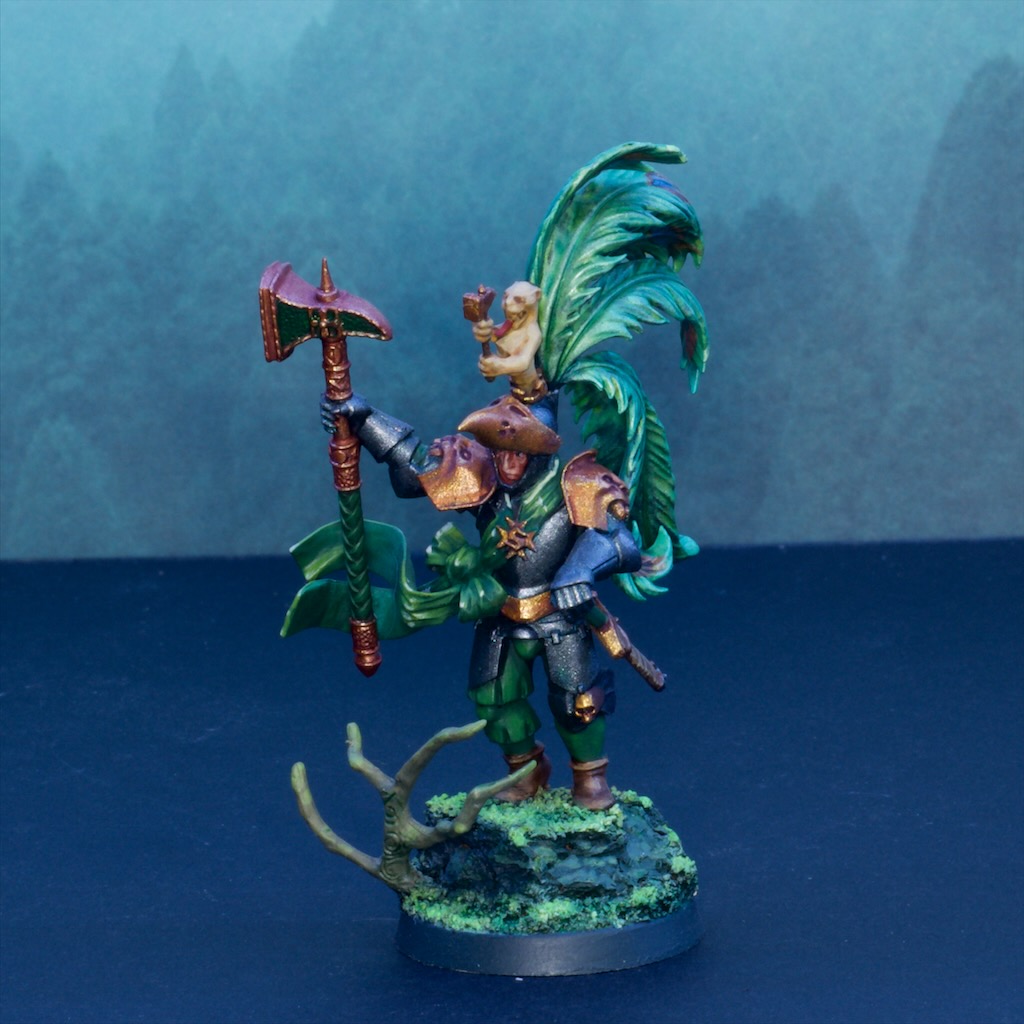
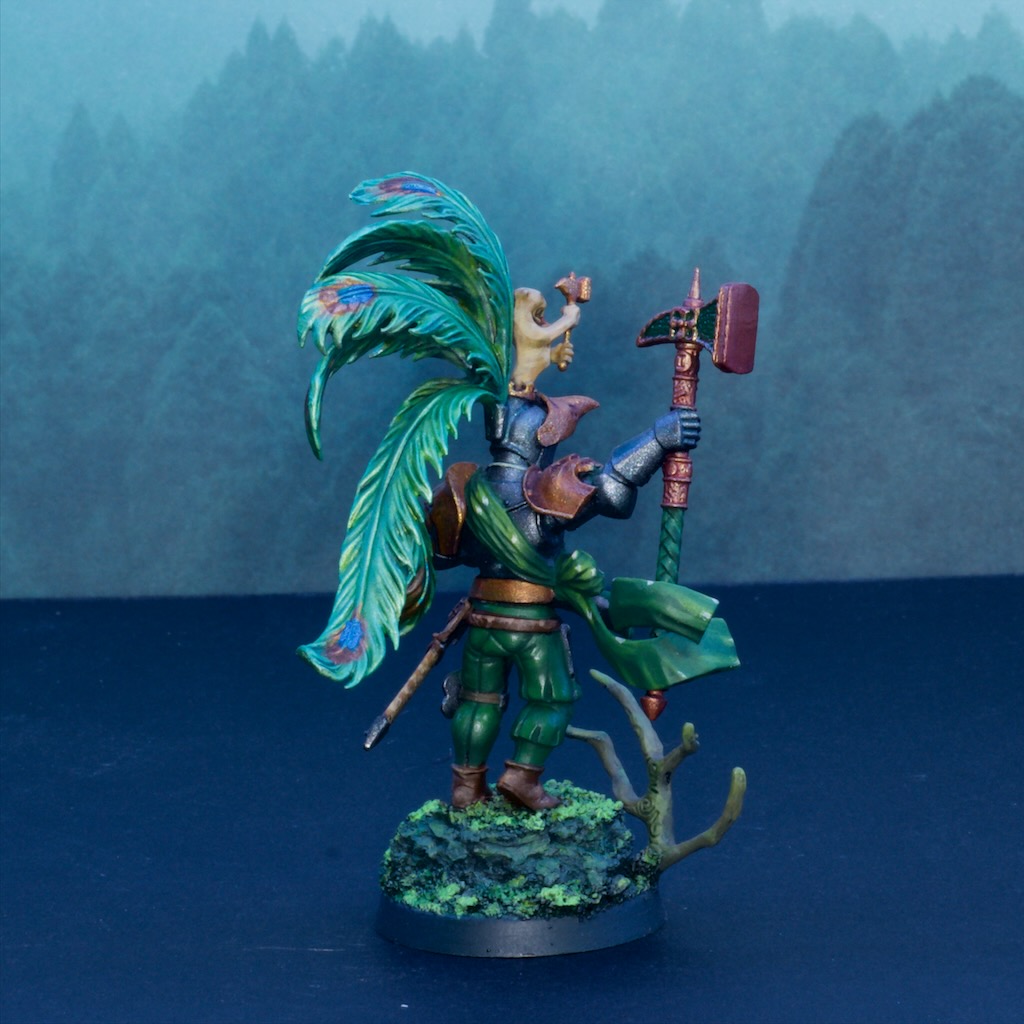
The final model in the collection was a bit of an experiment and got a bit rushed if I’m honest, and I think is the poorest paint job on these models. This is an old conversion of mine, with the upper half of the plastic Karl Franz riding griffon glued to a pair of Empire Greatswords legs. This was right at the start of my playing with GW’s contrast paints and I was keen to see if I could get a convincing peacock feather effect by using them over metallics.

The result is ok, it looks a little bit better in real life, but photographs a bit poorly. If I were to do it again I would make sure to not let the contrast layers dry, and make sure to blend them a bit better, you can see some rather drastic transitions between the colours there at the moment.

I hope you enjoyed looking through this small collection, and on my end I hope I can get back to painting soon, I’ve been missing it!

The Three Hunters

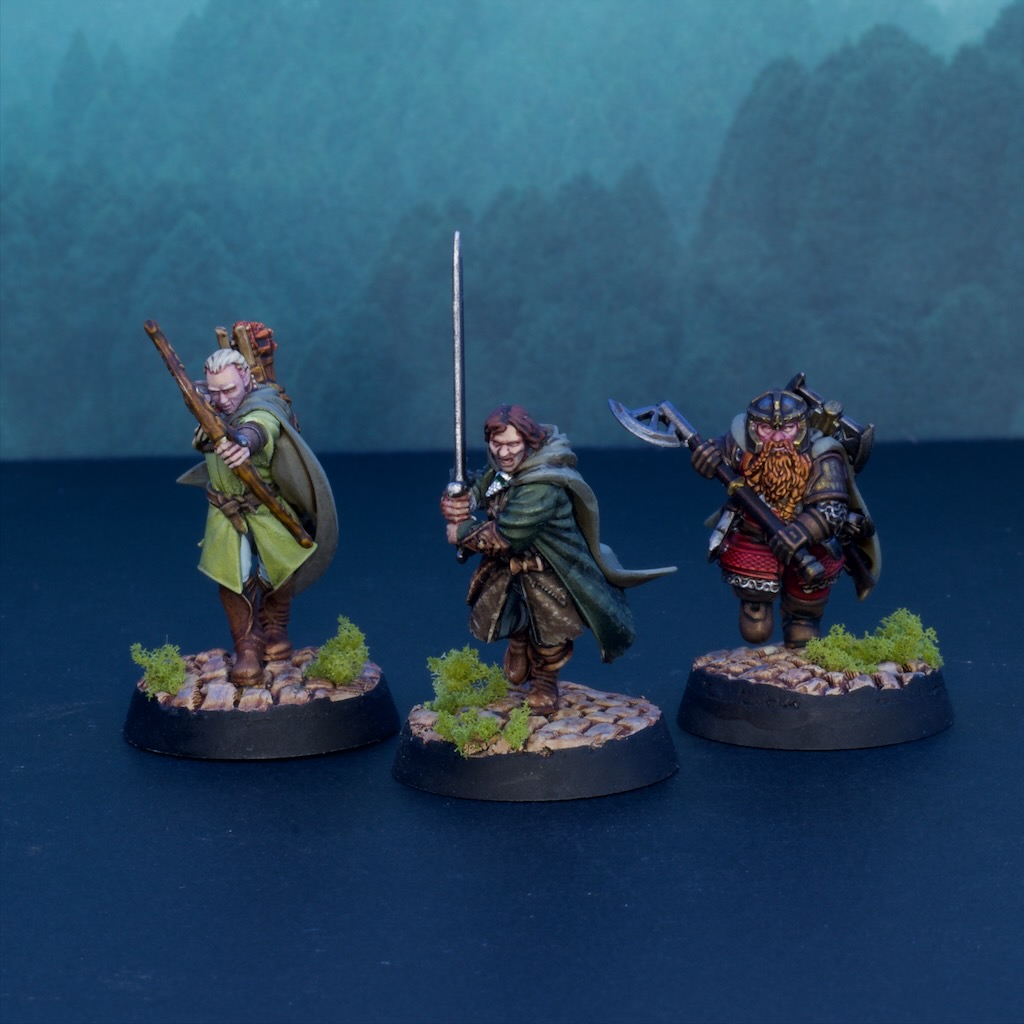
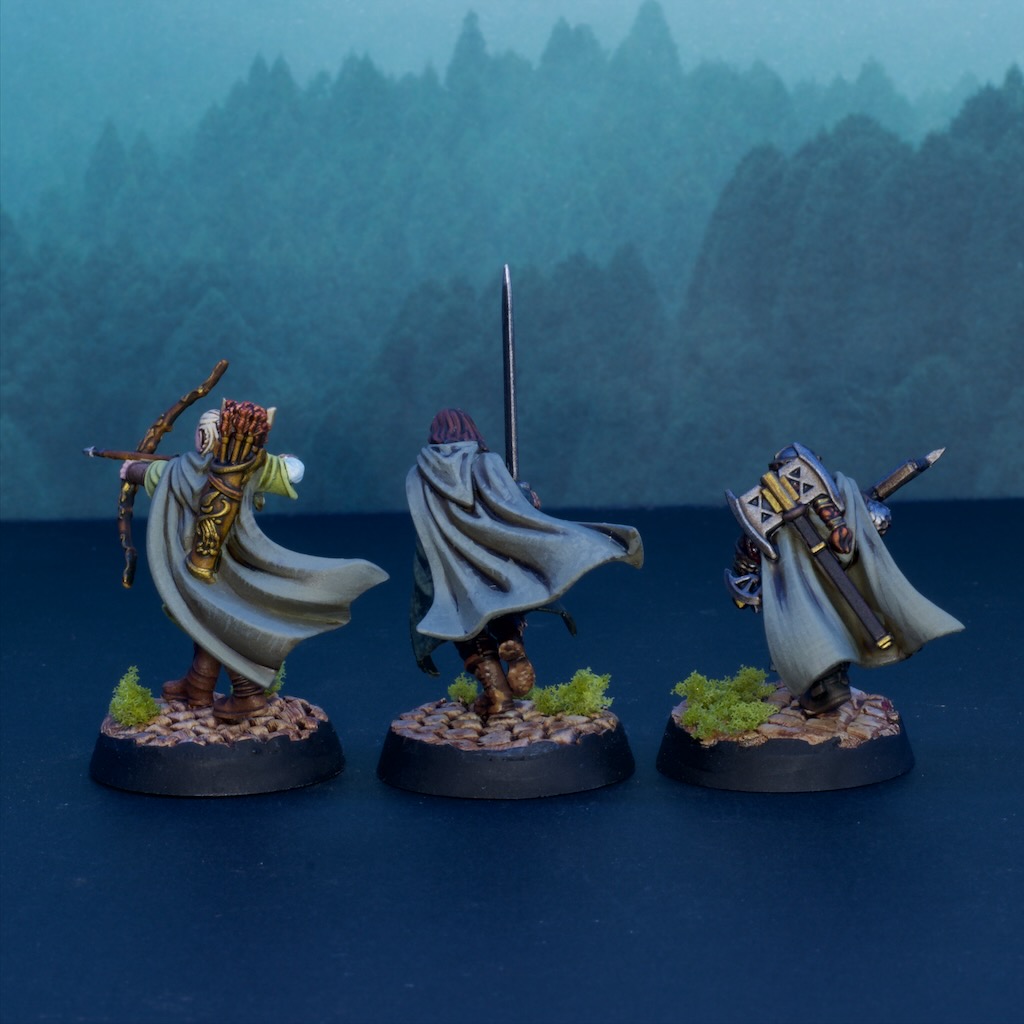
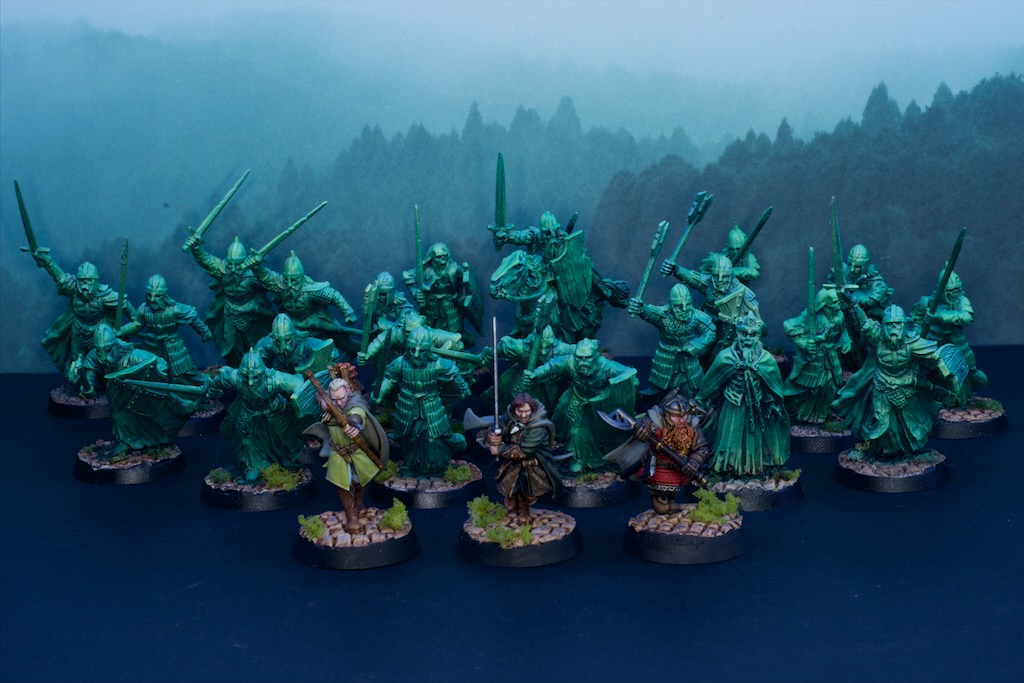
You might remember that quite a while back I painted some Lord of the Rings Dead of Dunharrow, and said at the time that I’d built the army so I’d be able to slot in the three hunters and make it exactly 800 points. Well it took me a while (and waiting for those models to come back in stock!) but here they finally are.

These are the new plastic set Games Workshop produced for the trio, and like all the new Middle-Earth plastics they’re excellently detailed and go really nicely together. I’ve actually had these on my painting desk since December, with Aragorn completed and Legolas and Gimli only about half done. I finally decided to finish them off tonight after a few months of staring guiltily at them.

The paint jobs relied pretty heavily on contrast paints with some selective highlights over the top, with most of the leathers and cloth areas done that way. The main exception are the elven cloaks, which I decided to paint in a more traditional manner (basecoat – wash – highlights) with Vallejo Field Grey, GW Agrax Earthshade, and Vallejo Green Grey respectively.

I tried to add a bit of texture to everything with highlights, although to be fair I spent a fair bit more time on Aragorn than on the other two, and therefore he has much more texturing on his clothes! I suppose I can rationalise that by his being a ranger with presumably poor access to new clothes!

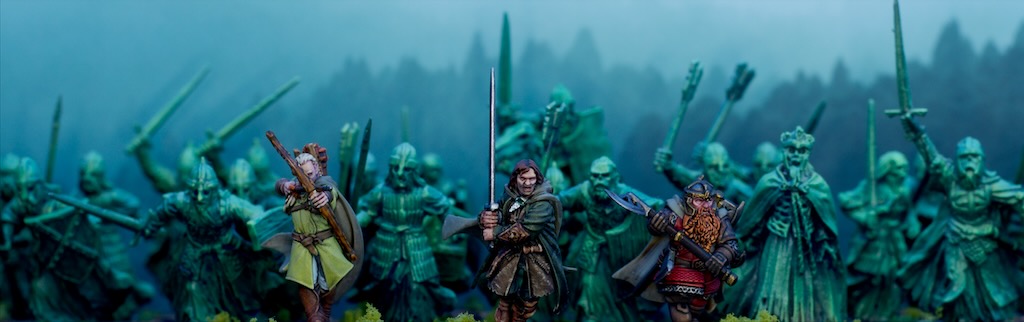
Part of the fun of finishing these three off was to be able to put them alongside the Army of the Dead and recreate that scene from Return of the King where they disembark from their stolen corsair ship. Although I lacked an appropriate photographic background so picked the one that matched their colours best.

Anyway it was nice to tie a bow around this particular Middle-Earth SBG army, and I look forward to using them in some games!

Mounted Daemonettes

It’s been a while between updates, I got a bit distracted from my painting by finally getting around to playing Cyberpunk 2077 and getting absolutely hooked on it. There’s a recommendation for you if you’re interested in the genre at all!

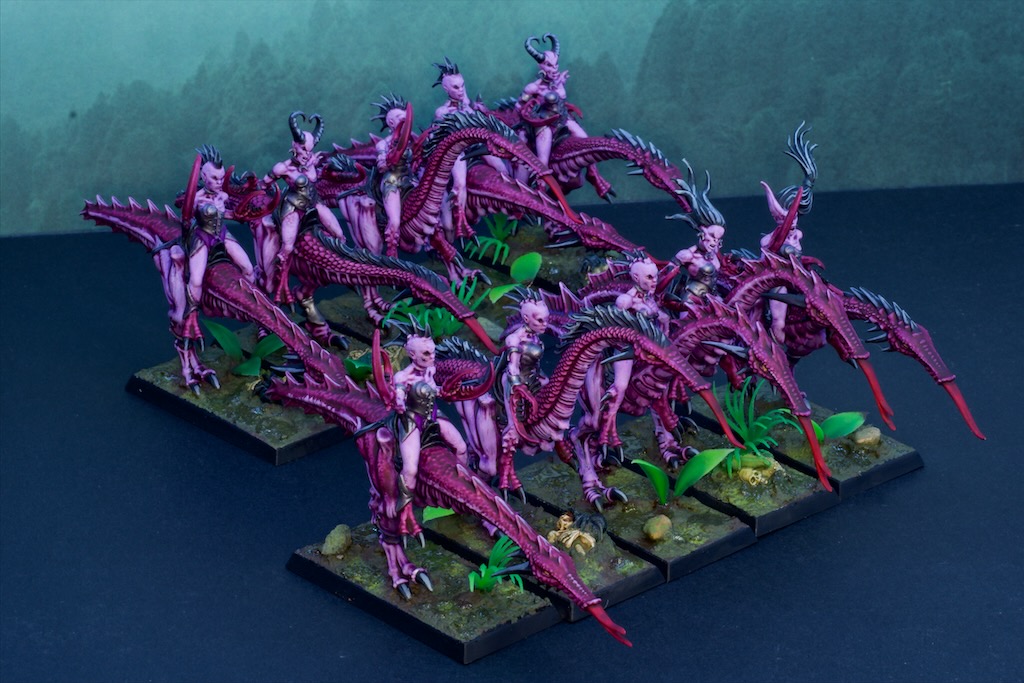
Back on topic, here’s the second batch of models for my Cult of Slaanesh army, mounted Daemonettes! I’ve got them all lined up above but they’ll be deployed in two units of 5. Maybe cyberpunk had an influence on me in my painting because these are very pink!

I actually painted them to match the Keeper of Secrets I painted a while back, and I think they ended up pretty close if a bit more saturated. At the time I had no army to put the Keeper in, so I imagined a snow scheme for its basing. I’ll probably rebase it at some stage in the future to match these.

On to how these were painted. Contrast paints did a lot of heavy lifting here, they’re extremely good for organic forms, and daemons are mostly that! I started with an all over coat of Magos Purple Contrast on both riders and steeds, with the steeds receiving a second coat to differentiate them a bit by making them darker. I then applied Volupus Pink Contrast over the scaly areas of the steeds as well as the claws and feet of the Daemonettes. Talons, horns, and hair were all given a coat of Black Templar Contrast, and the tongues of the steeds were picked out in Flesh Tearers Red Contrast. I then picked out the metallic areas with Scale 75 Black Metal.

I then did some highlights over the skin of the Daemonettes and the non-scaly parts of the steeds using Vallejo Game Color Squid Pink. This was applied in multiple light coats (semi opaque, so quite dilute) to create transitions that weren’t too harsh. The black areas were then quickly highlighted with Vallejo Game Stonewall Grey. I picked out the eyes of the Daemonettes in black and of the steeds in yellow and did a very light overall wash/filter of a purple oil paint (Daler Rowney Permanent Mauve) to tie the lot together and smooth out some of the rougher highlights. Overall then this was quite a quick process, and given the amount of effort I put in I’m quite happy with how they look.

Hopefully the next update is faster than this one, Cyberpunk 2077 is finished but who knows what other distractions lurk!

The Cult of Slaanesh

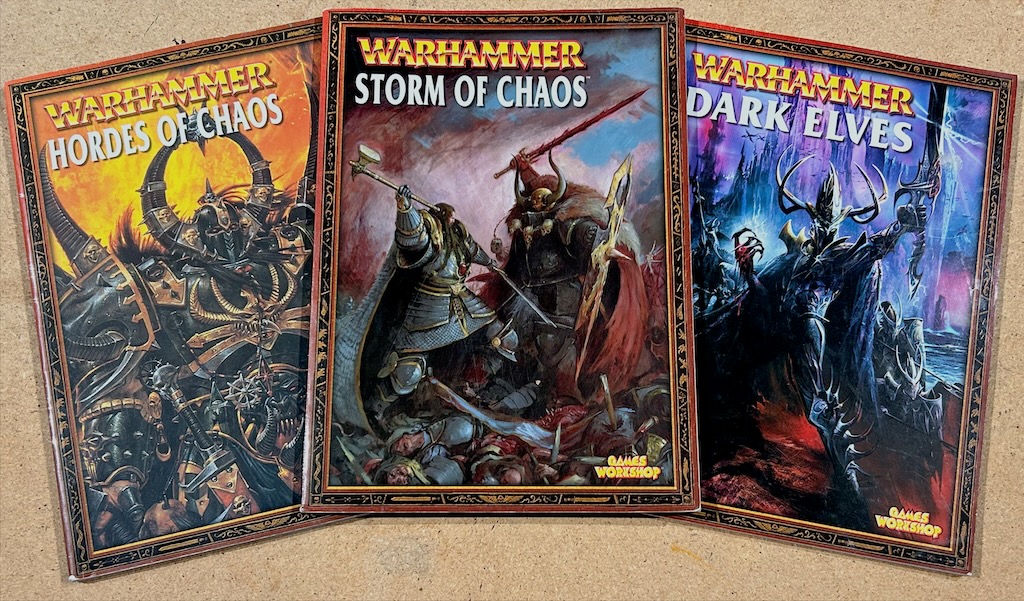
After our last scenario/narrative based game (Battle Report: A Rat in the Woods) we knew we wanted to do something similar again. That is over a few months paint a couple of armies, create a scenario that involves them, and some terrain to suit, then when all of that is done, play the game! We threw a few ideas around, but in the end settled on an idea triggered by the Storm of Chaos book from 6th edition Warhammer. At the end of that book is an army list for the Cult of Slaanesh, which is a really fun list that combines the Dark Elves with the Hordes of Chaos armies and represents the forces of the Morathi (The top Dark Elf sorceress for the uninitiated!) when she re-kindles the cult to the chaos god Slaanesh amongst her Dark Elf followers and joins up with other Slaanesh worshippers (of the human variety!).

During the events the Storm of Chaos book relates, Morathi takes her forces to Lustria (Pretty much Warhammer South America) to hunt for Artefacts of the Old Ones. The locals, the Lizardmen, don’t take kindly to such things and a conflict starts. My friend having a relatively large unpainted Lizardmen army and myself having many chaos models lying about we decided this was a good fit for us and started planning. So far we have both written army lists (3000 points!), although we have as yet to come up with a fun scenario to use these armies in!

3000 points is a fair amount of Warhammer to paint although both our respective armies are quite elite and therefore the model counts are at the lower end. Regardless it will take a while to paint everything so time to get started!

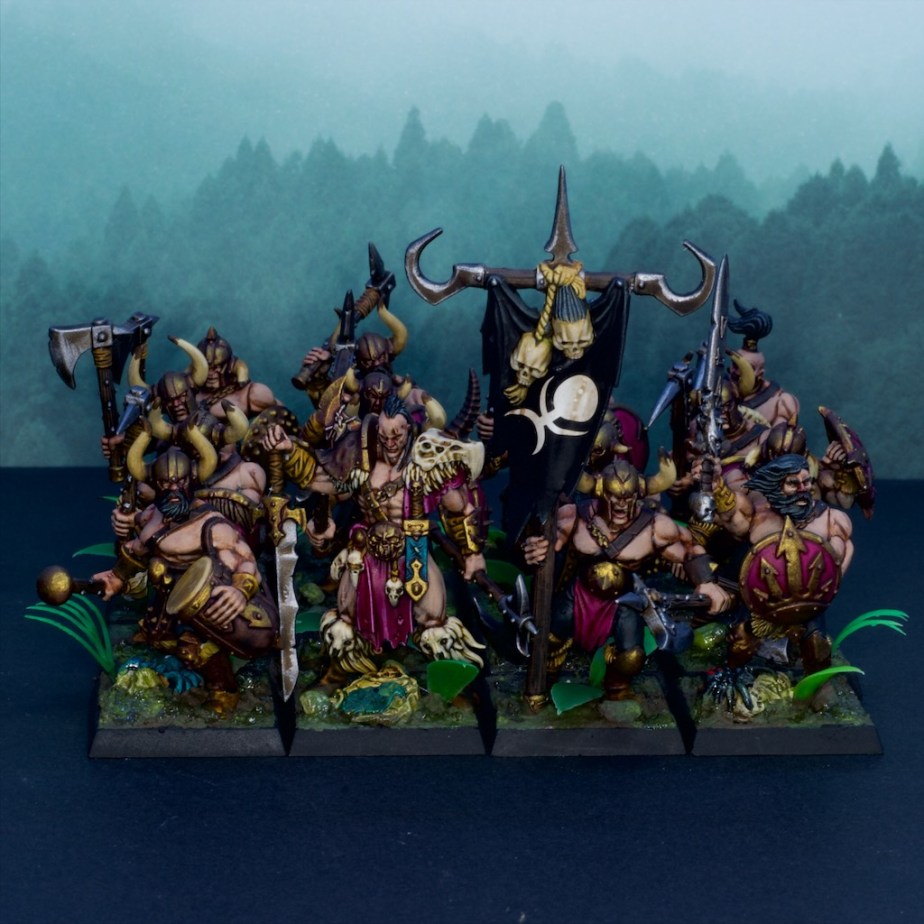
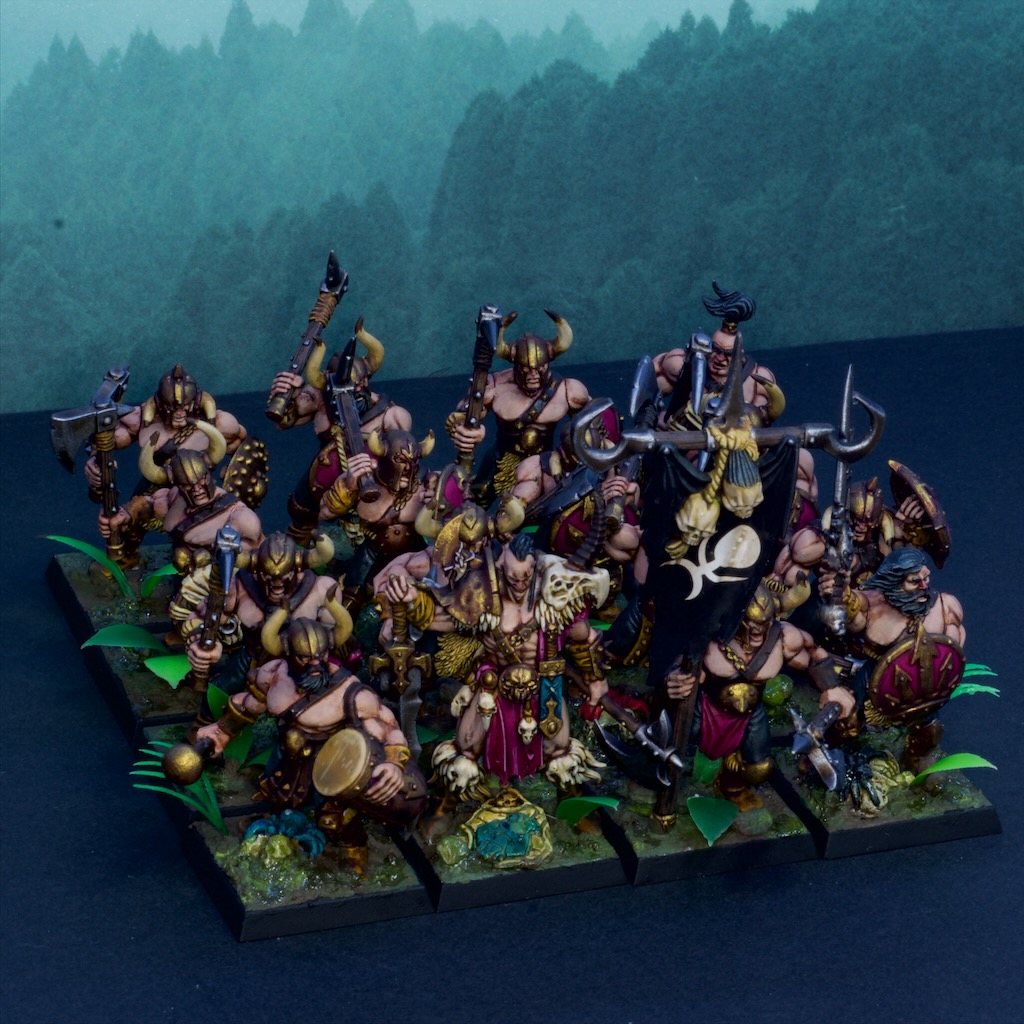
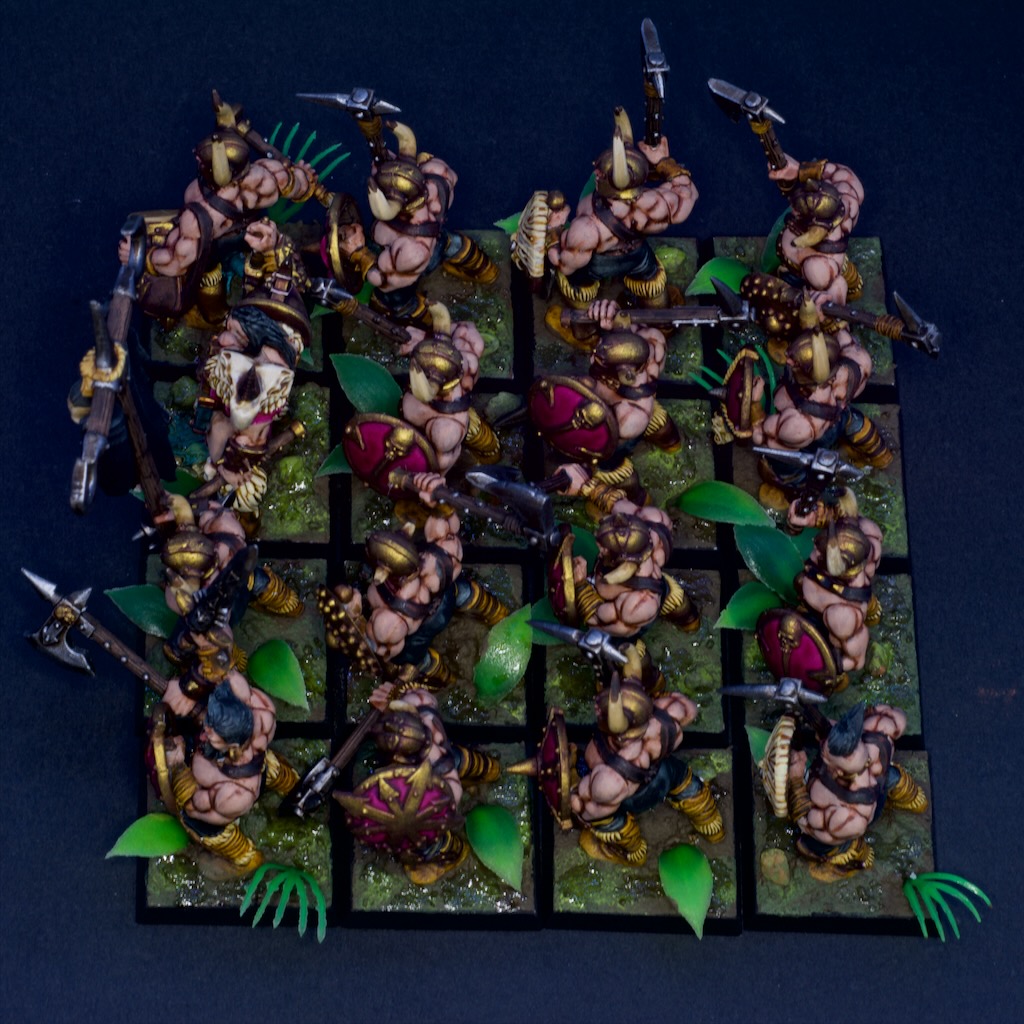
First up then I decided to paint a regiment of Chaos Marauders. These are at the bottom end of the chaos pile being pretty much just regular humans (although very muscly already!). They were a good starting point for the army however as being basic troops I’m not too worried if they don’t look fantastic, which meant I could experiment. Being Slaanesh worshippers (although not being recognised enough to get any cool powers for their devotion!) I wanted to paint them as recognisably so, hence the purply/magenta cloth and the Slaanesh symbol on the banner.

The models are quite old now and it shows in the lack of details in the casts, but I think they’re quite characterful and enjoyed painting them. You’ll notice the champion stands out a lot, he’s a head taller, and is a much newer model. He’s a character from the Silver Tower board game originally although he was later released as a standalone model for Age of Sigmar. I’ve had him for a while and just had to include him in this regiment.

I usually make a painting guide when I start a new army so I have a reference I can come back to as I invariably jump between projects. I haven’t bothered here as this is the only unit of marauders the army will have, and all other humans in the army will be in the full armour of Chaos Warriors and have little to no exposed skin. When I come to painting elves I might do some guides then.

Here’s the short version: contrast paints did a lot of heavy lifting here, tackling the furs, leather and cloth (black and purple) mostly untouched. The only areas with proper highlights are the skin, the metallics and the horns. This is less effort than I usually put into my models but I was painting all 16 at once and I think you can get away with some shortcuts in ranked units!

What I do want to document however as it will be repeated on the whole army is the basing.

I knew I was going to be doing some jungle themed bases for the army to fit the setting we want to set the game in. I’ve done some jungle bases in the past for my Necrons (Jungle Bases pt. 1, Jungle Bases pt. 2), and a fair few temperate forest bases recently for my Star Wars Legion army (Endor bases) and my Lord of the Rings Wood Elves (Wood Elves of Lothlorien and Rivendell). I wanted to try something different on this new set of models and went with a classic: gluing aquarium plants as is.

I’ve never really liked the look of the bare plastic, as they look too shiny next to painted models, but I took the gamble that as I would be matt varnishing the models, the leaves would be tied in to the overall scheme. I think it worked well and I’m happy with the way the unit looks when all ranked up.

You’ll also notice some other details on the bases such as spiders and ruins, these are from an old Games Workshop basing kit which had resin pieces for basing amongst other basing bits. These were glued down and painted with the model. The rest of the basing was done after the models were painted.

Here are the steps for the bases:

  1. Hot glue individual leaves from the aquarium plants to the bases
  2. Cover the bases in texture paint (AK Muddy Ground)
  3. Stick down some small stones
  4. Apply some AK Slimy Grime Dark in patches on the ground and the rocks
  5. Apply some AK Slimy Grime Light in smaller patches. Note this stands out much more so I diluted it with some thinner to help blend it in some.
  6. The base is matt varnished along with the rest of the model
  7. Patches of AK Puddles are applied randomly to add the impression the ground is quite wet

Anyway I hope you like them! I’m always excited when I start a new project (otherwise I wouldn’t;t have started it!), and am already eyeing off the next unit for the army.