
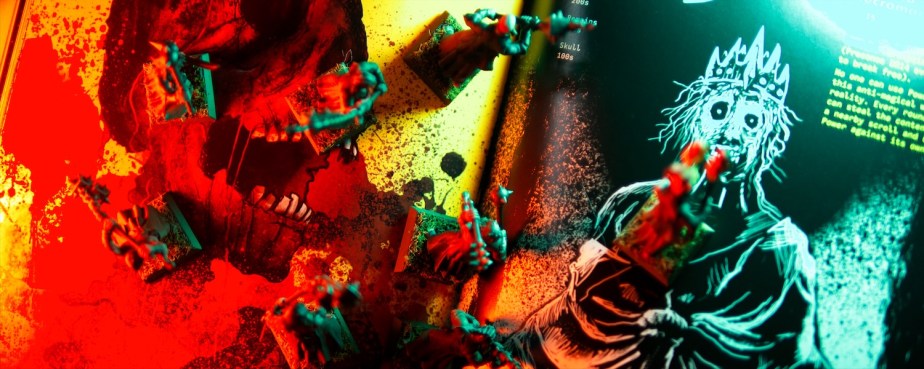
As I mentioned last post, I hadn’t done too much painting over the Christmas break, but I decided this week to break that negative streak and get back into it! The best way to do that was to pick an easy project and that meant finishing this next batch of Flagellants.
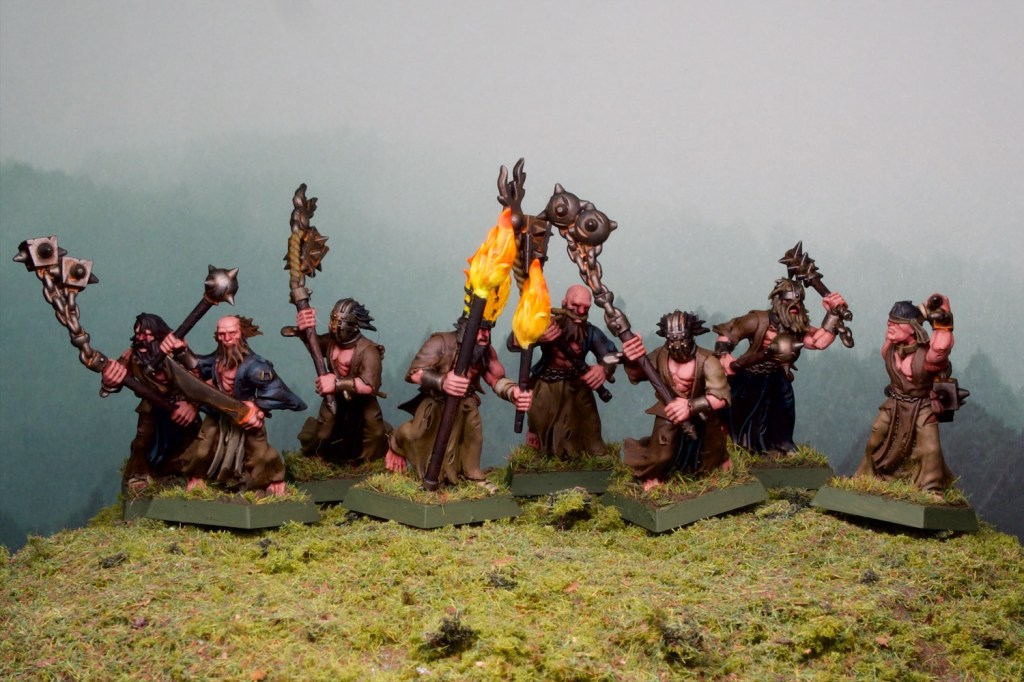
These will fight alongside the last batch, most likely in games of Midgard – hence the two sets of 8 models which make up a base each.
There’s not too much to discuss painting-wise, these are your bog standard doom saying, apocalypse preaching, world is ending types, in their usual accoutrements: brown and black rags! I tried to break up the mass of rags with some different shades of brown (I think I have 3 all up), as well as the aforementioned black sections. The fire was fun to paint, with some wet blended yellows and oranges over an off-white base coat.

If you remember my last post, I discussed creating a space in my posts to talk through books from my gaming bookshelf, partly to remind myself of old favourites, but mostly to motivate me to crack open those that have sat unread for many years. I’m a little bit undecided if these should be standalone posts or be part of “regular” posts (as I’ve done here; open to opinions if you have any!). Anyway, here’s my first shot at a segment I decided to call From the Shelves.

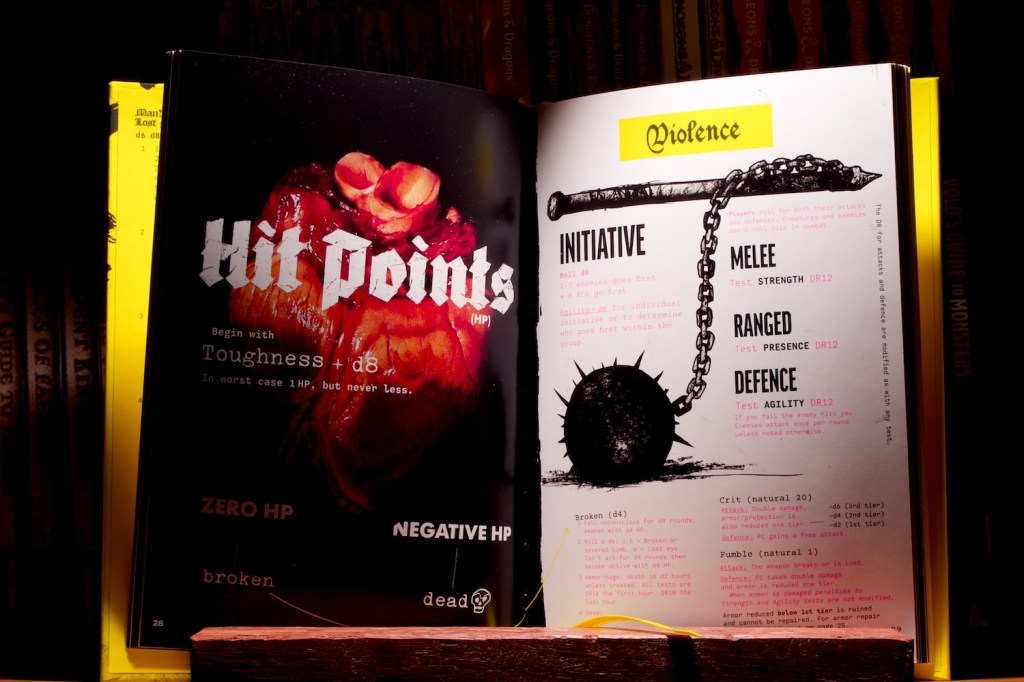
For the inaugural From the Shelves segment, I decided to pick out a book that has some nice thematic parallels to the flagellants above: Mörk Borg. Mörk Borg is a rules-light roleplaying game that sort of blurs the line between art project and game, with some pretty wild graphic design that looks like nothing else I’ve ever read.
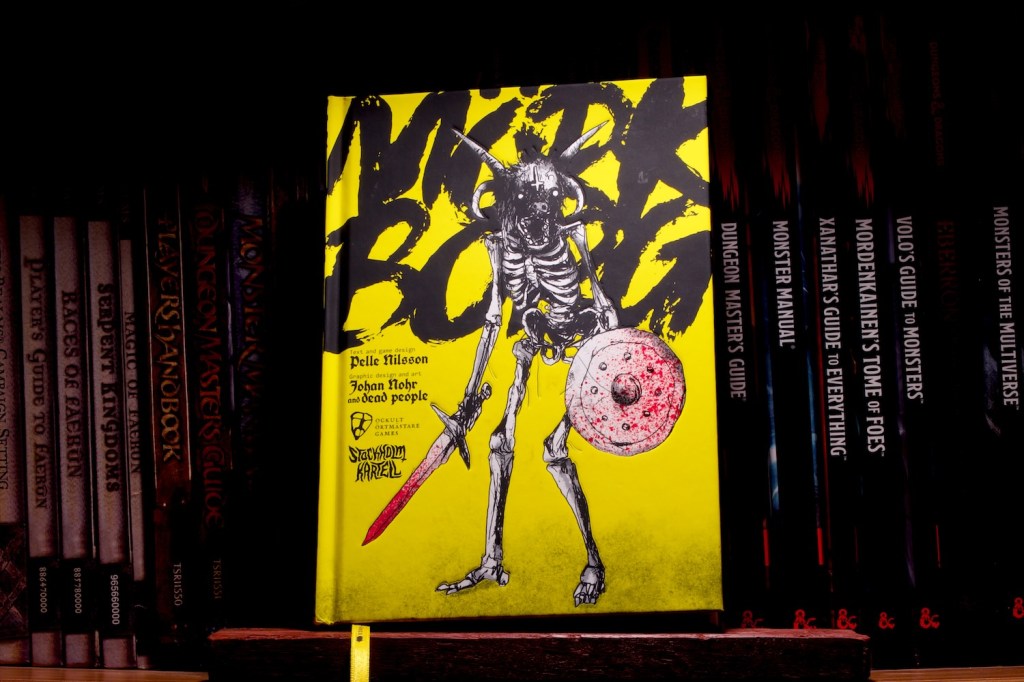
I’ve had my eye on this book for quite a while (it was originally released in 2020), but I only picked it up in December last year, as my gaming group started talking about running short games instead of long campaigns as our default way to play RPGs. The book is pretty short (80 something pages, most of which are pretty light on text) and the rules are very simple (~8 pages of the book are the actual rules of the game). There’s a few pages on the setting (the world is about to end, and things are generally pretty grim; maybe the flagellants are right!), then character creation rules which are mostly dice driven (i.e. result in pretty random characters), this is followed by the main game rules, some optional classes, a bestiary, and an introductory adventure. All in all a pretty complete game given the small format.
The game itself is a simplified fantasy adventure system, in the OSR genre (i.e. tries to capture some of the nature of early RPGs), but has its own voice rather than being a classic Dungeons and Dragons reproduction. While the universe at first glance is extremely grim, there is a tongue in cheek feel to the whole book which reminds me of early Warhammer fantasy/40k publications. This in some ways is so over the top it’s impossible to take it too seriously and I’m sure this ridiculousness will lead to some great moments at the gaming table.
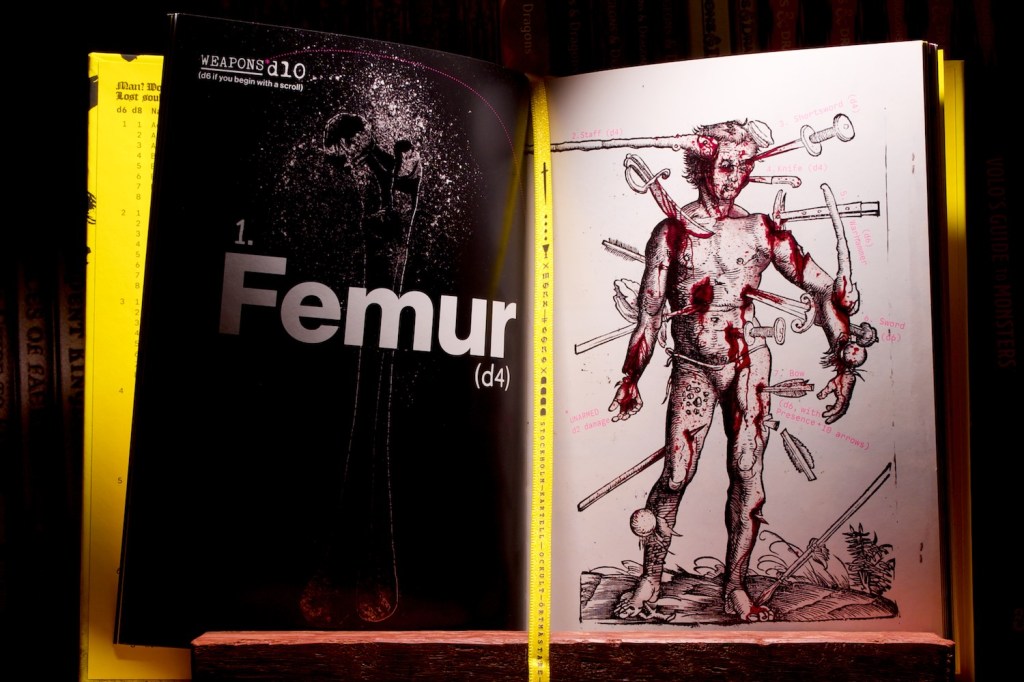
The crazy graphic design is pretty interesting, on the one hand it does a great job of communicating the feel of the game, but possibly more importantly it does a good job of making different sections easy to find. I read an article on this book that discussed that as each page looks different, you end up using the art/text as a landmark when flicking through the book, and I very much agree with that. The book also has the index on the rear inside cover which is a genius move that makes it very easy to consult at a moment’s notice.
Overall the book is a fun read and I really look forward to running games of it. It has a great amount of support out there from 3rd party publishers due to its permissive license model, so it’s hard to run out of pre-prepared content. It even has a in-universe 3rd-party miniature skirmish game called Forbidden Psalm which I’ll have to check out some day!
Hopefully you’ve enjoyed this quick look into this book, I’ve definitely enjoyed reading it and now I’m going to go try to convince my friends to play the game.
 Lair of the Lagomorph
As each day passes, I tend to think that the flagellants have a valid point about the apocalypse! The religious rabble look great and I can see where your army painting techniques came in with them. They have a nice unified look!
I know Mork Borg is quite popular but I wasn’t sure exactly what it was until now. It kind of sounds like the Swedish Chef’s sidekick to me but it is much grimmer than that, it turns out. I do agree with you that the book’s layouts and designs are very creative and striking!
LikeLiked by 2 people
Thanks Jeff! Yes very much in army painting territory here, shortcuts galore 😉
Glad I could showcase the game for you a bit, it’s a fun book to read even if you don’t play it. Nice to see people push the envelope in how game books can look.
LikeLiked by 1 person
I am likely going to do some batch painting next (assuming I can force myself to follow through with it) and I have a feeling there’s going to be a lot of grumbling along the way. We shall see! 🙂 I’m looking forward to more RPG content to see what else I can learn too!
LikeLiked by 1 person
If I can venture some advice for your batch painting, pick your battles. I usually select 1-2 areas I want to do more work on (usually the skin) but sometimes just whatever I think is fun about the models, and do 4+ stages on that. For the rest of the model I stay super basic (usually basecoat, wash, re-highlight with the basecoat assuming a relatively midtone basecoat). I find the better painted areas carry the rest of the model and the approach saves you a lot of time as you get to spend time on the bits you like and speed through the boring bits.
LikeLiked by 1 person
That does make a lot of sense and I took a similar approach with the frogs I painted for Hellboy come to think of it. These miniatures have a bit more going on than those did but I’m thinking I can basecoat and wash and then do the final highlights separately for each one, maybe. I think that will probably reduce my irritation and let me focus on making each model look nice enough without feeling rushed. Do you use a miniature holder while you paint? I think that is something I miss with batch painting though I’m not about to buy 5 more so I have one for each mini either!
LikeLiked by 1 person
I do use miniature holders for each, but my miniature holders are round bits of wood I cut up from some branches that fell in my garden. I used to use corks for that before I did that if that’s easier for you! I don’t like holding models by their bases while I paint if I can avoid it, it’s not very comfortable for me for long periods (I do have pretty big hands though so that may be a me problem)
LikeLiked by 1 person
I know of quite a few people who use corks, especially for sub-assemblies but it never worked as well as I liked. I always felt as though the miniature or sub-assembly could come off of there. I like the sound of your holders. Its natural and organic! I only have a single small and large Citadel handle both of which are getting quite old now. I would guess they’re something like 8-9 years old and still doing their jobs admirably. If I were to get serious about batch painting, I’d need to find a different way of doing things to be sure!
LikeLike
Nice work on the minis, Nic! 🙂 I think all UK residents will look like that soon! 😉 And that’s an interesting looking rulebook!
LikeLiked by 1 person
Thanks John! Hopefully the UK has a few good years before that amount of dishevelment becomes commonplace 😉
LikeLiked by 1 person